
Hospital Furniture Financing: Outfitting Modern Clinical & Medical Spaces

Hospital Furniture Financing

Hospital Furniture Financing: Outfitting Modern Clinical & Medical Spaces

Hospital furniture financing spreads the cost of patient beds, exam room furniture, and waiting area seating over time instead of pulling it from one capital line. A manual bed can run under $1,000. A full electric model built for continuous clinical use costs $1,000 to $3,000, according to Accora’s 2026 hospital bed pricing guide. Order one bed and you rarely stop at one, not once a unit renovation gets underway.

Dimension Funding finances business and hospital furniture alongside medical equipment, for practices and facilities nationwide. It works the same whether the order is a handful of exam tables for a clinic buildout or every bed and nurses station in a new wing.

Furniture purchases up to $250,000 move on the credit application alone, with terms running as long as 60 months, so you don’t have to wait on whenever the capital committee meets next.

What Hospital Furniture Financing Covers

Patient beds, exam tables, bedside cabinets, overbed tables, nurses stations, waiting room seating, and medical carts fall under this category. Buy with a loan and you own the furniture once the balance is paid off. Lease it and you only own it if you buy the furniture again at the end of the term.

Dimension Funding has written equipment financing since 1978, and that history shows in how the underwriting treats furniture specifically. Nurses stations don’t get replaced on a set schedule. They get replaced when a floor is renovated, when infection control standards change, or when a new wing opens and needs furniture that doesn’t exist yet.

Buying Hospital Furniture vs Leasing It

The monthly payment can look almost identical for a loan or a lease. What happens at the end of the term is not. Finance the purchase with a loan and you own the furniture free and clear once it’s paid off. Lease the same furniture and you only own it if you choose to buy it out when the term ends.


Loan

Lease

Ownership

Yes, once paid off

Not automatic

End of term

Furniture owned outright

Return, buy out, or upgrade

Best fit

Furniture that stays in service for years

Furniture likely to be replaced as standards shift

Payment basis

Reflects the full purchase price

Reflects the value used during the term

How a Hospital Furniture Loan Works

The lender pays for the beds, seating, or casework upfront. You repay it in equal monthly installments, and the furniture is yours from the day the loan funds, subject to the lender’s lien until the balance clears. Nothing to decide when the term ends, since you already own it.

How a Hospital Furniture Lease Works

A lease is priced against how much value the furniture loses over the term, not what it cost new. Two facilities furnishing identical patient rooms can end up with different monthly payments if their lease terms don’t match.

At the end, you can buy the furniture at a price set when you signed, hand it back, or move into newer pieces. Running the same casework for a decade calls for a different decision than redoing finishes with every renovation.

Why Hospital Furniture Costs Push Facilities Toward Financing

What Different Furniture Types Cost

Hospital bed pricing swings widely depending on function. Manual and basic semi electric beds sell for under $1,000. Full electric beds built for continuous professional use run $1,000 to $3,000. Bariatric beds start around $1,200 and climb past $6,000 once you add expanded weight capacity and pressure care technology, according to Accora’s pricing guide.

That’s before exam tables, seating, or casework. Multiply bed pricing across a twenty bed unit and add furniture for the rest of the space, and the total moves well past what most facilities keep sitting in a single capital line.

The Market Is Expanding

Hospital furniture is a $12.6 billion market in 2026, headed toward $20.0 billion by 2033, a 6.8 percent annual growth rate, according to Grand View Research’s hospital furniture market report. Beds alone account for about a quarter of that spending. Furniture built for patients, not staff or physicians, makes up close to half of it.

Capital budgets don’t grow at 6.8 percent a year in most health systems. That gap is part of why more of this spending shows up as financed purchases instead of cash outlays.

Infection Control Standards Are Reshaping Furniture Choices

An estimated 518,000 healthcare associated infections hit U.S. hospitals in 2023, about 1 in 38 hospitalized patients. That’s down from 1 in 31 in 2015, according to the CDC’s 2026 data release. Furniture is part of that math now, not an afterthought to it.

Vinyl, polyurethane, and treated fabrics such as Crypton and Nano-Tex resist liquids and hold up to repeated disinfection better than porous upholstery. Furniture built with fewer seams gives bacteria fewer places to hide, according to Furniture Concepts’ analysis of healthcare furniture and infection control

A chair that fails that standard gets replaced no matter how much life it has left, and that’s the kind of purchase that doesn’t wait for next year’s capital plan.

What Moves the Payment Up or Down

Furniture Type and Term Length

A bigger order or a shorter term raises your monthly payment. Stretch the term and the payment drops, but you risk still paying on seating or casework after an infection control standard has already made it obsolete. Dimension Funding caps furniture terms at 60 months, in line with how long most clinical furniture holds up before finishes or materials fall behind.

New Condition vs Used Condition

New furniture qualifies for a longer term because it has more working life ahead of it. Used furniture, especially seating or casework already showing wear, gets a shorter term to match what’s left.

Approval Requirements for Hospital Furniture Financing

Application Only Thresholds

Orders up to $250,000 can be approved from the credit application alone, no financial statements required. That covers most single unit furniture orders and a good share of full floor renovations. Go above it, and underwriting will ask for recent financials before funding moves forward.

Credit Profile and Approval Speed

Dimension Funding underwrites credit profiles from strong tier A down to marginal, not one line for every facility. Approval commonly comes back within hours, with funding following in a day or two once the paperwork is signed. That turnaround matters when a furniture order is the last thing standing between a renovated unit and its opening date.

Furnishing a Unit on the Renovation Schedule, Not the Capital Calendar

An empty patient room with no bed in it isn’t a patient room. It’s square footage waiting on a purchase order. Every day it sits that way is a day the renovation isn’t finished, no matter what the punch list says.

Dimension Funding can price out what financing a specific furniture order or full unit buildout looks like before you sign anything. That conversation is worth having before a capital calendar ends up dictating a move in date that the construction schedule should be setting instead.

Frequently Asked Questions

Can I finance furniture for a renovation, or only for new construction?

Financing works the same for renovations, new construction, and straightforward replacement orders. What matters to the lender is your credit and business history, not whether the furniture is headed into a brand new wing or an existing one.

What credit score do I need for hospital furniture financing?

No single score guarantees approval. Dimension Funding looks at your business history alongside personal credit, with programs running from strong tier A down to marginal, and on orders up to $250,000 that review can happen straight from the application, no bank statements involved.

How long are typical hospital furniture financing terms?

Terms typically run up to 60 months. Where you land in that range depends on whether the furniture is new or used and how long you expect it to stay in service before a renovation or infection control standard calls for something different.

Is leasing better than buying furniture for a facility that updates its look often?

Leasing fits better if you expect to swap out finishes on a shorter cycle, since you won’t get stuck owning furniture that no longer meets current standards. Buying makes more sense for pieces meant to stay put for years, like fixed nurses stations or built in casework.

Does financing cover delivery and installation, or only the furniture itself?

Delivery, assembly, and installation typically roll into the total financed amount rather than getting billed separately. That keeps your payment tied to a unit that’s furnished and usable, not furniture sitting on a loading dock.

Can I finance furniture and medical equipment together in one application?

Yes. Mixed orders are routine, patient beds and seating financed in the same application as diagnostic or patient care equipment. Each item can still carry its own term based on price and how long it’s expected to last.

How fast can hospital furniture financing be approved?

Approval can come back within hours on furniture orders up to $250,000 when everything is submitted electronically, with funding following in a day or two once the paperwork clears. That turnaround matters most when a furniture order is the one thing standing between a renovated unit and its scheduled opening.


When a Short Term Working Capital Loan Costs Less Than a Long One

short term working capital loans

When a Short Term Working Capital Loan Costs Less Than a Long One

Some business owners want financing that flexes with every up and down in cash flow. Others want the opposite: a number they can circle on the calendar and a payment that never changes between now and then. A working capital term loan is built for that second kind of business owner — someone who’d rather have certainty than flexibility.

Dimension Funding has spent over 40 years financing small and mid-sized businesses across the U.S., and its working capital loans are built around exactly that kind of predictability. Contact Dimension Funding to see if a fixed structure fits your business, or keep reading to see how it actually works.

When-a-Short-Term-Working-Capital-Loan-Costs-Less-Than-a-Long-One

What Makes a Term Loan “Fixed”

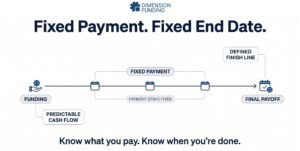
A working capital term loan gives you a lump sum upfront and sets a fixed repayment schedule from day one. The payment amount, the total cost, and the final payoff date are all locked in at the start and don’t move, no matter how the business performs during the term.

That’s very different from revolving financing, where the balance and payment can shift depending on how much you’ve drawn and repaid. With a term loan, there’s no guessing what next month’s payment will be. The number on the schedule today is the same number six months or a year from now.

What Your Payment Is Actually Made Of

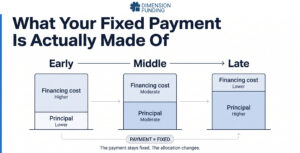
A lot of business owners assume every payment chips away at the loan balance by the same amount. In reality, while your payment amount stays the same the whole time, how that payment splits up changes as you go. Early payments cover a bigger share of financing cost and a smaller share of principal, because the amount you still owe is highest at the start.

Payment Period

Financing Cost Portion

Principal Portion

Early in term

Higher

Lower

Middle of term

Moderate

Moderate

Late in term

Lower

Higher

This is called amortization. The Consumer Financial Protection Bureau’s explanation of how loan paydown works points out that in an amortizing loan, more of each payment goes toward financing cost early on, and more goes toward principal as the loan progresses — which is also why a longer loan term lowers your payment but raises the total cost you pay over the life of the loan. Knowing this makes it easier to track your progress: the monthly payment never changes, but each one knocks down the balance by a bit more than the last, so the debt shrinks faster toward the end.

Why a Fixed Payment Matters for Budgeting

Predictability is worth more than peace of mind alone. When you know your exact loan payment months ahead of time, you can build that number right into your cash flow plans without leaving room for surprises. That makes it easier to plan payroll, restock inventory, or handle other regular costs around one known number.

That matters even more compared to financing tied to sales, like a merchant cash advance, where the amount pulled each day moves with your revenue. A slow sales month still means a cut of whatever comes in with a cash advance. A fixed-payment term loan stays exactly the same, which can actually make a slow month easier to handle, not harder.

Why a Fixed End Date Matters Just as Much

A fixed end date gives you a clear finish line. There’s no guessing about when the loan will be paid off, which makes it much easier to plan around — whether that’s figuring out when your cash flow frees up or timing your next financing move around this loan’s payoff.

Dimension Funding’s working capital loans run on terms up to 24 months, so you get a defined window instead of an open-ended obligation. Knowing exactly when a loan wraps up, down to the month, takes one more unknown out of your long-term planning.

How Repayment Frequency Fits Into a Fixed Structure

Even with a fixed-payment, fixed-term loan, you still have some say in how it’s scheduled. Repayment can usually be set up weekly, daily, or monthly, whichever matches your business’s revenue pattern best — without changing the fact that the total payment and payoff date stay fixed.

A seasonal business might prefer weekly payments that ease up during slow months, while a business with steady daily sales might pick daily repayment to match its cash flow rhythm. Whatever schedule you choose, the fixed structure means you always know the total amount owed and exactly when it ends.

Qualifying for a Fixed-Payment Term Loan

Getting approved for a working capital term loan usually comes down to a few basics: annual revenue above a set amount, proof of majority ownership, and recent bank statements to show your cash flow history. Bigger loan requests typically call for extra paperwork, like corporate tax returns.

Many lenders, including Dimension Funding, use a single-page application backed by bank statements instead of a long financial statement package, which keeps things moving fast without giving up the fixed structure you’re choosing this loan type for. Because underwriting looks at cash flow directly, businesses without a lot of collateral or years of credit history can still qualify for predictable, fixed terms.

Fixed Term Loans vs. Variable-Cost Alternatives

The clearest way to see the value of a fixed structure is to stack it against financing where the cost moves along with the business. A merchant cash advance, for instance, ties repayment to a slice of your daily sales, so both the total cost and the payoff timeline can shift depending on how the business does.

Businesses that compare the two often find a fixed-payment working capital loan ends up costing a lot less than a merchant cash advance, since the payment amount and end date stay locked in no matter how sales move. That stability is often worth more than the theoretical upside of a variable structure that might cost less in a great sales month — but could cost a lot more in a bad one.

When a Fixed Term Loan Is the Right Fit

A fixed-payment, fixed-end-date loan works best for a defined, one-time need: covering a known expense, bridging a specific cash flow gap, or funding a project with a clear scope. Since the amount and schedule are locked in upfront, it’s less suited to a business that expects to need repeated access to capital over time.

For recurring or unpredictable capital needs, a revolving line of credit might be a better fit, since it lets you draw repeatedly instead of taking one lump sum. The right choice comes down to whether your business needs one clearly bounded loan, or ongoing, flexible access to funds.

Certainty You Can Plan Around

A working capital term loan gives you something a lot of financing options can’t: total certainty about what you’ll pay and when you’ll be done paying it. That fixed payment and fixed end date make it easier to plan everything else in the business around one known obligation. Dimension Funding offers working capital loans between $25,000 and $250,000, with terms up to 24 months and same-day or next-business-day funding. Contact Dimension Funding to find out what your business qualifies for.

FAQs

If my business’s cash flow improves, can I pay off a fixed term loan early?

Many lenders allow early payoff, though it’s worth checking whether there’s an early payoff provision before signing. The CFPB’s general guidance on loan terms notes that some lenders build in prepayment penalties that eat into part of the savings from paying early, so it’s better to check the prepayment language in your loan agreement before you sign, not after.

It’s also worth knowing that “prepayment penalty” doesn’t always mean the same thing. A National Credit Union Administration legal opinion on SBA lending points out that SBA 7(a) loans actually prohibit a lender from charging its own prepayment fee — instead, the SBA itself charges a separate fee directly to the borrower on certain longer-term loans. That’s a different setup than a standard commercial term loan, where the lender sets and collects any early-payoff cost directly. It’s a good reminder to read what your own loan agreement actually says, rather than assume all “prepayment penalties” work the same way.

Does a fixed term loan report to business credit bureaus the same way a line of credit does?

Generally, yes. Most term loans and lines of credit both get reported to business credit bureaus, though it depends on the individual lender’s reporting practices. Worth confirming with any lender before assuming both products get reported the same way.

Can I request a second term loan while still repaying a current one?

It depends on the lender’s underwriting and how much of the current loan is still outstanding. Some businesses can qualify for an additional loan based on updated cash flow, while others may need to wait until the existing balance is paid down further.

What happens if a payment is missed on a fixed term loan?

Policies vary by lender, but a missed payment usually triggers a grace period before late fees or other consequences kick in. Reaching out to the lender ahead of time if a payment’s going to be late is generally more productive than letting it slide without a word.

Is a fixed term loan reported differently depending on the repayment frequency I choose?

No. Whether repayment is scheduled weekly, daily, or monthly, the loan itself still shows up as one fixed obligation. The repayment schedule affects your cash flow timing, not how the loan appears on your credit report.

Can the loan amount be adjusted after the term loan has already funded?

Usually not without a separate application. Since the amount, schedule, and payoff date are all set at the start, a business that needs more money after funding typically applies for new financing instead of changing the existing loan.

Does a fixed term loan make sense for a business that’s just starting to build credit history?

It can. Many working capital lenders weigh recent cash flow and bank statement history more heavily than a long credit record, so a newer business with strong, steady revenue may still qualify even without years of established credit.

Mini Excavator Financing: Flexible Terms for Growing Contractors

mini excavator financing

Mini Excavator Financing: Flexible Terms for Growing Contractors

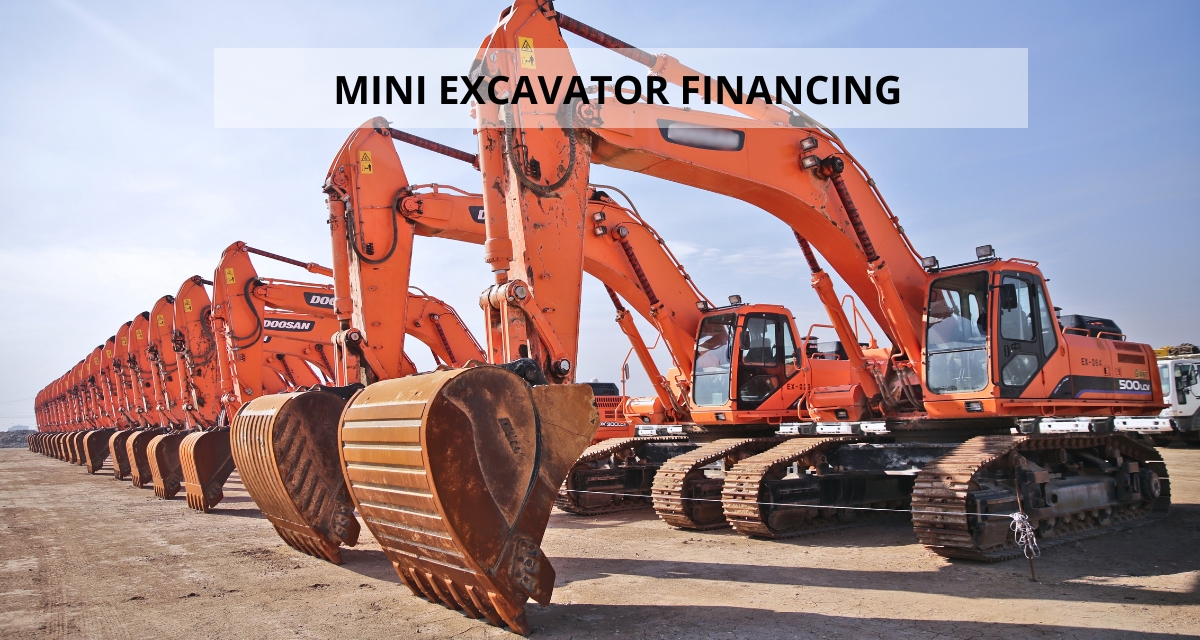
Financing a mini excavator transforms stagnant dealer inventory into immediate production capacity, ensuring a machine begins generating revenue the moment it arrives on-site. For contractors, this bridge to ownership is critical as new 3-ton units typically require a capital investment ranging from $35,000 to $60,000.

Step up to a 3 to 4 ton model and you can clear $80,000 before a single attachment gets added, according to Luby Equipment’s 2026 pricing guide. Most lenders define a mini excavator as anything under 6 tons.

Paying cash for one machine ties up money your business needs somewhere else: the next bid, payroll between jobs, materials for a project already underway.

Dimension Funding finances mini excavators and other construction equipment for businesses across the U.S. Loans and leases run up to 60 months.

A one page application can get you approved for amounts up to $250,000 without a full set of financial statements.

If a specific unit already has your attention, same-day approval means financing doesn’t have to be the thing that slows the purchase down.

What Counts as a Mini Excavator

Weight class is what separates a mini excavator from everything else in the lineup, not the brand on the hood. Under 6 tons is mini. Six to 10 tons is compact or midi. Past 10 tons, you’re in full-size territory.

The distinction matters for planning. A mini excavator handles utility trenching, tight residential yards, and grading jobs a bigger machine can’t reach. Stepping up even one size class can add tens of thousands to what you finance.

Compact, Midi, and Full-Size for Comparison

Compact or midi excavators, the 6 to 10 ton class, dig deeper and lift heavier than a mini can manage. Their attachments cost more too.

Full-size excavators past 10 tons are built for fleet-scale earthmoving, and financing amounts there typically clear the application-only threshold, so lenders start asking for financial statements.

Mini excavators sit under that 6 ton line, so most stay inside application-only territory, the fastest approval path a lender offers.

Renting a Mini Excavator vs Financing One

Renting still makes sense for a single week-long dig or a one-off job. Financing wins once the machine works across more than one contract, because the payment doesn’t reset to zero with every rental return.

Keep renting the same excavator for three or four months on a longer project and the total can pass what a loan payment would have cost you. At the end of it, no machine to show for it.

What Renting Costs

Rates for a 2 to 3 ton mini excavator run $200 to $350 a day, $600 to $1,050 a week, or $1,500 to $2,800 a month, per DOZR’s March 2026 analysis of 1,193 rental transactions.

Those two classes rent more often than any other size, since a 3 ton or 5 ton mini handles most residential pool digs.

Step up to a 4 ton unit and daily rates climb to $300 to $400, with monthly rates as high as $3,200.

Loans vs Leases: What Changes

The mechanics differ more than the number on your monthly statement. A loan finances the purchase, so you own the excavator once the term ends. A lease finances its use over a set period instead.


Loan

Lease

Ownership

Yes, once paid off

Not automatic

End of term

Machine is owned outright

Return, buy out, or upgrade

Best fit

Long term fleet additions

Equipment likely to be swapped or upgraded

Payment basis

Reflects the full purchase price

Reflects the value used during the term

How a Mini Excavator Loan Works

The lender covers the purchase price, and you repay it in fixed monthly installments. The excavator is yours from the day the loan closes, subject to the lender’s lien until you’ve paid it off.

How a Mini Excavator Lease Works

A lease prices your payment against the equipment’s value over the lease term, not the full purchase price. That’s why two payments on the same machine can look different.

At the end, you return the unit, buy it at a price set when the lease began, or roll into something newer.

Which Way Most Contractors Lean

Run a mini excavator daily across job sites for years, and a loan usually fits. The machine earns back its cost several times over before the note is paid off.

Seasonal work, or a fleet that shifts with whatever job comes next, points toward a lease instead. Get the call wrong and nothing sinks: you either pay for flexibility you didn’t need, or hold a machine you were ready to trade in.

What Drives the Price of a Mini Excavator

Size Class Sets the Baseline

A 1 to 2 ton unit like the Hitachi ZX17U-5N typically runs $25,000 to $40,000 new. Move up to the 2 to 3 ton class, home to models like the Hitachi ZX26U-5N and ZX30U-5N, and pricing lands between $35,000 and $60,000.

Go bigger still, and the 3 to 4 ton class pushes past $50,000, clearing $80,000 for a machine like the Hitachi ZX35U-5N, per Luby Equipment’s guide.

Attachments Add Up Fast

A hydraulic coupler for a 1 to 3 ton machine costs about $1,095, climbing toward $1,691 for an 8 ton frame, according to Everything Attachments’ pricing.

Tilt buckets run $4,023 to $4,977 depending on size class. An auger package sized for 1.5 to 6 ton machines runs $2,108 to $5,294, per Attachment Co’s specifications.

Buy a $45,000 excavator with a tilt bucket and a coupler, and your financed amount moves closer to $50,000. Roll the attachments into the same loan or lease and the payment reflects the full package you bought.

What Shapes Your Monthly Payment

Term Length and Equipment Condition

Term length is the biggest lever. Stretch it toward 60 months and the payment drops, but match it to how much working life the machine has left, or you’ll pay on equipment past its most productive years.

Condition matters too. New units support longer terms since more work sits ahead of them. Used units usually mean a shorter term, since less of that working life remains.

Credit and Business Documentation

Credit profile plays a smaller role than most contractors expect. Dimension Funding works with programs ranging from tier A+ down through marginal credit rather than applying one hard cutoff.

Applications up to $250,000 can move forward without a full set of financial statements once the business has two years of operating history behind it. That matters most for a newer contracting business that hasn’t built the track record a traditional bank wants before signing off on a purchase.

New vs Used: Where the Market Is Moving

New mini excavator financing slipped 7.7 percent to about 32,500 units between June 2025 and May 2026. Used financing climbed 13.1 percent to roughly 12,725 units, per Equipment World’s market data.

Caterpillar led both categories, holding 23.3 percent of new units financed and 21.8 percent of used, with Kubota, Bobcat, and John Deere close behind in each class.

Financing Sentiment Industry Wide

New equipment prices are pushing contractors toward used units and rentals, according to Equipment World, and financing sentiment industry wide has moved with them.

The Equipment Leasing and Finance Association’s Monthly Confidence Index climbed to 59.9 in May 2026 from 54.6 in April, inside a U.S. equipment finance market the association sizes at $1.3 trillion.

Top Financed Models

The Kubota KX040-5 topped the new-model list at 2,120 financed units. Cat’s 305 CR and John Deere’s 35 P-Tier followed, at 1,992 and 1,855 units, per Equipment World’s tracking.

Bobcat and Kubota swap places for second on the used side, though no single brand dominates resale the way Caterpillar and Kubota dominate new sales.

Takeuchi tells a different story: 3.2 percent of new units, but 4.7 percent of used. Resale loyalty doesn’t always mirror what people buy new.

Matching the Payment to the Job

A mini excavator earns its cost back on the job site, not sitting on a lot while you save toward it. Once it starts digging, the payment stops feeling like an expense.

Dimension Funding has financed equipment since 1978, working with contractors who buy in bursts tied to a job, not a fixed cycle. Get in touch for a loan or lease consultation, or read the company’s background and history.

Frequently Asked Questions

Can I finance a used mini excavator, or only new units?

Lenders finance used mini excavators as readily as new ones. Used financing has been the stronger trend lately, growing 13.1 percent over the past year while new financing slipped 7.7 percent, according to Equipment World’s 2025 to 2026 market data. The tradeoff is term length: used machines usually get shorter terms, since there’s less working life left to finance against.

What credit score do I need for mini excavator financing?

There’s no single credit score that decides approval on a mini excavator loan or lease. Dimension Funding weighs business history alongside personal credit, running programs anywhere from tier A+ down to marginal, and on amounts up to $250,000 that review often happens straight from the application, no bank statements required.

How long are typical mini excavator loan or lease terms?

Mini excavator terms commonly stretch up to 60 months. Where you land in that range depends on whether the machine is new or used and how long you intend to keep it. Push the term out and the payment drops, but you’re paying it for longer.

Is leasing a mini excavator better than buying if I only need it seasonally?

Leasing usually wins for seasonal mini excavator work. You’re not stuck making payments on equipment that sits idle for half the year. Once the work turns steady and year-round, the math tips back toward a loan.

Do mini excavator attachments get financed together with the machine?

Most lenders finance attachments right alongside the excavator itself. A coupler, bucket, or auger typically rolls into the same loan or lease, since the payment is meant to cover the whole working setup, not the bare machine. Worth confirming with your lender before the deal closes, since not everyone structures it the same way.

What happens at the end of a mini excavator lease?

Three things can happen at the end of a mini excavator lease. You hand the unit back, buy it out at the price locked in when the lease started, or trade up to something newer. Which one makes sense comes down to how many working hours are left on the machine.

Can financing cover delivery and setup costs along with the excavator itself?

Financing can cover more than the excavator’s sticker price. Many lenders fold delivery and initial maintenance into the full project cost, so it rides along in the same monthly payment instead of landing as a separate invoice.

Working Capital Term Loans: Fixed Payment, Fixed End Date

working capital term loan

Working Capital Term Loans: Fixed Payment, Fixed End Date

Some business owners want financing that adapts and flexes with every fluctuation in cash flow. Others want the opposite: a number they can circle on the calendar and a payment that never changes between now and then. A working capital term loan is built for the second kind of business owner, one who values certainty over flexibility.

Dimension Funding has spent over 40 years financing small and mid-sized businesses across the U.S., and its working capital loans are structured around exactly that kind of predictability. Contact Dimension Funding to see if a fixed structure fits your business, or keep reading to understand how it actually works.

Working-Capital-Term-Loans-Fixed-Payment,-Fixed-End-Date

What Makes a Term Loan “Fixed”

A working capital term loan disburses a lump sum upfront and sets a fixed repayment schedule from day one. The payment amount, the total financing cost, and the final payoff date are all established at the start of the loan and don’t move, regardless of how the business performs during the term.

This is fundamentally different from revolving financing, where the balance and the payment can shift depending on how much is drawn and repaid. With a term loan, there’s no guessing at what next month’s payment will be. The number on the schedule today is the same number six months or a year from now.

What Your Payment Is Actually Made Of

One of the biggest misconceptions about a fixed-payment working capital term loan is that every payment reduces the loan balance by the same amount. In reality, while your payment amount stays the same throughout the loan, how that payment is allocated changes over time. Early payments cover a larger share of financing cost and a smaller share of principal, because the outstanding balance is at its highest early in the term.

Payment Period

Financing Cost Portion

Principal Portion

Early in term

Higher

Lower

Middle of term

Moderate

Moderate

Late in term

Lower

Higher

This process is known as amortization. The Consumer Financial Protection Bureau’s explanation of how loan paydown works notes that in an amortizing loan, a greater percentage of each payment goes toward financing cost early in the term, while a greater percentage goes toward principal as the term progresses, which is also why a longer loan term lowers the payment amount but increases the total financing cost paid over the life of the loan. 

For business owners, understanding this structure makes it easier to track progress toward becoming debt-free: the monthly payment never changes, but each payment reduces the remaining balance by a larger amount than the one before it, so the loan balance declines more quickly in the later stages of repayment.

Why a Fixed Payment Matters for Budgeting

Predictability has real value beyond peace of mind. When a business knows its exact loan payment months in advance, it can build that number directly into cash flow projections without leaving room for surprises. That certainty makes it easier to plan payroll, inventory purchases, and other recurring expenses around a known obligation.

This is especially valuable compared to financing tied to sales volume, like a merchant cash advance, where the amount withdrawn each day shifts with revenue. A slow sales month with a merchant cash advance still pulls a percentage of whatever comes in, but a fixed-payment term loan stays exactly the same, which can actually make a slow month easier to manage rather than harder.

Why a Fixed End Date Matters Just as Much

A fixed end date gives a business a clear finish line. There’s no ambiguity about when the obligation will be paid off, which makes it far easier to plan around, whether that means budgeting for when cash flow frees up or timing a future financing need around the loan’s payoff.

Dimension Funding’s working capital loans run on terms up to 24 months, giving businesses a defined window rather than an open-ended obligation. Knowing exactly when a loan closes out, down to the month, removes one more variable from long-term financial planning.

How Repayment Frequency Fits Into a Fixed Structure

Even within a fixed-payment, fixed-term loan, businesses have some control over how that structure is scheduled. Repayment can typically be set up weekly, daily, or monthly, depending on which cadence best matches the business’s revenue pattern, without changing the fact that the total payment and payoff date remain fixed.

A seasonal business might prefer weekly payments that ease pressure during slower months, while a business with steady daily transactions might choose daily repayment to match its cash flow rhythm. Regardless of the schedule chosen, the fixed nature of the loan means the borrower always knows the total obligation and when it ends.

Qualifying for a Fixed-Payment Term Loan

Approval for a working capital term loan generally comes down to a handful of core requirements: annual revenue above a set threshold, majority ownership documentation, and recent bank statements to establish cash flow history. Larger loan requests typically require additional documentation, such as corporate tax returns.

Many lenders, including Dimension Funding, use a single-page application supported by bank statements rather than a lengthy financial statement package, which keeps the process fast without sacrificing the fixed structure borrowers are choosing this loan type for. Because underwriting reviews cash flow directly, businesses without extensive collateral or years of credit history can still qualify for predictable, fixed terms.

Fixed Term Loans vs. Variable-Cost Alternatives

The clearest way to see the value of a fixed structure is to compare it against financing where the cost moves with the business. A merchant cash advance, for example, ties repayment to a percentage of daily sales, which means the total cost and repayment timeline can both shift depending on how the business performs.

Businesses that compare the two often find that a fixed-payment working capital loan can cost considerably less than a merchant cash advance, since the payment amount and end date stay locked in regardless of sales fluctuations. That stability is often worth more to a business than the theoretical upside of a variable structure that could, in a strong sales month, cost less, since it can also cost significantly more in a weak one.

When a Fixed Term Loan Is the Right Fit

A fixed-payment, fixed-end-date loan works best for a defined, one-time need: covering a known expense, bridging a specific cash flow gap, or funding a project with a clear scope. Because the loan amount and schedule are set upfront, it’s less suited to a business that expects to need repeated access to capital over time.

For recurring or unpredictable capital needs, a revolving line of credit may be a better match, since it allows repeated draws rather than a single lump sum. The right choice comes down to whether your business needs one clearly bounded loan or ongoing, flexible access to funds.

Certainty You Can Plan Around

A working capital term loan offers something a lot of financing options can’t: total certainty about what you’ll pay and when you’ll be done paying it. That fixed payment and fixed end date make it easier to plan every other part of the business around one known obligation. Dimension Funding offers working capital loans between $25,000 and $250,000, with terms up to 24 months and same-day or next-business-day funding. Contact Dimension Funding to find out what your business qualifies for.

If my business’s cash flow improves, can I pay off a fixed term loan early?

Many lenders allow early payoff, though it’s worth confirming whether there’s any early payoff provision before signing. The CFPB’s general guidance on loan terms notes that some lenders include prepayment penalties that offset part of the savings from paying early, so reviewing the loan agreement’s prepayment language before signing, rather than after, is the more reliable way to know what an early payoff would actually save.

Does a fixed term loan report to business credit bureaus the same way a line of credit does?

Generally, yes. Most term loans and lines of credit are both reported to business credit bureaus, though the specifics depend on the individual lender’s reporting practices. It’s worth confirming with any lender before assuming either product affects credit reporting differently.

Can I request a second term loan while still repaying a current one?

It depends on the lender’s underwriting and how much of the current loan remains outstanding. Some businesses qualify for an additional loan based on updated cash flow, while others may need to wait until the existing balance is further paid down.

What happens if a payment is missed on a fixed term loan?

Policies vary by lender, but a missed payment typically triggers a grace period before late fees or other consequences apply. Contacting the lender proactively if a payment is going to be late is generally more productive than letting it pass without notice.

Is a fixed term loan reported differently depending on the repayment frequency I choose?

No. Whether repayment is scheduled weekly, daily, or monthly, the loan itself is still reported as a single fixed obligation. The repayment cadence affects cash flow timing, not how the loan appears on a credit report.

Can the loan amount be adjusted after the term loan has already funded?

Typically not without a separate application. Since the amount, schedule, and payoff date are all fixed at origination, a business that needs more capital after funding usually applies for additional financing rather than modifying the existing loan.

Does a fixed term loan make sense for a business that’s just starting to build credit history?

It can, since many working capital lenders weigh recent cash flow and bank statement history more heavily than an extensive credit record. A newer business with strong, consistent revenue may still qualify even without years of established credit.

HVAC Contractor Financing: Managing Cash Flow & Upgrading Systems

hvac contractor financing

HVAC Contractor Financing: Managing Cash Flow & Upgrading Systems

HVAC contractor financing turns a rooftop unit, a cooler compressor, or a service van into a payment you can plan around, not a lump sum that guts your account right before the busy season hits. A commercial rooftop replacement alone runs $6,000 to $62,000 installed depending on tonnage, according to Oxmaint’s 2026 RTU replacement cost data.

Dimension Funding finances HVAC equipment, refrigeration systems, and the tools that go with them for contractors across the U.S., whether that’s one condenser swap or a truck and unit order tied to a new contract. You can get approved for up to $250,000 on the application alone, with terms stretching to 60 months.

What HVAC Contractor Financing Covers

Rooftop package units, split systems, ductless mini splits, walk-in refrigeration racks, and the sheet metal and diagnostic tools you need for an install all fall under HVAC contractor financing. A loan builds toward owning the equipment outright. A lease spreads the cost of using it over a set period instead.

Dimension Funding has financed HVAC and refrigeration equipment since 1978, long enough for its underwriting to reflect how contractors buy. A compressor today because a unit failed. Three rooftop units next month because a retrofit got approved. Not a fixed replacement calendar.

Loans vs Leases for HVAC Equipment: What Changes

Same monthly number, a different deal once the term ends. A loan finances the purchase, so you own the unit once it’s paid off. Lease that same unit, and you only own it if you buy it separately when the term is up.


Loan

Lease

Ownership

Yes, once paid off

Not automatic

End of term

System owned outright

Return, buy out, or upgrade

Best fit

Systems that run for years

Equipment likely to be swapped as standards shift

Payment basis

Reflects the full purchase price

Reflects the value used during the term

How an HVAC Equipment Loan Works

The lender covers the purchase price of the unit, tools, or vehicle. You repay it in fixed monthly installments, and the equipment is yours from the day the loan closes, subject to the lender’s lien until it’s paid off. No return decision, no buyout negotiation, only ownership at the end.

How an HVAC Equipment Lease Works

A lease prices the payment against how much value the equipment loses over the term, not its full purchase price. That’s why two identical rooftop units can carry different lease payments. When the term ends, you buy the unit at a price set upfront, return it, or move into something newer.

Why HVAC Equipment Costs Push Contractors Toward Financing

The U.S. heating and air conditioning contractor industry pulls in $159.4 billion a year across roughly 120,000 businesses, growing 6.9 percent annually, according to Jobber’s 2026 HVAC industry data. That growth is colliding with two things at once, equipment prices that keep climbing and a refrigerant standard pulling older systems out of the replacement pool for good.

What Different HVAC Systems Cost

Installed rooftop unit costs run $2,800 to $3,500 per ton for smaller commercial systems, and $1,800 to $2,500 per ton once you’re into larger installations, according to Oxmaint’s 2026 RTU replacement cost data. A 15 to 20 ton retail unit runs $24,000 to $41,000 installed, and a 25 to 30 ton system for a manufacturing floor reaches $38,000 to $62,000.

Split system equipment alone typically runs $800 to $3,000 per ton, averaging around $1,500, according to Pick Comfort’s 2026 commercial HVAC pricing guide. Add crane mobilization, curb adapter work, and electrical upgrades, and your installed total climbs well past whatever number was on the initial quote.

The Refrigerant Transition Is Adding to the Bill

Equipment running R410A refrigerant, anything with a global warming potential above 700, could no longer be sold or installed new as of December 31, 2025, under EPA phasedown rules, according to Contracting Business’s 2026 coverage of the transition. Commercial products get until January 1, 2027 before the same deadline hits them.

Steel and copper prices have climbed roughly 40 percent over the past year, pushing material costs up another 4 to 5 percent in 2026, per the same coverage. That leaves you financing replacement systems on a tighter timeline than any planned upgrade cycle would allow.

What Shapes the Monthly Payment

System Type and Term Length

A higher purchase price or a shorter term raises your monthly payment on a rooftop unit. Stretch the term out and the payment drops, but you could end up paying on a system past the point a refrigerant change makes replacement worth it. Dimension Funding caps terms at 60 months, which tracks how long a system stays useful.

New Condition vs Used Condition

A new unit supports a longer term since it has more working life ahead before refrigerant rules or efficiency standards catch up to it. Go with used equipment, especially an older unit still running R410A, and your financing term shortens to match the years it has left.

Managing Cash Flow As an HVAC Contractor

Cash flow for an HVAC contractor rarely moves in a straight line. A commercial install pays out in milestone draws, a residential emergency call pays on completion, and payroll for the crew running both jobs goes out the same Friday no matter what.

Financing separates the equipment purchase from the job’s payment schedule. Buy a unit in March against a retrofit that pays out over four milestone draws through June, and it stops competing with April’s payroll for the same dollars. A few pressure points show up more than others:

  • Slow shoulder season stretches followed by a rush of summer or winter calls
  • Commercial jobs that pay in milestones, weeks behind when material and labor bills come due
  • A compressor that has to go in today, before the customer’s deposit even clears

Approval Requirements for HVAC Contractor Financing

Application Only Thresholds

Purchases up to $250,000 can move on the credit application alone, no financial statements required. That threshold covers most single rooftop replacements, refrigeration retrofits, and tool or vehicle additions you’ll finance in a given year. Go above it, and underwriting will ask for recent financials.

Credit Profile and Approval Speed

Dimension Funding works with credit profiles from strong tier A down to marginal, not one hard cutoff for everybody. Approvals commonly turn around the same day, with funding in two to three business days. Financing can also include a 90 day payment deferral, so the system gets installed and earning before your first payment comes due.

Matching the Purchase to the Job It’s Paying For

A rooftop unit crated on a truck isn’t earning you anything. Neither is a van sitting at the dealership waiting on a signature. The sooner a system is running, or a truck is on its first call, the sooner that payment starts looking like the reason the job got done instead of a bill hanging over it.

Dimension Funding can walk you through what financing a specific rooftop unit, refrigeration retrofit, or service vehicle would look like before you sign anything. Talk to them before your next customer call turns into an equipment order that has to happen this week instead of next quarter.

Frequently Asked Questions

Can I finance equipment I’m installing at a customer’s property, or only equipment for my own shop?

Yes. Most equipment lenders finance HVAC systems, refrigeration units, and related tools no matter where the equipment ends up, at a customer’s building or in your own shop. What matters to the lender is your business, not the unit’s final address.

What credit score do I need for HVAC contractor financing?

There’s no single score that guarantees approval. Lenders weigh your business history alongside personal credit rather than applying one hard cutoff, and on amounts up to $250,000, Dimension Funding can often approve you from the application alone.

How long are typical HVAC equipment financing terms?

Terms commonly run up to 60 months. The exact length depends on whether the equipment is new or used, and how much working life it has left before a refrigerant change or efficiency standard makes replacement likely.

Is leasing better than buying HVAC equipment for a growing contracting business?

It depends on how long you’ll keep the equipment. Leasing fits a business planning to swap systems or trucks every few years as standards shift, while buying makes more sense for equipment you expect to run for the long haul, like a rooftop unit at a long term commercial account.

Does financing cover installation, ductwork, and refrigerant lines, or only the unit itself?

Most lenders roll installation labor, ductwork, curb adapters, and refrigerant lines into the total financed amount, not only the bare equipment. That keeps your payment tied to the full working system, not the unit rolling off the truck.

Can I finance a mix of HVAC units, tools, and a service vehicle in one application?

Yes. Lenders generally accept mixed orders, a rooftop unit, diagnostic tools, and a service van financed together in one go. Each item can carry its own term based on price and how long it’ll last.

How fast can HVAC contractor financing be approved?

Approval can come back the same day you submit the application, with funding following in two to three business days once paperwork clears. That speed matters most when a customer’s system has already died and the replacement can’t wait.

Work Truck Financing: Flexible Solutions for Fleet & Local Operators

work Truck financing

Work Truck Financing: Flexible Solutions for Fleet & Local Operators

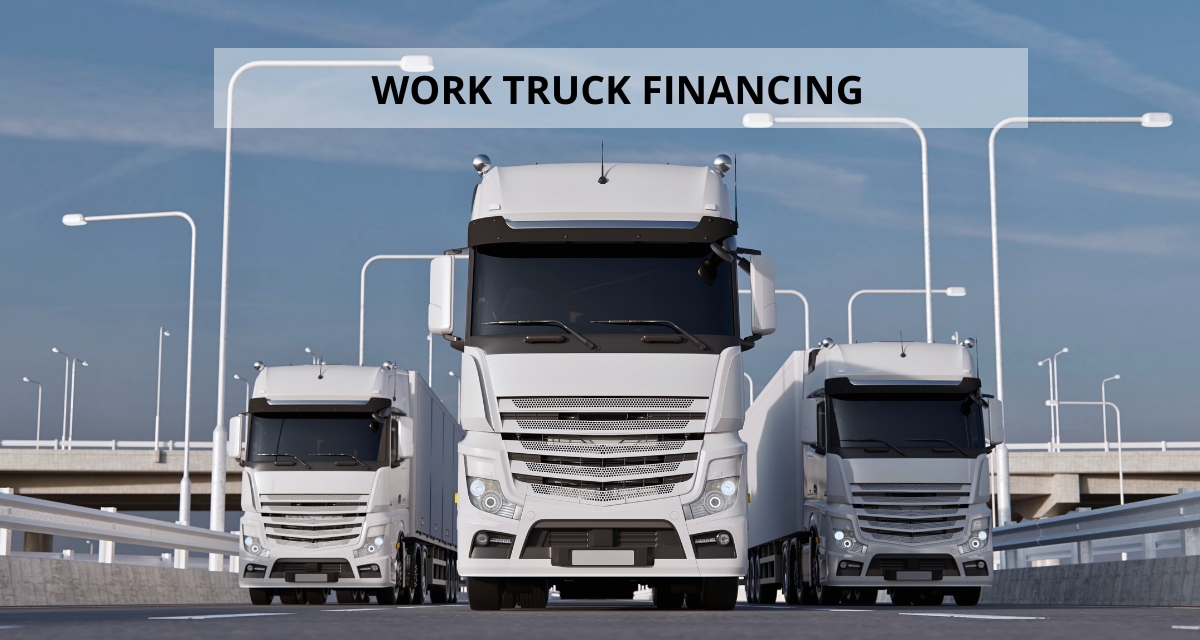
Work truck financing turns the cost of a pickup, van, or box truck into a payment sized to what that vehicle brings in, not what’s sitting in a business checking account. A new half ton pickup like the Ford F-150 starts around $40,000, and a Ford Transit cargo van runs $48,400 to $50,600 before a single shelf or ladder rack goes in.

Buying either one outright ties up cash most contractors and delivery operators need somewhere else: payroll, materials, fuel. Dimension Funding finances work trucks for businesses across the U.S., whether that means one replacement pickup or a dozen vans added at once. 

It’s worth checking what the payment looks like before a purchase eats into cash you need elsewhere. Loan and lease terms run up to 60 months, with approval possible from the application alone on amounts up to $250,000.

Electronic signatures mean funding can go through the same day, so a truck spotted this morning doesn’t have to sit on the lot while paperwork catches up.

What Work Truck Financing Covers

Most work truck purchases run through one of two structures. A loan builds toward owning the vehicle outright. A lease spreads the cost of using it over a set stretch of time instead. Either applies whether you’re financing a single pickup or matching vans to a growing service contract.

Dimension Funding has financed commercial vehicles since 1978, long enough for its underwriting to account for how local operators buy in practice. One truck when a contract lands, three more once the crew grows, not a fixed replacement calendar.


Loan

Lease

Ownership

Yes, once paid off

Not automatic

End of term

Truck owned outright

Return, buy out, or upgrade

Best fit

Trucks run for years

Trucks likely to be rotated

Payment basis

Reflects the full purchase price

Reflects the value used during the term

How a Work Truck Loan Works

The lender covers the purchase price and you repay it in fixed installments. The truck is yours from the day the loan closes, subject to the lender’s lien until the balance clears, with no return process or buyout decision waiting at the end.

How a Work Truck Lease Works

Lease pricing runs against the truck’s value over the term, not its full purchase price, so two trucks with the same sticker can carry different lease payments. At the end of the term, you return the unit, buy it at a set price, or move into something newer.

Wanting the same van on service calls for the next eight years is a different problem than running a courier fleet that turns over every two years to stay under warranty. Match the structure to that difference, not the smaller payment.

Why Work Truck Prices Push Operators Toward Structured Payments

What Pickups, Vans, and Box Trucks Cost

Body style moves the price more than the badge on the grille. Compact and midsize pickups start lower: the Ford Maverick at $29,840, the Ford Ranger XL at $32,720. Full size trucks land higher, with the GMC Sierra 1500 Pro at $39,595, the Chevrolet Silverado 1500 from $39,695 to $74,595, and the F-150 XL near $40,000, according to CarGurus’ 2026 pricing roundup.

Cargo vans run higher still. The Chevrolet Express and GMC Savana start around $42,200, the Ram ProMaster runs $46,370 to $51,725, the Ford Transit lands between $48,400 and $50,600, and the Mercedes Sprinter 3500XD starts at $59,860, per Cars.com’s 2026 model listings. Box trucks trade in a wider band. 

Used units three to seven years old run $12,100 to $24,000. Newer trucks run $30,000 to $41,000, and most buyers shop between $15,950 and $27,500, according to PriceItHere’s box truck pricing data.

What Upfitting Adds to the Financed Amount

Trucks rarely stay bare for long. A standard box truck liftgate runs $3,500 to $8,500 installed, and a heavy duty cantilever or rail model can reach $15,000 to $25,000 once wiring, hydraulics, and body reinforcement are factored in, according to The Upfit Insider’s liftgate cost guide.

Buy a $35,000 box truck with an $8,000 liftgate, and the financed amount is closer to $43,000, not $35,000. Roll that cost into the same loan or lease, and the payment reflects the truck as it’ll be used, not the bare chassis.

What Shapes Your Monthly Payment

Truck Type and Term Length

Term length should track how the vehicle gets used. A pickup running light errands can hold up fine over 60 months, while a box truck logging highway miles daily is often due for replacement before a longer term runs out. Dimension Funding sizes terms up to 60 months so the schedule follows the job.

New Condition vs Used Condition

Mileage tells a lender more than the model year does. A three year old van with 80,000 miles on it has less working life left than a five year old pickup that mostly sat between job sites, and financing terms tend to follow the odometer more closely than the title.

Credit Profile and Business Documentation

Banks often want two years of tax returns before they’ll even discuss numbers. Dimension Funding can approve work truck purchases up to $250,000 from the application alone, which matters most for a business that hasn’t been open long enough to build the paper trail a bank typically asks for.

Fleet Scale vs Single Truck: How the Financing Picture Is Shifting

Commercial van sales tell a mixed story so far in 2026. Ford Transit still leads with 91,868 units sold through July, up 2.63 percent, while Mercedes Sprinter climbed 37.36 percent to 17,884 units, according to GoodCarBadCar’s tracking of van sales. Ram ProMaster fell 21.68 percent over the same stretch, and roughly 500,000 commercial vans sell in the U.S. every year.

Financing is following that volume. The commercial vehicle financing market is valued at $123.39 billion in 2026 and is projected to reach $171.54 billion by 2031, a 6.81 percent annual growth rate, according to Mordor Intelligence’s market analysis. Light commercial vehicles, the pickups and vans under 3.5 tonnes most work truck fleets run, account for 45.61 percent of that market, pushed higher by e-commerce and delivery demand.

Matching the Structure to How You’ll Use the Truck

Sticker price settles less of this decision than most buyers expect. A few concrete details about daily use settle it instead:

  • Contract length matters. A three year delivery contract points toward a lease that ends when the contract does, while an open ended service route points toward a loan.
  • Mileage adds up differently by body style. A courier van can log 30,000 miles a year. A pickup running between job sites might see a fraction of that, and the two depreciate on different clocks.
  • Upfit reuse plays into it too. A liftgate or shelving package that carries over to a replacement truck tilts the math toward owning, since it doesn’t have to be pulled out and reinstalled every lease cycle.

Running the same pickup on daily service calls for years usually favors owning it outright, while sizing a fleet up and down as contracts come and go favors leasing instead. Guess wrong here and the fallout is modest: a little flexibility you paid for and didn’t need, or a truck still on the road a year longer than planned.

Getting the Truck On the Job Instead of the Lot

Sitting on a lot waiting for an upfit or a signature, a truck isn’t putting a dime toward its own payment. The financing clock starts regardless, so every day before the first job or delivery run is time it needs to make up later.

Dimension Funding can walk through loan and lease numbers for your specific truck, van, or box truck order before anything gets signed, so the term matches the work it’s buying into. Contact the team to talk through the numbers.

Frequently Asked Questions

Can I finance a used work truck, or only new ones?

Most equipment lenders finance both new and used work trucks. Used box trucks between three and seven years old typically run $12,100 to $24,000, well under new pricing, so buying used is a common way to keep the payment down rather than a fallback option.

What credit score do I need for work truck financing?

There’s no single score that guarantees approval, since lenders weigh business history alongside personal credit rather than applying a hard cutoff. On amounts up to $250,000, Dimension Funding can often make that call from the application alone.

How long are typical work truck loan or lease terms?

Terms commonly run up to 60 months. The exact length depends on whether the truck is new or used and how long you plan to keep it, since a shorter term suits a vehicle with fewer working years left.

Is leasing better than buying for a single work truck?

Leasing tends to fit better if you expect to upgrade or swap vehicles within a few years. A loan makes more sense when the same truck will run the same routes or jobs for the long haul.

Does financing cover upfitting like shelving, racks, or a liftgate?

Most lenders roll upfitting costs like shelving, racks, or a liftgate into the total financed amount. The payment is meant to cover the vehicle as it’ll be used on the job, not the bare truck rolling off the lot. Confirm this before the order is finalized, since not every lender handles it the same way.

Can I finance a mix of trucks and vans in the same order?

Lenders generally welcome mixed orders, such as pickups, cargo vans, and box trucks bought together for a growing operation, all on a single application. Each vehicle can carry its own term based on its price and condition.

How fast can work truck financing be approved?

Approval can happen the same day when the application and signatures are handled electronically. That speed matters most for a specific used truck that might not last the week.

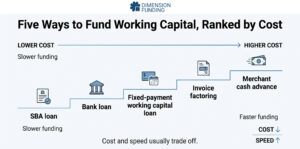
Five Ways to Fund Working Capital, Ranked by Cost

working capital funding

Five Ways to Fund Working Capital, Ranked by Cost

Not all working capital financing costs the same, and the differences are often bigger than business owners expect. The same $75,000 need can cost a few thousand dollars with one option and tens of thousands with another, depending entirely on which financing tool you choose. Ranking the major options by cost helps you see where your business actually fits.

Dimension Funding has spent over 40 years financing small and mid-sized businesses across the U.S., and its fixed-payment working capital loans sit firmly on the lower-cost end of this spectrum. Contact Dimension Funding to see where your business fits, or keep reading to understand how each option’s cost is actually built.

Five-Ways-to-Fund-Working-Capital,-Ranked-by-Cost

Total Borrowing Cost vs. Advertised Terms

A low headline number can make one financing option appear less expensive than another, but the true cost of borrowing depends on much more than what’s advertised. Guarantee fees, origination fees, invoice discounts, and holdback multiples all contribute to what a business ultimately repays over the life of the financing. Comparing only the advertised terms can lead business owners to underestimate the actual cost of accessing working capital.

Financing Type

Cost Structure to Compare

SBA loan

Base borrowing cost plus SBA guarantee fees and other applicable loan fees

Bank loan

Base borrowing cost plus origination and closing fees

Fixed-payment working capital loan

Total borrowing cost plus any lender fees, fixed regardless of usage

Invoice factoring

Discount fee deducted from each invoice purchased

Merchant cash advance

Total repayment amount set as a multiple of the amount advanced

For example, an SBA loan may advertise a low base cost, but borrowers should also account for the SBA guarantee fee and any lender-imposed closing costs when calculating the total amount repaid. 

Likewise, invoice factoring may not carry a traditional financing cost, yet repeated invoice discount fees can significantly increase costs over time. Merchant cash advances can be especially misleading because they’re commonly structured around a repayment multiple rather than a fixed cost, making it essential to compare the total repayment amount instead of focusing on the advance itself. 

The U.S. Small Business Administration’s loan programs page is a useful starting point for understanding how loan fees and repayment terms factor into the total cost of financing, since comparing the total dollar cost of each option provides a far more accurate picture than the advertised terms alone.

SBA-Backed Working Capital Loans: The Lowest Cost, The Longest Wait

SBA-backed loans, such as those issued through the SBA 7(a) loan program, generally carry the lowest cost of the options on this list because a government guarantee reduces the lender’s risk. That lower risk translates directly into more favorable terms and longer repayment periods for the borrower, making SBA financing attractive for businesses that can afford to wait.

Part of that lower cost comes from how the program is structured on the lender’s side. SBA guidance on lender terms and eligibility explains that lenders pay a guarantee fee for each loan the agency backs, and while lenders are permitted to pass that cost on to the borrower, the SBA caps how much can be charged. That guarantee is also what lets a lender extend financing to a borrower who might not clear a conventional bank’s collateral requirements on their own.

The tradeoff is speed and paperwork. SBA loans typically require extensive documentation, financial statements, and a review process that can take weeks or months rather than days. For a business facing an urgent, short-term cash flow gap, the lowest-cost option on paper often isn’t the most practical one in practice.

Traditional Bank Term Loans: Low Cost, Strict Qualification

A traditional bank term loan is usually the next most affordable option, offering costs well below what most alternative lenders charge. Banks structure these loans around strong underwriting standards, which keeps the cost low for businesses that clear the bar.

That underwriting bar is the catch. Banks generally require multiple years in business, strong credit, and often collateral, which shuts out newer businesses or those with less-than-perfect financials. Approval timelines also tend to run longer than most working capital needs can comfortably wait for.

Fixed-Payment Working Capital Loans: The Middle Ground That Works for Most Businesses

Fixed-payment working capital loans from alternative lenders sit in the middle of the cost spectrum, but they close the gap that banks and SBA loans leave open. Because approval is based on cash flow and bank statement history rather than years in business or hard collateral, more businesses qualify, and they qualify faster.

Dimension Funding’s working capital loans range from $25,000 to $250,000 with terms up to 24 months and fixed payments that don’t change over the life of the loan. That fixed structure means the cost is known upfront, approved businesses can access same-day or next-business-day funding, and the total cost stays predictable regardless of how the business performs during repayment.

Invoice Factoring: Fast Cash, but a Real Cost Per Invoice

Invoice factoring involves selling outstanding invoices to a third party at a discount, typically receiving 70% to 90% of face value upfront in exchange for immediate cash. The factoring company then collects directly from the business’s customers, recovering the remaining balance minus fees.

The cost here is less obvious than a stated financing charge, since it’s built into the discount taken on each invoice. For businesses with long payment cycles and strong receivables, factoring can be a reasonable trade-off, but the effective cost, especially when factoring repeatedly, often runs higher than a fixed-payment working capital loan, and it can affect customer relationships since the factoring company deals with them directly.

Merchant Cash Advances: The Fastest and Most Expensive Option

A merchant cash advance sits at the top of the cost ranking, and by a wide margin. Repayment is tied to a percentage of daily sales, often called a holdback, with the total repayment amount set as a multiple of the amount advanced, commonly 1.2 to 1.5 times the cash received.

Because that multiple applies regardless of how quickly the advance is repaid, the effective cost of a merchant cash advance frequently outpaces every other option on this list, sometimes dramatically. Businesses that compare this type of financing against a fixed-payment working capital loan often find they can save considerably by choosing the fixed-payment option instead, since payments stay level rather than fluctuating with sales volume.

Why Speed and Cost Usually Trade Off Against Each Other

Looking at this list end to end, a pattern emerges: the cheapest options tend to take the longest to fund, and the fastest options tend to cost the most. SBA and bank loans sit at the low-cost, slow-funding end, while merchant cash advances sit at the high-cost, fast-funding end.

Fixed-payment working capital loans occupy a genuinely useful middle position: priced closer to bank-level cost while funding on a timeline closer to a merchant cash advance. For businesses that need capital within days rather than weeks but don’t want to pay merchant cash advance pricing, that middle ground is often the most practical choice.

Matching the Option to the Actual Need

The right choice usually comes down to how urgent the need is and how the business plans to repay it. A defined, time-bound gap, such as waiting on a large receivable, might justify a faster, pricier option if the repayment source is clear and short-lived. An ongoing operating need is better served by a lower-cost option that won’t compound in cost the longer it’s used.

It’s also worth resisting the pull toward whichever option is fastest simply because it’s fastest. A business that takes on a merchant cash advance for a need that could have waited two extra days for a fixed-payment loan approval often ends up paying far more than necessary for that convenience.

Choosing Cost Over Convenience

Every option on this list can solve a working capital gap, but they don’t solve it at the same price. The lowest-cost financing takes the longest to arrive, the fastest financing costs the most, and a fixed-payment working capital loan often gives businesses the best balance of speed and affordability in between. 

Dimension Funding offers working capital loans between $25,000 and $250,000, with same-day or next-business-day funding and a single-page, bank-statement-based application. Contact Dimension Funding to find the option that fits your business’s actual need.

FAQs

Why does a government guarantee make SBA loans cheaper if the government isn’t the one lending the money?

The guarantee reduces the lender’s risk if a borrower defaults, since a portion of the loss is covered. That lower risk lets lenders offer more favorable terms than they would on an unguaranteed loan of similar size, even though a bank or approved lender is still funding it directly.

Can a business use more than one of these financing types at the same time?

Yes, and it’s fairly common. A business might use a fixed-payment working capital loan for ongoing operating needs while occasionally factoring a specific large invoice with a long payment cycle, rather than relying on one financing type for every situation.

Does a business’s industry affect which of these options makes the most sense?

It can. Businesses with long receivable cycles, like B2B service providers, tend to see more value from invoice factoring, while businesses with high daily card volume, like restaurants or retailers, are more often targeted by merchant cash advance providers, whether or not that’s actually their best fit.

If a business has been declined for an SBA or bank loan, does that hurt its chances with alternative lenders?

Not necessarily. Alternative lenders generally weigh cash flow and bank statement history more heavily than the stricter collateral and years-in-business requirements that banks and SBA lenders emphasize, so a decline from one doesn’t automatically predict the outcome with the other.

How often do businesses end up using invoice factoring repeatedly rather than as a one-time solution?

It varies, but factoring often becomes a recurring tool for businesses with consistently long payment cycles rather than a single-use option. That repetition is exactly why the discount fee’s cumulative effect matters more than it might appear on a single invoice.

Is there a minimum amount of time in business required to qualify for any of these options?

Requirements vary widely by option. SBA and bank loans typically expect several years of operating history, while fixed-payment working capital loans, invoice factoring, and merchant cash advances are often accessible to newer businesses with a shorter track record but consistent recent cash flow.

What’s the biggest mistake businesses make when comparing these five options?

Comparing them by speed alone, without weighing the total cost over the life of the financing. The fastest option to fund is rarely the cheapest, and choosing based only on how quickly cash arrives often means paying significantly more than a slightly slower option would have cost.

What Shapes Approval on a Working Capital Loan

working capital loans interest rates

What Shapes Approval on a Working Capital Loan

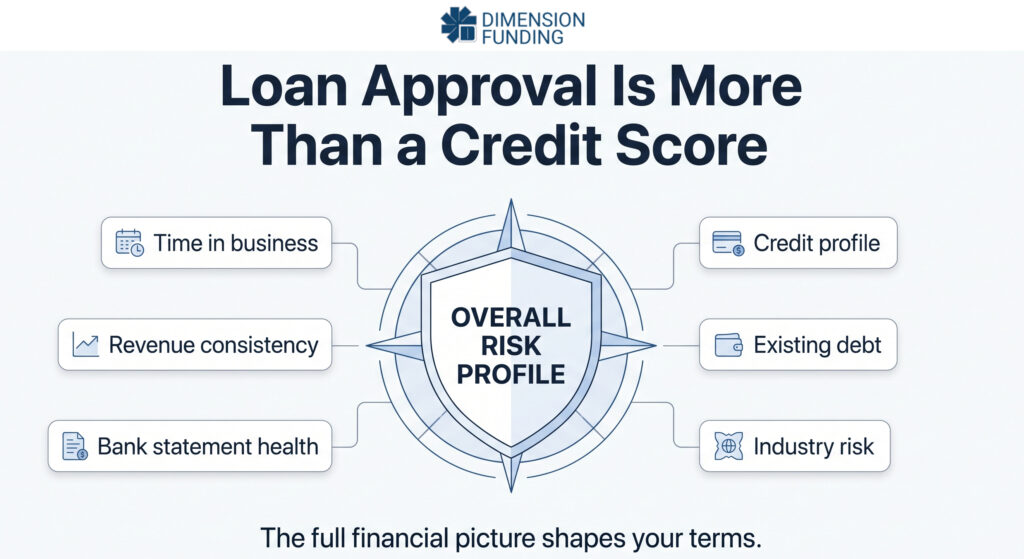
Two businesses can apply for the same working capital loan amount and end up with very different terms. The difference usually isn’t luck, it’s a handful of specific factors that lenders weigh every time they evaluate an application. Knowing what those factors are gives you real leverage before you ever submit one.

Dimension Funding has spent over 40 years financing small and mid-sized businesses across the U.S., and its working capital program is built around evaluating a business’s full financial profile rather than a single number. Contact Dimension Funding to talk through your business’s profile before applying, or keep reading to understand what underwriters actually look at.

What-Shapes-Approval-on-a-Working-Capital-Loan

How Underwriters Build a Risk Profile

Working capital loan approval is rarely based on a single number. Instead, underwriters combine several financial indicators to build a comprehensive risk profile that helps determine how likely a business is to repay on schedule. This holistic approach reflects federal banking guidance that prudent underwriting should consider a borrower’s overall financial condition, repayment capacity, and cash flow, not just one metric in isolation. The Office of the Comptroller of the Currency’s Commercial Loans booklet explains that sound commercial lending decisions rely on evaluating multiple sources of financial information before extending credit, rather than defaulting to a single ratio or score as a stand-in for the full picture.

Underwriting Factor

What It Tells the Lender

Time in business

Demonstrates business stability and operating history

Revenue consistency

Indicates predictable cash flow available for repayment

Bank statement trends

Reveals day-to-day cash management and liquidity

Credit history

Shows past borrowing and repayment behavior

Existing debt

Measures current repayment obligations and financial leverage

Industry risk

Reflects exposure to economic cycles and sector-specific challenges

Rather than assigning equal weight to every factor, lenders evaluate how they interact. A business with only two years of operating history may still receive favorable terms if it shows consistent monthly deposits, healthy account balances, and a manageable debt load. A long-established business, on the other hand, may see less favorable terms if recent bank statements reveal frequent overdrafts or declining revenue, which is why the sections below break down each factor individually.

Time in Business Sets the Baseline

Lenders view a longer operating history as evidence that a business can weather slow periods and still make payments. A company with five or ten years of consistent revenue is a more predictable applicant than one that opened its doors last year, and that predictability typically translates into more favorable terms.

Newer businesses aren’t necessarily locked out, but they often see more conservative terms until they build a longer track record. If your business is still young, strong recent revenue and clean bank statements can help offset the limited history in a lender’s eyes.

Revenue Consistency Matters More Than Revenue Size

A lender evaluating a working capital loan cares less about how much a business makes and more about how reliably that revenue shows up month after month. Steady, predictable deposits signal that a business can absorb a fixed payment without strain, which tends to support more favorable terms.

Erratic revenue, with big months followed by lean ones, reads as risk even if the annual total is strong. Businesses with seasonal swings can still qualify for competitive terms, but it often takes a documented pattern of managing those swings well over time.

Bank Statement Health Drives the Underwriting Conversation

Underwriters look closely at average daily balance, negative balance days, and overdraft frequency when evaluating an application. A business that consistently carries a healthy balance and avoids overdrafts is demonstrating exactly the kind of cash management a lender wants to see before extending credit.

Frequent negative balances or NSF fees push the underwriting conversation in the other direction, since they suggest a business may already be operating close to the edge of its cash flow. Cleaning up account activity in the months before applying can meaningfully improve the terms a lender is willing to offer.

Credit Profile Still Plays a Role

Personal and business credit history factor into approval, but rarely in isolation. A working capital lender weighs credit alongside cash flow, so a lower credit score doesn’t automatically rule out favorable terms if the underlying bank statements are strong.

That said, a stronger credit profile generally opens the door to better terms and, in some cases, higher approved amounts. Businesses considering an application benefit from checking their credit standing beforehand so there are no surprises once underwriting begins.

Industry Risk Adds Context to the Rest

Industry is the one factor on the list that has nothing to do with a specific business’s own numbers, and everything to do with where that business sits inside a larger economic pattern. A restaurant, a construction subcontractor, and a medical practice can each show identical revenue and identical bank statement health, and still receive different terms, because lenders track how exposed each industry tends to be to seasonal swings, supply shocks, or broader economic downturns.

That doesn’t mean a business in a higher-risk industry is worse off across the board. It means the other factors on this list carry a bit more weight in that evaluation. A seasonal landscaping business that can show it’s managed its slow months well for several years in a row is demonstrating exactly the kind of resilience a lender is trying to price for, which can offset the industry classification rather than being overridden by it.

Loan Amount and Term Length Shape the Terms You’re Offered

Larger loan amounts and longer terms typically carry more risk for a lender, since more capital is outstanding for a longer stretch of time. That added exposure is often reflected in the terms offered, particularly once a request crosses thresholds that require deeper documentation.

Dimension Funding’s working capital loans range from $25,000 to $250,000 with terms up to 24 months, and requests over $100,000 generally require corporate tax returns in addition to bank statements. Matching your requested amount and term to your actual need, rather than borrowing more or longer than necessary, keeps the overall terms as favorable as possible.

Repayment Structure Influences the Terms You’re Offered

The frequency of your repayment plan affects how a lender views risk over the life of the loan. Daily and weekly repayment plans return capital to the lender faster and more often, which can support more favorable terms compared to a monthly schedule stretched over a longer period.

Monthly repayment plans typically require a stronger credit profile and are capped at shorter terms, since a lender is collecting less frequently and carrying more exposure between payments. Choosing the repayment cadence that best matches your revenue pattern isn’t just about convenience, it can directly affect the terms on your offer.

How a Fixed Payment Compares to Alternative Financing Costs

One of the clearest ways to see what shapes overall cost is comparing a fixed-payment working capital loan to a merchant cash advance. A merchant cash advance ties repayment to a percentage of daily sales, which means the total cost can swing significantly depending on how the business performs during the repayment period.

Businesses that compare this type of financing often find that a fixed-payment working capital loan can cost considerably less than a merchant cash advance, since the payment stays the same regardless of sales volume. That predictability is part of why a strong financial profile paired with a fixed-payment loan usually ends up costing less over time than a variable-cost alternative.

Putting the Pieces Together Before You Apply

Your working capital loan terms aren’t decided by a single number, they’re shaped by time in business, revenue consistency, bank statement health, credit profile, industry, loan size, and repayment structure working together. None of these factors operate in a vacuum, and a weaker showing on one can often be offset by strength in another, which is exactly why two businesses with the same revenue can walk away from the same lender with different terms.

Dimension Funding offers working capital loans between $25,000 and $250,000, with same-day or next-business-day funding and a single-page, bank-statement-based application. Contact Dimension Funding to see what your business qualifies for.

If two businesses have identical revenue, will they always get the same terms?

Not necessarily. Revenue is only one input, and underwriters also weigh consistency, bank statement health, credit history, and existing debt. Two businesses with the same top-line revenue can look very different once those other factors are layered in.

Does switching business bank accounts right before applying hurt an application?

It can complicate underwriting, since lenders typically want to see several months of consistent history at one institution to establish a reliable pattern. A recent account switch may mean providing statements from both accounts or waiting until the new account has enough history.

Can a business improve its standing in the months before applying?

Yes. Paying down existing debt, avoiding overdrafts, and maintaining steady deposit patterns for a few months before applying can meaningfully strengthen how an application is viewed, even without changing the business’s underlying revenue.

Does the industry a business operates in affect approval beyond just its financials?

It can. Lenders sometimes factor in how exposed a given industry is to economic cycles or seasonal disruption, which means two businesses with similar financials in different industries may be evaluated somewhat differently. A business that can document how it’s managed seasonal or cyclical exposure well in the past often narrows that gap.

Is it better to apply for a smaller amount to improve approval odds?

Not automatically. Requesting less than the business actually needs can lead to a second financing need later, so it’s generally better to request an amount that matches the real gap and let the underwriting process weigh in on fit, rather than under-requesting preemptively.

How far back do lenders typically look at bank statement history?

Most working capital lenders review three to six months of statements, though larger requests may prompt a longer look-back or a request for additional documentation to confirm the pattern holds over time.

Can an existing customer get updated terms without reapplying from scratch?

Many lenders, including Dimension Funding, can reassess an existing customer’s terms based on updated bank statements and revenue rather than requiring a full new application, particularly if the business’s financial profile has improved since the original loan.

Small Business Working Capital Loans Without Stacking

small business working capital loan

Small Business Working Capital Loans Without Stacking

When cash flow gets tight, it’s tempting to apply for financing wherever it’s offered — a second loan here, a merchant cash advance there, until you’re juggling multiple payments just to stay afloat. This pattern, known as loan stacking, can turn a manageable cash flow gap into a much bigger problem. The better approach is securing the right amount of working capital once, sized correctly for your business.

That’s the philosophy behind how Dimension Funding structures its working capital loans. With over 40 years of financing small and mid-sized businesses across the U.S., the company focuses on right-sizing a single loan to a business’s actual cash flow rather than encouraging repeat borrowing. Understanding why stacking happens, and how lenders spot it, puts you in a much stronger financial position. Contact Dimension Funding if you’re weighing whether your current financing is sized correctly.

Small-Business-Working-Capital-Loans-Without-Stacking

What Loan Stacking Actually Is

Loan stacking refers to taking out two or more loans simultaneously, often from different lenders, in an attempt to access more capital than any single loan would provide. It became especially common after the 2008 financial crisis, when traditional banks tightened lending standards and small businesses turned to multiple loans as a workaround to secure working capital.

The appeal is obvious on the surface: more capital, faster. But many lenders don’t allow stacking because they don’t want to compete with other lenders over collateral if a borrower can’t repay, and the practice can quietly compound into far more debt than a business can service.

Why Regulators Are Paying Closer Attention

Stacking risk has grown alongside the products most often stacked. A Congressional Research Service report on small business lending notes that merchant cash advance originations more than doubled between 2014 and 2019, even though they represented less than 1% of the small business financing market as recently as 2017. That rapid growth is part of why regulators have started treating these products more like traditional credit.

The Consumer Financial Protection Bureau has clarified that merchant cash advances count as covered business credit under its small business lending rule, alongside loans and lines of credit, even though MCA providers have historically argued their products are structured as a sale of receivables rather than a loan. That distinction matters for a business considering multiple financing sources, since a merchant cash advance sitting alongside a term loan or line of credit is still additional debt from an underwriting standpoint, regardless of how it’s structured on paper.

How Lenders Detect Loan Stacking

Loan stacking isn’t always disclosed by borrowers, so lenders rely on several underwriting tools to determine whether a business has recently taken on additional financing. The goal isn’t simply to identify existing debt, it’s to assess whether the business has sufficient cash flow to support another repayment obligation. During underwriting, lenders commonly review credit reports, bank statements, and public financing records to build a complete picture of an applicant’s current financial commitments. The Federal Trade Commission’s work on small business credit reporting notes that commercial credit reports can include payment history and other information lenders use to evaluate business creditworthiness.

Underwriting Signal

Why It Raises Concern

Recent credit inquiries

May indicate multiple financing applications within a short period

New UCC filings

Suggest recently originated secured financing that may already encumber business assets

Multiple daily ACH withdrawals

Can indicate overlapping loan or merchant cash advance repayments

Sudden increase in debt obligations

Reduces available cash flow for servicing new debt

Bank statement inconsistencies

May reveal undisclosed financing or unusual borrowing activity requiring clarification

The Role of UCC Filings

One of the most valuable underwriting resources is the Uniform Commercial Code filing system. When a lender files a UCC-1 financing statement, it publicly records its security interest in a borrower’s business assets, allowing other lenders to identify existing secured obligations before extending additional credit. The Uniform Law Commission’s UCC Article 9 resources provide background on this filing framework, and the full statutory text is available through Cornell Law School’s UCC Article 9 reference. If lenders discover multiple undisclosed obligations, they may request additional documentation, reduce the approved loan amount, or decline the application altogether.

Why Stacking Creates More Problems Than It Solves

Stacking loans multiplies your fixed obligations without multiplying your revenue. Each additional loan adds its own payment schedule and its own risk of default, and because the payments often overlap, a single slow month can trigger missed payments across multiple lenders at once, not just one.

There’s also a compounding cost problem. Short-term loans and cash advances taken on top of existing debt tend to carry higher costs precisely because the borrower already looks overleveraged to a new lender. What starts as a bridge to cover one gap can quickly become a cycle of borrowing simply to make payments on previous borrowing.

Why Businesses End Up Stacking in the First Place

Stacking rarely starts as a plan, it starts as a reaction. A business borrows an amount that turns out to be too small for the actual need, and rather than going back to the same lender, it seeks a second loan elsewhere to cover the shortfall. Undersized initial financing is one of the most common root causes.

Slow approval timelines are another driver. If a business needs cash quickly and a first application is still pending, it may apply elsewhere out of urgency, ending up with two loans instead of one appropriately sized loan. Getting the amount and the speed right the first time removes much of the pressure that leads to stacking in the first place.

How Right-Sizing a Working Capital Loan Prevents Stacking

The most effective way to avoid stacking is securing a loan sized to your actual cash flow need from the start. That means being realistic about the amount requested, rather than under-borrowing to keep payments low and then needing a second loan to make up the difference. Dimension Funding’s working capital loans range from $25,000 to $250,000, giving businesses room to request an amount that actually covers the gap rather than a fraction of it.

Speed matters just as much as size. Because Dimension Funding uses a single-page application supported by bank statements, approved businesses can often access same-day or next-business-day funding, fast enough that businesses aren’t tempted to apply elsewhere while waiting. Getting the right amount, quickly, through one lender is the most direct way to avoid the stacking spiral altogether.

Repayment Structure as a Stacking Deterrent

Part of what pushes businesses toward stacking is a repayment structure that doesn’t fit their cash flow, leaving them short on funds mid-cycle and searching for a second source. Choosing a repayment plan that actually matches revenue timing, whether weekly, daily, or monthly, reduces the odds of running short before the loan is repaid.

Dimension Funding structures repayment around the business rather than a rigid schedule, offering weekly, monthly, or daily plans depending on what fits the borrower’s revenue pattern. A seasonal business on a repayment plan that eases during slow periods is far less likely to need supplemental financing than one locked into a payment schedule that doesn’t reflect its cash flow.

What to Do Instead of Stacking

If your current working capital loan isn’t covering what you need, the better move is usually going back to your existing lender rather than adding a new one. Many lenders, including Dimension Funding, can evaluate whether a business qualifies for additional working capital or a restructured amount based on updated revenue and bank statement history, rather than layering on a separate, competing loan.

It’s also worth stepping back and confirming the loan type actually fits the need. A working capital loan is built for daily expenses, inventory, and operating gaps, while a distinct cash flow event, like a large receivable on a 60- to 120-day cycle, may be better matched to short-term bridge financing instead of a second working capital loan taken on top of the first.

One Loan, Sized Right, Beats Several Sized Wrong

Stacking loans feels like a solution in the moment, but it almost always creates more financial pressure than it relieves. The better path is securing a single working capital loan sized correctly to your actual cash flow need, with a repayment structure that matches how your business earns revenue. Dimension Funding offers working capital loans between $25,000 and $250,000, with terms up to 24 months, same-day or next-business-day funding, and a single-page, bank-statement-based application. Contact Dimension Funding to find out what your business qualifies for.

Is loan stacking always intentional, or can it happen by accident?

It’s often unintentional. A business owner may apply to a second lender simply because a first application is taking too long, not realizing that holding two open approvals at once can look like stacking to an underwriter reviewing recent credit activity.

Does loan stacking show up on a personal credit report, or only a business one?

It primarily shows up on business credit reports and through UCC filings, though many small business loans also involve a personal guarantee, which means related credit inquiries can appear on the owner’s personal report as well.

If I’ve stacked loans in the past, does that hurt future applications permanently?

Not permanently. Lenders are generally more focused on your current debt load and cash flow than on past financing decisions, so demonstrating consistent repayment and a cleaner financial picture going forward can offset a stacking history over time.

Can consolidating multiple stacked loans into one new loan make sense?

It can, if the consolidated payment is genuinely lower or more manageable than the combined payments it replaces. It’s worth running the numbers carefully, since consolidating doesn’t always reduce total cost, even when it simplifies the number of payments.

How does a lender distinguish stacking from a business simply having multiple, unrelated types of financing?

Lenders generally look at timing and purpose. A business with an existing equipment loan and a newly opened working capital line for an unrelated need looks different than two working capital loans opened weeks apart to cover the same cash flow gap.

Does the size of a business affect how closely lenders watch for stacking?

Smaller businesses with thinner cash flow margins tend to get closer scrutiny, since a stacked repayment load has a proportionally bigger impact on a business with less revenue cushion to absorb it.

What’s the first step if I suspect I’m already overextended across multiple loans?

Start by listing every current obligation and its payment schedule against your actual monthly cash flow, rather than assuming it will work itself out. That full picture is also what a lender will want to see if you’re exploring a restructured or consolidated loan.

Wheel Loader Financing: Smart Options for Construction Operations

wheel loader financing

Wheel Loader Financing: Smart Options for Construction Operations

Wheel loader financing turns a six figure equipment purchase into a payment sized around the work the machine is doing, not the number on the quote. A mid-size unit like the Komatsu WA320-8 runs well past $100,000 new, and a used loader in decent shape can still clear six figures before a bucket gets added.

Dimension Funding finances construction equipment, including wheel loaders, for businesses across the U.S. Loan and lease terms run up to 60 months, and approval can come from the application alone on amounts up to $250,000.

Sign electronically and funding can go through the same day, so a loader you find this week doesn’t sit on a lot while you wait on a decision.

What Wheel Loader Financing Covers

You’re choosing between two structures here: a loan that builds toward ownership, or a lease that spreads the cost of using the machine over a fixed period. Both work on new or used units, and either one fits a single loader or a larger fleet order.

Dimension Funding has been financing equipment since 1978, long enough for its underwriting to adjust to how contractors buy loaders: tied to a specific job or bid, not a predictable annual cycle. The mechanics diverge once you look past the monthly number.


Loan

Lease

Ownership

Yes, once paid off

Not automatic

End of term

Machine is owned outright

Return, buy out, or upgrade

Best fit

Long term fleet additions

Equipment likely to be swapped or upgraded

Payment basis

Reflects the full purchase price

Reflects the value used during the term

How a Wheel Loader Loan Works

The lender covers the purchase price and you repay it in fixed installments. The machine is yours from the day the loan closes, subject to the lender’s lien until the balance clears. No return process, no buyout decision at the end.

How a Wheel Loader Lease Works

Lease payments are priced against the equipment’s value over the term, not its full purchase price. That’s why two loaders with the same sticker can carry different lease payments. At the end of the term, you return the unit, buy it at a set price, or move into something newer.

Neither structure wins by default. It comes down to how the machine gets used, which is worth working out before you sign anything.

Why Wheel Loader Costs Push You Toward Structured Payments

What Different Size Classes Cost

Size class moves the price more than brand does. Compact wheel loaders run 19,000 to 27,000 pounds with 1.3 to 2.5 cubic yard buckets, built for tighter sites and load-and-carry work.

Mid-size units land between 25,000 and 35,000 pounds with 2.5 to 4.2 cubic yard buckets, and large loaders push past 36,000 pounds, with the biggest units topping 85,000 pounds and buckets as large as 16.6 cubic yards, according to Equipment World’s 2026 buyer’s guide.

Used pricing follows that same spread, spanning $30,000 to $250,000 overall. A 2019 Cat 950M with 4,000 hours sold for $135,000 to $165,000, with comparable Komatsu WA320 and WA380 units trading $95,000 to $145,000, according to HeavyDutyYard’s 2026 pricing guide

Know which class the job needs before you shop, since moving up one tier can add tens of thousands to what you finance.

Renting Against Financing

Renting looks appealing until the job runs long. A small wheel loader typically rents for $200 to $300 a day, a medium unit for $300 to $500, and a large one for $500 to $800, per My Forklift’s rental cost breakdown.

Keep it on rent for three or four months on a longer project and the total can pass what a loan payment would have cost, with no machine to show for it afterward. A rental still makes sense for a single short job, but financing pays off once the loader earns its keep across more than one.

What Shapes Your Monthly Payment

Equipment Price and Term Length

Push the price up or shorten the term and the monthly payment climbs. Stretch the term out and it drops, but you could end up paying on a machine well past its most productive years. Dimension Funding runs terms as long as 60 months, long enough to match your schedule to what’s left in the loader.

New Condition vs Used Condition

New loaders support longer terms because they have more working life ahead of them. Choose used, especially with higher hours already logged, and you’ll get financed over a shorter stretch. The hours on the meter matter as much as the year on the title.

What Attachments Add to the Financed Amount

Attachments change the total more than most buyers expect. Pallet forks with a solid back frame run $3,395 to $6,195, and walk-thru frame hydraulic models run $4,095 to $6,895, according to Forge Claw’s attachment pricing.

Loader tires add to the number too. A set of four can run $8,000 to $20,000, per HeavyDutyYard’s pricing guide. Roll those costs into the same loan or lease and the payment reflects the full working setup, not the bare machine alone.

Credit Profile and Business Documentation

This kind of financing doesn’t always ask for what a bank loan does. Dimension Funding can approve amounts up to $250,000 on the application alone, working with most types of credit rather than the track record a bank usually wants from a newer business.

New vs Used: How the Financing Picture Is Shifting

New wheel loaders accounted for 11,983 financed units nationwide between September 2024 and August 2025, up 4 percent over the prior year, according to Equipment World’s tracking of financed sales. Caterpillar held 21.3 percent of that market, with John Deere at 20.7 percent and Komatsu at 12.3 percent.

Used volume moved the other way, slipping 4.6 percent to 6,743 units. Caterpillar led that market too, at 29 percent, ahead of Deere at 20.9 percent and Case at 17 percent, while average used pricing eased 1.4 percent to $150,648.

The Equipment Leasing and Finance Association’s Monthly Confidence Index sat at 63.7 in July 2026, unchanged from June, inside a U.S. equipment finance market the association sizes at $1.3 trillion.

Matching the Structure to How You’ll Use the Machine

Sticker price rarely settles this decision. How the loader gets used day to day usually does. A few things tend to tip it one way or the other:

  • Weekly hours matter. Run the machine daily, across every job, and the math leans toward a loan.
  • Some operations keep the same loader for a decade. Others trade in for something newer every couple of years.
  • Resale only matters if owning the equipment outright is part of the plan. Otherwise, having a working machine on site is enough.

The size class you need factors in here too. A large loader bought to load trucks all day at a quarry or aggregate yard tends to stay in service longer than a compact unit picked up for occasional site work, because the job it’s doing doesn’t go away. 

Run a loader that way for years and a loan usually wins out. If the workload swings with the season instead, a lease keeps you from getting stuck holding equipment you no longer need.

Get the call wrong and it’s rarely a disaster. You end up paying for flexibility you didn’t need, or holding on to a machine you were ready to trade in anyway.

Building a Payment Around the Job

Parked on a lot, a wheel loader isn’t earning anything, no matter how good the deal was. Once it’s moving material or loading trucks, the payment stops feeling like overhead and starts looking like what got the job finished on time.

If your business is weighing a new or used wheel loader purchase, Dimension Funding can walk through what a loan or lease would look like for that specific machine and timeline. Reach out and talk through the numbers before you commit to either one.

Frequently Asked Questions

Can I finance a used wheel loader, or only new units?

Most equipment lenders finance both new and used wheel loaders. Used units made up more than a third of financed volume in the year ending August 2025, so buying used is a normal path, not a fallback, though used loans typically run shorter terms than new ones.

What credit score do I need for wheel loader financing?

There’s no single score that guarantees approval. Lenders weigh business history alongside personal credit, and on amounts up to $250,000, Dimension Funding can often make that call from the application alone.

How long are typical wheel loader loan or lease terms?

Terms commonly run up to 60 months. The exact length depends on whether the loader is new or used. A shorter term suits a machine with fewer working years left.

Is leasing a wheel loader better than buying if I only need it seasonally?

Leasing tends to fit seasonal work better. You’re not stuck holding a loader that sits idle for months on end. A loan makes more sense when the same machine sees steady use all year.

Do wheel loader attachments get financed together with the machine?

Lenders usually roll attachments purchased alongside the loader into the total financed amount, because the payment is meant to cover the full working setup, not the base machine alone. Confirm this before the purchase closes. Not every lender handles it the same way.

Does wheel loader financing cover delivery and setup costs?

Delivery and freight are usually a separate arrangement with the equipment dealer, not something automatically wrapped into the financing. Some dealers quote delivery inside the purchase price, in which case it rolls into the financed amount too. Ask how delivery is billed before you apply.

How fast can wheel loader financing be approved?

Approval can happen the same day when the application and signatures are handled electronically. That speed matters most with a used loader, since a specific unit won’t necessarily still be there next week.