
What Shapes Approval on a Working Capital Loan

working capital loans interest rates

What Shapes Approval on a Working Capital Loan

Two businesses can apply for the same working capital loan amount and end up with very different terms. The difference usually isn’t luck, it’s a handful of specific factors that lenders weigh every time they evaluate an application. Knowing what those factors are gives you real leverage before you ever submit one.

Dimension Funding has spent over 40 years financing small and mid-sized businesses across the U.S., and its working capital program is built around evaluating a business’s full financial profile rather than a single number. Contact Dimension Funding to talk through your business’s profile before applying, or keep reading to understand what underwriters actually look at.
What-Shapes-Approval-on-a-Working-Capital-Loan

How Underwriters Build a Risk Profile

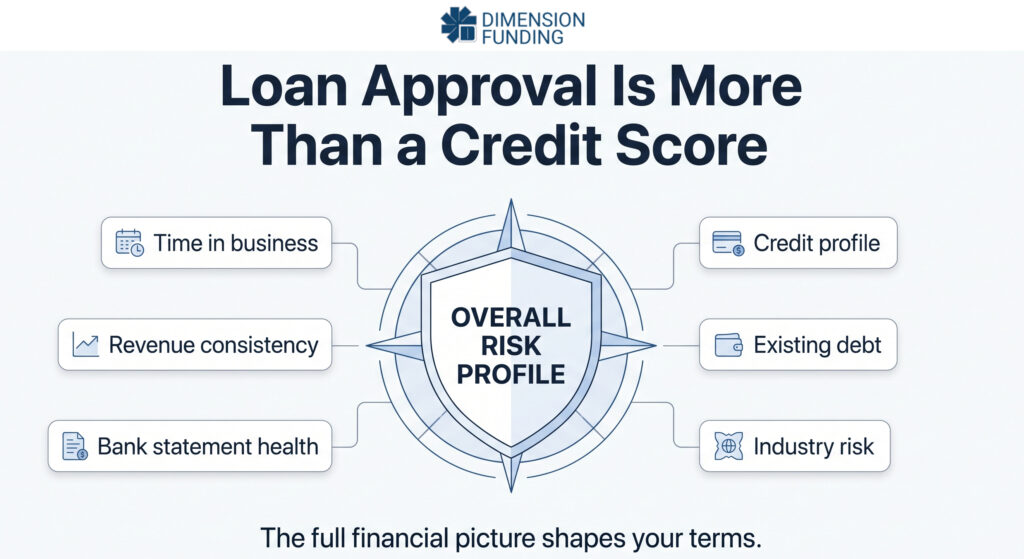
Working capital loan approval is rarely based on a single number. Instead, underwriters combine several financial indicators to build a comprehensive risk profile that helps determine how likely a business is to repay on schedule. This holistic approach reflects federal banking guidance that prudent underwriting should consider a borrower’s overall financial condition, repayment capacity, and cash flow, not just one metric in isolation. The Office of the Comptroller of the Currency’s Commercial Loans booklet explains that sound commercial lending decisions rely on evaluating multiple sources of financial information before extending credit, rather than defaulting to a single ratio or score as a stand-in for the full picture.

Underwriting Factor

What It Tells the Lender

Time in business

Demonstrates business stability and operating history

Revenue consistency

Indicates predictable cash flow available for repayment

Bank statement trends

Reveals day-to-day cash management and liquidity

Credit history

Shows past borrowing and repayment behavior

Existing debt

Measures current repayment obligations and financial leverage

Industry risk

Reflects exposure to economic cycles and sector-specific challenges

Rather than assigning equal weight to every factor, lenders evaluate how they interact. A business with only two years of operating history may still receive favorable terms if it shows consistent monthly deposits, healthy account balances, and a manageable debt load. A long-established business, on the other hand, may see less favorable terms if recent bank statements reveal frequent overdrafts or declining revenue, which is why the sections below break down each factor individually.

Time in Business Sets the Baseline

Lenders view a longer operating history as evidence that a business can weather slow periods and still make payments. A company with five or ten years of consistent revenue is a more predictable applicant than one that opened its doors last year, and that predictability typically translates into more favorable terms.

Newer businesses aren’t necessarily locked out, but they often see more conservative terms until they build a longer track record. If your business is still young, strong recent revenue and clean bank statements can help offset the limited history in a lender’s eyes.

Revenue Consistency Matters More Than Revenue Size

A lender evaluating a working capital loan cares less about how much a business makes and more about how reliably that revenue shows up month after month. Steady, predictable deposits signal that a business can absorb a fixed payment without strain, which tends to support more favorable terms.

Erratic revenue, with big months followed by lean ones, reads as risk even if the annual total is strong. Businesses with seasonal swings can still qualify for competitive terms, but it often takes a documented pattern of managing those swings well over time.

Bank Statement Health Drives the Underwriting Conversation

Underwriters look closely at average daily balance, negative balance days, and overdraft frequency when evaluating an application. A business that consistently carries a healthy balance and avoids overdrafts is demonstrating exactly the kind of cash management a lender wants to see before extending credit.

Frequent negative balances or NSF fees push the underwriting conversation in the other direction, since they suggest a business may already be operating close to the edge of its cash flow. Cleaning up account activity in the months before applying can meaningfully improve the terms a lender is willing to offer.

Credit Profile Still Plays a Role

Personal and business credit history factor into approval, but rarely in isolation. A working capital lender weighs credit alongside cash flow, so a lower credit score doesn’t automatically rule out favorable terms if the underlying bank statements are strong.

That said, a stronger credit profile generally opens the door to better terms and, in some cases, higher approved amounts. Businesses considering an application benefit from checking their credit standing beforehand so there are no surprises once underwriting begins.

Industry Risk Adds Context to the Rest

Industry is the one factor on the list that has nothing to do with a specific business’s own numbers, and everything to do with where that business sits inside a larger economic pattern. A restaurant, a construction subcontractor, and a medical practice can each show identical revenue and identical bank statement health, and still receive different terms, because lenders track how exposed each industry tends to be to seasonal swings, supply shocks, or broader economic downturns.

That doesn’t mean a business in a higher-risk industry is worse off across the board. It means the other factors on this list carry a bit more weight in that evaluation. A seasonal landscaping business that can show it’s managed its slow months well for several years in a row is demonstrating exactly the kind of resilience a lender is trying to price for, which can offset the industry classification rather than being overridden by it.

Loan Amount and Term Length Shape the Terms You’re Offered

Larger loan amounts and longer terms typically carry more risk for a lender, since more capital is outstanding for a longer stretch of time. That added exposure is often reflected in the terms offered, particularly once a request crosses thresholds that require deeper documentation.

Dimension Funding’s working capital loans range from $25,000 to $250,000 with terms up to 24 months, and requests over $100,000 generally require corporate tax returns in addition to bank statements. Matching your requested amount and term to your actual need, rather than borrowing more or longer than necessary, keeps the overall terms as favorable as possible.

Repayment Structure Influences the Terms You’re Offered

The frequency of your repayment plan affects how a lender views risk over the life of the loan. Daily and weekly repayment plans return capital to the lender faster and more often, which can support more favorable terms compared to a monthly schedule stretched over a longer period.

Monthly repayment plans typically require a stronger credit profile and are capped at shorter terms, since a lender is collecting less frequently and carrying more exposure between payments. Choosing the repayment cadence that best matches your revenue pattern isn’t just about convenience, it can directly affect the terms on your offer.

How a Fixed Payment Compares to Alternative Financing Costs

One of the clearest ways to see what shapes overall cost is comparing a fixed-payment working capital loan to a merchant cash advance. A merchant cash advance ties repayment to a percentage of daily sales, which means the total cost can swing significantly depending on how the business performs during the repayment period.

Businesses that compare this type of financing often find that a fixed-payment working capital loan can cost considerably less than a merchant cash advance, since the payment stays the same regardless of sales volume. That predictability is part of why a strong financial profile paired with a fixed-payment loan usually ends up costing less over time than a variable-cost alternative.

Putting the Pieces Together Before You Apply

Your working capital loan terms aren’t decided by a single number, they’re shaped by time in business, revenue consistency, bank statement health, credit profile, industry, loan size, and repayment structure working together. None of these factors operate in a vacuum, and a weaker showing on one can often be offset by strength in another, which is exactly why two businesses with the same revenue can walk away from the same lender with different terms.

Dimension Funding offers working capital loans between $25,000 and $250,000, with same-day or next-business-day funding and a single-page, bank-statement-based application. Contact Dimension Funding to see what your business qualifies for.

If two businesses have identical revenue, will they always get the same terms?

Not necessarily. Revenue is only one input, and underwriters also weigh consistency, bank statement health, credit history, and existing debt. Two businesses with the same top-line revenue can look very different once those other factors are layered in.

Does switching business bank accounts right before applying hurt an application?

It can complicate underwriting, since lenders typically want to see several months of consistent history at one institution to establish a reliable pattern. A recent account switch may mean providing statements from both accounts or waiting until the new account has enough history.

Can a business improve its standing in the months before applying?

Yes. Paying down existing debt, avoiding overdrafts, and maintaining steady deposit patterns for a few months before applying can meaningfully strengthen how an application is viewed, even without changing the business’s underlying revenue.

Does the industry a business operates in affect approval beyond just its financials?

It can. Lenders sometimes factor in how exposed a given industry is to economic cycles or seasonal disruption, which means two businesses with similar financials in different industries may be evaluated somewhat differently. A business that can document how it’s managed seasonal or cyclical exposure well in the past often narrows that gap.

Is it better to apply for a smaller amount to improve approval odds?

Not automatically. Requesting less than the business actually needs can lead to a second financing need later, so it’s generally better to request an amount that matches the real gap and let the underwriting process weigh in on fit, rather than under-requesting preemptively.

How far back do lenders typically look at bank statement history?

Most working capital lenders review three to six months of statements, though larger requests may prompt a longer look-back or a request for additional documentation to confirm the pattern holds over time.

Can an existing customer get updated terms without reapplying from scratch?

Many lenders, including Dimension Funding, can reassess an existing customer’s terms based on updated bank statements and revenue rather than requiring a full new application, particularly if the business’s financial profile has improved since the original loan.


Small Business Working Capital Loans Without Stacking

small business working capital loan

Small Business Working Capital Loans Without Stacking

When cash flow gets tight, it’s tempting to apply for financing wherever it’s offered — a second loan here, a merchant cash advance there, until you’re juggling multiple payments just to stay afloat. This pattern, known as loan stacking, can turn a manageable cash flow gap into a much bigger problem. The better approach is securing the right amount of working capital once, sized correctly for your business.

That’s the philosophy behind how Dimension Funding structures its working capital loans. With over 40 years of financing small and mid-sized businesses across the U.S., the company focuses on right-sizing a single loan to a business’s actual cash flow rather than encouraging repeat borrowing. Understanding why stacking happens, and how lenders spot it, puts you in a much stronger financial position. Contact Dimension Funding if you’re weighing whether your current financing is sized correctly.

Small-Business-Working-Capital-Loans-Without-Stacking

What Loan Stacking Actually Is

Loan stacking refers to taking out two or more loans simultaneously, often from different lenders, in an attempt to access more capital than any single loan would provide. It became especially common after the 2008 financial crisis, when traditional banks tightened lending standards and small businesses turned to multiple loans as a workaround to secure working capital.

The appeal is obvious on the surface: more capital, faster. But many lenders don’t allow stacking because they don’t want to compete with other lenders over collateral if a borrower can’t repay, and the practice can quietly compound into far more debt than a business can service.

Why Regulators Are Paying Closer Attention

Stacking risk has grown alongside the products most often stacked. A Congressional Research Service report on small business lending notes that merchant cash advance originations more than doubled between 2014 and 2019, even though they represented less than 1% of the small business financing market as recently as 2017. That rapid growth is part of why regulators have started treating these products more like traditional credit.

The Consumer Financial Protection Bureau has clarified that merchant cash advances count as covered business credit under its small business lending rule, alongside loans and lines of credit, even though MCA providers have historically argued their products are structured as a sale of receivables rather than a loan. That distinction matters for a business considering multiple financing sources, since a merchant cash advance sitting alongside a term loan or line of credit is still additional debt from an underwriting standpoint, regardless of how it’s structured on paper.

How Lenders Detect Loan Stacking

Loan stacking isn’t always disclosed by borrowers, so lenders rely on several underwriting tools to determine whether a business has recently taken on additional financing. The goal isn’t simply to identify existing debt, it’s to assess whether the business has sufficient cash flow to support another repayment obligation. During underwriting, lenders commonly review credit reports, bank statements, and public financing records to build a complete picture of an applicant’s current financial commitments. The Federal Trade Commission’s work on small business credit reporting notes that commercial credit reports can include payment history and other information lenders use to evaluate business creditworthiness.

Underwriting Signal

Why It Raises Concern

Recent credit inquiries

May indicate multiple financing applications within a short period

New UCC filings

Suggest recently originated secured financing that may already encumber business assets

Multiple daily ACH withdrawals

Can indicate overlapping loan or merchant cash advance repayments

Sudden increase in debt obligations

Reduces available cash flow for servicing new debt

Bank statement inconsistencies

May reveal undisclosed financing or unusual borrowing activity requiring clarification

The Role of UCC Filings

One of the most valuable underwriting resources is the Uniform Commercial Code filing system. When a lender files a UCC-1 financing statement, it publicly records its security interest in a borrower’s business assets, allowing other lenders to identify existing secured obligations before extending additional credit. The Uniform Law Commission’s UCC Article 9 resources provide background on this filing framework, and the full statutory text is available through Cornell Law School’s UCC Article 9 reference. If lenders discover multiple undisclosed obligations, they may request additional documentation, reduce the approved loan amount, or decline the application altogether.

Why Stacking Creates More Problems Than It Solves

Stacking loans multiplies your fixed obligations without multiplying your revenue. Each additional loan adds its own payment schedule and its own risk of default, and because the payments often overlap, a single slow month can trigger missed payments across multiple lenders at once, not just one.

There’s also a compounding cost problem. Short-term loans and cash advances taken on top of existing debt tend to carry higher costs precisely because the borrower already looks overleveraged to a new lender. What starts as a bridge to cover one gap can quickly become a cycle of borrowing simply to make payments on previous borrowing.

Why Businesses End Up Stacking in the First Place

Stacking rarely starts as a plan, it starts as a reaction. A business borrows an amount that turns out to be too small for the actual need, and rather than going back to the same lender, it seeks a second loan elsewhere to cover the shortfall. Undersized initial financing is one of the most common root causes.

Slow approval timelines are another driver. If a business needs cash quickly and a first application is still pending, it may apply elsewhere out of urgency, ending up with two loans instead of one appropriately sized loan. Getting the amount and the speed right the first time removes much of the pressure that leads to stacking in the first place.

How Right-Sizing a Working Capital Loan Prevents Stacking

The most effective way to avoid stacking is securing a loan sized to your actual cash flow need from the start. That means being realistic about the amount requested, rather than under-borrowing to keep payments low and then needing a second loan to make up the difference. Dimension Funding’s working capital loans range from $25,000 to $250,000, giving businesses room to request an amount that actually covers the gap rather than a fraction of it.

Speed matters just as much as size. Because Dimension Funding uses a single-page application supported by bank statements, approved businesses can often access same-day or next-business-day funding, fast enough that businesses aren’t tempted to apply elsewhere while waiting. Getting the right amount, quickly, through one lender is the most direct way to avoid the stacking spiral altogether.

Repayment Structure as a Stacking Deterrent

Part of what pushes businesses toward stacking is a repayment structure that doesn’t fit their cash flow, leaving them short on funds mid-cycle and searching for a second source. Choosing a repayment plan that actually matches revenue timing, whether weekly, daily, or monthly, reduces the odds of running short before the loan is repaid.

Dimension Funding structures repayment around the business rather than a rigid schedule, offering weekly, monthly, or daily plans depending on what fits the borrower’s revenue pattern. A seasonal business on a repayment plan that eases during slow periods is far less likely to need supplemental financing than one locked into a payment schedule that doesn’t reflect its cash flow.

What to Do Instead of Stacking

If your current working capital loan isn’t covering what you need, the better move is usually going back to your existing lender rather than adding a new one. Many lenders, including Dimension Funding, can evaluate whether a business qualifies for additional working capital or a restructured amount based on updated revenue and bank statement history, rather than layering on a separate, competing loan.

It’s also worth stepping back and confirming the loan type actually fits the need. A working capital loan is built for daily expenses, inventory, and operating gaps, while a distinct cash flow event, like a large receivable on a 60- to 120-day cycle, may be better matched to short-term bridge financing instead of a second working capital loan taken on top of the first.

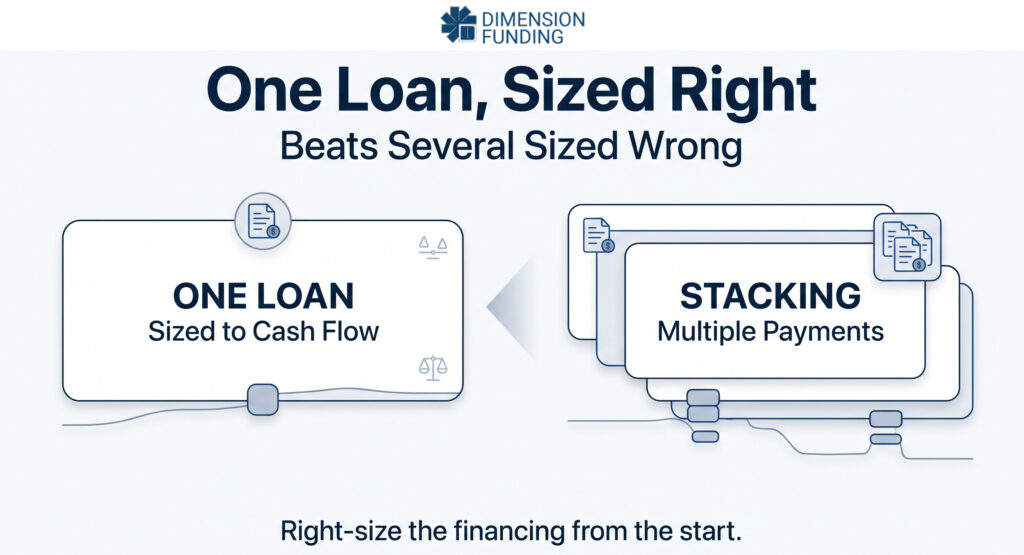
One Loan, Sized Right, Beats Several Sized Wrong

Stacking loans feels like a solution in the moment, but it almost always creates more financial pressure than it relieves. The better path is securing a single working capital loan sized correctly to your actual cash flow need, with a repayment structure that matches how your business earns revenue. Dimension Funding offers working capital loans between $25,000 and $250,000, with terms up to 24 months, same-day or next-business-day funding, and a single-page, bank-statement-based application. Contact Dimension Funding to find out what your business qualifies for.

Is loan stacking always intentional, or can it happen by accident?

It’s often unintentional. A business owner may apply to a second lender simply because a first application is taking too long, not realizing that holding two open approvals at once can look like stacking to an underwriter reviewing recent credit activity.

Does loan stacking show up on a personal credit report, or only a business one?

It primarily shows up on business credit reports and through UCC filings, though many small business loans also involve a personal guarantee, which means related credit inquiries can appear on the owner’s personal report as well.

If I’ve stacked loans in the past, does that hurt future applications permanently?

Not permanently. Lenders are generally more focused on your current debt load and cash flow than on past financing decisions, so demonstrating consistent repayment and a cleaner financial picture going forward can offset a stacking history over time.

Can consolidating multiple stacked loans into one new loan make sense?

It can, if the consolidated payment is genuinely lower or more manageable than the combined payments it replaces. It’s worth running the numbers carefully, since consolidating doesn’t always reduce total cost, even when it simplifies the number of payments.

How does a lender distinguish stacking from a business simply having multiple, unrelated types of financing?

Lenders generally look at timing and purpose. A business with an existing equipment loan and a newly opened working capital line for an unrelated need looks different than two working capital loans opened weeks apart to cover the same cash flow gap.

Does the size of a business affect how closely lenders watch for stacking?

Smaller businesses with thinner cash flow margins tend to get closer scrutiny, since a stacked repayment load has a proportionally bigger impact on a business with less revenue cushion to absorb it.

What’s the first step if I suspect I’m already overextended across multiple loans?

Start by listing every current obligation and its payment schedule against your actual monthly cash flow, rather than assuming it will work itself out. That full picture is also what a lender will want to see if you’re exploring a restructured or consolidated loan.