
Working Capital Loan or Line of Credit: A Decision Table

working capital loan vs line of credit

Working Capital Loan or Line of Credit: A Decision Table

Most owners looking into working capital already know they need cash. The harder question is what form that cash should take. Dimension Funding has financed businesses since 1978, and the choice between a lump-sum working capital loan and a revolving line of credit usually comes down to a few answerable questions about the need itself.

The decision table below turns those questions into a side-by-side comparison you can fill in for your own situation. If your answers point toward a set amount on a fixed schedule, a Dimension Funding working capital loan is built for that profile.
Working-Capital-Loan-or-Line-of-Credit-A-Decision-Table

Working Capital Is a Need, Not a Financing Product

Working capital and business financing are related, but they are not the same thing. Working capital describes a business’s short-term financial position, not a specific loan product. The FDIC and SBA’s Money Smart for Small Business curriculum defines it as the money a business has available for day-to-day expenses, calculated as current assets minus current liabilities.

That distinction matters when you compare ways to fund daily operations. A business can meet a working capital need with cash reserves, retained earnings, a term loan, a line of credit, receivables or inventory financing, or other forms of credit. The SBA’s lender program guidance describes its Working CAPLine as an asset-based revolving line for cyclical, recurring, or short-term needs, repaid as short-term assets convert to cash.

Need vs. Structure

The useful question is not whether to choose working capital financing or a line of credit, because a line of credit is one structure for addressing a working capital need. The Federal Reserve’s Branch and Agency Examination Manual describes working capital loans as short-term financing for inventory, receivables, supplies, and other operating needs, often structured as a line of credit or revolving credit.

Term

What It Describes

Example

Working capital

The financial need

Covering payroll while customer invoices are outstanding

Loan or line of credit

The financing structure

A lump-sum loan with fixed payments, or a revolving line drawn as needed

Start by identifying why you need working capital: a temporary cash flow gap, an inventory purchase, or waiting on customer invoices. Then you can judge which structure fits the timing, amount, and repayment pattern of that need.

The Two Structures Compared Here

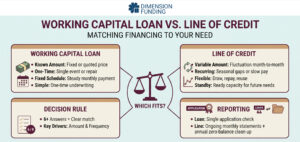
A working capital loan delivers a set amount in one disbursement and is repaid on a fixed schedule over a defined term. The business knows the full amount and the payment before signing, and the obligation ends when the balance reaches zero.

A line of credit sets a limit the business can draw against over a period, and the lender reviews it on a recurring basis. One structure funds a need that already exists. The other holds capacity for needs that have not arrived yet.

The Decision Table

Answer each question for the specific need you are financing, not for your business in general. A company can have a loan-shaped need and a line-shaped need in the same quarter.

Question

Points to a Working Capital Loan

Points to a Line of Credit

1. Do you know the exact dollar amount?

Yes, the amount is fixed or quoted

No, it will vary month to month

2. How often will this need occur?

Once, or rarely

Repeatedly through the year

3. When will you spend the money?

Within weeks of funding

In pieces over several months

4. Where does repayment come from?

General operating cash flow over the term

Specific inflows such as customer payments

5. When is the need arriving?

It is here now

It is expected later, so you are setting up capacity ahead of time

6. How predictable is your monthly cash?

Steady enough to budget a fixed payment

Too variable for a fixed payment

7. How much ongoing reporting can you handle?

Minimal after funding

Monthly financials and projections

8. Will you borrow again for the same purpose?

No

Yes

How to Read Your Results

Count your answers in each column. Six or more in one column is a clear signal. A closer split usually means two needs are mixed together, so separate the one-time portion from the recurring portion and finance each on its own.

When the split is even, questions 1 and 8 carry the most weight. Together they show whether the need is a fixed event or an ongoing pattern.

Eight Common Scenarios and the Better Fit

Scenario

Better Fit

Why

Supplier offers a discount on a bulk inventory order

Working capital loan

One purchase at a quoted price

Payroll gap during a predictable slow season

Line of credit

Recurs each year, and the amount varies

Bridge to one large contract payment

Working capital loan

Defined amount, defined end date

Clients who routinely pay 60 or more days late

Line of credit

Ongoing gap tied to receivables

Emergency repair to keep operations running

Working capital loan

Immediate, one-time, quoted cost

Staffing up before a new contract’s first invoice

Working capital loan

Fixed ramp-up period, known payroll total

Restocking inventory ahead of each peak season

Line of credit

Repeats yearly and scales with demand

Marketing campaign with a set budget

Working capital loan

Fixed budget and launch date

The pattern holds across industries. A fixed amount with a fixed date points to a loan, while a recurring need with a variable amount points to a line.

What Lenders Weigh Before Approving Either Product

Your decision table answers are only half the picture. Lending conditions and documentation requirements also shape which structure is realistic to get.

Current Lending Conditions

According to the Federal Reserve’s July 2026 Senior Loan Officer Opinion Survey, banks reported basically unchanged standards for commercial and industrial loans to firms of all sizes in the second quarter of 2026. Demand from small firms was also basically unchanged.

Approval outcomes still vary widely. The Federal Reserve’s 2026 Report on Employer Firms found that 42% of financing applicants received the full amount they sought, 36% received some or most, and 22% received nothing. A request tied to a clearly defined need is easier for a lender to size, which is why the decision table starts with the amount.

The Documentation Gap

Lines require ongoing oversight. The same Federal Reserve manual recommends analyzing working capital lines through monthly or quarterly reviews of the balance sheet and income statement, supported by receivables agings, inventory lists, and payables agings.

A working capital loan is underwritten once, at application. After funding, the obligation is the payment schedule. For owners without the staff to produce monthly reporting, that difference can settle the decision on its own.

When a Working Capital Loan From Dimension Funding Fits

Dimension Funding offers working capital loans for unexpected expenses and slow periods, along with small business loans and short-term business loans for defined needs with a clear end date. Funding typically arrives the same day or the next business day, and documents are signed through DocuSign.

Before applying, use the Dimension Funding payment calculator to test whether a fixed payment fits your monthly budget. That answers question 6 with real numbers. Dimension Funding prefers two or more years in business, though strong credit can substitute.

Letting the Need Choose the Product

Define the working capital need first, then pick the structure. Match fixed events with a fixed loan, and reserve revolving credit for patterns that repeat.

When your answers land in the working capital loan column, Contact Dimension Funding at 1-800-755-0585 or Sales@DimensionFunding.com to review the amount, term, and payment that fit your situation.

Frequently Asked Questions

Can a business have a working capital loan and a line of credit at the same time?

Yes. Lenders review your total payment obligations, and some agreements restrict additional borrowing through covenants. Disclose every existing obligation on each application.

Does paying off a working capital loan early reduce what I owe?

It depends on the agreement. Some structures reduce the total owed on early payoff, while others set a fixed payback amount. Ask how early payoff is calculated before you sign.

Will applying for both products hurt my credit?

Each application can trigger a hard inquiry on business credit, and often personal credit. Several inquiries in a short window can weigh on your scores, so apply only for the structure the table points to.

Are working capital loan proceeds taxable income?

Loan proceeds are generally not taxable income, and repaying principal is generally not deductible. The treatment of other charges varies, so confirm the details with your CPA.

Can I use a line of credit to make payments on a working capital loan?

Lenders generally discourage it. The Federal Reserve’s examination manual lists line advances used for debt payments or unrelated costs as a warning sign, since those advances should fund inventory or payables.

Can a newer business qualify for a working capital loan?

Many lenders set time-in-business minimums. Dimension Funding prefers two or more years, but strong credit can substitute.

What if my need turns out to be recurring after I take a loan?

A working capital loan cannot be redrawn once it is repaid. If the same need returns, it likely fits a line of credit better, so revisit the decision table before your next request.

A few notes on the changes:

  • Placement: Your section replaces the old “Core Difference in Two Definitions” H2, and the loan and line definitions now sit under it as an H3. That keeps the article at 7 H2s and puts the need-versus-structure framing before the decision table, where it sets up the comparison.
  • Sourcing adjustments:
    • I couldn’t find an sba.gov page defining working capital as current assets remaining after current liabilities. The definition now cites the joint FDIC and SBA Money Smart curriculum, which gives the same formula.
    • For the SBA point about lines and asset-based financing, the link goes to the SBA’s lender resources page. Its Working CAPLine description covers both ideas in one program: an asset-based revolving line.
    • The Federal Reserve claim checks out, so I kept it as written.
  • Client rules: I removed “cost” from your final sentence, since it invites rate comparisons in borrower-facing content. I also replaced the em dashes and turned the “Think of it this way” list into a small table.
  • Length: To stay within the word count, I trimmed the lending-conditions section (dropping the April 2026 SLOOS reference), the conversion section, the conclusion, and several FAQ answers. The article is now about 1,700 words.


What Shapes Approval on a Working Capital Loan

working capital loans interest rates

What Shapes Approval on a Working Capital Loan

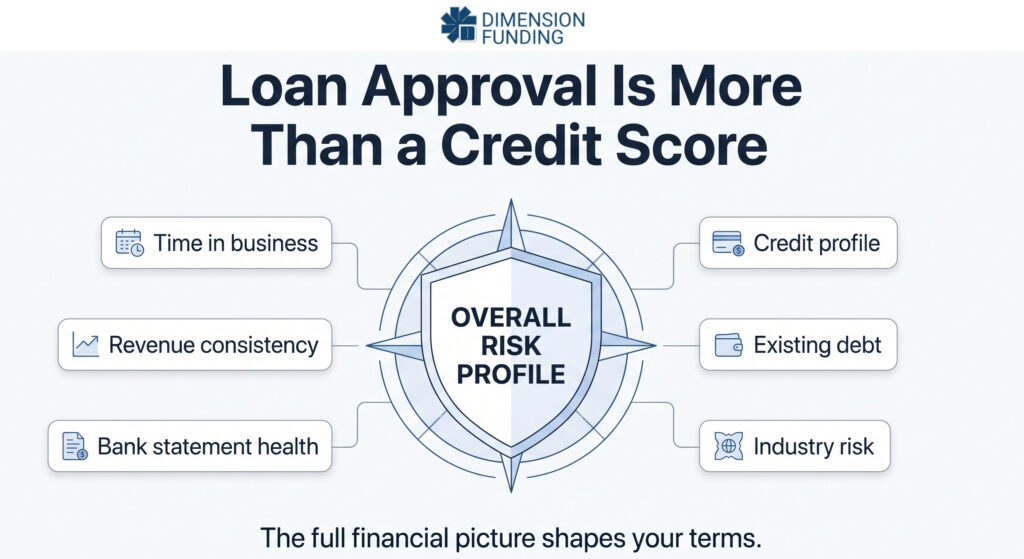
Two businesses can apply for the same working capital loan amount and end up with very different terms. The difference usually isn’t luck, it’s a handful of specific factors that lenders weigh every time they evaluate an application. Knowing what those factors are gives you real leverage before you ever submit one.

Dimension Funding has spent over 40 years financing small and mid-sized businesses across the U.S., and its working capital program is built around evaluating a business’s full financial profile rather than a single number. Contact Dimension Funding to talk through your business’s profile before applying, or keep reading to understand what underwriters actually look at.

What-Shapes-Approval-on-a-Working-Capital-Loan

How Underwriters Build a Risk Profile

Working capital loan approval is rarely based on a single number. Instead, underwriters combine several financial indicators to build a comprehensive risk profile that helps determine how likely a business is to repay on schedule. This holistic approach reflects federal banking guidance that prudent underwriting should consider a borrower’s overall financial condition, repayment capacity, and cash flow, not just one metric in isolation. The Office of the Comptroller of the Currency’s Commercial Loans booklet explains that sound commercial lending decisions rely on evaluating multiple sources of financial information before extending credit, rather than defaulting to a single ratio or score as a stand-in for the full picture.

Underwriting Factor

What It Tells the Lender

Time in business

Demonstrates business stability and operating history

Revenue consistency

Indicates predictable cash flow available for repayment

Bank statement trends

Reveals day-to-day cash management and liquidity

Credit history

Shows past borrowing and repayment behavior

Existing debt

Measures current repayment obligations and financial leverage

Industry risk

Reflects exposure to economic cycles and sector-specific challenges

Rather than assigning equal weight to every factor, lenders evaluate how they interact. A business with only two years of operating history may still receive favorable terms if it shows consistent monthly deposits, healthy account balances, and a manageable debt load. A long-established business, on the other hand, may see less favorable terms if recent bank statements reveal frequent overdrafts or declining revenue, which is why the sections below break down each factor individually.

Time in Business Sets the Baseline

Lenders view a longer operating history as evidence that a business can weather slow periods and still make payments. A company with five or ten years of consistent revenue is a more predictable applicant than one that opened its doors last year, and that predictability typically translates into more favorable terms.

Newer businesses aren’t necessarily locked out, but they often see more conservative terms until they build a longer track record. If your business is still young, strong recent revenue and clean bank statements can help offset the limited history in a lender’s eyes.

Revenue Consistency Matters More Than Revenue Size

A lender evaluating a working capital loan cares less about how much a business makes and more about how reliably that revenue shows up month after month. Steady, predictable deposits signal that a business can absorb a fixed payment without strain, which tends to support more favorable terms.

Erratic revenue, with big months followed by lean ones, reads as risk even if the annual total is strong. Businesses with seasonal swings can still qualify for competitive terms, but it often takes a documented pattern of managing those swings well over time.

Bank Statement Health Drives the Underwriting Conversation

Underwriters look closely at average daily balance, negative balance days, and overdraft frequency when evaluating an application. A business that consistently carries a healthy balance and avoids overdrafts is demonstrating exactly the kind of cash management a lender wants to see before extending credit.

Frequent negative balances or NSF fees push the underwriting conversation in the other direction, since they suggest a business may already be operating close to the edge of its cash flow. Cleaning up account activity in the months before applying can meaningfully improve the terms a lender is willing to offer.

Credit Profile Still Plays a Role

Personal and business credit history factor into approval, but rarely in isolation. A working capital lender weighs credit alongside cash flow, so a lower credit score doesn’t automatically rule out favorable terms if the underlying bank statements are strong.

That said, a stronger credit profile generally opens the door to better terms and, in some cases, higher approved amounts. Businesses considering an application benefit from checking their credit standing beforehand so there are no surprises once underwriting begins.

Industry Risk Adds Context to the Rest

Industry is the one factor on the list that has nothing to do with a specific business’s own numbers, and everything to do with where that business sits inside a larger economic pattern. A restaurant, a construction subcontractor, and a medical practice can each show identical revenue and identical bank statement health, and still receive different terms, because lenders track how exposed each industry tends to be to seasonal swings, supply shocks, or broader economic downturns.

That doesn’t mean a business in a higher-risk industry is worse off across the board. It means the other factors on this list carry a bit more weight in that evaluation. A seasonal landscaping business that can show it’s managed its slow months well for several years in a row is demonstrating exactly the kind of resilience a lender is trying to price for, which can offset the industry classification rather than being overridden by it.

Loan Amount and Term Length Shape the Terms You’re Offered

Larger loan amounts and longer terms typically carry more risk for a lender, since more capital is outstanding for a longer stretch of time. That added exposure is often reflected in the terms offered, particularly once a request crosses thresholds that require deeper documentation.

Dimension Funding’s working capital loans range from $25,000 to $250,000 with terms up to 24 months, and requests over $100,000 generally require corporate tax returns in addition to bank statements. Matching your requested amount and term to your actual need, rather than borrowing more or longer than necessary, keeps the overall terms as favorable as possible.

Repayment Structure Influences the Terms You’re Offered

The frequency of your repayment plan affects how a lender views risk over the life of the loan. Daily and weekly repayment plans return capital to the lender faster and more often, which can support more favorable terms compared to a monthly schedule stretched over a longer period.

Monthly repayment plans typically require a stronger credit profile and are capped at shorter terms, since a lender is collecting less frequently and carrying more exposure between payments. Choosing the repayment cadence that best matches your revenue pattern isn’t just about convenience, it can directly affect the terms on your offer.

How a Fixed Payment Compares to Alternative Financing Costs

One of the clearest ways to see what shapes overall cost is comparing a fixed-payment working capital loan to a merchant cash advance. A merchant cash advance ties repayment to a percentage of daily sales, which means the total cost can swing significantly depending on how the business performs during the repayment period.

Businesses that compare this type of financing often find that a fixed-payment working capital loan can cost considerably less than a merchant cash advance, since the payment stays the same regardless of sales volume. That predictability is part of why a strong financial profile paired with a fixed-payment loan usually ends up costing less over time than a variable-cost alternative.

Putting the Pieces Together Before You Apply

Your working capital loan terms aren’t decided by a single number, they’re shaped by time in business, revenue consistency, bank statement health, credit profile, industry, loan size, and repayment structure working together. None of these factors operate in a vacuum, and a weaker showing on one can often be offset by strength in another, which is exactly why two businesses with the same revenue can walk away from the same lender with different terms.

Dimension Funding offers working capital loans between $25,000 and $250,000, with same-day or next-business-day funding and a single-page, bank-statement-based application. Contact Dimension Funding to see what your business qualifies for.

If two businesses have identical revenue, will they always get the same terms?

Not necessarily. Revenue is only one input, and underwriters also weigh consistency, bank statement health, credit history, and existing debt. Two businesses with the same top-line revenue can look very different once those other factors are layered in.

Does switching business bank accounts right before applying hurt an application?

It can complicate underwriting, since lenders typically want to see several months of consistent history at one institution to establish a reliable pattern. A recent account switch may mean providing statements from both accounts or waiting until the new account has enough history.

Can a business improve its standing in the months before applying?

Yes. Paying down existing debt, avoiding overdrafts, and maintaining steady deposit patterns for a few months before applying can meaningfully strengthen how an application is viewed, even without changing the business’s underlying revenue.

Does the industry a business operates in affect approval beyond just its financials?

It can. Lenders sometimes factor in how exposed a given industry is to economic cycles or seasonal disruption, which means two businesses with similar financials in different industries may be evaluated somewhat differently. A business that can document how it’s managed seasonal or cyclical exposure well in the past often narrows that gap.

Is it better to apply for a smaller amount to improve approval odds?

Not automatically. Requesting less than the business actually needs can lead to a second financing need later, so it’s generally better to request an amount that matches the real gap and let the underwriting process weigh in on fit, rather than under-requesting preemptively.

How far back do lenders typically look at bank statement history?

Most working capital lenders review three to six months of statements, though larger requests may prompt a longer look-back or a request for additional documentation to confirm the pattern holds over time.

Can an existing customer get updated terms without reapplying from scratch?

Many lenders, including Dimension Funding, can reassess an existing customer’s terms based on updated bank statements and revenue rather than requiring a full new application, particularly if the business’s financial profile has improved since the original loan.