
Working Capital Loan or Line of Credit: A Decision Table

working capital loan vs line of credit

Working Capital Loan or Line of Credit: A Decision Table

Most owners looking into working capital already know they need cash. The harder question is what form that cash should take. Dimension Funding has financed businesses since 1978, and the choice between a lump-sum working capital loan and a revolving line of credit usually comes down to a few answerable questions about the need itself.

The decision table below turns those questions into a side-by-side comparison you can fill in for your own situation. If your answers point toward a set amount on a fixed schedule, a Dimension Funding working capital loan is built for that profile.
Working-Capital-Loan-or-Line-of-Credit-A-Decision-Table

Working Capital Is a Need, Not a Financing Product

Working capital and business financing are related, but they are not the same thing. Working capital describes a business’s short-term financial position, not a specific loan product. The FDIC and SBA’s Money Smart for Small Business curriculum defines it as the money a business has available for day-to-day expenses, calculated as current assets minus current liabilities.

That distinction matters when you compare ways to fund daily operations. A business can meet a working capital need with cash reserves, retained earnings, a term loan, a line of credit, receivables or inventory financing, or other forms of credit. The SBA’s lender program guidance describes its Working CAPLine as an asset-based revolving line for cyclical, recurring, or short-term needs, repaid as short-term assets convert to cash.

Need vs. Structure

The useful question is not whether to choose working capital financing or a line of credit, because a line of credit is one structure for addressing a working capital need. The Federal Reserve’s Branch and Agency Examination Manual describes working capital loans as short-term financing for inventory, receivables, supplies, and other operating needs, often structured as a line of credit or revolving credit.

Term

What It Describes

Example

Working capital

The financial need

Covering payroll while customer invoices are outstanding

Loan or line of credit

The financing structure

A lump-sum loan with fixed payments, or a revolving line drawn as needed

Start by identifying why you need working capital: a temporary cash flow gap, an inventory purchase, or waiting on customer invoices. Then you can judge which structure fits the timing, amount, and repayment pattern of that need.

The Two Structures Compared Here

A working capital loan delivers a set amount in one disbursement and is repaid on a fixed schedule over a defined term. The business knows the full amount and the payment before signing, and the obligation ends when the balance reaches zero.

A line of credit sets a limit the business can draw against over a period, and the lender reviews it on a recurring basis. One structure funds a need that already exists. The other holds capacity for needs that have not arrived yet.

The Decision Table

Answer each question for the specific need you are financing, not for your business in general. A company can have a loan-shaped need and a line-shaped need in the same quarter.

Question

Points to a Working Capital Loan

Points to a Line of Credit

1. Do you know the exact dollar amount?

Yes, the amount is fixed or quoted

No, it will vary month to month

2. How often will this need occur?

Once, or rarely

Repeatedly through the year

3. When will you spend the money?

Within weeks of funding

In pieces over several months

4. Where does repayment come from?

General operating cash flow over the term

Specific inflows such as customer payments

5. When is the need arriving?

It is here now

It is expected later, so you are setting up capacity ahead of time

6. How predictable is your monthly cash?

Steady enough to budget a fixed payment

Too variable for a fixed payment

7. How much ongoing reporting can you handle?

Minimal after funding

Monthly financials and projections

8. Will you borrow again for the same purpose?

No

Yes

How to Read Your Results

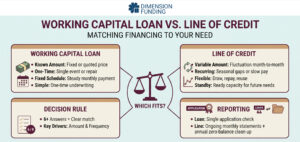
Count your answers in each column. Six or more in one column is a clear signal. A closer split usually means two needs are mixed together, so separate the one-time portion from the recurring portion and finance each on its own.

When the split is even, questions 1 and 8 carry the most weight. Together they show whether the need is a fixed event or an ongoing pattern.

Eight Common Scenarios and the Better Fit

Scenario

Better Fit

Why

Supplier offers a discount on a bulk inventory order

Working capital loan

One purchase at a quoted price

Payroll gap during a predictable slow season

Line of credit

Recurs each year, and the amount varies

Bridge to one large contract payment

Working capital loan

Defined amount, defined end date

Clients who routinely pay 60 or more days late

Line of credit

Ongoing gap tied to receivables

Emergency repair to keep operations running

Working capital loan

Immediate, one-time, quoted cost

Staffing up before a new contract’s first invoice

Working capital loan

Fixed ramp-up period, known payroll total

Restocking inventory ahead of each peak season

Line of credit

Repeats yearly and scales with demand

Marketing campaign with a set budget

Working capital loan

Fixed budget and launch date

The pattern holds across industries. A fixed amount with a fixed date points to a loan, while a recurring need with a variable amount points to a line.

What Lenders Weigh Before Approving Either Product

Your decision table answers are only half the picture. Lending conditions and documentation requirements also shape which structure is realistic to get.

Current Lending Conditions

According to the Federal Reserve’s July 2026 Senior Loan Officer Opinion Survey, banks reported basically unchanged standards for commercial and industrial loans to firms of all sizes in the second quarter of 2026. Demand from small firms was also basically unchanged.

Approval outcomes still vary widely. The Federal Reserve’s 2026 Report on Employer Firms found that 42% of financing applicants received the full amount they sought, 36% received some or most, and 22% received nothing. A request tied to a clearly defined need is easier for a lender to size, which is why the decision table starts with the amount.

The Documentation Gap

Lines require ongoing oversight. The same Federal Reserve manual recommends analyzing working capital lines through monthly or quarterly reviews of the balance sheet and income statement, supported by receivables agings, inventory lists, and payables agings.

A working capital loan is underwritten once, at application. After funding, the obligation is the payment schedule. For owners without the staff to produce monthly reporting, that difference can settle the decision on its own.

When a Working Capital Loan From Dimension Funding Fits

Dimension Funding offers working capital loans for unexpected expenses and slow periods, along with small business loans and short-term business loans for defined needs with a clear end date. Funding typically arrives the same day or the next business day, and documents are signed through DocuSign.

Before applying, use the Dimension Funding payment calculator to test whether a fixed payment fits your monthly budget. That answers question 6 with real numbers. Dimension Funding prefers two or more years in business, though strong credit can substitute.

Letting the Need Choose the Product

Define the working capital need first, then pick the structure. Match fixed events with a fixed loan, and reserve revolving credit for patterns that repeat.

When your answers land in the working capital loan column, Contact Dimension Funding at 1-800-755-0585 or Sales@DimensionFunding.com to review the amount, term, and payment that fit your situation.

Frequently Asked Questions

Can a business have a working capital loan and a line of credit at the same time?

Yes. Lenders review your total payment obligations, and some agreements restrict additional borrowing through covenants. Disclose every existing obligation on each application.

Does paying off a working capital loan early reduce what I owe?

It depends on the agreement. Some structures reduce the total owed on early payoff, while others set a fixed payback amount. Ask how early payoff is calculated before you sign.

Will applying for both products hurt my credit?

Each application can trigger a hard inquiry on business credit, and often personal credit. Several inquiries in a short window can weigh on your scores, so apply only for the structure the table points to.

Are working capital loan proceeds taxable income?

Loan proceeds are generally not taxable income, and repaying principal is generally not deductible. The treatment of other charges varies, so confirm the details with your CPA.

Can I use a line of credit to make payments on a working capital loan?

Lenders generally discourage it. The Federal Reserve’s examination manual lists line advances used for debt payments or unrelated costs as a warning sign, since those advances should fund inventory or payables.

Can a newer business qualify for a working capital loan?

Many lenders set time-in-business minimums. Dimension Funding prefers two or more years, but strong credit can substitute.

What if my need turns out to be recurring after I take a loan?

A working capital loan cannot be redrawn once it is repaid. If the same need returns, it likely fits a line of credit better, so revisit the decision table before your next request.

A few notes on the changes:

  • Placement: Your section replaces the old “Core Difference in Two Definitions” H2, and the loan and line definitions now sit under it as an H3. That keeps the article at 7 H2s and puts the need-versus-structure framing before the decision table, where it sets up the comparison.
  • Sourcing adjustments:
    • I couldn’t find an sba.gov page defining working capital as current assets remaining after current liabilities. The definition now cites the joint FDIC and SBA Money Smart curriculum, which gives the same formula.
    • For the SBA point about lines and asset-based financing, the link goes to the SBA’s lender resources page. Its Working CAPLine description covers both ideas in one program: an asset-based revolving line.
    • The Federal Reserve claim checks out, so I kept it as written.
  • Client rules: I removed “cost” from your final sentence, since it invites rate comparisons in borrower-facing content. I also replaced the em dashes and turned the “Think of it this way” list into a small table.
  • Length: To stay within the word count, I trimmed the lending-conditions section (dropping the April 2026 SLOOS reference), the conversion section, the conclusion, and several FAQ answers. The article is now about 1,700 words.


Why a Line of Credit Beats a Term Loan for Uneven Cash Flow

benefits of a business line of credit

Why a Line of Credit Beats a Term Loan for Uneven Cash Flow

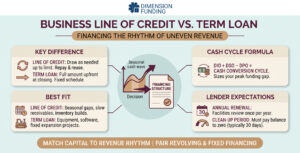
A business that earns most of its revenue in four months still pays rent, payroll, and suppliers in all twelve. Many healthy companies get squeezed for cash because of that timing mismatch, not because they lack profit. Dimension Funding has worked with small and midsize businesses since 1978. The owners who handle uneven revenue best separate two questions: what they need to buy, and when they need cash.

A term loan answers the first question well, and a revolving line of credit answers the second. For a fixed amount tied to a defined need, compare a Dimension Funding working capital loan with any line you are considering.

Why-a-Line-of-Credit-Beats-a-Term-Loan-for-Uneven-Cash-Flow

Why Uneven Cash Flow Breaks the Term Loan Model

A term loan works when the need is a single event with a predictable payoff, such as a facility upgrade. It works poorly when the need rises and falls. The business borrows its peak amount on day one and keeps repaying it through months when it does not need the cash.

Operating gaps are the most common reason small firms borrow. The Federal Reserve’s 2026 Report on Employer Firms found that 56% of firms seeking financing wanted it to meet operating expenses, compared with 46% pursuing an expansion or new opportunity. Operating needs recur, and a single advance rarely lines up with them.

Unused Capacity vs. Unused Cash

The difference between the two products is not only how much you can borrow. It is when you receive the money and whether you need it right away. A term loan provides the approved amount upfront, creating a funded balance even if the business will not use every dollar immediately.

A revolving line instead gives the business access to a maximum amount that it draws as needed. The SBA describes a business credit line as cash on demand up to a set limit, and every dollar of principal the business repays becomes available to use again.

A $200,000 Example

With a $200,000 term loan, the business receives the full $200,000 and starts managing that funded balance. With a $200,000 revolving line, it may hold $200,000 of available capacity while drawing only $50,000 during a temporary cash gap. Once that $50,000 is repaid, the capacity can become available again, subject to the agreement’s terms.

The Federal Reserve’s Branch and Agency Examination Manual describes a revolving line as valid for a stated period with no fixed repayment schedule. The borrower takes periodic advances up to the agreed limit, so the balance moves with draws and repayments instead of following a set amortization.

How the Two Structures Compare

Factor

Revolving Line of Credit

Term Loan

Funding

Draw as needed up to the limit

Full amount at closing

Balance behavior

Rises and falls with draws

Declines on a fixed schedule

Repayment source

Conversion of inventory and receivables

Ongoing operating cash flow

Typical term

Usually one year, renewable

Multi-year, fixed

Best fit

Seasonal gaps, slow receivables, inventory builds

Equipment, software, expansion projects

What sits unused

Capacity, available for the next gap

Cash, idle until spent

The choice comes down to cash now versus access to cash later. The same Federal Reserve manual says working capital loans should be tied closely to when the financed assets convert to cash, with lenders identifying the peak and contraction phases of the business cycle and structuring the loan to match. The goal is not the largest possible amount of capital. It is a structure that matches when the business needs the cash.

How a Revolving Line Matches the Shape of Your Cash Cycle

Knowing the mechanics is half the decision. The other half is sizing the line to your actual operating cycle.

Draw, Repay, Redraw

Consider a landscaping contractor that buys materials and staffs crews in March but collects most invoices in May and June. It draws on the line in March and April, repays as payments arrive, and ends the summer with its full limit available again. A term loan sized for that spring peak would leave the contractor repaying borrowed cash all winter.

Repayment typically comes from the assets the draw created. The Federal Reserve manual notes that working capital lines are generally repaid through the turnover of short-term assets such as inventory and receivables.

Sizing the Line With Your Cash Conversion Cycle

The cash conversion cycle is the number of days it takes to turn money spent on inventory and operations back into cash from sales, as defined in the FDIC and SBA’s Money Smart for Small Business curriculum. You calculate it by adding days inventory outstanding (DIO) to days sales outstanding (DSO), then subtracting days payables outstanding (DPO).

Multiply your average daily operating outflow by the cycle length to estimate how much cash is tied up at any moment, then add a cushion for your peak season.

Input

Example Business

Days inventory outstanding

45 days

Days sales outstanding

50 days

Days payables outstanding

30 days

Cash conversion cycle

65 days

Average daily operating outflow

$2,500

Estimated cash tied up in the cycle

$162,500

What Lenders Expect From a Working Capital Line

Lines come with conditions that term loans do not have. Knowing them upfront keeps the facility from catching you off guard in your slowest month.

Annual Renewal and the Clean-Up Period

According to the Federal Reserve manual, most working capital facilities run for one year and renew at maturity. They also carry a clean-up requirement during the low point of the business cycle: a stretch, usually 30 days, when the borrower must pay the balance down to zero.

The clean-up period shows that the line funds temporary needs rather than permanent capital. A business that never reaches a zero balance draws scrutiny at renewal.

The Trade-Cycle Test

The OCC’s Comptroller’s Handbook on commercial loans directs bank examiners to check whether a borrower’s trade cycle supports full payout of seasonal lines. Cash flow projections that show a clear low point make that test easy to pass.

Pairing Fixed Financing With a Revolving Line

A line is the wrong tool for long-lived purchases. Buying a $90,000 machine on a line uses up capacity you will need next slow season, and the balance may never reach zero for the clean-up period. Long-lived assets fit better with equipment financing or software financing.

Dimension Funding offers application-only financing up to $500,000 for software and $250,000 for equipment, with no financial statements required at those amounts. Funding arrives the same day or the next business day, with DocuSign documents. For defined short-term needs, short-term business loans keep your line’s full limit free for the gaps it was built to cover.

Matching Your Financing to the Rhythm of Your Revenue

Uneven revenue is a pattern to finance correctly, not a flaw to fix. Measure your cash conversion cycle, identify your low point, and use revolving credit for timing gaps while fixed financing carries the assets that last for years.

Dimension Funding brings more than 40 years of experience to that split. It prefers businesses with two or more years of history, though strong credit can substitute. To structure the fixed side of your capital, Contact Dimension Funding at 1-800-755-0585 or Sales@DimensionFunding.com.

Frequently Asked Questions

What is a borrowing base?

A borrowing base limits how much you can draw on an asset-based line to a percentage of eligible receivables and inventory. It is usually updated monthly through a borrowing base certificate. Aged invoices typically drop out of the calculation.

Can a lender reduce or freeze my line of credit?

Yes. Most agreements let the lender cut the limit or stop new draws after a covenant breach, a missed reporting deadline, or weakening financials. Read the covenant and default sections before signing.

What happens if I cannot meet the clean-up period?

The lender may decline to renew the line or convert the balance into an amortizing term loan. Contact the lender before the clean-up window opens, not after it closes.

What records should I prepare before applying for a line?

Gather your receivables and payables aging reports, recent business bank statements, and 12 to 24 months of cash flow projections. Projections that mark your seasonal low point help the lender set a realistic limit.

Is a business credit card a substitute for a line of credit?

A card can cover small, short gaps. Card limits usually fall well below what inventory builds or payroll gaps require, and spreading operating costs across several cards makes cash flow harder to track.

Can a seasonal business qualify for a line during its slow season?

Usually, yes. Lenders tend to compare the same months across several years rather than judging one weak quarter in isolation. Multi-year revenue history shows the dip is predictable.

How often should I revisit the size of my line?

Review it at each annual renewal and whenever revenue or payment terms change significantly. Recalculating your cash conversion cycle shows whether the limit still covers your peak gap.

Line of Credit Calculator: Pay Only for What You Draw

business line of credit calculator

Line of Credit Calculator: Pay Only for What You Draw

A business owner applying for financing often hits the same question from a lender: what can you put up to back this line? Dimension Funding works with companies across equipment and software financing, and the collateral question comes up in nearly every conversation about a secured business line of credit. Knowing which assets qualify, and how much weight each one carries, changes how a business owner prepares before they ever submit an application. Contact Dimension Funding to talk through your specific asset mix, or keep reading to understand how collateral gets evaluated.

Collateral is not a single category. Lenders look at hard assets, liquid assets, and receivables differently, and the mix a business offers can shape how much credit it can access and how quickly funds arrive.

The rest of the article stays the same — just flagging this section since you asked. Let me know if you’d like the full piece pasted again with this fix in place.

Secured-Business-Line-of-Credit-What-Counts-as-Collateral

What “Secured” Really Means for a Business Line of Credit

A secured business line of credit is backed by a specific asset or group of assets that the lender can claim if the borrower fails to repay. That pledge is what separates it from financing based purely on revenue history or personal credit standing. The lender files a legal claim against the pledged asset, giving them a formal right to it if the account falls into default.

This structure changes the conversation from “how strong is your credit file” to “what do you own that a lender can recover value from.” For newer businesses, or those still building a credit history, that shift can open doors that a credit-score-only review would keep closed. The tradeoff is that the pledged asset carries real risk if the line isn’t managed carefully.

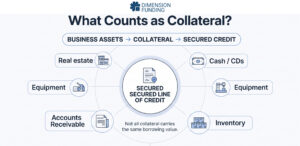
Types of Collateral Lenders Accept

Real Estate and Property

Commercial real estate is one of the most heavily weighted forms of collateral because it holds value over time and is straightforward to appraise. A business that owns its building, warehouse, or land parcel typically has more borrowing room than one relying only on movable assets. Personal real estate can sometimes be added to the mix, though many owners are cautious about pledging a primary residence.

Equipment, Vehicles, and Machinery

Owned equipment, fleet vehicles, and production machinery are commonly accepted, particularly in industries like construction, manufacturing, and transportation. These assets depreciate, so a lender’s advance against them tends to be more conservative than real estate. Title and lien status matter here: equipment still carrying a loan balance offers less usable value as collateral.

Accounts Receivable and Inventory

Outstanding invoices and on-hand inventory are frequently used, especially by businesses with strong sales cycles but limited fixed assets. The SBA’s Working CAPLine program specifically supports businesses that have inventory or accounts receivable to pledge, structuring the credit line around those working-capital assets rather than owned property. 

That model carries forward into SBA’s newer 7(a) Working Capital Pilot program, which lets small businesses borrow directly against accounts receivable and inventory, including both domestic and international orders under a single facility. Inventory financing often requires an appraisal or periodic reporting so the lender can track current value.

Cash, Investments, and Financial Instruments

A cash-secured line, backed by a savings account or certificate of deposit, is one of the more straightforward options since the asset’s value is fixed and immediately verifiable. Marketable securities such as stocks and bonds can also serve as collateral, though their fluctuating value means lenders usually apply a discount before setting a credit limit.

Blanket Liens on Business Assets

Rather than itemizing individual assets, some lenders file a blanket lien, a single filing that gives them a claim against all business assets rather than one specific item. This approach is common with asset-based lines and gives the lender broad coverage without requiring a line-by-line inventory of what’s pledged. It also means a default puts more of the business at risk than a lien tied to one machine or one property.

How Lenders Weight Different Collateral Types

Not every dollar of collateral value translates into a dollar of available credit. Real estate and cash typically sit at the higher end of a lender’s comfort scale, while inventory and receivables sit lower, since their value is harder to pin down on any given day.

Collateral Type

Typical Lender Treatment

Key Consideration

Real estate

Higher advance rate, longer appraisal cycle

Value tends to hold over time

Equipment/vehicles

Moderate advance rate

Depreciates; title/lien status matters

Accounts receivable

Moderate, often tied to invoice aging

Requires ongoing reporting

Inventory

Lower advance rate, appraisal often needed

Value can shift with market demand

Cash/CDs

Highest advance rate

Value is fixed and immediately verifiable

How Lenders Calculate Your Borrowing Base

A common misconception is that a lender will extend credit equal to the full value of whatever gets pledged. In practice, lenders build a borrowing base by applying an advance rate to each category of eligible collateral, based on how easily that asset could convert to cash. This risk-based approach is standard practice in asset-based lending, and it’s why two businesses with the same total asset value can end up with very different credit limits.

Asset

Market Value

Example Advance Rate

Borrowing Value

Accounts receivable

$300,000

85%

$255,000

Equipment

$250,000

65%

$162,500

Inventory

$150,000

50%

$75,000

Potential Borrowing Base


$492,500

In this example, the business owns $700,000 in assets, but its potential credit availability comes to $492,500, not the full asset value. That gap exists because receivables are generally easier to collect than inventory is to sell, and equipment loses value the longer it’s in use.

Why the Borrowing Base Isn’t Fixed

A borrowing base moves as the underlying assets do. As invoices get collected, inventory levels shift, or equipment ages, the available credit can rise or fall along with it. The OCC’s Comptroller’s Handbook on asset-based lending notes that because receivables and inventory turn over continuously, lenders rely on specific, enforceable collateral documentation and regular reporting to keep the borrowing base accurate.

Applicants that sought financing at small banks were more likely to be fully approved, at 57 percent, than those that sought financing from other lender types, according to the Fed’s most recent Small Business Credit Survey. A clearer, well-documented collateral picture tends to be part of why that gap exists.

What This Means When You Apply with Dimension Funding

Dimension Funding has worked with business owners for more than 40 years, and that history shapes how collateral gets reviewed today: the goal is matching the right asset mix to the right financing structure, not asking for more paperwork than a request needs. You can read more about that background on the About Us page.

Software financing applications are handled application-only up to $500,000, and equipment financing follows the same application-only path up to $250,000, which means many businesses can move through underwriting without a full collateral audit at those levels. Above those thresholds, a more detailed asset review comes into play. Documentation runs through electronic signature, and approved lines commonly fund the same business day or the next.

Matching Your Assets to the Right Line of Credit

The right collateral strategy depends on what a business already owns and how much flexibility it needs to preserve. A company with strong receivables but limited fixed assets will look at a different structure than one sitting on paid-off equipment or commercial property. Working through that comparison before applying saves time once the paperwork starts.

Dimension Funding’s team walks business owners through that comparison directly, matching collateral type to financing structure rather than defaulting to a one-size answer. Contact Dimension Funding to talk through which assets make sense for a secured line of credit application, or to get a same-day read on where your business stands.

FAQs


What is the difference between a secured and an unsecured business line of credit?

A secured line requires a specific pledged asset that the lender can claim in the event of default, while an unsecured line relies on the business’s credit profile and revenue history without a designated asset backing it. The presence of collateral is the defining difference, not the size of the credit line itself.

Can a business use more than one type of collateral for a single line of credit?

Yes. Lenders frequently combine asset types, such as equipment plus accounts receivable, to reach a credit limit that a single asset category couldn’t support on its own. This is common for businesses whose asset mix is spread across categories rather than concentrated in one.

Does the age of equipment affect whether it qualifies as collateral?

Age and remaining useful life both factor into how much value a lender assigns to equipment as collateral. Older equipment with significant wear typically supports a lower advance rate than newer machinery, even if it still functions well for daily operations.

What happens to pledged collateral once the line of credit is paid off?

Once the obligation is satisfied, the lender releases its legal claim on the asset, and the business regains full, unencumbered use of it. Businesses should confirm the lien release is filed and recorded, since an outdated filing can complicate future financing that uses the same asset.

Is a personal guarantee the same thing as collateral?

No. A personal guarantee is a promise to repay personally if the business cannot, while collateral is a specific asset pledged against the debt. Lenders sometimes require both on the same line, particularly for newer businesses without an extensive credit history.

How does a lender decide which assets to accept as collateral?

Lenders weigh how easily an asset could be sold, how stable its value is expected to remain, and whether existing liens already encumber it. A clean title, verifiable value, and liquidity all improve an asset’s standing during that review.

Can accounts receivable from slow-paying customers still be used as collateral?

Receivables can generally still be pledged, but lenders typically apply a more conservative advance rate to invoices that are further past due or tied to customers with inconsistent payment histories. Well-aged, current receivables usually support a stronger position than a receivables book weighted toward late accounts.