

A business that earns most of its revenue in four months still pays rent, payroll, and suppliers in all twelve. Many healthy companies get squeezed for cash because of that timing mismatch, not because they lack profit. Dimension Funding has worked with small and midsize businesses since 1978. The owners who handle uneven revenue best separate two questions: what they need to buy, and when they need cash.
A term loan answers the first question well, and a revolving line of credit answers the second. For a fixed amount tied to a defined need, compare a Dimension Funding working capital loan with any line you are considering.
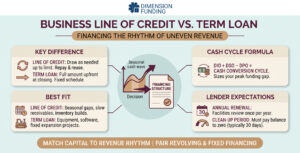
Why Uneven Cash Flow Breaks the Term Loan Model
A term loan works when the need is a single event with a predictable payoff, such as a facility upgrade. It works poorly when the need rises and falls. The business borrows its peak amount on day one and keeps repaying it through months when it does not need the cash.
Operating gaps are the most common reason small firms borrow. The Federal Reserve’s 2026 Report on Employer Firms found that 56% of firms seeking financing wanted it to meet operating expenses, compared with 46% pursuing an expansion or new opportunity. Operating needs recur, and a single advance rarely lines up with them.
Unused Capacity vs. Unused Cash
The difference between the two products is not only how much you can borrow. It is when you receive the money and whether you need it right away. A term loan provides the approved amount upfront, creating a funded balance even if the business will not use every dollar immediately.
A revolving line instead gives the business access to a maximum amount that it draws as needed. The SBA describes a business credit line as cash on demand up to a set limit, and every dollar of principal the business repays becomes available to use again.
A $200,000 Example
With a $200,000 term loan, the business receives the full $200,000 and starts managing that funded balance. With a $200,000 revolving line, it may hold $200,000 of available capacity while drawing only $50,000 during a temporary cash gap. Once that $50,000 is repaid, the capacity can become available again, subject to the agreement’s terms.
The Federal Reserve’s Branch and Agency Examination Manual describes a revolving line as valid for a stated period with no fixed repayment schedule. The borrower takes periodic advances up to the agreed limit, so the balance moves with draws and repayments instead of following a set amortization.
How the Two Structures Compare
Factor | Revolving Line of Credit | Term Loan |
Funding | Draw as needed up to the limit | Full amount at closing |
Balance behavior | Rises and falls with draws | Declines on a fixed schedule |
Repayment source | Conversion of inventory and receivables | Ongoing operating cash flow |
Typical term | Usually one year, renewable | Multi-year, fixed |
Best fit | Seasonal gaps, slow receivables, inventory builds | Equipment, software, expansion projects |
What sits unused | Capacity, available for the next gap | Cash, idle until spent |
The choice comes down to cash now versus access to cash later. The same Federal Reserve manual says working capital loans should be tied closely to when the financed assets convert to cash, with lenders identifying the peak and contraction phases of the business cycle and structuring the loan to match. The goal is not the largest possible amount of capital. It is a structure that matches when the business needs the cash.
How a Revolving Line Matches the Shape of Your Cash Cycle
Knowing the mechanics is half the decision. The other half is sizing the line to your actual operating cycle.
Draw, Repay, Redraw
Consider a landscaping contractor that buys materials and staffs crews in March but collects most invoices in May and June. It draws on the line in March and April, repays as payments arrive, and ends the summer with its full limit available again. A term loan sized for that spring peak would leave the contractor repaying borrowed cash all winter.
Repayment typically comes from the assets the draw created. The Federal Reserve manual notes that working capital lines are generally repaid through the turnover of short-term assets such as inventory and receivables.
Sizing the Line With Your Cash Conversion Cycle
The cash conversion cycle is the number of days it takes to turn money spent on inventory and operations back into cash from sales, as defined in the FDIC and SBA’s Money Smart for Small Business curriculum. You calculate it by adding days inventory outstanding (DIO) to days sales outstanding (DSO), then subtracting days payables outstanding (DPO).
Multiply your average daily operating outflow by the cycle length to estimate how much cash is tied up at any moment, then add a cushion for your peak season.
Input | Example Business |
Days inventory outstanding | 45 days |
Days sales outstanding | 50 days |
Days payables outstanding | 30 days |
Cash conversion cycle | 65 days |
Average daily operating outflow | $2,500 |
Estimated cash tied up in the cycle | $162,500 |
What Lenders Expect From a Working Capital Line
Lines come with conditions that term loans do not have. Knowing them upfront keeps the facility from catching you off guard in your slowest month.
Annual Renewal and the Clean-Up Period
According to the Federal Reserve manual, most working capital facilities run for one year and renew at maturity. They also carry a clean-up requirement during the low point of the business cycle: a stretch, usually 30 days, when the borrower must pay the balance down to zero.
The clean-up period shows that the line funds temporary needs rather than permanent capital. A business that never reaches a zero balance draws scrutiny at renewal.
The Trade-Cycle Test
The OCC’s Comptroller’s Handbook on commercial loans directs bank examiners to check whether a borrower’s trade cycle supports full payout of seasonal lines. Cash flow projections that show a clear low point make that test easy to pass.
Pairing Fixed Financing With a Revolving Line
A line is the wrong tool for long-lived purchases. Buying a $90,000 machine on a line uses up capacity you will need next slow season, and the balance may never reach zero for the clean-up period. Long-lived assets fit better with equipment financing or software financing.
Dimension Funding offers application-only financing up to $500,000 for software and $250,000 for equipment, with no financial statements required at those amounts. Funding arrives the same day or the next business day, with DocuSign documents. For defined short-term needs, short-term business loans keep your line’s full limit free for the gaps it was built to cover.
Matching Your Financing to the Rhythm of Your Revenue
Uneven revenue is a pattern to finance correctly, not a flaw to fix. Measure your cash conversion cycle, identify your low point, and use revolving credit for timing gaps while fixed financing carries the assets that last for years.
Dimension Funding brings more than 40 years of experience to that split. It prefers businesses with two or more years of history, though strong credit can substitute. To structure the fixed side of your capital, Contact Dimension Funding at 1-800-755-0585 or Sales@DimensionFunding.com.
Frequently Asked Questions
What is a borrowing base?
A borrowing base limits how much you can draw on an asset-based line to a percentage of eligible receivables and inventory. It is usually updated monthly through a borrowing base certificate. Aged invoices typically drop out of the calculation.
Can a lender reduce or freeze my line of credit?
Yes. Most agreements let the lender cut the limit or stop new draws after a covenant breach, a missed reporting deadline, or weakening financials. Read the covenant and default sections before signing.
What happens if I cannot meet the clean-up period?
The lender may decline to renew the line or convert the balance into an amortizing term loan. Contact the lender before the clean-up window opens, not after it closes.
What records should I prepare before applying for a line?
Gather your receivables and payables aging reports, recent business bank statements, and 12 to 24 months of cash flow projections. Projections that mark your seasonal low point help the lender set a realistic limit.
Is a business credit card a substitute for a line of credit?
A card can cover small, short gaps. Card limits usually fall well below what inventory builds or payroll gaps require, and spreading operating costs across several cards makes cash flow harder to track.
Can a seasonal business qualify for a line during its slow season?
Usually, yes. Lenders tend to compare the same months across several years rather than judging one weak quarter in isolation. Multi-year revenue history shows the dip is predictable.
How often should I revisit the size of my line?
Review it at each annual renewal and whenever revenue or payment terms change significantly. Recalculating your cash conversion cycle shows whether the limit still covers your peak gap.