


Most owners looking into working capital already know they need cash. The harder question is what form that cash should take. Dimension Funding has financed businesses since 1978, and the choice between a lump-sum working capital loan and a revolving line of credit usually comes down to a few answerable questions about the need itself.
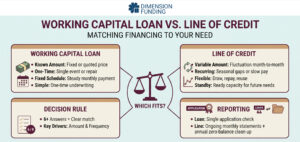
The decision table below turns those questions into a side-by-side comparison you can fill in for your own situation. If your answers point toward a set amount on a fixed schedule, a Dimension Funding working capital loan is built for that profile.
Working Capital Is a Need, Not a Financing Product
Working capital and business financing are related, but they are not the same thing. Working capital describes a business’s short-term financial position, not a specific loan product. The FDIC and SBA’s Money Smart for Small Business curriculum defines it as the money a business has available for day-to-day expenses, calculated as current assets minus current liabilities.
That distinction matters when you compare ways to fund daily operations. A business can meet a working capital need with cash reserves, retained earnings, a term loan, a line of credit, receivables or inventory financing, or other forms of credit. The SBA’s lender program guidance describes its Working CAPLine as an asset-based revolving line for cyclical, recurring, or short-term needs, repaid as short-term assets convert to cash.
Need vs. Structure
The useful question is not whether to choose working capital financing or a line of credit, because a line of credit is one structure for addressing a working capital need. The Federal Reserve’s Branch and Agency Examination Manual describes working capital loans as short-term financing for inventory, receivables, supplies, and other operating needs, often structured as a line of credit or revolving credit.
Term | What It Describes | Example |
Working capital | The financial need | Covering payroll while customer invoices are outstanding |
Loan or line of credit | The financing structure | A lump-sum loan with fixed payments, or a revolving line drawn as needed |
Start by identifying why you need working capital: a temporary cash flow gap, an inventory purchase, or waiting on customer invoices. Then you can judge which structure fits the timing, amount, and repayment pattern of that need.
The Two Structures Compared Here
A working capital loan delivers a set amount in one disbursement and is repaid on a fixed schedule over a defined term. The business knows the full amount and the payment before signing, and the obligation ends when the balance reaches zero.
A line of credit sets a limit the business can draw against over a period, and the lender reviews it on a recurring basis. One structure funds a need that already exists. The other holds capacity for needs that have not arrived yet.
The Decision Table
Answer each question for the specific need you are financing, not for your business in general. A company can have a loan-shaped need and a line-shaped need in the same quarter.
Question | Points to a Working Capital Loan | Points to a Line of Credit |
1. Do you know the exact dollar amount? | Yes, the amount is fixed or quoted | No, it will vary month to month |
2. How often will this need occur? | Once, or rarely | Repeatedly through the year |
3. When will you spend the money? | Within weeks of funding | In pieces over several months |
4. Where does repayment come from? | General operating cash flow over the term | Specific inflows such as customer payments |
5. When is the need arriving? | It is here now | It is expected later, so you are setting up capacity ahead of time |
6. How predictable is your monthly cash? | Steady enough to budget a fixed payment | Too variable for a fixed payment |
7. How much ongoing reporting can you handle? | Minimal after funding | Monthly financials and projections |
8. Will you borrow again for the same purpose? | No | Yes |
How to Read Your Results
Count your answers in each column. Six or more in one column is a clear signal. A closer split usually means two needs are mixed together, so separate the one-time portion from the recurring portion and finance each on its own.
When the split is even, questions 1 and 8 carry the most weight. Together they show whether the need is a fixed event or an ongoing pattern.
Eight Common Scenarios and the Better Fit
Scenario | Better Fit | Why |
Supplier offers a discount on a bulk inventory order | Working capital loan | One purchase at a quoted price |
Payroll gap during a predictable slow season | Line of credit | Recurs each year, and the amount varies |
Bridge to one large contract payment | Working capital loan | Defined amount, defined end date |
Clients who routinely pay 60 or more days late | Line of credit | Ongoing gap tied to receivables |
Emergency repair to keep operations running | Working capital loan | Immediate, one-time, quoted cost |
Staffing up before a new contract’s first invoice | Working capital loan | Fixed ramp-up period, known payroll total |
Restocking inventory ahead of each peak season | Line of credit | Repeats yearly and scales with demand |
Marketing campaign with a set budget | Working capital loan | Fixed budget and launch date |
The pattern holds across industries. A fixed amount with a fixed date points to a loan, while a recurring need with a variable amount points to a line.
What Lenders Weigh Before Approving Either Product
Your decision table answers are only half the picture. Lending conditions and documentation requirements also shape which structure is realistic to get.
Current Lending Conditions
According to the Federal Reserve’s July 2026 Senior Loan Officer Opinion Survey, banks reported basically unchanged standards for commercial and industrial loans to firms of all sizes in the second quarter of 2026. Demand from small firms was also basically unchanged.
Approval outcomes still vary widely. The Federal Reserve’s 2026 Report on Employer Firms found that 42% of financing applicants received the full amount they sought, 36% received some or most, and 22% received nothing. A request tied to a clearly defined need is easier for a lender to size, which is why the decision table starts with the amount.
The Documentation Gap
Lines require ongoing oversight. The same Federal Reserve manual recommends analyzing working capital lines through monthly or quarterly reviews of the balance sheet and income statement, supported by receivables agings, inventory lists, and payables agings.
A working capital loan is underwritten once, at application. After funding, the obligation is the payment schedule. For owners without the staff to produce monthly reporting, that difference can settle the decision on its own.
When a Working Capital Loan From Dimension Funding Fits
Dimension Funding offers working capital loans for unexpected expenses and slow periods, along with small business loans and short-term business loans for defined needs with a clear end date. Funding typically arrives the same day or the next business day, and documents are signed through DocuSign.
Before applying, use the Dimension Funding payment calculator to test whether a fixed payment fits your monthly budget. That answers question 6 with real numbers. Dimension Funding prefers two or more years in business, though strong credit can substitute.
Letting the Need Choose the Product
Define the working capital need first, then pick the structure. Match fixed events with a fixed loan, and reserve revolving credit for patterns that repeat.
When your answers land in the working capital loan column, Contact Dimension Funding at 1-800-755-0585 or Sales@DimensionFunding.com to review the amount, term, and payment that fit your situation.
Frequently Asked Questions
Can a business have a working capital loan and a line of credit at the same time?
Yes. Lenders review your total payment obligations, and some agreements restrict additional borrowing through covenants. Disclose every existing obligation on each application.
Does paying off a working capital loan early reduce what I owe?
It depends on the agreement. Some structures reduce the total owed on early payoff, while others set a fixed payback amount. Ask how early payoff is calculated before you sign.
Will applying for both products hurt my credit?
Each application can trigger a hard inquiry on business credit, and often personal credit. Several inquiries in a short window can weigh on your scores, so apply only for the structure the table points to.
Are working capital loan proceeds taxable income?
Loan proceeds are generally not taxable income, and repaying principal is generally not deductible. The treatment of other charges varies, so confirm the details with your CPA.
Can I use a line of credit to make payments on a working capital loan?
Lenders generally discourage it. The Federal Reserve’s examination manual lists line advances used for debt payments or unrelated costs as a warning sign, since those advances should fund inventory or payables.
Can a newer business qualify for a working capital loan?
Many lenders set time-in-business minimums. Dimension Funding prefers two or more years, but strong credit can substitute.
What if my need turns out to be recurring after I take a loan?
A working capital loan cannot be redrawn once it is repaid. If the same need returns, it likely fits a line of credit better, so revisit the decision table before your next request.
A few notes on the changes:
- Placement: Your section replaces the old “Core Difference in Two Definitions” H2, and the loan and line definitions now sit under it as an H3. That keeps the article at 7 H2s and puts the need-versus-structure framing before the decision table, where it sets up the comparison.
- Sourcing adjustments:
- I couldn’t find an sba.gov page defining working capital as current assets remaining after current liabilities. The definition now cites the joint FDIC and SBA Money Smart curriculum, which gives the same formula.
- For the SBA point about lines and asset-based financing, the link goes to the SBA’s lender resources page. Its Working CAPLine description covers both ideas in one program: an asset-based revolving line.
- The Federal Reserve claim checks out, so I kept it as written.
- Client rules: I removed “cost” from your final sentence, since it invites rate comparisons in borrower-facing content. I also replaced the em dashes and turned the “Think of it this way” list into a small table.
- Length: To stay within the word count, I trimmed the lending-conditions section (dropping the April 2026 SLOOS reference), the conversion section, the conclusion, and several FAQ answers. The article is now about 1,700 words.