


Two businesses can apply for the same working capital loan amount and end up with very different terms. The difference usually isn’t luck, it’s a handful of specific factors that lenders weigh every time they evaluate an application. Knowing what those factors are gives you real leverage before you ever submit one.
Dimension Funding has spent over 40 years financing small and mid-sized businesses across the U.S., and its working capital program is built around evaluating a business’s full financial profile rather than a single number. Contact Dimension Funding to talk through your business’s profile before applying, or keep reading to understand what underwriters actually look at.
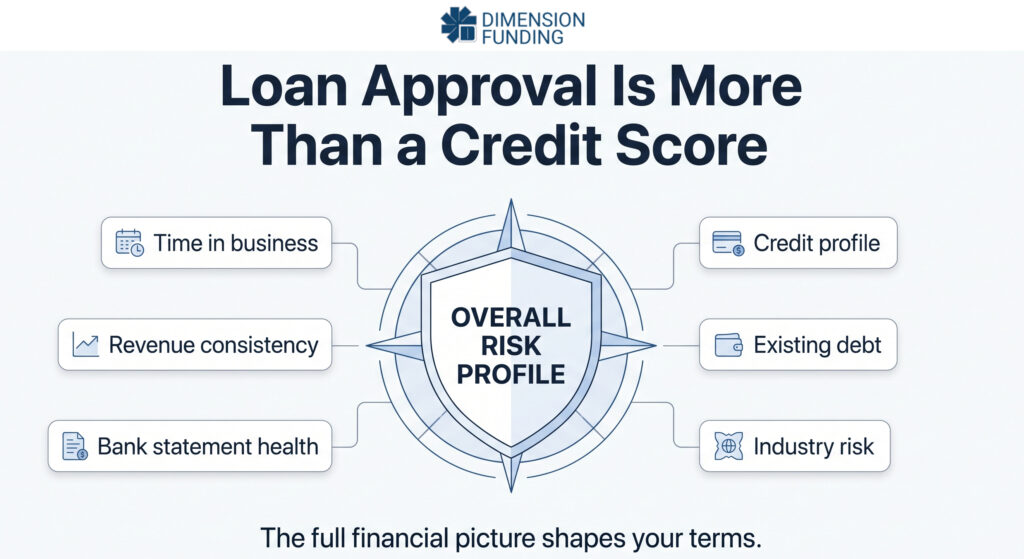
How Underwriters Build a Risk Profile
Working capital loan approval is rarely based on a single number. Instead, underwriters combine several financial indicators to build a comprehensive risk profile that helps determine how likely a business is to repay on schedule. This holistic approach reflects federal banking guidance that prudent underwriting should consider a borrower’s overall financial condition, repayment capacity, and cash flow, not just one metric in isolation. The Office of the Comptroller of the Currency’s Commercial Loans booklet explains that sound commercial lending decisions rely on evaluating multiple sources of financial information before extending credit, rather than defaulting to a single ratio or score as a stand-in for the full picture.
Underwriting Factor | What It Tells the Lender |
Time in business | Demonstrates business stability and operating history |
Revenue consistency | Indicates predictable cash flow available for repayment |
Bank statement trends | Reveals day-to-day cash management and liquidity |
Credit history | Shows past borrowing and repayment behavior |
Existing debt | Measures current repayment obligations and financial leverage |
Industry risk | Reflects exposure to economic cycles and sector-specific challenges |
Rather than assigning equal weight to every factor, lenders evaluate how they interact. A business with only two years of operating history may still receive favorable terms if it shows consistent monthly deposits, healthy account balances, and a manageable debt load. A long-established business, on the other hand, may see less favorable terms if recent bank statements reveal frequent overdrafts or declining revenue, which is why the sections below break down each factor individually.
Time in Business Sets the Baseline
Lenders view a longer operating history as evidence that a business can weather slow periods and still make payments. A company with five or ten years of consistent revenue is a more predictable applicant than one that opened its doors last year, and that predictability typically translates into more favorable terms.
Newer businesses aren’t necessarily locked out, but they often see more conservative terms until they build a longer track record. If your business is still young, strong recent revenue and clean bank statements can help offset the limited history in a lender’s eyes.
Revenue Consistency Matters More Than Revenue Size
A lender evaluating a working capital loan cares less about how much a business makes and more about how reliably that revenue shows up month after month. Steady, predictable deposits signal that a business can absorb a fixed payment without strain, which tends to support more favorable terms.
Erratic revenue, with big months followed by lean ones, reads as risk even if the annual total is strong. Businesses with seasonal swings can still qualify for competitive terms, but it often takes a documented pattern of managing those swings well over time.
Bank Statement Health Drives the Underwriting Conversation
Underwriters look closely at average daily balance, negative balance days, and overdraft frequency when evaluating an application. A business that consistently carries a healthy balance and avoids overdrafts is demonstrating exactly the kind of cash management a lender wants to see before extending credit.
Frequent negative balances or NSF fees push the underwriting conversation in the other direction, since they suggest a business may already be operating close to the edge of its cash flow. Cleaning up account activity in the months before applying can meaningfully improve the terms a lender is willing to offer.
Credit Profile Still Plays a Role
Personal and business credit history factor into approval, but rarely in isolation. A working capital lender weighs credit alongside cash flow, so a lower credit score doesn’t automatically rule out favorable terms if the underlying bank statements are strong.
That said, a stronger credit profile generally opens the door to better terms and, in some cases, higher approved amounts. Businesses considering an application benefit from checking their credit standing beforehand so there are no surprises once underwriting begins.
Industry Risk Adds Context to the Rest
Industry is the one factor on the list that has nothing to do with a specific business’s own numbers, and everything to do with where that business sits inside a larger economic pattern. A restaurant, a construction subcontractor, and a medical practice can each show identical revenue and identical bank statement health, and still receive different terms, because lenders track how exposed each industry tends to be to seasonal swings, supply shocks, or broader economic downturns.
That doesn’t mean a business in a higher-risk industry is worse off across the board. It means the other factors on this list carry a bit more weight in that evaluation. A seasonal landscaping business that can show it’s managed its slow months well for several years in a row is demonstrating exactly the kind of resilience a lender is trying to price for, which can offset the industry classification rather than being overridden by it.
Loan Amount and Term Length Shape the Terms You’re Offered
Larger loan amounts and longer terms typically carry more risk for a lender, since more capital is outstanding for a longer stretch of time. That added exposure is often reflected in the terms offered, particularly once a request crosses thresholds that require deeper documentation.
Dimension Funding’s working capital loans range from $25,000 to $250,000 with terms up to 24 months, and requests over $100,000 generally require corporate tax returns in addition to bank statements. Matching your requested amount and term to your actual need, rather than borrowing more or longer than necessary, keeps the overall terms as favorable as possible.
Repayment Structure Influences the Terms You’re Offered
The frequency of your repayment plan affects how a lender views risk over the life of the loan. Daily and weekly repayment plans return capital to the lender faster and more often, which can support more favorable terms compared to a monthly schedule stretched over a longer period.
Monthly repayment plans typically require a stronger credit profile and are capped at shorter terms, since a lender is collecting less frequently and carrying more exposure between payments. Choosing the repayment cadence that best matches your revenue pattern isn’t just about convenience, it can directly affect the terms on your offer.
How a Fixed Payment Compares to Alternative Financing Costs
One of the clearest ways to see what shapes overall cost is comparing a fixed-payment working capital loan to a merchant cash advance. A merchant cash advance ties repayment to a percentage of daily sales, which means the total cost can swing significantly depending on how the business performs during the repayment period.
Businesses that compare this type of financing often find that a fixed-payment working capital loan can cost considerably less than a merchant cash advance, since the payment stays the same regardless of sales volume. That predictability is part of why a strong financial profile paired with a fixed-payment loan usually ends up costing less over time than a variable-cost alternative.
Putting the Pieces Together Before You Apply
Your working capital loan terms aren’t decided by a single number, they’re shaped by time in business, revenue consistency, bank statement health, credit profile, industry, loan size, and repayment structure working together. None of these factors operate in a vacuum, and a weaker showing on one can often be offset by strength in another, which is exactly why two businesses with the same revenue can walk away from the same lender with different terms.
Dimension Funding offers working capital loans between $25,000 and $250,000, with same-day or next-business-day funding and a single-page, bank-statement-based application. Contact Dimension Funding to see what your business qualifies for.
If two businesses have identical revenue, will they always get the same terms?
Not necessarily. Revenue is only one input, and underwriters also weigh consistency, bank statement health, credit history, and existing debt. Two businesses with the same top-line revenue can look very different once those other factors are layered in.
Does switching business bank accounts right before applying hurt an application?
It can complicate underwriting, since lenders typically want to see several months of consistent history at one institution to establish a reliable pattern. A recent account switch may mean providing statements from both accounts or waiting until the new account has enough history.
Can a business improve its standing in the months before applying?
Yes. Paying down existing debt, avoiding overdrafts, and maintaining steady deposit patterns for a few months before applying can meaningfully strengthen how an application is viewed, even without changing the business’s underlying revenue.
Does the industry a business operates in affect approval beyond just its financials?
It can. Lenders sometimes factor in how exposed a given industry is to economic cycles or seasonal disruption, which means two businesses with similar financials in different industries may be evaluated somewhat differently. A business that can document how it’s managed seasonal or cyclical exposure well in the past often narrows that gap.
Is it better to apply for a smaller amount to improve approval odds?
Not automatically. Requesting less than the business actually needs can lead to a second financing need later, so it’s generally better to request an amount that matches the real gap and let the underwriting process weigh in on fit, rather than under-requesting preemptively.
How far back do lenders typically look at bank statement history?
Most working capital lenders review three to six months of statements, though larger requests may prompt a longer look-back or a request for additional documentation to confirm the pattern holds over time.
Can an existing customer get updated terms without reapplying from scratch?
Many lenders, including Dimension Funding, can reassess an existing customer’s terms based on updated bank statements and revenue rather than requiring a full new application, particularly if the business’s financial profile has improved since the original loan.