Finance Commercial Equipment: Smart Strategies for Growing Companies

finance commercial equipment (1)

Finance Commercial Equipment: Smart Strategies for Growing Companies

A company lands a contract that finally justifies the new equipment it has needed for a year, then finds out the bank loan process takes weeks and calls for years of financial statements it would rather not hand over. 

By the time approval comes through, the window to actually use that contract to grow may have narrowed. This is the exact moment more companies choose to finance commercial equipment instead of waiting on a traditional bank loan.

Why Growing Companies Finance Commercial Equipment Instead of Paying Cash

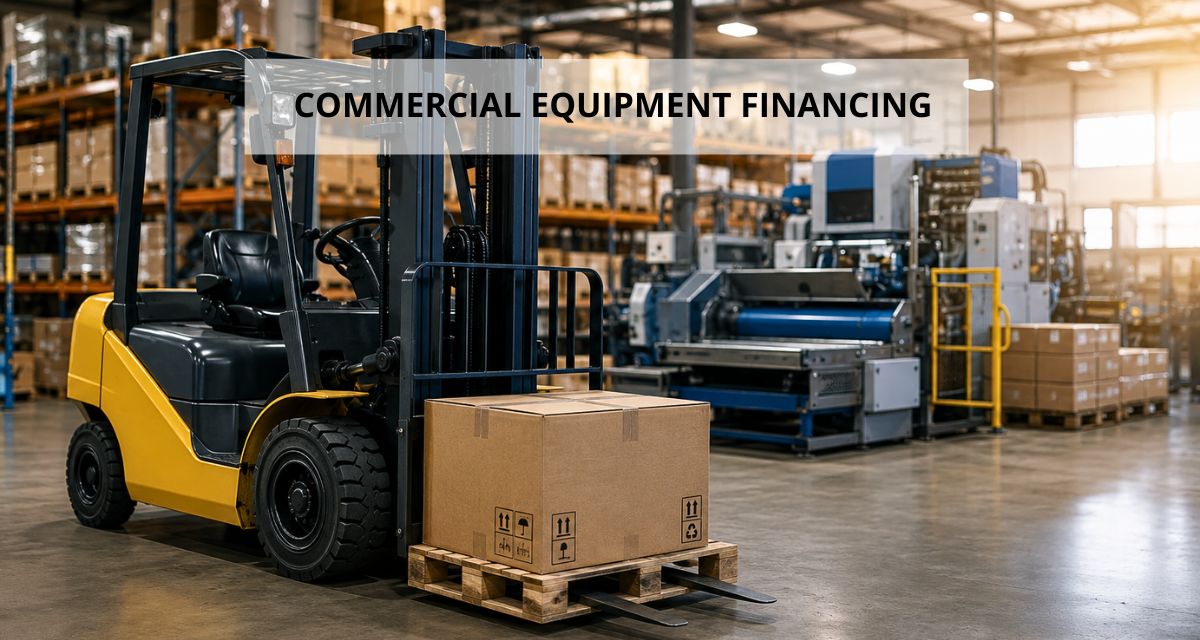
Paying cash for a forklift, a commercial oven, or a fleet of service vehicles feels simple, but it ties up money a growing company usually needs somewhere else, payroll, inventory, marketing, or the next opportunity that shows up before the current one is even finished paying for itself.

Financing spreads that cost into a single fixed monthly payment instead of one large outlay. That keeps cash available for the parts of the business that do not have a financing option, while the equipment itself starts generating revenue right away. For a company adding capacity to handle growth, that timing matters more than the interest rate.

The companies that get the most out of this approach tend to treat equipment financing as a standing part of how they grow, not a one-time fix for a single purchase. 

Every time capacity becomes the limiting factor, whether that is a second delivery vehicle, another piece of production equipment, or a system upgrade, the same question comes up: save up and buy it outright later, or put it to work now while the payment stays predictable and cash keeps moving.

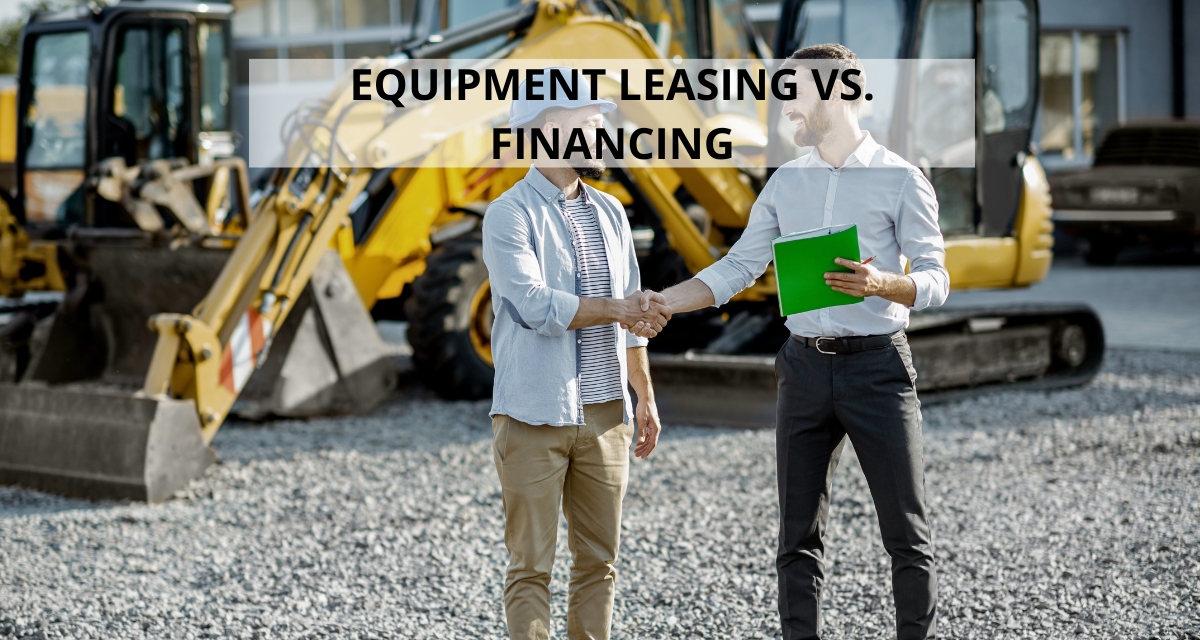
Financing vs. Leasing: Which Fits Your Strategy

Both options get equipment onto your floor without draining your bank account, but they work differently depending on what the business needs most.

Equipment Financing (Loans)

With an equipment loan, the business owns the equipment from day one and builds equity in it as the loan gets paid down. Payments are fixed, terms commonly run up to 60 months, and once the loan is paid off, the equipment is fully owned with no further payments or lease-end decisions to make.

Equipment Leasing

A lease can be structured a couple of different ways, and the structure changes what it does for the business. A capital lease looks and functions much like a loan, letting the business claim depreciation and take advantage of the same tax treatment as ownership. 

An operating lease usually does not appear as debt on the balance sheet, which matters for a company watching its debt to credit ratio, though it also affects the tax benefits available.

Because the right structure depends on a company’s specific financials and goals, this is worth a conversation with an accountant or tax advisor before deciding, not just a rate comparison.

Why Application-Only Financing Speeds Everything Up

The biggest practical difference between a bank and an equipment finance company is usually the paperwork. Application-only financing up to $250,000 does not require financial statements, tax returns, or the kind of underwriting package a bank typically wants before approving a commercial loan.

That difference shows up in speed. Approvals often come back within 24 hours, and funding is commonly available within 48 hours of approval. For a company that needs equipment running before a busy season starts or a new contract kicks off, that turnaround can matter as much as the payment amount itself.

Using Section 179 to Lower the Real Cost

Financed equipment is not just easier to acquire, it can also reduce what a company owes in taxes for the year it goes into service. Under Section 179 of the IRS code, businesses can elect to deduct the full cost of qualifying equipment and off-the-shelf software in the year it is purchased, rather than depreciating it slowly over several years.

For 2025, the deduction limit sits at $2,500,000, with a $4,000,000 spending cap before the available deduction starts phasing out dollar for dollar. Bonus depreciation, generally applied once that spending cap is reached, is set at 100 percent for the year. 

Both new and used equipment can qualify, as long as it is used for business more than half the time and placed in service within the tax year. These figures are adjusted for inflation periodically, so it is worth confirming the current year’s numbers before assuming last year’s limits still apply.

Financing does not disqualify equipment from this treatment. In many cases a business can finance the purchase, keep its cash on hand, and still take the full deduction in the same year, which is part of why financing and Section 179 tend to get mentioned together. 

Because the details depend on a company’s specific tax situation, this is worth confirming with an accountant before filing, not assumed from a blog post. 

Dimension Funding keeps an updated breakdown of the current year’s Section 179 deduction limits for anyone comparing the numbers before a purchase.

What It Takes to Qualify

Growing companies often assume equipment financing requires the same credit profile as a bank loan, which is not usually the case. Approval is based more on the overall picture, time in business, revenue trends, and how the equipment itself supports the company’s plans, than on a single credit score cutoff.

Credit profiles ranging from strong to marginal are commonly considered rather than automatically declined, and a newer or less established company is not necessarily locked out the way it might be with a traditional bank. 

That does not mean every applicant is approved for every amount, but it does mean a less than perfect credit history is not automatically disqualifying the way it often is elsewhere.

Common Mistakes Growing Companies Make When Financing Equipment

A few patterns show up often enough to be worth flagging before signing anything.

Waiting until cash is already tight to start the financing conversation is one of the most common. Approval and funding take some amount of time even at their fastest, so starting the process before the equipment is needed, not after, avoids a scramble.

Matching the loan or lease term to how long the equipment will actually stay useful is another. A term that runs longer than the equipment’s useful life means paying for something the business has already replaced.

Overlooking soft costs is a third. Delivery, installation, and ongoing maintenance are often left out of a budget built around the sticker price of the equipment alone, when in most cases those costs can be rolled into the financing itself instead of paid separately out of pocket.

Financing Commercial Equipment with Dimension Funding

Dimension Funding has financed equipment for small and mid-sized businesses since 1978, working with almost any equipment vendor a company chooses rather than a fixed list of approved suppliers.

Approvals up to $250,000 are available without financial statements, and most decisions come back quickly, with funding often available within 48 hours of approval. Terms extend up to 60 months, and both loan and lease structures are available depending on which fits a company’s tax and balance sheet goals better. Financing over $250,000 requires financial statements but still moves through a streamlined process rather than a traditional bank underwriting timeline.

Delivery, installation, and maintenance costs can be rolled into the financed amount, and the application itself is a short electronic form rather than a stack of paperwork, with most agreements signed and finalized without a single trip to a bank branch.

Equipment vendors who want to offer financing directly to their own customers can also look into Dimension Funding’s vendor partner programs, which let a sales team answer the payment question on the spot instead of losing a deal to a slow financing decision.

Frequently Asked Questions About Financing Commercial Equipment

Is it better to finance or lease commercial equipment?

It depends on the goal. Financing builds equity toward ownership from day one, while a lease, depending on how it is structured, can either mirror ownership for tax purposes or keep the equipment off the balance sheet. An accountant can weigh in on which fits a specific company’s situation.

How much financing is available without financial statements?

Approvals up to $250,000 don’t require financial statements. Financing above that amount requires financials but still moves through a streamlined process rather than a traditional bank underwriting timeline.

How fast can commercial equipment financing get approved?

Approvals often come back within 24 hours, and funding is commonly available within 48 hours of approval, much faster than the multi-week process typical of a traditional bank loan.

Can financed equipment still qualify for the Section 179 tax deduction?

In many cases, yes. Financing a purchase does not disqualify it from Section 179 treatment, so a business can often keep its cash on hand and still take the deduction in the year the equipment is placed in service. The specifics depend on the company’s tax situation, so this is worth confirming with an accountant.

Does a company need strong credit to finance commercial equipment?

Not necessarily. Approval tends to weigh the overall picture, time in business, revenue trends, and how the equipment supports the company’s plans, rather than a single credit score cutoff, so credit profiles from strong to marginal are commonly considered.

What does Dimension Funding’s commercial equipment financing include?

Delivery, installation, and maintenance costs can be rolled into the financed amount, and equipment can come from almost any vendor a business chooses rather than a fixed list of approved suppliers.

If growth is being held back by equipment a company cannot justify paying cash for, use the payment calculator to see what a monthly payment could look like, or start a financing application to get a quote, usually within a few hours.

Equipment Leasing vs. Financing: Tax Benefits, Costs & When to Lease

Equipment Leasing vs. Financing: Tax Benefits, Costs & When to Lease

Equipment Leasing vs. Financing: Tax Benefits, Costs & When to Lease

The choice between equipment leasing and financing isn’t just about monthly payments — it’s a tax strategy decision that can shift thousands of dollars in your favor depending on how you structure it. Get it right and you’re maximizing write-offs, protecting cash flow, and aligning your payment structure to how long you’ll actually use the equipment.

Dimension Funding has helped businesses navigate this decision for over 40 years, providing both equipment lease financing and finance agreements across virtually every industry and equipment type. According to the Equipment Leasing and Finance Association (ELFA), more than 8 in 10 U.S. businesses use some form of financing or leasing when acquiring equipment.

Leasing vs. Financing: Quick Reference

Before getting into the tax mechanics, here’s how each option compares at a glance.


Equipment Financing

Equipment Leasing

Ownership

Own from day one

Lender retains ownership (true lease)

Monthly payment

Higher

Lower

Total cost

Lower long-term

Can be higher long-term

Section 179 eligible

Yes

Only if capital lease

Bonus depreciation

Yes

Only if capital lease

Lease payments deductible

No (interest only)

Yes (operating lease)

Balance sheet impact

Asset + liability

Off-balance sheet (operating lease)

Best for

Long-term use, tax optimization

Flexibility, short lifecycle equipment

How the IRS Classifies Leasing vs. Financing

This is where most businesses get tripped up — and where the biggest tax implications live.

According to the IRS, whether your agreement is a true lease or a conditional sales contract determines how you deduct it. True lease payments are deductible as rent. If the IRS considers the arrangement a conditional sale, you depreciate the cost instead — and lose the full payment deduction.

Operating lease vs. capital lease

An operating lease keeps payments off your balance sheet and lets you deduct them as a business operating expense each month. A capital lease is treated more like a purchase — the asset appears on your balance sheet and you recover costs through depreciation. The IRS looks at the economic substance of your agreement, not just what it’s called. If a “lease” includes a nominal end-of-term buyout or builds equity through payments, it may be reclassified as a purchase.

How Section 179 Changes the Math

This is the section most competitors skip — and it fundamentally changes the leasing vs. financing calculation.

When you finance equipment, you own it, which means you can elect to expense the full purchase price in the year it’s placed in service using Section 179. For 2025, the deduction limit is $2,500,000 (phase-out at $4,000,000). For 2026, those figures rise to $2,560,000 and $4,090,000, per IRS Publication 946.

Finance equipment and still write off 100% in year one

Here’s what surprises many business owners: you can finance equipment and still take the full Section 179 deduction in year one. You don’t need to pay cash — you just need to own the asset and place it in service during the tax year. A business financing $200,000 in equipment can potentially write off the entire amount while spreading the actual cash outlay over 36 to 60 months.

Section 179 and leasing

With a true operating lease, Section 179 doesn’t apply because you don’t own the equipment. If the lease is structured as a capital lease — where ownership effectively transfers at term end — Section 179 may apply. Lease type and specific terms determine eligibility, which is another reason the operating vs. capital distinction matters in practice.

Bonus Depreciation: The Additional Layer

The One Big Beautiful Bill Act (OBBBA) of 2025 restored 100% bonus depreciation for qualified property acquired and placed in service after January 19, 2025 — covering both new and used equipment, as long as it’s new to your business, per IRS Form 4562 instructions.

IRS rules require Section 179 to be applied first, then bonus depreciation on any remaining eligible basis. Used together, these two deductions allow many businesses to write off 100% of qualifying equipment costs in year one. A business in a 35% tax bracket financing $100,000 in equipment could reduce its tax bill by $35,000 immediately — while spreading the actual loan payment over several years, according to U.S. Bank’s equipment tax guidance.

Why Leasing Feels Cheaper — But Often Isn’t

Lower monthly payments are the most visible advantage of leasing, and they’re real. But lower payments don’t equal lower total cost.

With an operating lease, you pay for the use of the equipment over the term — then return it with nothing to show for it. With financing, each payment builds ownership in an asset that may carry meaningful resale value at the end of the term. When total cost of ownership is calculated over five to ten years, financing frequently comes out ahead for long-lifecycle equipment.

Hidden lease costs to watch for

Excess usage penalties, early termination clauses, and maintenance requirements can quietly raise the true cost of a lease. Reading the full agreement — not just the monthly payment figure — is essential before signing.

When Leasing Is the Smarter Move

Leasing isn’t the inferior option — it’s the right option in specific situations.

Technology and equipment that becomes obsolete within three to five years is a strong candidate for leasing. The ability to return and upgrade at lease end avoids the problem of owning outdated assets. Startups conserving cash, seasonal businesses with variable revenue, and businesses wanting to keep debt off their balance sheet for lending or investor purposes also tend to benefit from leasing over financing.

When Financing Wins

For most businesses acquiring long-life, revenue-generating equipment, financing is the stronger choice when total cost and tax impact are both factored in.

Heavy equipment, commercial trucks, medical equipment, and manufacturing machinery — assets with useful lives of seven to fifteen years or more — make strong financing candidates. Add Section 179 and bonus depreciation, and profitable businesses can offset a substantial portion of first-year cost through tax savings while building an owned asset on the balance sheet.

Dimension Funding accepts most credit types and offers application-only financing up to $250,000 with no financial statements required — same-day approvals on qualifying transactions. For businesses with strong equipment needs and imperfect credit, this provides a path to ownership that repeated lease cycles don’t. Learn more on the About Us page.

The Right Structure Depends on Your Situation

The lease vs. finance decision comes down to three variables: how long you’ll use the equipment, what your current taxable income looks like, and how much you value flexibility versus ownership.

Profitable businesses with long equipment lifecycles and high taxable income almost always benefit more from financing — Section 179 and bonus depreciation turn a multi-year capital expenditure into a significant first-year tax event. Businesses prioritizing cash preservation or short equipment cycles often find leasing the better fit.

The team at Dimension Funding can walk through both options based on your equipment type, business profile, and financing goals. Reach out to explore which structure works best — same-day decisions are available on qualifying transactions.

Frequently Asked Questions

Is equipment leasing tax deductible? 

Yes, but the deduction depends on lease type. Payments under a true operating lease are fully deductible as a business operating expense in the year they’re paid. With a capital lease, only the interest portion is deductible — the asset must be depreciated over time, similar to purchased equipment.

Can I use Section 179 if I finance equipment instead of paying cash? 

Yes. Section 179 requires ownership, not cash payment. A business that finances equipment can still elect to deduct the full purchase price in the year the equipment is placed in service — up to $2,500,000 for 2025 and $2,560,000 for 2026 per IRS Publication 946.

What is bonus depreciation and how does it work with Section 179? 

Bonus depreciation allows businesses to immediately deduct a large percentage of a qualifying asset’s cost in the year it’s placed in service. For property placed in service after January 19, 2025, the allowance was restored to 100% under the OBBBA. Section 179 is applied first, with bonus depreciation covering any remaining eligible basis.

What’s the difference between an operating lease and a capital lease? 

An operating lease is a true rental — you deduct monthly payments as operating expenses and return the equipment at term end. A capital lease is treated more like a purchase: the asset appears on your balance sheet, costs are recovered through depreciation, and Section 179 may apply depending on the agreement’s terms.

Does leasing always cost less per month than financing? 

Lease payments are typically lower because you’re financing the use of the equipment, not its full value. However, at lease end you own nothing — while a financed asset may still carry significant resale value. Total cost of ownership over five to ten years often favors financing for long-lifecycle equipment.

What types of businesses benefit most from equipment financing? 

Businesses with high taxable income benefit most, since Section 179 and bonus depreciation create the largest immediate tax impact. Industries with long-lifecycle assets — construction, manufacturing, transportation, and healthcare — also tend to favor financing. Startups and cash-constrained businesses often find leasing a better fit until revenue stabilizes.

How does Dimension Funding approach the lease vs. finance decision? 

Dimension Funding offers both equipment lease financing and finance agreements, structured around your specific equipment type, term preferences, and business profile. Application-only financing is available up to $250,000 with no financial statements required, and most credit types are accepted. The contact team can walk through options before you apply.