Finance Commercial Equipment: Smart Strategies for Growing Companies

finance commercial equipment (1)

Finance Commercial Equipment: Smart Strategies for Growing Companies

A company lands a contract that finally justifies the new equipment it has needed for a year, then finds out the bank loan process takes weeks and calls for years of financial statements it would rather not hand over. 

By the time approval comes through, the window to actually use that contract to grow may have narrowed. This is the exact moment more companies choose to finance commercial equipment instead of waiting on a traditional bank loan.

Why Growing Companies Finance Commercial Equipment Instead of Paying Cash

Paying cash for a forklift, a commercial oven, or a fleet of service vehicles feels simple, but it ties up money a growing company usually needs somewhere else, payroll, inventory, marketing, or the next opportunity that shows up before the current one is even finished paying for itself.

Financing spreads that cost into a single fixed monthly payment instead of one large outlay. That keeps cash available for the parts of the business that do not have a financing option, while the equipment itself starts generating revenue right away. For a company adding capacity to handle growth, that timing matters more than the interest rate.

The companies that get the most out of this approach tend to treat equipment financing as a standing part of how they grow, not a one-time fix for a single purchase. 

Every time capacity becomes the limiting factor, whether that is a second delivery vehicle, another piece of production equipment, or a system upgrade, the same question comes up: save up and buy it outright later, or put it to work now while the payment stays predictable and cash keeps moving.

Financing vs. Leasing: Which Fits Your Strategy

Both options get equipment onto your floor without draining your bank account, but they work differently depending on what the business needs most.

Equipment Financing (Loans)

With an equipment loan, the business owns the equipment from day one and builds equity in it as the loan gets paid down. Payments are fixed, terms commonly run up to 60 months, and once the loan is paid off, the equipment is fully owned with no further payments or lease-end decisions to make.

Equipment Leasing

A lease can be structured a couple of different ways, and the structure changes what it does for the business. A capital lease looks and functions much like a loan, letting the business claim depreciation and take advantage of the same tax treatment as ownership. 

An operating lease usually does not appear as debt on the balance sheet, which matters for a company watching its debt to credit ratio, though it also affects the tax benefits available.

Because the right structure depends on a company’s specific financials and goals, this is worth a conversation with an accountant or tax advisor before deciding, not just a rate comparison.

Why Application-Only Financing Speeds Everything Up

The biggest practical difference between a bank and an equipment finance company is usually the paperwork. Application-only financing up to $250,000 does not require financial statements, tax returns, or the kind of underwriting package a bank typically wants before approving a commercial loan.

That difference shows up in speed. Approvals often come back within 24 hours, and funding is commonly available within 48 hours of approval. For a company that needs equipment running before a busy season starts or a new contract kicks off, that turnaround can matter as much as the payment amount itself.

Using Section 179 to Lower the Real Cost

Financed equipment is not just easier to acquire, it can also reduce what a company owes in taxes for the year it goes into service. Under Section 179 of the IRS code, businesses can elect to deduct the full cost of qualifying equipment and off-the-shelf software in the year it is purchased, rather than depreciating it slowly over several years.

For 2025, the deduction limit sits at $2,500,000, with a $4,000,000 spending cap before the available deduction starts phasing out dollar for dollar. Bonus depreciation, generally applied once that spending cap is reached, is set at 100 percent for the year. 

Both new and used equipment can qualify, as long as it is used for business more than half the time and placed in service within the tax year. These figures are adjusted for inflation periodically, so it is worth confirming the current year’s numbers before assuming last year’s limits still apply.

Financing does not disqualify equipment from this treatment. In many cases a business can finance the purchase, keep its cash on hand, and still take the full deduction in the same year, which is part of why financing and Section 179 tend to get mentioned together. 

Because the details depend on a company’s specific tax situation, this is worth confirming with an accountant before filing, not assumed from a blog post. 

Dimension Funding keeps an updated breakdown of the current year’s Section 179 deduction limits for anyone comparing the numbers before a purchase.

What It Takes to Qualify

Growing companies often assume equipment financing requires the same credit profile as a bank loan, which is not usually the case. Approval is based more on the overall picture, time in business, revenue trends, and how the equipment itself supports the company’s plans, than on a single credit score cutoff.

Credit profiles ranging from strong to marginal are commonly considered rather than automatically declined, and a newer or less established company is not necessarily locked out the way it might be with a traditional bank. 

That does not mean every applicant is approved for every amount, but it does mean a less than perfect credit history is not automatically disqualifying the way it often is elsewhere.

Common Mistakes Growing Companies Make When Financing Equipment

A few patterns show up often enough to be worth flagging before signing anything.

Waiting until cash is already tight to start the financing conversation is one of the most common. Approval and funding take some amount of time even at their fastest, so starting the process before the equipment is needed, not after, avoids a scramble.

Matching the loan or lease term to how long the equipment will actually stay useful is another. A term that runs longer than the equipment’s useful life means paying for something the business has already replaced.

Overlooking soft costs is a third. Delivery, installation, and ongoing maintenance are often left out of a budget built around the sticker price of the equipment alone, when in most cases those costs can be rolled into the financing itself instead of paid separately out of pocket.

Financing Commercial Equipment with Dimension Funding

Dimension Funding has financed equipment for small and mid-sized businesses since 1978, working with almost any equipment vendor a company chooses rather than a fixed list of approved suppliers.

Approvals up to $250,000 are available without financial statements, and most decisions come back quickly, with funding often available within 48 hours of approval. Terms extend up to 60 months, and both loan and lease structures are available depending on which fits a company’s tax and balance sheet goals better. Financing over $250,000 requires financial statements but still moves through a streamlined process rather than a traditional bank underwriting timeline.

Delivery, installation, and maintenance costs can be rolled into the financed amount, and the application itself is a short electronic form rather than a stack of paperwork, with most agreements signed and finalized without a single trip to a bank branch.

Equipment vendors who want to offer financing directly to their own customers can also look into Dimension Funding’s vendor partner programs, which let a sales team answer the payment question on the spot instead of losing a deal to a slow financing decision.

Frequently Asked Questions About Financing Commercial Equipment

Is it better to finance or lease commercial equipment?

It depends on the goal. Financing builds equity toward ownership from day one, while a lease, depending on how it is structured, can either mirror ownership for tax purposes or keep the equipment off the balance sheet. An accountant can weigh in on which fits a specific company’s situation.

How much financing is available without financial statements?

Approvals up to $250,000 don’t require financial statements. Financing above that amount requires financials but still moves through a streamlined process rather than a traditional bank underwriting timeline.

How fast can commercial equipment financing get approved?

Approvals often come back within 24 hours, and funding is commonly available within 48 hours of approval, much faster than the multi-week process typical of a traditional bank loan.

Can financed equipment still qualify for the Section 179 tax deduction?

In many cases, yes. Financing a purchase does not disqualify it from Section 179 treatment, so a business can often keep its cash on hand and still take the deduction in the year the equipment is placed in service. The specifics depend on the company’s tax situation, so this is worth confirming with an accountant.

Does a company need strong credit to finance commercial equipment?

Not necessarily. Approval tends to weigh the overall picture, time in business, revenue trends, and how the equipment supports the company’s plans, rather than a single credit score cutoff, so credit profiles from strong to marginal are commonly considered.

What does Dimension Funding’s commercial equipment financing include?

Delivery, installation, and maintenance costs can be rolled into the financed amount, and equipment can come from almost any vendor a business chooses rather than a fixed list of approved suppliers.

If growth is being held back by equipment a company cannot justify paying cash for, use the payment calculator to see what a monthly payment could look like, or start a financing application to get a quote, usually within a few hours.

Equipment Financing Rates in 2026: What Interest Rate to Expect?

equipment financing rates

Equipment Financing Rates in 2026: What Interest Rate to Expect?

If you’ve been shopping for equipment financing, you’ve probably noticed that no two lenders quote the same number. 

One bank comes back at 7 percent, an online lender quotes 18 percent, and a leasing company skips the rate conversation entirely and just hands you a fixed monthly payment. That spread leaves a lot of business owners stuck on one question: what rate should you actually expect to pay in 2026?

There’s no single answer, and anyone who gives you a flat number without asking about your business first is skipping steps. Your rate depends on your credit profile, how long you’ve been operating, the type of equipment involved, and which kind of lender you approach. 

Once you know how those pieces fit together, you can sit down for a financing conversation and tell whether the offer in front of you is actually fair.

What Actually Determines Your Equipment Financing Rate

A lender isn’t guessing when it hands you a number. A handful of factors do most of the work.

Your credit history

Personal and business credit is usually the first thing an underwriter looks at. Strong credit doesn’t just improve your odds of approval, it unlocks the lower end of the rate range. Businesses with marginal or limited credit still get approved often, just at a higher rate that offsets the lender’s added risk.

Time in business and revenue

A company with several years of steady revenue reads as a safer bet than a brand new operation, and the rate reflects that. Newer businesses can still qualify, but should expect a few extra points added to the quote until they build a track record.

Equipment type and age

Financing for new equipment with strong resale value, like a delivery vehicle or a piece of medical equipment, tends to price better than financing for older or specialized equipment that would be hard to resell if a deal fell apart.

Loan term and amount

Shorter terms generally carry lower rates. Longer terms spread the payment out but can add cost over the life of the agreement. The financing amount plays a role too. Larger requests sometimes earn better pricing, though they may call for more documentation up front.

Down payment

Putting money down reduces the lender’s exposure and can shave points off your rate. Many equipment financing programs don’t require one at all, which is part of the appeal, but a modest down payment can still improve your terms if your budget allows for it.

Equipment Financing Rates in 2026: What the Ranges Look Like

Rates move with the broader economy, but the order between lender types tends to hold steady from year to year.

Banks and credit unions typically offer the most competitive pricing on commercial equipment financing, often between 6 and 12 percent for borrowers with strong credit and an established history. The tradeoff is a slower process, more paperwork, and stricter approval standards.

SBA backed programs can push rates even lower, sometimes into the 5 to 10 percent range, but they come with tighter credit requirements and a longer timeline that doesn’t always fit a business that needs equipment running this month.

Alternative and direct lenders move faster and work with a wider range of credit profiles. Rates through these channels commonly fall between 10 and 25 percent, depending on the strength of the borrower and the specifics of the deal.

Put together, a well qualified borrower using a bank, credit union, or SBA program can expect a rate around 6 to 14 percent. A business with a shorter operating history or less than ideal credit should expect a rate toward the higher end of the overall range, sometimes above 20 percent, particularly through faster alternative channels.

How the 2026 Rate Environment Factors In

The Federal Reserve has held its benchmark rate steady through the first half of 2026, and the prime rate lenders use as a starting point has followed along. That stability is good for planning. A quote you get this quarter probably won’t look dramatically different three months from now, so there’s less reason to rush a decision purely out of fear that rates will jump overnight.

That doesn’t mean every lender is standing still. Underwriting standards, seasonal promotions, and how badly a particular lender wants new business all move the number you get quoted, often more than the benchmark rate itself does. Comparing more than one offer still matters, even when the broader rate environment is calm.

Fixed Rate Versus a Rate Tied to the Market

Most equipment financing and leasing arrangements use a fixed rate for the full term, so your payment stays the same from the first month to the last. That’s different from a variable rate credit line, where payments move as the market shifts.

A fixed rate gives you a number you can actually plan around for budgeting and cash flow. That predictability is why it’s the standard structure for equipment financing, not a feature you have to ask for.

Loans vs Leases: Does the Rate Work the Same Way?

Equipment loans and equipment leases get compared using different math. A loan has a straightforward interest rate attached to it. 

A lease is often quoted as a payment factor or bundled into one monthly number that already reflects the cost of financing, so a lease payment and a loan rate aren’t always apples to apples on paper.

That doesn’t make one automatically cheaper than the other. A loan builds equity in the equipment from day one and tends to make sense if you plan to keep it long term. 

A lease can lower the monthly payment and may bundle in maintenance or upgrade options, which matters more for equipment that ages out fast, like certain IT hardware. The right structure depends on how long you plan to actually use the equipment, not just which number looks smaller.

How to Position Your Business for a Better Rate

Clean up your credit before you apply, if you have time. Even a modest score improvement can move you into a better pricing tier.

Have your basic financials organized, even for application only programs. A clear answer to a lender’s questions speeds up approval and supports a stronger offer.

Think about term length. A shorter term often earns a better rate, but the payment still needs to fit comfortably into your monthly cash flow.

Get more than one quote. Shopping for equipment financing typically doesn’t affect your credit the way shopping for many consumer loans does, and a second quote gives you real leverage in the conversation.

Why the Rate Isn’t the Only Number to Watch

The interest rate is only part of the cost picture. Through Dimension Funding, businesses can get application only financing up to 250,000 dollars for equipment and up to 500,000 dollars for software, meaning no financial statements are required to get an answer. 

Financing can cover 100 percent of the project, including delivery, installation, and maintenance, so those costs don’t come out of your pocket separately. Terms run from 12 to 60 months, giving you room to match the payment to how long the equipment will actually generate revenue for your business.

Most equipment purchases also qualify for a Section 179 write off, which can lower the after tax cost of financing below what the sticker rate suggests. Run the numbers with your accountant before you finalize a purchase, and use the payment calculator to see what a given rate actually means for your monthly payment.

A slightly higher rate paired with same day approval, a longer term, and maintenance built into the payment can cost less in practice than a lower rate that takes weeks to close and leaves you covering installation on your own.

Frequently Asked Questions

What is a good interest rate for equipment financing in 2026?

Anything in the 6 to 14 percent range is strong for a well qualified borrower going through a bank, credit union, or SBA program right now. Rates above 20 percent aren’t unusual for businesses with a shorter operating history or credit challenges, especially through faster alternative lenders.

Can you get equipment financing with bad credit?

Yes. Most equipment financing programs work with a wide range of credit profiles, including marginal or limited credit. The tradeoff is usually a higher rate rather than an outright decline, since the higher rate offsets the lender’s added risk.

Do you need a down payment for equipment financing?

Not always. Many programs are structured without a large down payment, which helps preserve working capital. Putting money down is optional in most cases, though it can improve your rate if your budget allows for it.

Is equipment financing tax deductible?

The equipment itself may qualify for a Section 179 write off, which can let you deduct a significant portion of the purchase in the year you buy it instead of depreciating it over time. Talk to your accountant about how this applies to your specific purchase and financing structure.

How fast can you get approved for equipment financing?

Approvals are often issued within a few hours for application only programs, with funding arriving the same day or within 48 hours. Larger financing amounts that require full financials take a bit longer, but still move faster than most traditional bank loans.

Does shopping for equipment financing hurt your credit?

Generally, no. Getting quotes from multiple equipment lenders typically doesn’t affect your credit the way shopping for personal loans or credit cards can, so comparing more than one offer before you commit is a reasonable thing to do.

Getting Your Actual Rate Quote

Every number in this article is a range. The only way to know what your business will actually pay is to apply and let a lender underwrite your specific credit, revenue, and equipment.

Dimension Funding has been financing equipment and software for small and medium sized businesses since 1978, working with almost all credit types across industries including construction, medical, restaurant, brewery, and IT technology equipment. Approvals are typically issued within a few hours, with funding often arriving the same day or within 48 hours.

If you want a clear answer on what rate and payment your business qualifies for, request a quick financing quote or call 1.800.755.0585 to talk through your options with a financing expert.

How to Finance Equipment: 7 Funding Options for Business Owners

how to finance equipment

How to Finance Equipment: 7 Funding Options for Business Owners

Financing equipment means spreading the cost of a business asset across a fixed term rather than paying the full amount upfront, preserving working capital while the equipment generates revenue. The right method depends on the type of equipment, how long the business expects to use it, the borrower’s credit profile, and whether ownership at the end of the term matters. 

Dimension Funding has provided commercial equipment and software financing to small and mid-sized businesses across the U.S. since 1978, covering everything from construction machinery and medical devices to enterprise software and IT hardware.

According to the Equipment Leasing and Finance Foundation’s 2024 Industry Horizon Report, 82% of businesses that acquired equipment or software in 2023 used at least one form of financing to do so, up from 79% in the 2022 survey. Leasing accounted for 26% of total acquisitions, secured loans 16%, and lines of credit 14%.

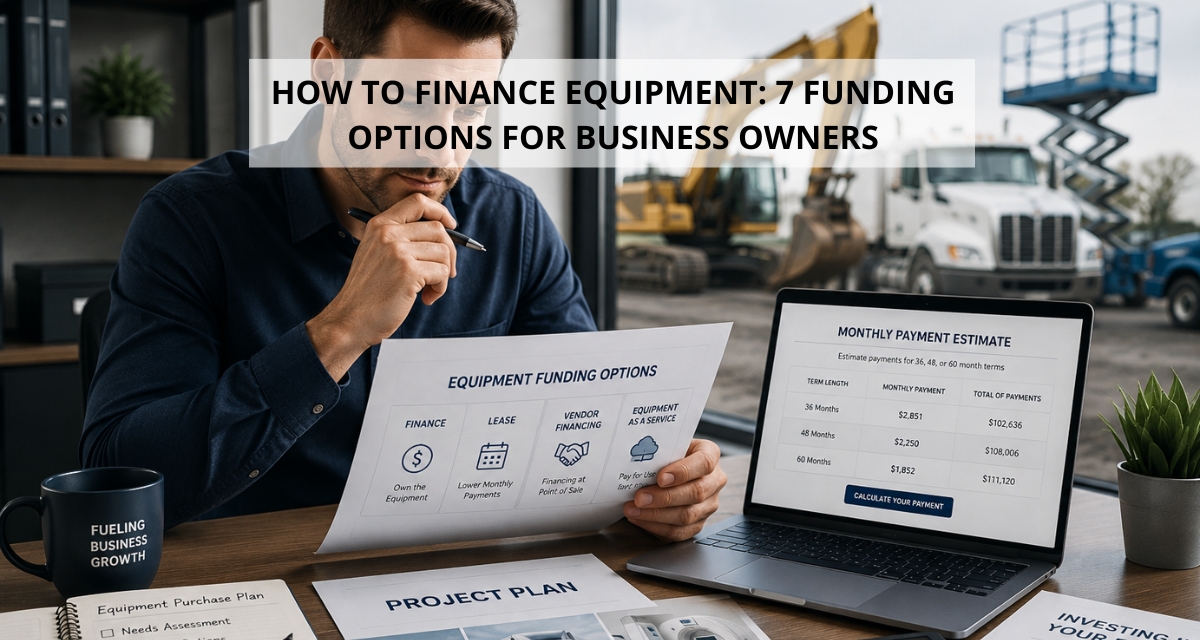
Use the Dimension Funding payment calculator to estimate monthly payments for 36-, 48-, or 60-month terms before deciding which funding path best fits your project.

1. Equipment Financing Through a Specialty Lender

An equipment financing agreement from a specialty lender funds the full purchase price of the equipment and converts it into fixed monthly payments over a set term. The lender underwrites the deal based on the borrowing business’s creditworthiness, the type of equipment, and whether the asset has strong secondary-market value. The borrower takes ownership of the equipment and holds it free and clear at the end of the term.

Specialty lenders underwrite based on the business’s credit profile and the equipment’s collateral value, rather than requiring the full financial documentation package that a bank demands. That difference in underwriting approach is why specialty lenders approve deals banks routinely decline, and why approvals come back in hours rather than weeks. 

For projects up to $250,000, Dimension Funding approves on an application-only basis with no financial statements required. Funding is typically available within 48 hours, with same-day funding available once documentation is complete.

Terms range from 60 months on commercial equipment financing, and financing is available up to $10 million. New and used equipment both qualify. The application is electronic, and agreements are executed through DocuSign, so the borrower moves from approval to a funded deal without paperwork delays.

Best for:

Businesses that need fast approval, want ownership at the end of the term, and are purchasing equipment with established secondary-market value; construction, medical, trucking, material handling, food processing, and manufacturing are all well served by this structure.

2. Equipment Leasing

An equipment lease gives a business use of the equipment over a defined term without transferring ownership. Monthly payments are typically lower than those under a financing arrangement for equivalent equipment because they are calculated based on the asset’s depreciated value over the lease period rather than the full purchase price.

At the end of a standard operating lease, the business returns the equipment, upgrades to a newer model, or purchases the asset at fair market value. Some lease structures include a $1 buyout option, which effectively functions like a financing agreement but with the lower monthly payment profile of a lease during the term.

Equipment leasing makes the most practical sense for technology-heavy equipment categories where obsolescence is a real cost. IT hardware, diagnostic imaging equipment, and certain lab instruments depreciate faster than their useful life suggests. A lease lets a business stay current without being locked into an asset that has lost most of its market value by the end of the term.

The ELFA’s 2024 data confirms leasing as the most popular acquisition method for equipment and software in the U.S., accounting for 26% of total volume.

Best for:

Technology equipment, medical and diagnostic devices, and any category in which the equipment is likely to become obsolete before the end of a standard financing term.

3. Vendor Financing

Vendor financing is a credit arrangement structured between an equipment manufacturer or dealer and a third-party finance company, offered to the buyer at the point of sale. The buyer applies for financing directly through the vendor’s program, the finance company handles approval and funding, and the vendor receives full payment upfront. The buyer repays the finance company over the agreed term.

Buyers find vendor financing convenient because it happens inside the sales process and doesn’t require sourcing a separate lender. Approval criteria are often calibrated to the specific equipment being purchased, and promotional terms, including deferred payment periods and reduced-payment structures,  are sometimes available through manufacturer programs on new equipment.

Dimension Funding’s vendor financing program operates on both sides of this relationship. For equipment vendors and manufacturers, Dimension Funding provides the financing infrastructure that lets them offer payment options directly to buyers. For buyers, vendor financing through Dimension Funding covers 100% of the purchase price, including delivery and installation, with the same application-only threshold up to $250,000.

Best for:

Buyers purchasing from a vendor who already has a financing program in place. Also a strong fit for equipment categories where the manufacturer offers promotional terms on new product lines.

4. Equipment-as-a-Service and Subscription Structures

Equipment-as-a-service (EaaS) is a structure in which a business pays a recurring subscription fee for access to equipment rather than purchasing or leasing it. The vendor retains ownership; the buyer gets full access, typically including maintenance, support, and upgrades within the subscription cost. 

Capital expenditure is recognized as an operating expense; the asset never appears on the balance sheet as a capital liability, and the vendor is incentivized to keep the equipment functional because maintenance is bundled in.

EaaS adoption is accelerating. According to the Equipment Leasing and Finance Foundation’s 2024 Horizon Report, half of equipment and software end users already use some form of subscription-based model, with an additional 23% planning to adopt this option.

EaaS is most available in technology, medical, and industrial automation categories. Heavy construction equipment, commercial trucks, and specialized manufacturing machinery are rarely available through subscription models, which is why traditional financing and leasing continue to dominate these verticals.

Dimension Funding’s software financing and SaaS financing programs cover subscription-based software under the same structure as traditional equipment deals, allowing businesses to convert annual software subscription costs into fixed monthly payments.

Best for:

Businesses in technology, healthcare, and industrial automation where the vendor offers an EaaS program and the business prefers operating expense treatment over capital expenditure.

5. Business Line of Credit

A business line of credit gives a company access to a revolving pool of capital up to a set limit. Draws are made as needed, and the business repays what it borrows over time, restoring available credit. For equipment purchases, a line of credit functions similarly to a credit card: the business draws from the line at the point of purchase and repays on its own schedule rather than a fixed term set by the lender.

Lines of credit work well for frequent, lower-cost equipment purchases, where the flexibility to draw and repay on a rolling basis is more useful than a fixed-term loan structure. They are less well-suited to large equipment purchases. A $150,000 excavator financed on a revolving line of credit incurs variable payment obligations and typically carries a higher financing cost than a fixed-term equipment loan for the same amount.

Banks and credit unions offer lines of credit, but their approval criteria are more stringent than those of specialty lenders, and draw periods often come with conditions. Some lines require that the full balance be paid down to zero at least once annually. For businesses with established banking relationships and strong credit, a line of credit is a useful complement to equipment financing for smaller, recurring purchases.

Best for:

Smaller equipment, tools, and accessories purchased repeatedly, where the revolving structure adds more flexibility than a fixed loan. Less suitable as the primary funding source for major equipment acquisitions.

6. Working Capital Loans

A working capital loan is a short-term business loan designed to fund day-to-day operations rather than long-term asset purchases. For equipment, working capital loans are most practical when the purchase is modest in size, and the business needs fast access to cash without the documentation requirements of a traditional bank loan.

Dimension Funding offers working capital loans with a one-page application, weekly or daily repayment plans, and terms up to two years. The structure differs meaningfully from equipment financing: repayment is faster, the term is shorter, and the equipment itself does not secure the loan. That unsecured structure means approval decisions lean heavily on revenue consistency and time in business rather than the collateral value of what’s being purchased.

A two-year repayment term on a $75,000 piece of equipment results in a substantially higher monthly obligation than the same purchase financed over 48 or 60 months through an equipment-specific program. For businesses that need equipment quickly and plan to repay within 12 to 24 months, the structure works. For major capital purchases intended to generate revenue over several years, equipment financing is the more cost-effective structure.

Best for:

Smaller purchases under $50,000 where the business needs fast access to cash and can service a short repayment term. Also useful as a bridge while waiting for an equipment financing application to be funded for a larger deal.

7. Cash Purchase and Section 179 Planning

Paying cash for equipment eliminates monthly payment obligations and, depending on tax position, can be structured to generate a full-year deduction in the year of purchase through IRS Section 179. For 2025, the Section 179 deduction limit is $1,160,000, allowing businesses to write off the full cost of qualifying equipment placed in service during the tax year rather than depreciating it over its useful life.

A contractor who pays $200,000 cash for a crane and eliminates a monthly payment also eliminates $200,000 from working capital that could fund materials, payroll, or a second piece of equipment. Financing the crane and deploying that $200,000 toward revenue-generating activity often produces a better total outcome, particularly when the financed monthly payment is covered by what the crane bills.

The smarter approach is to finance the equipment and take the Section 179 deduction on the financed purchase. As Dimension Funding’s Section 179 resource page explains, financed equipment qualifies for the deduction in the year it is placed in service, even though the cash outlay is spread across monthly payments. A business gets the full tax benefit of ownership in year one while keeping its cash available for operations.

Best for:

Businesses with strong cash positions evaluating a large purchase and looking to optimize tax position. Most effective when combined with a financing arrangement that preserves working capital and captures the Section 179 deduction simultaneously.

Which Option Fits Your Situation

The deciding factors in any equipment purchase are the same: how large the monthly payment obligation is, how long the business plans to use the equipment, whether ownership matters, and what the tax position looks like in the year of purchase. Many businesses use equipment financing as their primary acquisition tool for major assets, maintain a line of credit for smaller recurring purchases, and deploy working capital loans as a bridge when timing requires it.

For most small and mid-sized businesses acquiring commercial equipment with a useful life of three years or more, a fixed-term equipment financing agreement from a specialty lender addresses all of those variables more predictably than cash, a revolving credit line, or a short-term loan.

Dimension Funding has held an A+ rating from the Better Business Bureau since its founding in 1978. Applications up to $250,000 require no financial statements, and the financing team averages more than 20 years of experience structuring deals across every major equipment category. Apply for financing or run your monthly payment estimate on the Dimension Funding calculator before your next equipment purchase.

Frequently Asked Questions

What is the most common way businesses finance equipment?

Leasing is the single most common method for acquiring equipment and software in the U.S., accounting for 26% of total acquisition volume in 2023 according to the Equipment Leasing and Finance Foundation’s 2024 Horizon Report. Secured loans and lines of credit follow at 16% and 14%, respectively. Across all methods combined, 82% of businesses that acquired equipment or software in 2023 used some form of financing rather than paying cash outright.

How much of an equipment purchase can be financed?

Dimension Funding finances 100% of the equipment purchase price, including delivery and installation. Down payments are not required on most commercial equipment deals, though a business with a thinner credit profile may be asked to provide one to reduce the lender’s exposure on larger transactions.

What credit score do I need to finance equipment?

Dimension Funding works with a broad range of credit profiles and does not publish a minimum score threshold. Businesses with two or more years of operating history, consistent revenue, and a clean credit profile have the most straightforward path to approval. For projects up to $250,000, the decision is based on the credit application, with no financial statements required.

Is it better to lease or finance equipment?

Leasing produces a lower monthly payment and keeps the asset off the balance sheet as a capital liability, but the business does not own the equipment at the end of the term. Financing results in a higher monthly payment but transfers full ownership at the end of the term. Leasing makes more sense for equipment that becomes obsolete quickly; financing makes more sense for equipment with a long useful life and strong secondary market value.

Can I finance used equipment?

Yes. Dimension Funding finances both new and used commercial equipment. Used equipment is evaluated on age, condition, and secondary market value. Well-maintained, late-model construction equipment, commercial trucks, and medical devices are routinely approved. Equipment that is more than 10 to 15 years old or has limited resale market may be subject to different underwriting criteria.

How fast can equipment financing be approved and funded?

Through Dimension Funding, most approvals come back within a few hours for standard applications up to $250,000. Funding follows within 48 hours of approval in most cases. Same-day funding is available when documentation is complete. The application is electronic, and agreements are executed through DocuSign.

Can I deduct financed equipment under Section 179?

Yes. Financed equipment qualifies for the IRS Section 179 deduction in the year it is placed in service, even though the actual cash outlay is spread across monthly payments over the financing term. The deduction applies to the full purchase price, not just the amount paid during the tax year. A tax advisor should confirm eligibility for specific equipment categories and verify the current year deduction limits before filing.