How to Finance Equipment: 7 Funding Options for Business Owners

how to finance equipment

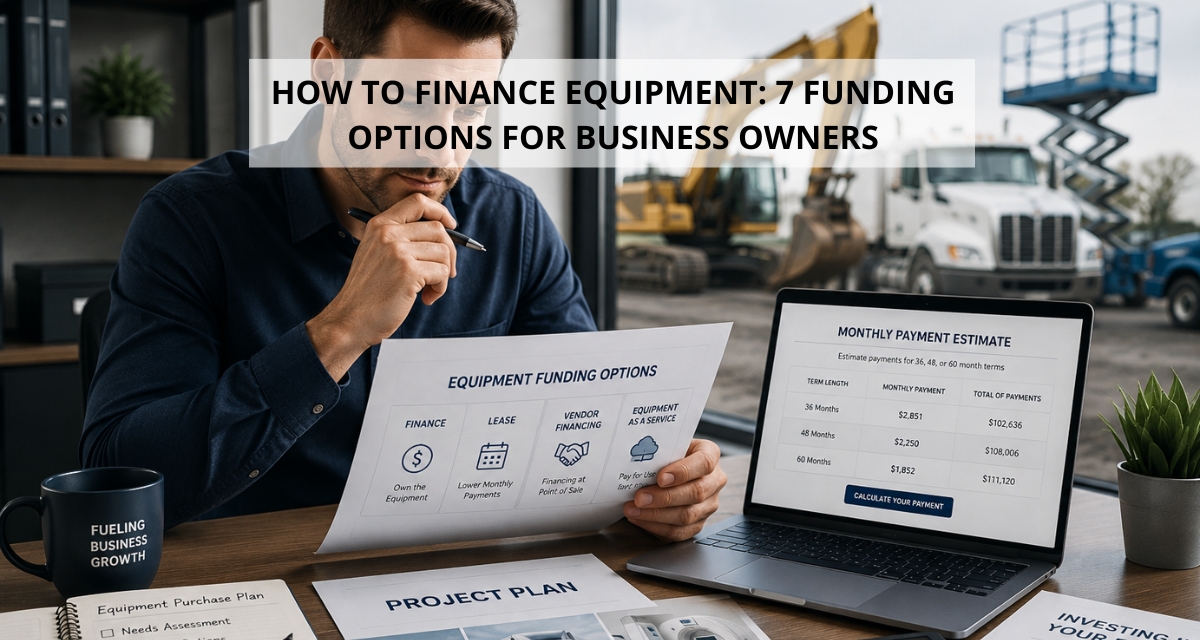
How to Finance Equipment: 7 Funding Options for Business Owners

Financing equipment means spreading the cost of a business asset across a fixed term rather than paying the full amount upfront, preserving working capital while the equipment generates revenue. The right method depends on the type of equipment, how long the business expects to use it, the borrower’s credit profile, and whether ownership at the end of the term matters. 

Dimension Funding has provided commercial equipment and software financing to small and mid-sized businesses across the U.S. since 1978, covering everything from construction machinery and medical devices to enterprise software and IT hardware.

According to the Equipment Leasing and Finance Foundation’s 2024 Industry Horizon Report, 82% of businesses that acquired equipment or software in 2023 used at least one form of financing to do so, up from 79% in the 2022 survey. Leasing accounted for 26% of total acquisitions, secured loans 16%, and lines of credit 14%.

Use the Dimension Funding payment calculator to estimate monthly payments for 36-, 48-, or 60-month terms before deciding which funding path best fits your project.

1. Equipment Financing Through a Specialty Lender

An equipment financing agreement from a specialty lender funds the full purchase price of the equipment and converts it into fixed monthly payments over a set term. The lender underwrites the deal based on the borrowing business’s creditworthiness, the type of equipment, and whether the asset has strong secondary-market value. The borrower takes ownership of the equipment and holds it free and clear at the end of the term.

Specialty lenders underwrite based on the business’s credit profile and the equipment’s collateral value, rather than requiring the full financial documentation package that a bank demands. That difference in underwriting approach is why specialty lenders approve deals banks routinely decline, and why approvals come back in hours rather than weeks. 

For projects up to $250,000, Dimension Funding approves on an application-only basis with no financial statements required. Funding is typically available within 48 hours, with same-day funding available once documentation is complete.

Terms range from 60 months on commercial equipment financing, and financing is available up to $10 million. New and used equipment both qualify. The application is electronic, and agreements are executed through DocuSign, so the borrower moves from approval to a funded deal without paperwork delays.

Best for:

Businesses that need fast approval, want ownership at the end of the term, and are purchasing equipment with established secondary-market value; construction, medical, trucking, material handling, food processing, and manufacturing are all well served by this structure.

2. Equipment Leasing

An equipment lease gives a business use of the equipment over a defined term without transferring ownership. Monthly payments are typically lower than those under a financing arrangement for equivalent equipment because they are calculated based on the asset’s depreciated value over the lease period rather than the full purchase price.

At the end of a standard operating lease, the business returns the equipment, upgrades to a newer model, or purchases the asset at fair market value. Some lease structures include a $1 buyout option, which effectively functions like a financing agreement but with the lower monthly payment profile of a lease during the term.

Equipment leasing makes the most practical sense for technology-heavy equipment categories where obsolescence is a real cost. IT hardware, diagnostic imaging equipment, and certain lab instruments depreciate faster than their useful life suggests. A lease lets a business stay current without being locked into an asset that has lost most of its market value by the end of the term.

The ELFA’s 2024 data confirms leasing as the most popular acquisition method for equipment and software in the U.S., accounting for 26% of total volume.

Best for:

Technology equipment, medical and diagnostic devices, and any category in which the equipment is likely to become obsolete before the end of a standard financing term.

3. Vendor Financing

Vendor financing is a credit arrangement structured between an equipment manufacturer or dealer and a third-party finance company, offered to the buyer at the point of sale. The buyer applies for financing directly through the vendor’s program, the finance company handles approval and funding, and the vendor receives full payment upfront. The buyer repays the finance company over the agreed term.

Buyers find vendor financing convenient because it happens inside the sales process and doesn’t require sourcing a separate lender. Approval criteria are often calibrated to the specific equipment being purchased, and promotional terms, including deferred payment periods and reduced-payment structures,  are sometimes available through manufacturer programs on new equipment.

Dimension Funding’s vendor financing program operates on both sides of this relationship. For equipment vendors and manufacturers, Dimension Funding provides the financing infrastructure that lets them offer payment options directly to buyers. For buyers, vendor financing through Dimension Funding covers 100% of the purchase price, including delivery and installation, with the same application-only threshold up to $250,000.

Best for:

Buyers purchasing from a vendor who already has a financing program in place. Also a strong fit for equipment categories where the manufacturer offers promotional terms on new product lines.

4. Equipment-as-a-Service and Subscription Structures

Equipment-as-a-service (EaaS) is a structure in which a business pays a recurring subscription fee for access to equipment rather than purchasing or leasing it. The vendor retains ownership; the buyer gets full access, typically including maintenance, support, and upgrades within the subscription cost. 

Capital expenditure is recognized as an operating expense; the asset never appears on the balance sheet as a capital liability, and the vendor is incentivized to keep the equipment functional because maintenance is bundled in.

EaaS adoption is accelerating. According to the Equipment Leasing and Finance Foundation’s 2024 Horizon Report, half of equipment and software end users already use some form of subscription-based model, with an additional 23% planning to adopt this option.

EaaS is most available in technology, medical, and industrial automation categories. Heavy construction equipment, commercial trucks, and specialized manufacturing machinery are rarely available through subscription models, which is why traditional financing and leasing continue to dominate these verticals.

Dimension Funding’s software financing and SaaS financing programs cover subscription-based software under the same structure as traditional equipment deals, allowing businesses to convert annual software subscription costs into fixed monthly payments.

Best for:

Businesses in technology, healthcare, and industrial automation where the vendor offers an EaaS program and the business prefers operating expense treatment over capital expenditure.

5. Business Line of Credit

A business line of credit gives a company access to a revolving pool of capital up to a set limit. Draws are made as needed, and the business repays what it borrows over time, restoring available credit. For equipment purchases, a line of credit functions similarly to a credit card: the business draws from the line at the point of purchase and repays on its own schedule rather than a fixed term set by the lender.

Lines of credit work well for frequent, lower-cost equipment purchases, where the flexibility to draw and repay on a rolling basis is more useful than a fixed-term loan structure. They are less well-suited to large equipment purchases. A $150,000 excavator financed on a revolving line of credit incurs variable payment obligations and typically carries a higher financing cost than a fixed-term equipment loan for the same amount.

Banks and credit unions offer lines of credit, but their approval criteria are more stringent than those of specialty lenders, and draw periods often come with conditions. Some lines require that the full balance be paid down to zero at least once annually. For businesses with established banking relationships and strong credit, a line of credit is a useful complement to equipment financing for smaller, recurring purchases.

Best for:

Smaller equipment, tools, and accessories purchased repeatedly, where the revolving structure adds more flexibility than a fixed loan. Less suitable as the primary funding source for major equipment acquisitions.

6. Working Capital Loans

A working capital loan is a short-term business loan designed to fund day-to-day operations rather than long-term asset purchases. For equipment, working capital loans are most practical when the purchase is modest in size, and the business needs fast access to cash without the documentation requirements of a traditional bank loan.

Dimension Funding offers working capital loans with a one-page application, weekly or daily repayment plans, and terms up to two years. The structure differs meaningfully from equipment financing: repayment is faster, the term is shorter, and the equipment itself does not secure the loan. That unsecured structure means approval decisions lean heavily on revenue consistency and time in business rather than the collateral value of what’s being purchased.

A two-year repayment term on a $75,000 piece of equipment results in a substantially higher monthly obligation than the same purchase financed over 48 or 60 months through an equipment-specific program. For businesses that need equipment quickly and plan to repay within 12 to 24 months, the structure works. For major capital purchases intended to generate revenue over several years, equipment financing is the more cost-effective structure.

Best for:

Smaller purchases under $50,000 where the business needs fast access to cash and can service a short repayment term. Also useful as a bridge while waiting for an equipment financing application to be funded for a larger deal.

7. Cash Purchase and Section 179 Planning

Paying cash for equipment eliminates monthly payment obligations and, depending on tax position, can be structured to generate a full-year deduction in the year of purchase through IRS Section 179. For 2025, the Section 179 deduction limit is $1,160,000, allowing businesses to write off the full cost of qualifying equipment placed in service during the tax year rather than depreciating it over its useful life.

A contractor who pays $200,000 cash for a crane and eliminates a monthly payment also eliminates $200,000 from working capital that could fund materials, payroll, or a second piece of equipment. Financing the crane and deploying that $200,000 toward revenue-generating activity often produces a better total outcome, particularly when the financed monthly payment is covered by what the crane bills.

The smarter approach is to finance the equipment and take the Section 179 deduction on the financed purchase. As Dimension Funding’s Section 179 resource page explains, financed equipment qualifies for the deduction in the year it is placed in service, even though the cash outlay is spread across monthly payments. A business gets the full tax benefit of ownership in year one while keeping its cash available for operations.

Best for:

Businesses with strong cash positions evaluating a large purchase and looking to optimize tax position. Most effective when combined with a financing arrangement that preserves working capital and captures the Section 179 deduction simultaneously.

Which Option Fits Your Situation

The deciding factors in any equipment purchase are the same: how large the monthly payment obligation is, how long the business plans to use the equipment, whether ownership matters, and what the tax position looks like in the year of purchase. Many businesses use equipment financing as their primary acquisition tool for major assets, maintain a line of credit for smaller recurring purchases, and deploy working capital loans as a bridge when timing requires it.

For most small and mid-sized businesses acquiring commercial equipment with a useful life of three years or more, a fixed-term equipment financing agreement from a specialty lender addresses all of those variables more predictably than cash, a revolving credit line, or a short-term loan.

Dimension Funding has held an A+ rating from the Better Business Bureau since its founding in 1978. Applications up to $250,000 require no financial statements, and the financing team averages more than 20 years of experience structuring deals across every major equipment category. Apply for financing or run your monthly payment estimate on the Dimension Funding calculator before your next equipment purchase.

Frequently Asked Questions

What is the most common way businesses finance equipment?

Leasing is the single most common method for acquiring equipment and software in the U.S., accounting for 26% of total acquisition volume in 2023 according to the Equipment Leasing and Finance Foundation’s 2024 Horizon Report. Secured loans and lines of credit follow at 16% and 14%, respectively. Across all methods combined, 82% of businesses that acquired equipment or software in 2023 used some form of financing rather than paying cash outright.

How much of an equipment purchase can be financed?

Dimension Funding finances 100% of the equipment purchase price, including delivery and installation. Down payments are not required on most commercial equipment deals, though a business with a thinner credit profile may be asked to provide one to reduce the lender’s exposure on larger transactions.

What credit score do I need to finance equipment?

Dimension Funding works with a broad range of credit profiles and does not publish a minimum score threshold. Businesses with two or more years of operating history, consistent revenue, and a clean credit profile have the most straightforward path to approval. For projects up to $250,000, the decision is based on the credit application, with no financial statements required.

Is it better to lease or finance equipment?

Leasing produces a lower monthly payment and keeps the asset off the balance sheet as a capital liability, but the business does not own the equipment at the end of the term. Financing results in a higher monthly payment but transfers full ownership at the end of the term. Leasing makes more sense for equipment that becomes obsolete quickly; financing makes more sense for equipment with a long useful life and strong secondary market value.

Can I finance used equipment?

Yes. Dimension Funding finances both new and used commercial equipment. Used equipment is evaluated on age, condition, and secondary market value. Well-maintained, late-model construction equipment, commercial trucks, and medical devices are routinely approved. Equipment that is more than 10 to 15 years old or has limited resale market may be subject to different underwriting criteria.

How fast can equipment financing be approved and funded?

Through Dimension Funding, most approvals come back within a few hours for standard applications up to $250,000. Funding follows within 48 hours of approval in most cases. Same-day funding is available when documentation is complete. The application is electronic, and agreements are executed through DocuSign.

Can I deduct financed equipment under Section 179?

Yes. Financed equipment qualifies for the IRS Section 179 deduction in the year it is placed in service, even though the actual cash outlay is spread across monthly payments over the financing term. The deduction applies to the full purchase price, not just the amount paid during the tax year. A tax advisor should confirm eligibility for specific equipment categories and verify the current year deduction limits before filing.

Used Equipment Financing: How to Finance Pre-Owned Machinery & Trucks

Used Equipment Financing: How to Finance Pre-Owned Machinery & Trucks

Used Equipment Financing: How to Finance Pre-Owned Machinery & Trucks

A piece of equipment that sold new for $200,000 three years ago may be available used for $90,000 — and every dollar of that price difference can be financed. Used equipment financing lets businesses acquire functional, revenue-generating machinery and trucks at a fraction of the new cost, without waiting to accumulate capital. The question isn’t whether lenders will finance it. It’s how to structure the deal so it actually works in your favor.

Dimension Funding has been financing pre-owned commercial equipment for over 40 years — machinery, trucks, construction equipment, medical devices, and more — with same-day approvals and an A+ BBB rating. According to the Equipment Leasing & Finance Foundation’s 2024 Horizon Report, 82% of U.S. businesses used some form of financing to acquire equipment in 2023, with the industry reaching a record $1.34 trillion — used equipment financing is a mainstream capital strategy, not a fallback option.

Why Used Equipment Financing Makes Financial Sense

The financial case for buying used goes beyond the lower sticker price. New equipment, like a new vehicle, loses 20–40% of its value in the first year of ownership, according to equipment finance data compiled by SFS Lenders. By financing used equipment, you let the original owner absorb that initial depreciation hit. The asset you acquire has already passed through the steepest part of its depreciation curve — meaning it holds its value more predictably over the time you own it.

This matters for resale value and your balance sheet. Used equipment that has already worked through most of its IRS MACRS recovery period — 5 years for trucks and light equipment, 7 years for most machinery per IRS Publication 946 — has absorbed the bulk of its depreciation, giving the buyer a more stable asset and the lender more predictable collateral over the loan term.

How Lenders Underwrite Used Equipment

Lenders treat used equipment as a higher-risk asset than new, and loan terms reflect that. Understanding why helps you position your application more effectively.

The core issue is collateral. With new equipment, the lender has a clear, verified asset value at origination. With used equipment, value depends on age, mileage or hours, condition, and secondary market liquidity — variables that introduce uncertainty. Lenders price that uncertainty into the deal. 

According to SFS Lenders, used equipment loans typically carry rates 1–3 percentage points higher than comparable new equipment financing, reflecting depreciation risk and reduced collateral certainty.

Equipment age and mileage limits

Most lenders impose age caps that vary by equipment type — commonly 10 to 15 years, though some lenders go older for assets with strong secondary market demand and documented maintenance histories. Trucks and construction equipment with verified service records and moderate usage qualify more easily than high-hour machinery with unknown maintenance histories. Mileage or operational hours serve as a proxy for remaining useful life — the more remaining life, the stronger the collateral position.

Approval rates and what the data shows

Equipment financing consistently achieves higher approval rates than unsecured business loans, primarily because the asset serves as collateral — reducing lender risk in ways that unsecured credit cannot. 

According to the Federal Reserve’s 2025 Small Business Credit Survey, equipment and auto loans showed higher approval rates than general business loans among small employer firms. Business age remains one of the strongest approval predictors: firms under two years old had a full-funding rate of just 28%, compared to 57% for businesses with ten or more years of history.

Why specialized lenders matter more now

The Federal Reserve’s October 2025 Senior Loan Officer Opinion Survey reported that banks tightened standards on commercial and industrial loans to firms of all sizes through Q3 2025. For businesses seeking used equipment financing, this tightening means traditional bank channels are increasingly restrictive — making specialized equipment lenders a more practical path. Dimension Funding accepts most credit types, including applicants declined by conventional banks, with application-only decisions up to $250,000.

Used vs. New Equipment Financing: Key Differences

The financing terms for used equipment differ from new in several concrete ways.


New Equipment

Used Equipment

Typical loan terms

Up to 60–84 months

24–60 months (often shorter)

Down payment

Low or none (strong credit)

Often higher

Collateral risk

Lower

Higher

Depreciation curve

Steep early

Flatter, more predictable

Section 179 / bonus depreciation

Yes

Yes (new to your business)

Approval complexity

Standard

Equipment condition also assessed

One important note on tax treatment: used equipment qualifies for bonus depreciation under current IRS rules, provided the asset is new to your business. The One Big Beautiful Bill Act of 2025 restored 100% bonus depreciation for qualifying property placed in service after January 19, 2025 — this applies to used equipment as well as new, per IRS Publication 946.

Best Equipment Types to Finance Used

Not all used equipment is equal from a financing and ROI standpoint. Asset type affects lender appetite, loan terms, and long-term value retention.

Strong candidates for used financing

Construction equipment — excavators, bulldozers, graders, and cranes — holds value well in secondary markets and has a long useful life when maintained. These assets are widely financed used, with strong resale liquidity providing solid collateral. 

Commercial trucks (semi tractors, dump trucks, box trucks) are another strong category, as documented maintenance history and verifiable mileage give lenders clear data to underwrite against. Medical equipment — imaging systems, surgical devices, patient monitoring equipment — also retains value well and is routinely financed pre-owned.

Equipment to approach with more caution

Technology-heavy equipment (servers, certain automation systems) depreciates rapidly and may be difficult to finance at favorable terms beyond a few years of age. Equipment in compliance-heavy industries — where older models may no longer meet regulatory standards — can face reduced lender appetite as their operational window shortens. High-hour machinery with incomplete service records presents the highest risk to both lenders and buyers.

Hidden Costs to Account for Before You Finance

The purchase price and monthly payment tell only part of the story on used equipment. A complete financial picture includes what you’ll spend after the deal closes.

Maintenance and repair exposure

Used equipment typically comes without manufacturer warranty, shifting maintenance risk entirely to the buyer. Older machinery may require more frequent servicing, and parts availability can become an issue on discontinued models. Factoring in a realistic annual maintenance budget — and confirming parts availability — before financing is essential to avoid operating costs that undercut the savings from the lower purchase price.

Downtime risk

Revenue-generating equipment that’s out of service costs money in two directions simultaneously: repair costs plus lost productivity. This risk is highest with high-hour machinery or equipment with unknown maintenance histories. Requesting service records, commissioning an independent inspection, and reviewing usage logs significantly reduces this exposure before you commit.

When Used Equipment Financing Is the Right Play

Used financing fits cleanest in several recurring business scenarios.

Startups that need operational equipment but can’t justify new pricing benefit most directly — lower acquisition cost reduces monthly payment size when revenue is still building. Contractors and fleet operators expanding capacity frequently turn to used markets to scale faster than new equipment budgets allow. Volatile markets also favor used financing: lower capital at risk means less exposure if utilization drops.

When to Think Twice

Used financing isn’t always the right move. Equipment with known reliability issues in a specific model year warrants extra scrutiny. Industries where assets must meet current safety or emissions standards are another caution area — a truck about to require expensive compliance upgrades may cost more to operate than its financing savings justify. If an inspection reveals deferred maintenance, factor the full remediation cost into your total acquisition price before committing.

Financing Pre-Owned Equipment with Dimension Funding

Dimension Funding finances used commercial equipment across virtually every category — trucks, construction machinery, manufacturing equipment, medical devices, restaurant equipment, and more. Application-only financing is available up to $250,000 with no financial statements required, and most credit types are accepted, including applicants who’ve been declined by traditional banks.

The team at Dimension Funding can walk you through financing options based on your specific equipment, business profile, and timeline. Learn more about the company’s 40-year track record on the About Us page, or start an application — same-day decisions are available on qualifying transactions.

Frequently Asked Questions

How old can equipment be and still qualify for financing? 

Most lenders set age caps that vary by equipment type — commonly 10 to 15 years, though some go older for assets with strong secondary market demand and documented maintenance histories. Construction equipment and commercial trucks often qualify at older ages than technology or specialty equipment. The specific cap depends on the lender and the asset being financed.

Is it harder to get approved for used equipment than new? 

The process is similar but includes an additional layer: lenders assess the equipment itself as collateral alongside your credit and business profile. Factors like age, condition, mileage or hours, and secondary market liquidity all influence the decision. Having documentation — service records, inspection reports, purchase agreement — strengthens a used equipment application considerably.

Do I need a down payment to finance used equipment? 

Not always. Borrowers with strong credit and established business history may qualify for low or no down payment financing on qualifying transactions. Weaker credit or older equipment typically requires 10–20% down. Lenders use the down payment to manage loan-to-value exposure on assets that carry more depreciation risk than new equipment.

Can I use Section 179 or bonus depreciation on used equipment? 

Yes. Under the One Big Beautiful Bill Act of 2025, 100% bonus depreciation applies to qualified property placed in service after January 19, 2025 — including used equipment, provided it is new to your business. Section 179 also applies to used equipment purchases subject to annual deduction limits. Consult a tax advisor to confirm eligibility for your specific situation.

What documentation should I have ready before applying? 

For application-only financing up to $250,000, no financial statements are required — just a completed application and basic equipment information (year, make, model, condition, mileage or hours, purchase price). Larger transactions or thinner credit profiles may require bank statements or tax returns. Service records and an independent inspection report strengthen any used equipment application.

What types of used equipment does Dimension Funding finance? 

Dimension Funding finances virtually all categories of commercial equipment pre-owned, including semi trucks, dump trucks, box trucks, construction machinery, medical equipment, manufacturing equipment, and restaurant equipment. Coverage includes 100% of the purchase price on qualifying transactions, with terms up to 60 months.

Is used equipment financing a good option for startups? 

Yes, particularly for businesses in their first one to two years that need operational equipment but face higher down payment requirements. Used equipment’s lower purchase price reduces total financing need and monthly payment size — both of which matter most when revenue is still building. Dimension Funding accepts most credit types, including applicants with limited business history.