
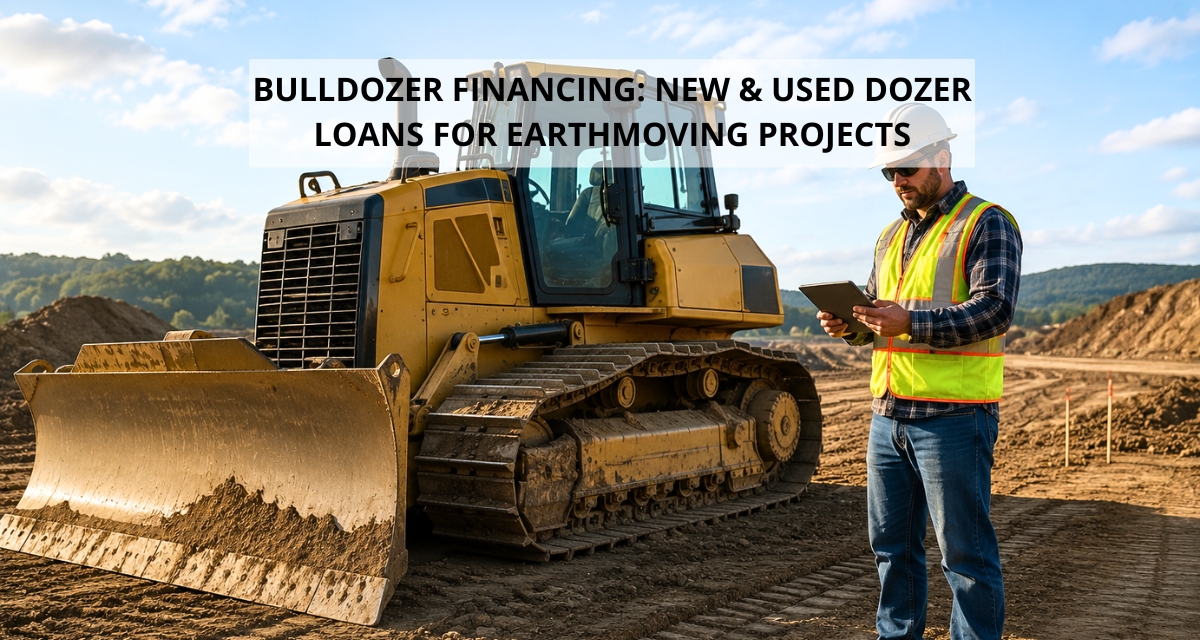
Bulldozer Financing: New & Used Dozer Loans for Earthmoving Projects

Bulldozer Financing

Bulldozer Financing: New & Used Dozer Loans for Earthmoving Projects

Bulldozer financing turns one of the largest equipment purchases in construction into a fixed monthly payment instead of a six-figure withdrawal from your operating account. A new crawler dozer from a major manufacturer can cost as much as a house. 

Even a clean used machine is rarely cheap once you factor in freight, attachments, and reconditioning. Few earthmoving contractors keep that kind of cash idle, and the ones who do usually need it for payroll, fuel, and the next bid.

Dimension Funding has financed equipment for small and medium-sized businesses since 1978, including the machines that move dirt for a living. The company funds new and used bulldozer purchases with fixed rates for the entire term, monthly payments stretched up to 60 months, and a one-page application for amounts up to $250,000. 

If you already have a machine picked out, you can start a financing application and get an answer the same day. If you are still weighing options, the rest of this article covers how dozer financing works, what it takes to qualify, and how to structure the deal around your cash flow.

Why Contractors Finance Dozers Instead of Paying Cash

A bulldozer earns money by the hour, not by sitting on your balance sheet. Financing matches the cost of the machine to the revenue it produces. You make a payment each month, and the dozer generates billable work. Paying cash inverts that logic: you absorb the full cost on day one and spend years recovering it.

There is also the question of what that cash could do instead. A grading contractor who drains reserves to buy a dozer outright has nothing left for a blown final drive, a slow winter, or a bonding requirement on a larger job. 

Keeping cash in the business protects your ability to operate. If a rough season does hit, working capital loans exist for that scenario, but it is better to never need one because you never emptied the account.

What Bulldozer Financing Covers

Dozer financing is not limited to the machine itself. Under its construction equipment financing program, Dimension Funding can finance 100 percent of the project, including costs buyers often forget to budget for, such as delivery and maintenance. Hauling a 20-ton machine across two states is not cheap, and rolling that cost into the financing means you pay almost nothing upfront. 

The program covers both new and used bulldozers, and used machines are where the terms genuinely matter. The price gap between a three-year-old dozer and a new one can fund a second piece of equipment, which is exactly why so many contractors shop the secondary market in the first place. 

Dimension Funding structures the term around the working life of the bulldozer, up to 60 months, so you are not making payments on a machine that has aged out of your fleet. If the dozer is part of a larger fleet purchase, the same process applies to companion machines such as mini excavators and dump trucks, so a contractor outfitting a new crew can run everything through one lender instead of three.

What It Takes to Qualify

Dimension Funding keeps the requirements short and publishes them plainly. Here is what the company looks for on a dozer deal:

  1. At least two years in business. This is the firm requirement. Startups under two years old do not qualify for the bulldozer program.
  2. A completed application. Approvals up to $250,000 run on a one-page application with no financial statements. Deals above $250,000 require financials.
  3. Credit somewhere on the spectrum. Programs are set up for everything from A+ credit to marginal credit, so a past rough patch does not automatically end the conversation.

The process itself runs on electronic documents signed through DocuSign, so there is nothing to print, scan, or mail. Most applicants hear back the same day, and funding typically completes within two to three business days. 

If you want to know where you stand before committing to a machine, the financing application takes only a few minutes and carries no obligation, making it a reasonable first step even while you are still comparing dozers.
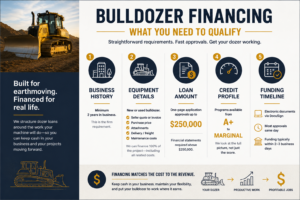
Bulldozer financing - what you need to qualify

How the Numbers Work: Terms, Payments, and Taxes

Three program features shape your monthly payment:

Term length. Financing runs up to 60 months. A longer term lowers the monthly payment; a shorter term reduces total interest paid. A machine working full time on contracted jobs can justify a shorter, more aggressive payoff. A dozer that supplements rentals during peak season may fit better on the full 60 months.

Fixed rate. The rate is locked at signing and holds for the entire term. The number you budget in year one is the same number you pay in year five.

Deferred first payment. Qualifying borrowers can take no payments for the first 90 days, with restrictions. That window lets the dozer start generating revenue before the first payment comes due, a meaningful cushion when the machine is tied to a new contract that has not started paying yet.

Run your target purchase price through the payment calculator before you apply. Five minutes there tells you whether the dozer you are looking at fits your budget at 48 months or needs the full 60.

Financed equipment can also qualify for the Section 179 deduction, which under IRS rules lets businesses deduct qualifying equipment purchases in the year the equipment is placed in service rather than depreciating the cost over several years. 

Buying Used? A Short Checklist Before You Finance

A financing approval does not inspect the machine for you. Before signing on a used dozer, verify these items yourself or pay a heavy equipment mechanic to do it:

  • Undercarriage condition. Caterpillar’s maintenance guidance puts undercarriage parts and service at an average of 50 percent of a dozer’s lifetime maintenance cost, which makes it the single most expensive item to misjudge.
  • Hour meter reading against maintenance records, since hours matter more than age.
  • Final drives, hydraulics, and blade cylinders for leaks or play.
  • A clean title and a lien search on the serial number.

A thorough inspection protects the financing decision as much as the purchase decision. Sixty months is a long time to make payments on a machine with a cracked frame.

Getting a Dozer Financed with Dimension Funding

Dimension Funding has financed equipment for over 40 years, holds an A+ rating from the Better Business Bureau, and works with contractors across the U.S. The process is built for speed: a one page application for deals up to $250,000, same day approvals, electronic signing through DocuSign, and funding within two to three business days.

If you have a bulldozer purchase in front of you, new or used, apply for financing online or call 800.755.0585 to talk through the deal with someone who has structured hundreds like it. You can have an answer before the dealer closes for the day.

Frequently Asked Questions

How long can I finance a bulldozer?

Dimension Funding offers bulldozer financing terms up to 60 months with a fixed rate for the entire term. The term is structured around the machine’s working life, so used dozers qualify for monthly payment plans just as new ones do.

What credit score do I need to finance a bulldozer?

Dimension Funding does not gate approvals behind a single minimum score. Programs are set up for credit profiles ranging from A+ to marginal, and the firm must be at least 2 years old. Credit history typically affects the rate you are offered more than the approval itself.

How fast can I get approved for a dozer loan?

Most applicants receive same-day approval, and funding is typically completed within two to three business days. Deals up to $250,000 require only a one-page application with no financial statements.

What should I have ready when I apply?

For deals up to $250,000, you only need the information requested on the one-page application; financial statements come into play above that amount. Having the seller’s quote or invoice for the bulldozer on hand speeds up the paperwork, since the financed amount and equipment details come straight from it.

Does the financing cover delivery and other project costs?

Dimension Funding can finance 100 percent of the project, including delivery and maintenance costs, not just the bulldozer’s purchase price. Rolling these costs into the contract keeps your upfront cash outlay near zero.

Used Equipment Financing: How to Finance Pre-Owned Machinery & Trucks

Used Equipment Financing: How to Finance Pre-Owned Machinery & Trucks

Used Equipment Financing: How to Finance Pre-Owned Machinery & Trucks

A piece of equipment that sold new for $200,000 three years ago may be available used for $90,000 — and every dollar of that price difference can be financed. Used equipment financing lets businesses acquire functional, revenue-generating machinery and trucks at a fraction of the new cost, without waiting to accumulate capital. The question isn’t whether lenders will finance it. It’s how to structure the deal so it actually works in your favor.

Dimension Funding has been financing pre-owned commercial equipment for over 40 years — machinery, trucks, construction equipment, medical devices, and more — with same-day approvals and an A+ BBB rating. According to the Equipment Leasing & Finance Foundation’s 2024 Horizon Report, 82% of U.S. businesses used some form of financing to acquire equipment in 2023, with the industry reaching a record $1.34 trillion — used equipment financing is a mainstream capital strategy, not a fallback option.

Why Used Equipment Financing Makes Financial Sense

The financial case for buying used goes beyond the lower sticker price. New equipment, like a new vehicle, loses 20–40% of its value in the first year of ownership, according to equipment finance data compiled by SFS Lenders. By financing used equipment, you let the original owner absorb that initial depreciation hit. The asset you acquire has already passed through the steepest part of its depreciation curve — meaning it holds its value more predictably over the time you own it.

This matters for resale value and your balance sheet. Used equipment that has already worked through most of its IRS MACRS recovery period — 5 years for trucks and light equipment, 7 years for most machinery per IRS Publication 946 — has absorbed the bulk of its depreciation, giving the buyer a more stable asset and the lender more predictable collateral over the loan term.

How Lenders Underwrite Used Equipment

Lenders treat used equipment as a higher-risk asset than new, and loan terms reflect that. Understanding why helps you position your application more effectively.

The core issue is collateral. With new equipment, the lender has a clear, verified asset value at origination. With used equipment, value depends on age, mileage or hours, condition, and secondary market liquidity — variables that introduce uncertainty. Lenders price that uncertainty into the deal. 

According to SFS Lenders, used equipment loans typically carry rates 1–3 percentage points higher than comparable new equipment financing, reflecting depreciation risk and reduced collateral certainty.

Equipment age and mileage limits

Most lenders impose age caps that vary by equipment type — commonly 10 to 15 years, though some lenders go older for assets with strong secondary market demand and documented maintenance histories. Trucks and construction equipment with verified service records and moderate usage qualify more easily than high-hour machinery with unknown maintenance histories. Mileage or operational hours serve as a proxy for remaining useful life — the more remaining life, the stronger the collateral position.

Approval rates and what the data shows

Equipment financing consistently achieves higher approval rates than unsecured business loans, primarily because the asset serves as collateral — reducing lender risk in ways that unsecured credit cannot. 

According to the Federal Reserve’s 2025 Small Business Credit Survey, equipment and auto loans showed higher approval rates than general business loans among small employer firms. Business age remains one of the strongest approval predictors: firms under two years old had a full-funding rate of just 28%, compared to 57% for businesses with ten or more years of history.

Why specialized lenders matter more now

The Federal Reserve’s October 2025 Senior Loan Officer Opinion Survey reported that banks tightened standards on commercial and industrial loans to firms of all sizes through Q3 2025. For businesses seeking used equipment financing, this tightening means traditional bank channels are increasingly restrictive — making specialized equipment lenders a more practical path. Dimension Funding accepts most credit types, including applicants declined by conventional banks, with application-only decisions up to $250,000.

Used vs. New Equipment Financing: Key Differences

The financing terms for used equipment differ from new in several concrete ways.


New Equipment

Used Equipment

Typical loan terms

Up to 60–84 months

24–60 months (often shorter)

Down payment

Low or none (strong credit)

Often higher

Collateral risk

Lower

Higher

Depreciation curve

Steep early

Flatter, more predictable

Section 179 / bonus depreciation

Yes

Yes (new to your business)

Approval complexity

Standard

Equipment condition also assessed

One important note on tax treatment: used equipment qualifies for bonus depreciation under current IRS rules, provided the asset is new to your business. The One Big Beautiful Bill Act of 2025 restored 100% bonus depreciation for qualifying property placed in service after January 19, 2025 — this applies to used equipment as well as new, per IRS Publication 946.

Best Equipment Types to Finance Used

Not all used equipment is equal from a financing and ROI standpoint. Asset type affects lender appetite, loan terms, and long-term value retention.

Strong candidates for used financing

Construction equipment — excavators, bulldozers, graders, and cranes — holds value well in secondary markets and has a long useful life when maintained. These assets are widely financed used, with strong resale liquidity providing solid collateral. 

Commercial trucks (semi tractors, dump trucks, box trucks) are another strong category, as documented maintenance history and verifiable mileage give lenders clear data to underwrite against. Medical equipment — imaging systems, surgical devices, patient monitoring equipment — also retains value well and is routinely financed pre-owned.

Equipment to approach with more caution

Technology-heavy equipment (servers, certain automation systems) depreciates rapidly and may be difficult to finance at favorable terms beyond a few years of age. Equipment in compliance-heavy industries — where older models may no longer meet regulatory standards — can face reduced lender appetite as their operational window shortens. High-hour machinery with incomplete service records presents the highest risk to both lenders and buyers.

Hidden Costs to Account for Before You Finance

The purchase price and monthly payment tell only part of the story on used equipment. A complete financial picture includes what you’ll spend after the deal closes.

Maintenance and repair exposure

Used equipment typically comes without manufacturer warranty, shifting maintenance risk entirely to the buyer. Older machinery may require more frequent servicing, and parts availability can become an issue on discontinued models. Factoring in a realistic annual maintenance budget — and confirming parts availability — before financing is essential to avoid operating costs that undercut the savings from the lower purchase price.

Downtime risk

Revenue-generating equipment that’s out of service costs money in two directions simultaneously: repair costs plus lost productivity. This risk is highest with high-hour machinery or equipment with unknown maintenance histories. Requesting service records, commissioning an independent inspection, and reviewing usage logs significantly reduces this exposure before you commit.

When Used Equipment Financing Is the Right Play

Used financing fits cleanest in several recurring business scenarios.

Startups that need operational equipment but can’t justify new pricing benefit most directly — lower acquisition cost reduces monthly payment size when revenue is still building. Contractors and fleet operators expanding capacity frequently turn to used markets to scale faster than new equipment budgets allow. Volatile markets also favor used financing: lower capital at risk means less exposure if utilization drops.

When to Think Twice

Used financing isn’t always the right move. Equipment with known reliability issues in a specific model year warrants extra scrutiny. Industries where assets must meet current safety or emissions standards are another caution area — a truck about to require expensive compliance upgrades may cost more to operate than its financing savings justify. If an inspection reveals deferred maintenance, factor the full remediation cost into your total acquisition price before committing.

Financing Pre-Owned Equipment with Dimension Funding

Dimension Funding finances used commercial equipment across virtually every category — trucks, construction machinery, manufacturing equipment, medical devices, restaurant equipment, and more. Application-only financing is available up to $250,000 with no financial statements required, and most credit types are accepted, including applicants who’ve been declined by traditional banks.

The team at Dimension Funding can walk you through financing options based on your specific equipment, business profile, and timeline. Learn more about the company’s 40-year track record on the About Us page, or start an application — same-day decisions are available on qualifying transactions.

Frequently Asked Questions

How old can equipment be and still qualify for financing? 

Most lenders set age caps that vary by equipment type — commonly 10 to 15 years, though some go older for assets with strong secondary market demand and documented maintenance histories. Construction equipment and commercial trucks often qualify at older ages than technology or specialty equipment. The specific cap depends on the lender and the asset being financed.

Is it harder to get approved for used equipment than new? 

The process is similar but includes an additional layer: lenders assess the equipment itself as collateral alongside your credit and business profile. Factors like age, condition, mileage or hours, and secondary market liquidity all influence the decision. Having documentation — service records, inspection reports, purchase agreement — strengthens a used equipment application considerably.

Do I need a down payment to finance used equipment? 

Not always. Borrowers with strong credit and established business history may qualify for low or no down payment financing on qualifying transactions. Weaker credit or older equipment typically requires 10–20% down. Lenders use the down payment to manage loan-to-value exposure on assets that carry more depreciation risk than new equipment.

Can I use Section 179 or bonus depreciation on used equipment? 

Yes. Under the One Big Beautiful Bill Act of 2025, 100% bonus depreciation applies to qualified property placed in service after January 19, 2025 — including used equipment, provided it is new to your business. Section 179 also applies to used equipment purchases subject to annual deduction limits. Consult a tax advisor to confirm eligibility for your specific situation.

What documentation should I have ready before applying? 

For application-only financing up to $250,000, no financial statements are required — just a completed application and basic equipment information (year, make, model, condition, mileage or hours, purchase price). Larger transactions or thinner credit profiles may require bank statements or tax returns. Service records and an independent inspection report strengthen any used equipment application.

What types of used equipment does Dimension Funding finance? 

Dimension Funding finances virtually all categories of commercial equipment pre-owned, including semi trucks, dump trucks, box trucks, construction machinery, medical equipment, manufacturing equipment, and restaurant equipment. Coverage includes 100% of the purchase price on qualifying transactions, with terms up to 60 months.

Is used equipment financing a good option for startups? 

Yes, particularly for businesses in their first one to two years that need operational equipment but face higher down payment requirements. Used equipment’s lower purchase price reduces total financing need and monthly payment size — both of which matter most when revenue is still building. Dimension Funding accepts most credit types, including applicants with limited business history.