How to Finance Equipment: 7 Funding Options for Business Owners

how to finance equipment

How to Finance Equipment: 7 Funding Options for Business Owners

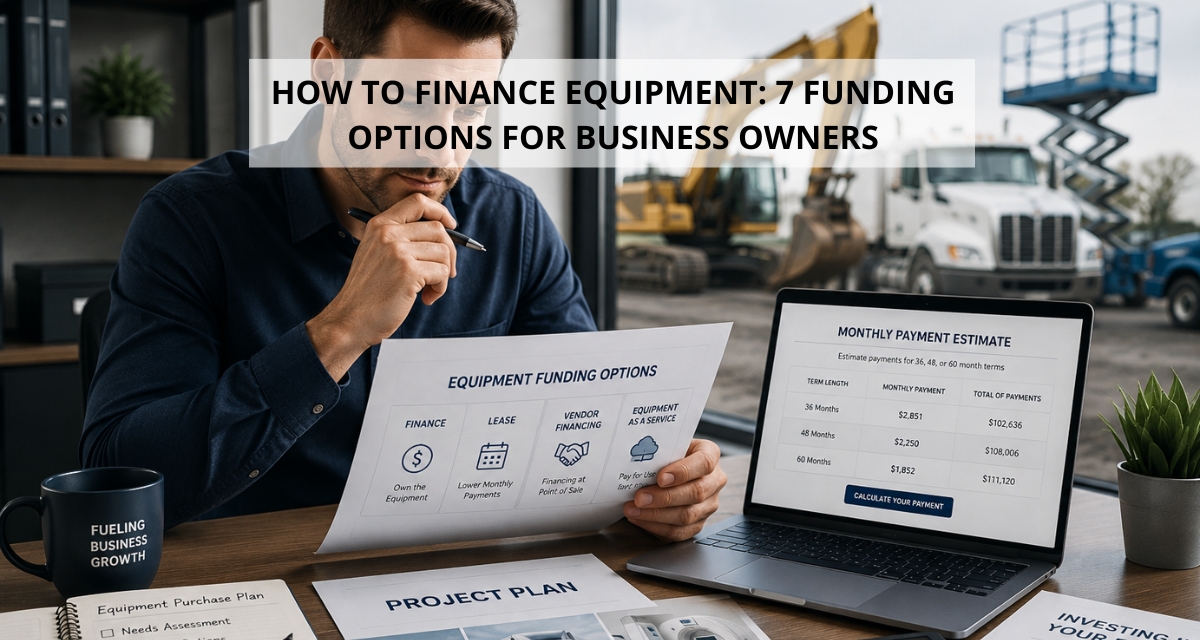
Financing equipment means spreading the cost of a business asset across a fixed term rather than paying the full amount upfront, preserving working capital while the equipment generates revenue. The right method depends on the type of equipment, how long the business expects to use it, the borrower’s credit profile, and whether ownership at the end of the term matters. 

Dimension Funding has provided commercial equipment and software financing to small and mid-sized businesses across the U.S. since 1978, covering everything from construction machinery and medical devices to enterprise software and IT hardware.

According to the Equipment Leasing and Finance Foundation’s 2024 Industry Horizon Report, 82% of businesses that acquired equipment or software in 2023 used at least one form of financing to do so, up from 79% in the 2022 survey. Leasing accounted for 26% of total acquisitions, secured loans 16%, and lines of credit 14%.

Use the Dimension Funding payment calculator to estimate monthly payments for 36-, 48-, or 60-month terms before deciding which funding path best fits your project.

1. Equipment Financing Through a Specialty Lender

An equipment financing agreement from a specialty lender funds the full purchase price of the equipment and converts it into fixed monthly payments over a set term. The lender underwrites the deal based on the borrowing business’s creditworthiness, the type of equipment, and whether the asset has strong secondary-market value. The borrower takes ownership of the equipment and holds it free and clear at the end of the term.

Specialty lenders underwrite based on the business’s credit profile and the equipment’s collateral value, rather than requiring the full financial documentation package that a bank demands. That difference in underwriting approach is why specialty lenders approve deals banks routinely decline, and why approvals come back in hours rather than weeks. 

For projects up to $250,000, Dimension Funding approves on an application-only basis with no financial statements required. Funding is typically available within 48 hours, with same-day funding available once documentation is complete.

Terms range from 60 months on commercial equipment financing, and financing is available up to $10 million. New and used equipment both qualify. The application is electronic, and agreements are executed through DocuSign, so the borrower moves from approval to a funded deal without paperwork delays.

Best for:

Businesses that need fast approval, want ownership at the end of the term, and are purchasing equipment with established secondary-market value; construction, medical, trucking, material handling, food processing, and manufacturing are all well served by this structure.

2. Equipment Leasing

An equipment lease gives a business use of the equipment over a defined term without transferring ownership. Monthly payments are typically lower than those under a financing arrangement for equivalent equipment because they are calculated based on the asset’s depreciated value over the lease period rather than the full purchase price.

At the end of a standard operating lease, the business returns the equipment, upgrades to a newer model, or purchases the asset at fair market value. Some lease structures include a $1 buyout option, which effectively functions like a financing agreement but with the lower monthly payment profile of a lease during the term.

Equipment leasing makes the most practical sense for technology-heavy equipment categories where obsolescence is a real cost. IT hardware, diagnostic imaging equipment, and certain lab instruments depreciate faster than their useful life suggests. A lease lets a business stay current without being locked into an asset that has lost most of its market value by the end of the term.

The ELFA’s 2024 data confirms leasing as the most popular acquisition method for equipment and software in the U.S., accounting for 26% of total volume.

Best for:

Technology equipment, medical and diagnostic devices, and any category in which the equipment is likely to become obsolete before the end of a standard financing term.

3. Vendor Financing

Vendor financing is a credit arrangement structured between an equipment manufacturer or dealer and a third-party finance company, offered to the buyer at the point of sale. The buyer applies for financing directly through the vendor’s program, the finance company handles approval and funding, and the vendor receives full payment upfront. The buyer repays the finance company over the agreed term.

Buyers find vendor financing convenient because it happens inside the sales process and doesn’t require sourcing a separate lender. Approval criteria are often calibrated to the specific equipment being purchased, and promotional terms, including deferred payment periods and reduced-payment structures,  are sometimes available through manufacturer programs on new equipment.

Dimension Funding’s vendor financing program operates on both sides of this relationship. For equipment vendors and manufacturers, Dimension Funding provides the financing infrastructure that lets them offer payment options directly to buyers. For buyers, vendor financing through Dimension Funding covers 100% of the purchase price, including delivery and installation, with the same application-only threshold up to $250,000.

Best for:

Buyers purchasing from a vendor who already has a financing program in place. Also a strong fit for equipment categories where the manufacturer offers promotional terms on new product lines.

4. Equipment-as-a-Service and Subscription Structures

Equipment-as-a-service (EaaS) is a structure in which a business pays a recurring subscription fee for access to equipment rather than purchasing or leasing it. The vendor retains ownership; the buyer gets full access, typically including maintenance, support, and upgrades within the subscription cost. 

Capital expenditure is recognized as an operating expense; the asset never appears on the balance sheet as a capital liability, and the vendor is incentivized to keep the equipment functional because maintenance is bundled in.

EaaS adoption is accelerating. According to the Equipment Leasing and Finance Foundation’s 2024 Horizon Report, half of equipment and software end users already use some form of subscription-based model, with an additional 23% planning to adopt this option.

EaaS is most available in technology, medical, and industrial automation categories. Heavy construction equipment, commercial trucks, and specialized manufacturing machinery are rarely available through subscription models, which is why traditional financing and leasing continue to dominate these verticals.

Dimension Funding’s software financing and SaaS financing programs cover subscription-based software under the same structure as traditional equipment deals, allowing businesses to convert annual software subscription costs into fixed monthly payments.

Best for:

Businesses in technology, healthcare, and industrial automation where the vendor offers an EaaS program and the business prefers operating expense treatment over capital expenditure.

5. Business Line of Credit

A business line of credit gives a company access to a revolving pool of capital up to a set limit. Draws are made as needed, and the business repays what it borrows over time, restoring available credit. For equipment purchases, a line of credit functions similarly to a credit card: the business draws from the line at the point of purchase and repays on its own schedule rather than a fixed term set by the lender.

Lines of credit work well for frequent, lower-cost equipment purchases, where the flexibility to draw and repay on a rolling basis is more useful than a fixed-term loan structure. They are less well-suited to large equipment purchases. A $150,000 excavator financed on a revolving line of credit incurs variable payment obligations and typically carries a higher financing cost than a fixed-term equipment loan for the same amount.

Banks and credit unions offer lines of credit, but their approval criteria are more stringent than those of specialty lenders, and draw periods often come with conditions. Some lines require that the full balance be paid down to zero at least once annually. For businesses with established banking relationships and strong credit, a line of credit is a useful complement to equipment financing for smaller, recurring purchases.

Best for:

Smaller equipment, tools, and accessories purchased repeatedly, where the revolving structure adds more flexibility than a fixed loan. Less suitable as the primary funding source for major equipment acquisitions.

6. Working Capital Loans

A working capital loan is a short-term business loan designed to fund day-to-day operations rather than long-term asset purchases. For equipment, working capital loans are most practical when the purchase is modest in size, and the business needs fast access to cash without the documentation requirements of a traditional bank loan.

Dimension Funding offers working capital loans with a one-page application, weekly or daily repayment plans, and terms up to two years. The structure differs meaningfully from equipment financing: repayment is faster, the term is shorter, and the equipment itself does not secure the loan. That unsecured structure means approval decisions lean heavily on revenue consistency and time in business rather than the collateral value of what’s being purchased.

A two-year repayment term on a $75,000 piece of equipment results in a substantially higher monthly obligation than the same purchase financed over 48 or 60 months through an equipment-specific program. For businesses that need equipment quickly and plan to repay within 12 to 24 months, the structure works. For major capital purchases intended to generate revenue over several years, equipment financing is the more cost-effective structure.

Best for:

Smaller purchases under $50,000 where the business needs fast access to cash and can service a short repayment term. Also useful as a bridge while waiting for an equipment financing application to be funded for a larger deal.

7. Cash Purchase and Section 179 Planning

Paying cash for equipment eliminates monthly payment obligations and, depending on tax position, can be structured to generate a full-year deduction in the year of purchase through IRS Section 179. For 2025, the Section 179 deduction limit is $1,160,000, allowing businesses to write off the full cost of qualifying equipment placed in service during the tax year rather than depreciating it over its useful life.

A contractor who pays $200,000 cash for a crane and eliminates a monthly payment also eliminates $200,000 from working capital that could fund materials, payroll, or a second piece of equipment. Financing the crane and deploying that $200,000 toward revenue-generating activity often produces a better total outcome, particularly when the financed monthly payment is covered by what the crane bills.

The smarter approach is to finance the equipment and take the Section 179 deduction on the financed purchase. As Dimension Funding’s Section 179 resource page explains, financed equipment qualifies for the deduction in the year it is placed in service, even though the cash outlay is spread across monthly payments. A business gets the full tax benefit of ownership in year one while keeping its cash available for operations.

Best for:

Businesses with strong cash positions evaluating a large purchase and looking to optimize tax position. Most effective when combined with a financing arrangement that preserves working capital and captures the Section 179 deduction simultaneously.

Which Option Fits Your Situation

The deciding factors in any equipment purchase are the same: how large the monthly payment obligation is, how long the business plans to use the equipment, whether ownership matters, and what the tax position looks like in the year of purchase. Many businesses use equipment financing as their primary acquisition tool for major assets, maintain a line of credit for smaller recurring purchases, and deploy working capital loans as a bridge when timing requires it.

For most small and mid-sized businesses acquiring commercial equipment with a useful life of three years or more, a fixed-term equipment financing agreement from a specialty lender addresses all of those variables more predictably than cash, a revolving credit line, or a short-term loan.

Dimension Funding has held an A+ rating from the Better Business Bureau since its founding in 1978. Applications up to $250,000 require no financial statements, and the financing team averages more than 20 years of experience structuring deals across every major equipment category. Apply for financing or run your monthly payment estimate on the Dimension Funding calculator before your next equipment purchase.

Frequently Asked Questions

What is the most common way businesses finance equipment?

Leasing is the single most common method for acquiring equipment and software in the U.S., accounting for 26% of total acquisition volume in 2023 according to the Equipment Leasing and Finance Foundation’s 2024 Horizon Report. Secured loans and lines of credit follow at 16% and 14%, respectively. Across all methods combined, 82% of businesses that acquired equipment or software in 2023 used some form of financing rather than paying cash outright.

How much of an equipment purchase can be financed?

Dimension Funding finances 100% of the equipment purchase price, including delivery and installation. Down payments are not required on most commercial equipment deals, though a business with a thinner credit profile may be asked to provide one to reduce the lender’s exposure on larger transactions.

What credit score do I need to finance equipment?

Dimension Funding works with a broad range of credit profiles and does not publish a minimum score threshold. Businesses with two or more years of operating history, consistent revenue, and a clean credit profile have the most straightforward path to approval. For projects up to $250,000, the decision is based on the credit application, with no financial statements required.

Is it better to lease or finance equipment?

Leasing produces a lower monthly payment and keeps the asset off the balance sheet as a capital liability, but the business does not own the equipment at the end of the term. Financing results in a higher monthly payment but transfers full ownership at the end of the term. Leasing makes more sense for equipment that becomes obsolete quickly; financing makes more sense for equipment with a long useful life and strong secondary market value.

Can I finance used equipment?

Yes. Dimension Funding finances both new and used commercial equipment. Used equipment is evaluated on age, condition, and secondary market value. Well-maintained, late-model construction equipment, commercial trucks, and medical devices are routinely approved. Equipment that is more than 10 to 15 years old or has limited resale market may be subject to different underwriting criteria.

How fast can equipment financing be approved and funded?

Through Dimension Funding, most approvals come back within a few hours for standard applications up to $250,000. Funding follows within 48 hours of approval in most cases. Same-day funding is available when documentation is complete. The application is electronic, and agreements are executed through DocuSign.

Can I deduct financed equipment under Section 179?

Yes. Financed equipment qualifies for the IRS Section 179 deduction in the year it is placed in service, even though the actual cash outlay is spread across monthly payments over the financing term. The deduction applies to the full purchase price, not just the amount paid during the tax year. A tax advisor should confirm eligibility for specific equipment categories and verify the current year deduction limits before filing.

Equipment Financing Calculator: Estimate Monthly Payments (Tool)

equipment financing calculator

Equipment Financing Calculator: Estimate Monthly Payments (Tool)

An equipment financing calculator estimates the fixed monthly payment for a financed equipment purchase by taking three inputs: the total amount financed, the repayment term in months, and the finance charge applied by the lender. 

Knowing that number before applying lets a business compare the monthly obligation against what the equipment is expected to produce. Dimension Funding’s payment calculator covers equipment and software across nearly every commercial category, with terms up to 60 months and financing available up to $10 million.

Use the calculator to estimate your monthly payment, then contact the Dimension Funding team for a formal quote tailored to your specific project.

What the Calculator Actually Computes

The monthly payment on a financed equipment purchase is a function of three variables: amount financed, term length, and the finance charge built into the agreement.

Term length is the most controllable variable for most borrowers. Dimension Funding offers terms of up to 60 months for commercial equipment financing, giving a business real room to adjust the monthly obligation. 

A 36-month term on the same financed amount produces a meaningfully higher payment than a 60-month term. The tradeoff is that a longer term means carrying the finance charge over more months. The right term depends on what the equipment produces relative to the monthly cost of carrying it.

The lender sets the finance charge based on the borrowing business’s credit profile, the type of equipment, and whether the application requires financial statements. For projects up to $250,000, Dimension Funding approves equipment financing on an application-only basis. That threshold covers the majority of small and mid-market equipment purchases outright.

The calculator output is an estimate. Actual payment amounts are confirmed when an application is reviewed, and a formal quote is issued.

How to Use the Calculator Effectively

Enter the total project cost, not just the equipment purchase price. If installation, delivery, extended warranty, or accessories are being financed alongside the equipment itself, those amounts should be included in the total financed amount. Dimension Funding’s equipment leasing and financing programs cover soft costs bundled with the equipment purchase.

Run the calculation at two or three different term lengths before deciding which to pursue. A business buying a commercial truck might find that a 48-month term keeps the monthly payment within a target range while a 36-month term pushes it above what the route revenue supports. Seeing both numbers before applying gives the borrower a clearer position going into the application.

Keep the monthly payment in context of the equipment’s productive output. The useful question is whether the equipment generates enough additional revenue or operational savings each month to carry the payment and leave margin. A piece of construction equipment that adds two billable days per month should be evaluated against the financing cost on those terms.

What Equipment Qualifies

Dimension Funding finances almost every category of commercial equipment.

Construction equipment, including excavators, bulldozers, cranes, and dump trucks, is among the most commonly financed categories. According to the Equipment Leasing and Finance Association (ELFA), construction consistently ranks as the top industry by equipment financing volume in the U.S., representing 12 to 15% of total market activity. 

Commercial trucks, trailers, and fleet vehicles are financed over a range of terms, depending on vehicle type and expected useful life.

Medical equipment, lab equipment, restaurant and food-processing equipment, brewery equipment, material-handling equipment, IT hardware, and recycling equipment all qualify under the same application structure. New and used equipment are both eligible. Used equipment financing is available for well-maintained, late-model assets with established secondary market value.

The ELFA’s 2024 Equipment Leasing and Finance U.S. Economic Outlook found that more than 8 in 10 U.S. companies use some form of financing when acquiring equipment, including loans, leases, and lines of credit.

Financing vs. Leasing: What Changes in the Calculation

An equipment financing calculator and an equipment lease calculator produce different outputs because their underlying structures differ. In a financing arrangement, the borrower takes ownership of the equipment and repays the full financed amount plus the finance charge over the term. 

At the end of the term, the business owns the equipment outright. Monthly payments on a financed purchase are typically higher than lease payments on equivalent equipment because the borrower is paying down the full asset value.

In an equipment lease, the borrower pays for use of the equipment over the term. Lease payments are often lower because they are calculated based on the equipment’s depreciation cost over the lease period rather than its full value. At the end of a standard operating lease, the business returns the equipment. Some lease structures include a purchase option at fair market value or a nominal buyout amount.

Whether financing or leasing yields a lower monthly payment depends on the type of equipment, how long the business expects to use it, and whether ownership at the end of the term matters. Dimension Funding’s calculator reflects a financing structure. For businesses evaluating a lease, the financing team can model both scenarios based on the specific equipment and project cost.

Section 179 and the Monthly Payment Picture

One number the calculator does not model is the tax treatment of the financed equipment. IRS Section 179 allows businesses to deduct the full purchase price of qualifying equipment placed in service during the tax year, up to the annual limit set by the IRS. Dimension Funding’s Section 179 resource page covers the current year limits and how the deduction applies to financed purchases.

A business can take a full-year deduction in the same tax year the equipment is placed in service, even while spreading the actual cash outlay over 36 to 60 monthly payments. This does not change the monthly payment the calculator produces, but it does change how that payment is treated for the business’s tax position for the year. Consulting a tax advisor before finalizing a financed purchase is the right step.

How Dimension Funding Structures the Quote

The payment calculator gives an estimate. A formal quote from Dimension Funding’s financing team gives the actual monthly payment, term options, and any documentation requirements specific to the deal.

For equipment projects up to $250,000, the application requires no financial statements. Approvals typically come back within a few hours. Funding is available within 48 hours of approval in most cases, and same-day funding is available once documentation is complete. For projects above $250,000, financial statements are required, but the process remains considerably faster than a bank loan review.

Dimension Funding has held an A+ rating from the Better Business Bureau and has been operating since 1978. The sales team averages more than 20 years of tenure, which is relevant when a deal involves bundled costs or multiple asset types that need to be structured into a single agreement.

Once a business has its calculator estimate in hand, the next step is to submit a financing application to obtain the actual quote. The application is electronic, agreements are handled through DocuSign, and funding is available within 48 hours of approval.

Frequently Asked Questions

How does an equipment financing calculator estimate monthly payments?

An equipment financing calculator applies a finance charge, derived from the term length and the lender’s credit-based pricing, to the financed amount, then divides the result by the number of months in the term to produce a fixed monthly payment estimate. The output is an approximation — actual payment amounts are confirmed when the lender issues a formal quote after reviewing the application.

What is a good monthly payment for equipment financing?

A practical benchmark is whether the monthly payment is covered by the revenue or cost savings generated by the equipment. If a financed piece of equipment adds consistent billable capacity each month, the payment should be evaluated against that output. Most lenders, including Dimension Funding, structure terms up to 60 months specifically to keep monthly payments within the range a business’s cash flow can support.

Can I finance used equipment with the same calculator?

Yes. Dimension Funding finances both new and used commercial equipment, and the calculator applies to either. Used equipment is evaluated on the asset’s age, condition, and secondary market value. Well-maintained, late-model equipment in categories like construction, commercial trucks, and medical devices is routinely approved.

What is the maximum term available on equipment financing?

Dimension Funding offers terms up to 60 months on commercial equipment financing. Longer terms lower the monthly payment but extend the total financing obligation. The appropriate term length depends on the equipment type, its expected productive life, and the monthly cash flow the business is working within.

How much can I finance without providing financial statements?

Dimension Funding approves equipment financing up to $250,000 on an application-only basis, with no financial statements required. Projects above $250,000 require financial documentation but remain a faster and less document-intensive process than a traditional bank loan.

What is the difference between equipment financing and equipment leasing for monthly payment purposes?

A financing arrangement calculates the monthly payment against the full financed value of the equipment, with ownership transferring to the borrower at the end of the term. A lease calculates payments based on the equipment’s expected depreciation over the lease period, which typically results in a lower monthly payment. Dimension Funding can model both structures for a given equipment purchase.

Does financing equipment affect my Section 179 deduction?

Financed equipment can qualify for the IRS Section 179 deduction in the year it is placed in service, even though the cash outlay is spread across monthly payments over the financing term. The deduction is applied to the full purchase price, not just the portion paid in the tax year. A tax advisor should confirm eligibility for specific purchases and current year deduction limits.

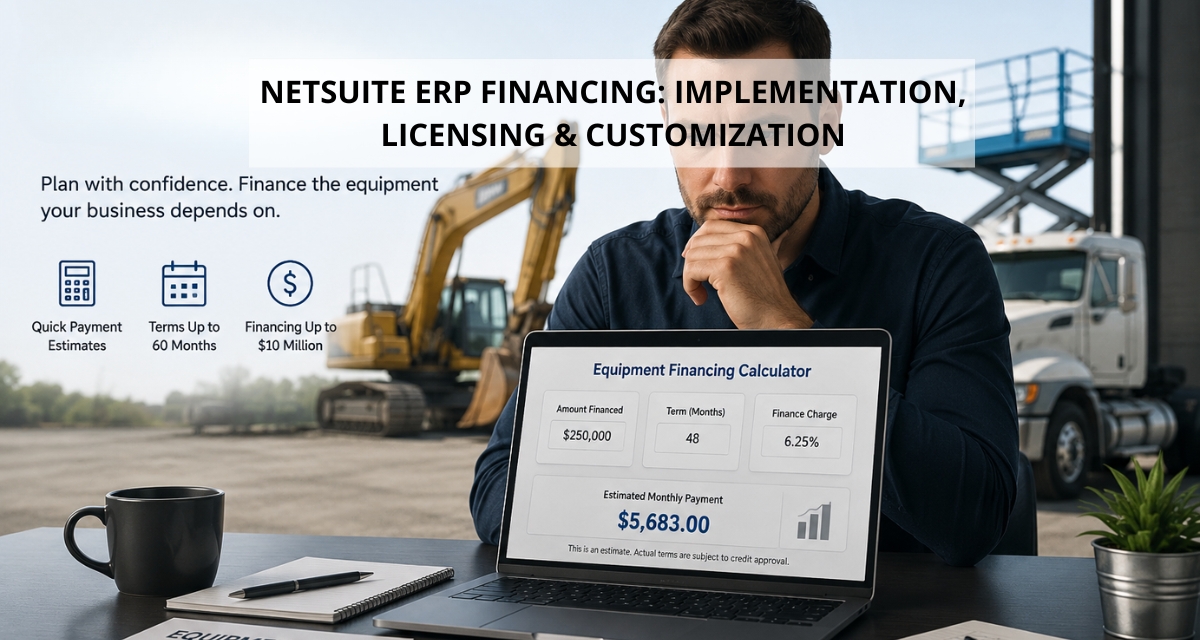
NetSuite ERP Financing: Implementation, Licensing & Customization

netsuite financing

NetSuite ERP Financing: Implementation, Licensing & Customization

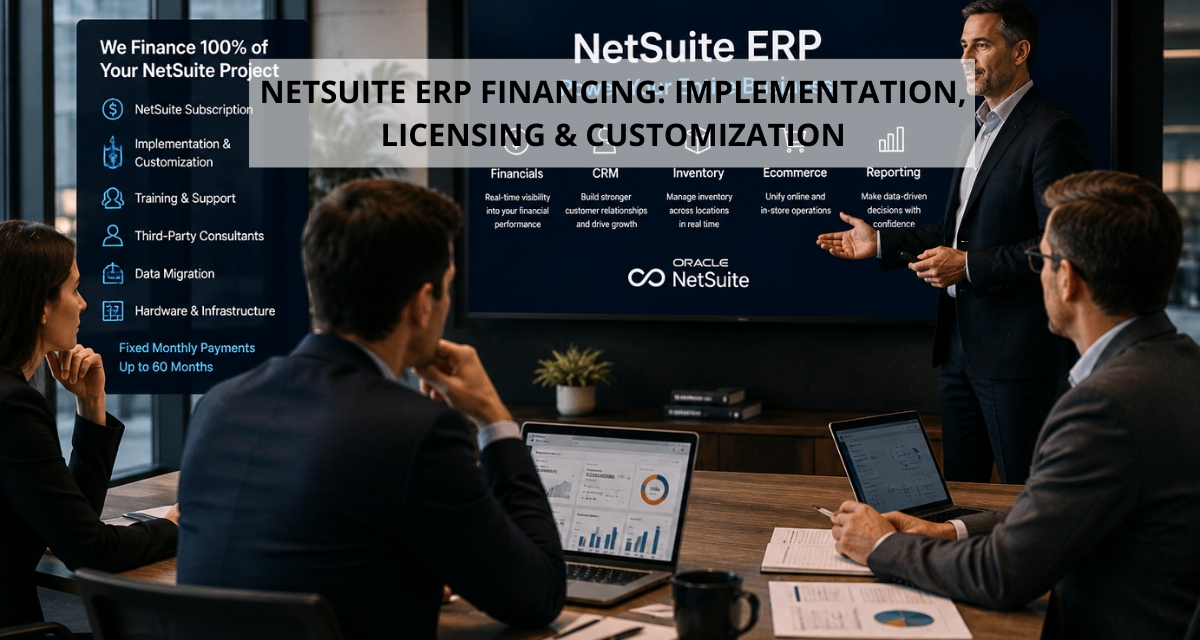
NetSuite ERP financing covers the full cost of a NetSuite deployment, including the annual subscription, implementation services, user training, customization work, third-party consultant fees, and any hardware purchased alongside the software. 

Dimension Funding has provided ERP and software financing to small and mid-sized businesses across the U.S. since 1978. It works directly with NetSuite buyers and their implementation partners to structure financing that covers 100% of project costs under a single fixed monthly payment, with applications up to $500k with no financial statements required. Reach out to get a quote tied to your specific project scope.

What a NetSuite Deployment Actually Costs

Panorama Consulting’s 2025 ERP Report puts the average ERP implementation cost at approximately $450,000 for mid-sized organizations, and fewer than a third of implementations finish on time. Those numbers reflect how many cost layers stack on top of the base subscription, and how often businesses underestimate them going in.

NetSuite uses a named-user licensing model, meaning each person who accesses the system requires their own license. Full user licenses, required for roles such as financial controllers and operations managers, are priced at the higher end, while self-service licenses cover employees who need only limited access. 

Beyond licensing, businesses add modules for inventory management, revenue recognition, manufacturing, or SuiteCommerce, each carrying its own monthly fee. Add-on modules commonly run between $399 and $999 per module per month according to ERP pricing research published by ERPRundown.

Implementation services are the most variable cost layer. According to the Software Pricing Guide’s 2025 NetSuite cost analysis, a small-business deployment with fewer than 10 users and a single legal entity typically costs between $30,000 and $75,000 for implementation alone. 

Mid-market deployments with 20 to 50 users and moderate module complexity range from $75,000 to $200,000, while multi-entity environments using NetSuite OneWorld can reach $150,000 to $350,000. Implementation costs for small businesses also commonly run 1 to 5 times the annual software subscription fee, depending on complexity and partner selection, according to Folio3’s NetSuite pricing guide for 2026.

Training, data migration from legacy systems such as QuickBooks or Sage, and third-party consultant work added after go-live fall outside those figures entirely.

Why Lenders Treat NetSuite Projects Differently Than Equipment Loans

Software has no collateral value. There is no serial number, no resale market, no asset a lender can recover if a deal goes sideways. That is why most traditional banks pass on software financing while specialty lenders structure products specifically built for it.

Software financing through Dimension Funding is structured as a fixed-term agreement, typically lasting up to 60 months, with the entire project bundled into a single monthly payment. The lender underwrites the deal based on the borrowing business’s creditworthiness. 

For projects up to $250,000, Dimension Funding’s NetSuite financing requires no financial statements. Deals above $250,000 require some financials but remain a streamlined process rather than a full bank loan review.

The underwriting criteria that matter most are time in business, revenue consistency, and credit profile. A business that has operated for two or more years with steady revenue has a much cleaner path to approval than a startup, regardless of how detailed the NetSuite implementation plan looks on paper.

What Dimension Funding’s NetSuite Financing Covers

A single financing agreement can cover the NetSuite subscription itself, including multi-year contracts that lock in current pricing. Implementation and professional services are included, along with all user training costs for both the deployment team and end users. 

Third-party consultant fees are covered even when those vendors are added after the initial agreement is signed. Hardware purchases, servers, workstations, and peripheral technology can be bundled in, as can delivery and maintenance costs tied to any hardware component.

Implementation costs are frequently the largest line item in a NetSuite project, and they often arrive in uneven installments rather than a single upfront invoice. Dimension Funding can include third-party vendor costs added mid-project, preventing businesses from having to renegotiate their financing structure once work is already underway.

Multi-year NetSuite subscriptions can also be financed under a single agreement, converting what would otherwise be a large annual payment into a predictable monthly amount while preserving working capital for operations.

How the Application and Funding Process Works

Software financing approvals at Dimension Funding typically come back within a few hours for straightforward applications. Funding is available within 48 hours of approval in most cases, and same-day funding is available once documentation is complete.

Applications up to $500,000 require no financial statements. Borrowers submit a credit application electronically, and DocuSign handles the agreement. For larger projects, financial statements are required, but the review process remains considerably faster than that for a conventional bank loan.

Dimension Funding has held an A+ rating from the Better Business Bureau since its founding in 1978. The sales team’s average tenure exceeds 20 years, which is relevant in software financing because experience with deal structures matters when bundling complex, multi-vendor cost components into a single agreement.

Subscription Structure and Zero-Percent Options

NetSuite is sold as an annual subscription, which creates a straightforward cash flow problem: the full annual fee is typically due at or near the start of the contract period. Financing converts that obligation into a fixed monthly payment spread over terms of up to 60 months.

Some NetSuite implementation partners offer promotional zero-percent financing on new deployments, typically for 12-month terms, as a sales tool to close deals faster. These arrangements run through the reseller and Oracle’s vendor financing program, and they apply conditions around which services qualify. 

Independent financing through a company like Dimension Funding is not structured at zero percent. Still, it provides broader coverage, longer terms, and the ability to bundle third-party costs that a vendor financing program would exclude.

Businesses evaluating both options should compare total coverage rather than headline terms. A 12-month zero-percent promotion that excludes implementation and training costs leaves the two largest project expenses outside the financing agreement.

Financing a NetSuite Renewal or Mid-Cycle Upgrade

NetSuite deployments rarely stay static. Businesses add modules, expand user counts, or engage consultants for customization work throughout the lifecycle of their subscription. Software renewal financing through Dimension Funding covers annual subscription renewals, module additions, and post-implementation customization engagements under the same financing structure as the original deployment.

Renewal invoices often arrive on a schedule that doesn’t match a business’s cash flow cycle. Financing a renewal spreads the obligation over the renewal term and preserves working capital for operations.

Customization costs are often the most unpredictable expense in a NetSuite environment. According to Panorama Consulting’s data, cited in NetSuite’s 2024 ERP statistics, only 7% of organizations run their ERP systems without modification. The remaining 93% require some degree of customization. When those projects are scoped and executed by third-party developers, the invoices can be included in a Dimension Funding financing agreement in the same way as any other project cost.

What to Know Before You Apply

Businesses that go into a NetSuite financing application with a clear picture of their total project scope get better outcomes than those who treat the financing as an afterthought. Before applying, get a detailed project quote from your NetSuite partner that itemizes the subscription, implementation, training, and any third-party consultants. Determine whether hardware will be purchased alongside the software, as it can be bundled into the same agreement. Also decide on your desired term length, longer terms lower the monthly payment but extend the total obligation.

Dimension Funding structures its ERP financing agreements to accommodate projects that span multiple vendors and cost types, so a complete project quote is the right starting document, not just the Oracle subscription invoice.

Use the payment calculator on the Dimension Funding site to estimate monthly payments for a 36-, 48-, or 60-month term. When you’re ready to move forward, apply here or contact the team directly for a quote tied to your project scope.

Frequently Asked Questions

Does NetSuite ERP financing cover implementation costs in addition to the subscription?

Yes. Dimension Funding’s NetSuite financing covers 100% of project costs, including subscription, implementation, professional services, training, third-party consultant fees, and hardware. Costs from third-party vendors can be added to the financing agreement even after the initial subscription has been financed.

How much does a NetSuite implementation typically cost for a small or mid-sized business?

According to the Software Pricing Guide’s 2025 analysis, a small-business deployment with under 10 users and a single legal entity costs between $30,000 and $75,000 for implementation services alone, not including the annual subscription. Mid-market deployments with 20 to 50 users commonly range from $75,000 to $200,000 for implementation. Total first-year costs, including subscriptions, modules, and services, typically range from $25,000 to $300,000, depending on scope.

What credit score do I need to qualify for NetSuite financing?

Dimension Funding works with a broad range of credit profiles and does not publish a minimum score threshold. Businesses with two or more years of operating history and consistent revenue have the most straightforward path to approval. The underwriting reviews the full picture of the business, not a single number.

Can a multi-year NetSuite subscription be financed?

Yes. Multi-year subscriptions can be financed under a single agreement, allowing a business to lock in current subscription pricing and convert the obligation into fixed monthly payments rather than a large annual outlay.

How long does the approval and funding process take?

Most approvals come back within a few hours for standard applications. Funding typically follows within 48 hours of approval, and same-day funding is available when documentation is complete.

What is the maximum financing amount available without financial statements?

Dimension Funding approves NetSuite software financing up to $500,000 on an application-only basis, meaning no financial statements are required. Projects above $500,000 require financials but remain a faster and less paperwork-intensive process than a conventional bank loan.

Can a NetSuite financing agreement cover a renewal invoice that comes up mid-year?

Yes. Dimension Funding offers software renewal financing that covers NetSuite subscription renewals, module additions, and post-implementation customization costs. Renewal financing spreads the annual invoice into monthly payments, preserving working capital for other business needs.

SaaS Financing: How to Fund Subscription Software & Cloud Platforms

SaaS Financing

SaaS Financing: How to Fund Subscription Software & Cloud Platforms

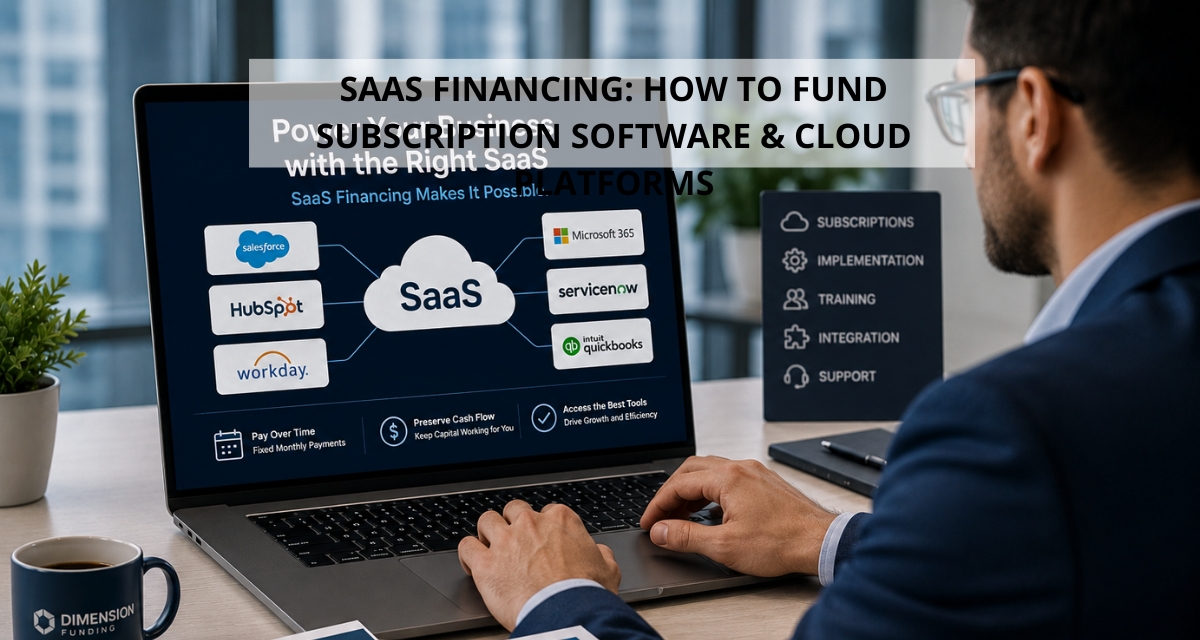
SaaS financing converts the upfront cost of a cloud software subscription into fixed monthly payments, so businesses can access the platforms they need without concentrating an annual contract payment into a single cash outlay. 

Lenders consider business credit, time in business, and the overall project scope when structuring the agreement. Dimension Funding has provided SaaS financing to small and mid-sized businesses across the U.S. since 1978, with application-only approvals of up to $500,000 that require no financial statements.

Most SaaS vendors bill annually and expect payment at the start of the contract period. Financing covers that invoice directly, paying the vendor at signing while the borrower repays in monthly installments across the subscription term. Contact Dimension Funding to get a quote built around your specific software contracts.

Why SaaS Billing Creates a Cash Flow Problem

SaaS vendors price annual contracts lower than month-to-month plans, which makes the annual commitment the economically rational choice. The catch is that annual billing requires one large outflow at renewal, not twelve smaller ones spread across the year. 

For a business running multiple cloud platforms, renewal dates rarely align, so cash pressure is recurring and hits at different points throughout the year rather than arriving as a single, predictable event.

According to Zylo’s 2025 SaaS Management Index, the average company spends $4,830 per employee annually on SaaS, with mid-market companies seeing per-employee spend increase approximately 40% year-over-year in 2025. A 50-person company is looking at roughly $240,000 in annual SaaS spend. 

The total increases with multi-year commitments, implementation services for new platforms, and renewal invoices that arrive independently of the business’s budget cycle. Financing does not reduce the software’s cost. It changes when that cost leaves the business: the annual invoice gets paid at signing, and the borrower repays over the term in fixed monthly installments rather than absorbing the full amount up front.

Every Cost a SaaS Project Generates

SaaS projects rarely land as a single subscription invoice. A new platform deployment typically produces charges from the vendor, an implementation partner, an onboarding consultant, and sometimes a hardware supplier, each on its own billing timeline.

Dimension Funding’s software financing covers every cost category attached to a SaaS deployment:

  • Subscription fees, including annual and multi-year contracts
  • Implementation and configuration services
  • Onboarding and training costs
  • Third-party consultants and integration specialists
  • Associated hardware or IT infrastructure
  • Ongoing maintenance and support agreements

Third-party vendors not included in the original agreement can also be added to the monthly payment after the fact. Post-go-live additions are common: a new integration, an extra module, or a consulting engagement contracted after the initial deployment is complete. Each can be folded into the existing agreement rather than managed as a separate cash outlay.

The Case for Multi-Year SaaS Commitments

Vendors typically offer discounts of 15 to 20 percent or more on two- or three-year commitments compared to annual renewals, but those agreements require payment at signing or at each annual anniversary. Businesses that commit to multi-year contracts to lock in pricing often end up absorbing a large upfront payment.

Gartner forecasts worldwide SaaS spending to reach $299 billion in 2025, a 19.2% year-over-year increase from 2024, according to Zylo’s 2025 SaaS Management Index. Vendor prices are climbing as AI capabilities are embedded in existing platforms, making pricing at today’s rates increasingly valuable heading into the next renewal cycle. 

Financing makes the multi-year commitment possible on a monthly basis: the vendor is paid in full at signing, the business locks in current pricing, and the total subscription cost spreads over the agreement period rather than concentrating in year one.

A vendor offering a 20% discount on a two-year contract produces real savings over that period. Financing allows a business to capture those savings without requiring the upfront concentration of capital that a lump-sum, multi-year payment demands.

SaaS Renewal Financing

Many businesses that financed their original software deployment handle subsequent renewals out of pocket, even when the renewal invoice presents the same cash-flow problem as the initial purchase. Renewal financing is available for exactly that situation.

Dimension Funding finances software renewals across the full range of platform categories: ERP, CRM, HR and payroll, legal practice management, medical EHR, and general SaaS subscriptions. The process mirrors new deployment financing. Provide the renewal invoice, specify the preferred term, and Dimension Funding structures the monthly payment agreement.

For businesses running multiple platforms, staggered renewal dates create a recurring problem. A $50,000 CRM renewal lands in March; a payroll platform renews in July; a project management tool renews in October. Each draws from the same operating pool and competes with normal expenses. Financed separately, each becomes a fixed monthly line item instead of a seasonal cash event.

What the Application Process Looks Like

No financial statements are required for SaaS financing projects up to $500,000. Most applicants receive an approval within a few hours. Funding typically follows within 48 hours, with same-day funding available on qualifying transactions. 

To initiate financing on a vendor quote or renewal invoice, email the invoice to Dimension Funding, specify the preferred payment term, and the agreement gets structured from there. The entire process is handled electronically via DocuSign, with no physical paperwork.

SaaS vendors commonly require payment before provisioning access or before a renewal period activates. Same-day approval keeps the implementation or renewal timeline intact without requiring the business to front cash while financing closes.

Managing SaaS Costs as a Monthly Operating Expense

A $50,000 renewal invoice arriving in March competes with payroll, vendor payments, and any unexpected cost that same month. Financed, it becomes a fixed monthly item that sits in the budget like any other recurring expense rather than spiking cash outflows at unpredictable intervals through the year.

Dimension Funding’s ERP financing program applies the same structure to larger deployments. A full ERP implementation with professional services attached follows the same agreement model as a standalone SaaS subscription, with terms of up to 60 months and 100% of project costs eligible for inclusion.

Get Monthly Payments on Your SaaS Stack

Dimension Funding finances SaaS subscriptions, multi-year contracts, renewals, implementation services, and third-party integrations in a single monthly payment over terms up to 60 months. Application-only approvals cover projects up to $500,000 and require no financial statements. Approvals come back within hours and funding typically follows within 48 hours. Use the payment calculator to model monthly payments for a specific subscription or project, or submit a financing application to get a quote tailored to your current software contracts.

Frequently Asked Questions

What is SaaS financing and how does it work? 

SaaS financing converts the upfront cost of a software subscription into fixed monthly payments over a defined term of up to 60 months. A lender pays the vendor at contract signing, and the borrower repays in monthly installments. The subscription stays active, and the business avoids a large single payment at the start of the contract or renewal period.

What SaaS platforms and software categories can be financed? 

Almost any cloud-based or subscription software qualifies, including CRM platforms, ERP systems, HR and payroll software, project management tools, legal practice management software, medical EHR systems, and general business SaaS applications. Dimension Funding also covers implementation, onboarding, and third-party integration costs associated with a new platform deployment.

Can I finance a SaaS renewal, not just a new subscription? 

Yes. SaaS renewal financing is available for any subscription coming up for annual or multi-year renewal. Provide the renewal invoice, specify the term, and Dimension Funding structures the monthly payment agreement. The process is the same as financing a new deployment.

How much SaaS spend can I finance without financial statements? 

Projects up to $500,000 qualify for application-only financing with no financial statements required. Projects above that threshold undergo a structured review process that still proceeds efficiently.

What credit score do I need to qualify? 

Dimension Funding works with a wide range of business credit profiles. Good credit typically produces an approval within a few hours. Businesses with less established credit histories may still qualify. A financing specialist reviews each application individually rather than running it through a purely automated decision.

Can implementation and onboarding costs be included in the financing? 

Yes. Implementation services, onboarding, training, third-party consultants, and associated hardware costs are all eligible for inclusion in the financing agreement. Third-party vendors added after the original agreement is signed can also be folded into the existing monthly payment.

How long does the approval and funding process take? 

Most approvals come back within a few hours of submitting the application. Funding typically follows within 48 hours of approval. Same-day funding is available on qualifying transactions. The entire process is handled electronically via DocuSign, with no physical paperwork required.

Software Financing: Fund Enterprise Software & Implementation

Software Financing

Software Financing: Fund Enterprise Software & Implementation

Software financing covers the full cost of a business software project: the license or subscription, implementation services, staff training, third-party consultants, and associated hardware, all spread over fixed monthly payments rather than a single upfront outlay. Lenders evaluate business credit, time in business, and total project scope when structuring the agreement. 

Dimension Funding has provided software financing to small and mid-sized businesses across the U.S. since 1978, with application-only approvals of up to $500,000 that require no financial statements.

Most businesses underestimate what an enterprise software project actually costs. The license or subscription fee is the starting point, not the total. Implementation, data migration, staff training, and third-party consulting routinely match or exceed the cost of the platform itself. Financing covers the entire project, not just the software purchase. 

Contact Dimension Funding to get a quote built around your specific project scope.

What a Software Project Actually Bills You For

Enterprise software projects rarely arrive with a single invoice. A business adopting a new ERP system typically receives separate proposals from the platform vendor, an implementation partner, a data migration specialist, and a hardware supplier. Each is a distinct cost center, billed separately, often on different timelines. Financing consolidates all of them into one monthly payment.

Dimension Funding finances every cost category that touches a software deployment:

  • Software licenses and SaaS subscription fees, including multi-year commitments
  • Implementation and configuration services
  • Staff and administrator training
  • Third-party consultants and integration specialists
  • Hardware, computers, and IT infrastructure tied to the deployment
  • Delivery, maintenance, and ongoing support agreements
  • Renewal fees on existing platforms

Every one of those line items can go into a single financing agreement rather than hitting your operating budget as separate invoices.

Why the Real Number Is Always Higher Than the Quote

According to research compiled by Sci-Tech Today, 64% of ERP implementations exceed their initial budget, with average cost overruns ranging from 25% to 40% of the original estimate. For a small or mid-sized business, that gap between the quoted figure and the final bill is often what derails the project.

The categories that tend to catch businesses off guard are implementation labor and third-party consulting. A platform like SAP, NetSuite, Odoo, or Acumatica requires configuration work before it reflects a specific company’s processes. 

That work is billed by implementation partners at professional services rates, separate from what the software vendor charges. The same is true of staff training. No software project is operational without it, yet training costs are often omitted from the initial budget.

Financing does not reduce those costs. What it does is convert them from a capital event into a monthly operating line. A business that would otherwise deplete its working capital or draw down a credit line to fund a software deployment keeps both intact by financing the full project scope instead.

How ERP and Subscription Software Financing Works

ERP financing covers the full project cost regardless of which platform a business has selected: SAP, Sage, SageIntacct, Odoo, Acumatica, NetSuite, Microsoft Dynamics, Oracle, Workday, Infor, and others all qualify under the same program terms.

For subscription-based software, annual contracts convert into monthly payments. This is particularly useful for multi-year agreements, where a vendor may offer a discount for committing to a longer term upfront. Financing allows a business to capture multi-year pricing without concentrating the full cost in year one.

For total project financing, the structure covers 100% of acquisition costs across all the categories above. Dimension Funding finances projects up to $500,000 on an application-only basis, with no financial statements required. Projects above $500,000 require documentation but move through a similarly direct process.

Terms run up to 60 months. That matters because a software platform a business will use for five years should be paid across five years, not front-loaded into the first invoice cycle. A 60-month term aligns the payment schedule with the asset’s actual useful life rather than a generic bank amortization schedule.

Software Financing by Industry

The cost structure of a software project varies by sector, and so does the financing.

Medical and Healthcare Software

Medical software financing covers EHR and EMR platforms, practice management systems, and implementation costs. Healthcare software transitions carry a specific burden that most other sectors do not: clinical staff must be trained and validated before go-live, which extends the implementation timeline and increases consulting hours. Those costs are eligible for financing alongside the platform itself.

Legal Practice Management Software

Legal practice management software involves substantial data migration from legacy case management systems that most law firms have used for years. The migration work alone can match the licensing cost. Financing covers the full project, including any third-party consultant engaged to manage the transition.

HR, Payroll, and Accounting Software

HR and accounting software deployments frequently involve hardware upgrades alongside the platform switch, since payroll and financial reporting systems have specific processing requirements. Infrastructure costs associated with the deployment are eligible for inclusion in the financing, not treated as a separate line item.

Application-Only Approvals Up to $500,000

Traditional lenders typically require financial statements for any loan above a modest threshold. Dimension Funding’s application-only approval covers software projects up to $500,000 with no financial statements required, which handles a large share of ERP and enterprise software deployments outright.

Approvals come back within a few hours of submitting the application on most transactions. Funding typically follows within 48 hours, with same-day funding available on qualifying deals. Electronic documentation and DocuSign are used throughout.

That speed matters for a practical reason: software vendors commonly require payment before the go-live date, not after. A financing process that takes weeks creates a timing problem in the middle of a procurement cycle with a fixed project schedule. Fast approvals keep the vendor timeline intact.

Four Ways to Structure a Software Financing Agreement

Not every software financing situation has the same shape. Dimension Funding works across four common structures depending on what a business is financing and when.

Bundled project financing combines the software subscription, implementation services, hardware, and third-party vendor costs into one monthly payment. This is the standard structure for a business deploying a new platform from scratch.

Maintenance and services financing covers support or service contracts as a standalone agreement, with the payment term matched to the service contract term. This applies to businesses that have already purchased the underlying software but want to spread recurring support costs over time rather than pay a lump sum each year.

Multi-year subscription financing allows a business to commit to a longer vendor contract, locking in current pricing while paying monthly. 

According to Gartner projections reported by Xensam, global enterprise software spending is on track to reach $1.25 trillion in 2025, a 14.2% increase over 2024, with a significant portion of that growth attributable to AI capabilities embedded in existing platforms and driving price increases. Locking in a multi-year contract before those increases take effect, with monthly financing, can yield real savings over the subscription period.

Renewal financing covers the cost of renewing an existing software subscription. This use case is frequently overlooked: a business that financed the original platform purchase often handles the renewal with cash, when the same financing structure is available for the renewal invoice.

Finance Your Full Software Project With Dimension Funding

Dimension Funding structures software financing to cover licenses, implementation, training, hardware, and third-party services in a single monthly payment over terms up to 60 months. Application-only approvals cover projects up to $500,000 and require no financial statements. Most decisions arrive within hours and funding typically follows within 48 hours. 

Use the payment calculator to model monthly payments for your project, or submit a financing application to get a quote tailored to your specific software and implementation scope.

Frequently Asked Questions

What types of business software can be financed? 

Almost any type of business software qualifies, including ERP platforms such as SAP, NetSuite, Sage, Odoo, and Acumatica, as well as CRM systems, HR and payroll software, legal practice management platforms, medical EHR and EMR systems, and SaaS subscriptions. Dimension Funding also finances renewals on existing platforms.

Does software financing cover implementation and training costs? 

Yes. Dimension Funding provides 100% project financing, which includes implementation services, staff training, third-party consultants, data migration, hardware, and IT infrastructure tied to the deployment, not just the license or subscription fee.

How much can I finance without providing financial statements? 

Software projects up to $500,000 qualify for application-only financing with no financial statements required. Projects above that threshold undergo a structured review that still proceeds efficiently.

What credit score do I need to qualify for software financing? 

Dimension Funding works with a wide range of business credit profiles. Good credit typically produces an approval within a few hours, but businesses with less established credit histories may still qualify. A financing specialist reviews each application individually.

How long does approval and funding take? 

Most approvals come through within a few hours of submitting the financing application, with some exceptions for larger or more complex transactions. Funding commonly follows within 48 hours of approval, and same-day funding is available on qualifying projects.

Can I finance a multi-year software subscription on monthly terms? 

Yes. Annual and multi-year subscription contracts can be converted into monthly payments through Dimension Funding’s financing program. This lets businesses commit to a longer contract term with the vendor to lock in pricing while paying monthly.

Are software subscription renewals eligible for financing? 

Yes. Software renewal financing applies to subscription renewals for ERP, CRM, HR, accounting, legal, and medical software platforms. Businesses facing a renewal invoice can finance it rather than drawing on operating cash or a line of credit.

IT Equipment Financing: Servers, Networks & Infrastructure

IT Equipment Financing

IT Equipment Financing: Servers, Networks & Infrastructure

IT equipment financing covers the purchase of commercial hardware and technology infrastructure used to run business operations, including servers, networking equipment, storage systems, workstations, security appliances, and unified communications systems. 

Lenders evaluate the business’s credit profile, revenue, and time in operation when structuring a financing arrangement. For companies looking to refresh aging infrastructure or build out new capacity without a large upfront outlay, Dimension Funding has been financing technology equipment since 1978, with application-only approvals up to $500,000 and same-day funding in most cases.

Dimension Funding finances new and used IT hardware under IT and technology financing terms that bundle hardware, software, implementation, training, and third-party vendor costs into a single fixed monthly payment, with terms extending up to 60 months.

What IT Equipment Financing Covers

Dimension Funding finances the full range of commercial IT hardware and infrastructure: servers, network switches, routers, firewalls, storage area networks (SANs), network attached storage (NAS), wireless access points, VoIP and unified communications systems, workstations, laptops, point-of-sale hardware, security appliances, and data center infrastructure.

Software, implementation costs, consulting fees, staff training, and third-party vendor expenses can be bundled into a single package with hardware. When software is included, the application-only threshold is $500,000, meaning businesses can finance a complete hardware-and-software project up to that amount without providing financial statements.

The Refresh Cycle Behind Most IT Purchases

Most IT equipment financing is driven by the same practical pressure: hardware ages out, and replacing it on a depreciating budget is harder than replacing it with monthly payments.

Industry data from CHG-MERIDIAN places practical refresh timelines at four to six years for servers and five to seven years for networking equipment. Delaying past those windows compounds risk. IBM’s 2024 Cost of a Data Breach Report put the average breach cost at $4.88 million, and hardware past its end-of-support lifecycle is a primary attack surface. 

A server running without vendor security patches is a governance problem as much as a technology one.

Financing a refresh cycle converts a large capital event into a predictable monthly expense aligned with the equipment’s useful life. A three-year financing term for networking equipment and a five-year term for servers keep the payment structure roughly aligned with the refresh cadence.

Why the $500,000 Application-Only Threshold Matters for IT

Most equipment categories at Dimension Funding carry an application-only threshold of $250,000. IT financing is different. Because hardware and software are routinely bundled in the same transaction, Dimension Funding allows up to $500,000 on an application-only basis when software is part of the financing.

That threshold matters in practice. A mid-sized business replacing its server infrastructure, upgrading its network switching layer, adding a firewall cluster, and rolling out a new operating system across 50 workstations can move through the entire financing without producing tax returns or financial statements. Transactions above $500,000 involve a review of basic financials, though the process moves faster than a conventional bank underwriting cycle.

How Lenders Evaluate an IT Financing Application

Credit score, time in business, and revenue are the primary underwriting factors. Established businesses with two or more years of operating history move through faster. Newer companies are typically asked for a business plan or revenue projections.

Dimension Funding accepts most credit profiles, from Tier A down to marginal credit. Unlike a bank equipment loan, which often places a blanket lien on all business assets, Dimension Funding’s financing uses only the financed IT hardware as security. For technology companies or professional services firms carrying intellectual property or other sensitive assets, that distinction matters.

Financing vs. Paying Cash

Gartner projects worldwide IT spending to reach $5.43 trillion in 2025. The businesses contributing to that number are not all writing checks. Most are financing because the alternative is to pull working capital from operations every three to five years, on a schedule set by hardware lifecycles rather than business conditions.

A business that pays cash for a server refresh removes that capital from payroll, inventory, or growth initiatives at the moment the hardware demands it. The same purchase financed over 48 months keeps the cash position intact while the infrastructure runs from day one.

IRS Section 179 applies to IT equipment as well. Under 2025 rules, qualifying hardware placed in service before December 31 can be deducted up to $2,500,000 in the year of purchase, per Section179.org. Both new and used equipment qualifies. The IRS Section 179 deduction page on Dimension Funding’s site explains how this applies to financed IT purchases. Confirm specifics with a CPA before filing.

Applying for IT Equipment Financing

Dimension Funding finances IT hardware and software from the vendor of the business’s choice. The application is electronic, execution runs through DocuSign, and funding typically follows within 24 hours of approval. Hardware-only transactions up to $250,000 require no financial statements. Transactions that include software are application-only up to $500,000. Transactions above $500,000 require recent tax returns and basic financials.

Use Dimension Funding’s payment calculator to model monthly payment ranges before applying. The financing application handles requests from small businesses replacing a server and a firewall through larger organizations doing full infrastructure refreshes across multiple sites. The team is reachable at 1.800.755.0585.

Frequently Asked Questions

What types of IT equipment can I finance through Dimension Funding?

Dimension Funding finances virtually any commercial IT hardware, including servers, network switches, routers, firewalls, storage systems, workstations, laptops, VoIP systems, wireless infrastructure, and security appliances. Software, implementation costs, training, and third-party vendor fees can all be bundled into the same financing package.

How much can a business finance without providing financial statements?

Hardware-only transactions up to $250,000 require no financial statements. When software is included alongside hardware, the application-only threshold rises to $500,000. Transactions above $500,000 require basic financials but process faster than a conventional bank loan.

What credit score do I need to qualify for IT equipment financing?

Dimension Funding works with most credit profiles, from strong commercial credit down to marginal ratings. Time in business, revenue, and overall financial picture are weighed alongside credit score. A lower score does not automatically disqualify an application.

Does financing IT equipment put my other business assets at risk?

No. Dimension Funding uses only the financed IT hardware as security, not a blanket lien on all business assets. That matters for technology firms or professional services companies with intellectual property or other sensitive assets that should remain unencumbered.

Can I finance used IT hardware or refurbished servers?

Yes. Dimension Funding finances both new and used IT equipment under the same program terms. Certified refurbished servers, networking gear, and storage hardware qualify for the same fixed monthly payment structure as new purchases.

Does financing IT equipment qualify for an IRS Section 179 deduction?

Financed IT equipment placed in service during the tax year generally qualifies for Section 179, which allows deductions up to $2,500,000 for 2025 per Section179.org. Both new and used equipment qualify. A business can take the full deduction in year one, while cash payments are spread over the financing term. Confirm eligibility with a CPA before filing.

How long does it take to get approved and funded?

Most approvals come back the same day. Funding typically follows within 24 hours. The entire process is handled electronically via DocuSign, with no physical paperwork required.

HVAC Equipment Financing: Commercial Heating & Cooling Loans

HVAC Equipment Financing

HVAC Equipment Financing: Commercial Heating & Cooling Loans

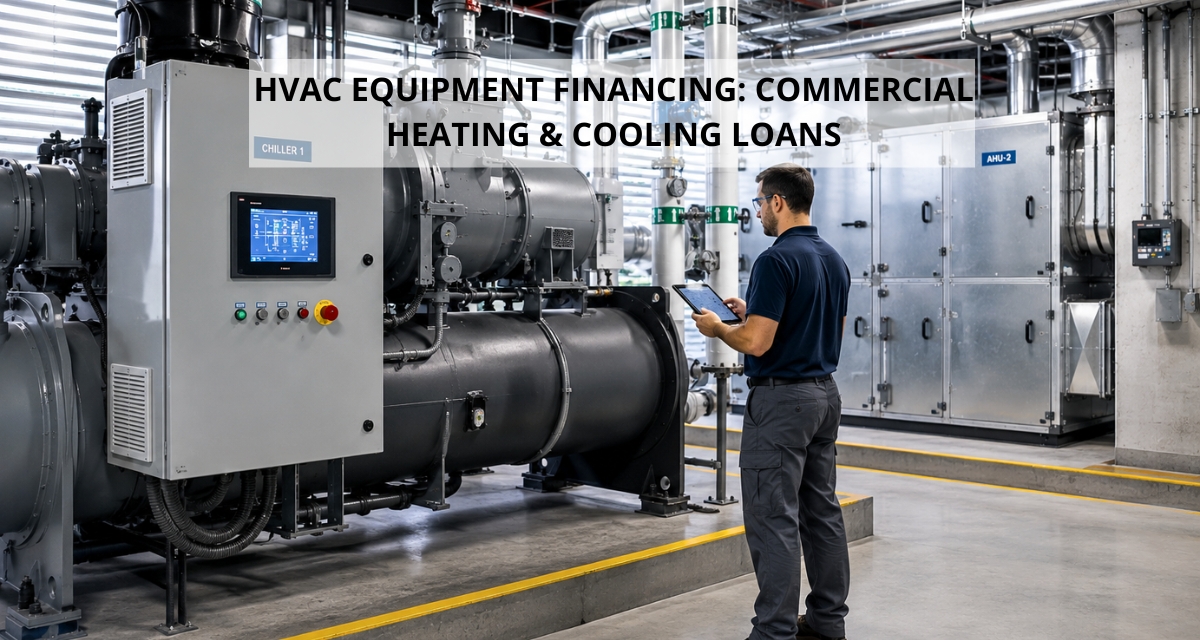
HVAC equipment financing covers the purchase of commercial heating, ventilation, air conditioning, and refrigeration systems for business facilities, including rooftop units, chillers, boilers, air handling units, heat pumps, and building controls. 

For businesses facing a planned or unplanned system replacement, Dimension Funding has financed commercial equipment since 1978, offering application-only approvals up to $250,000 and same-day approvals in most cases. Lenders evaluate time in business, credit profile, and revenue when structuring a financing arrangement. 

Dimension Funding finances new and used commercial HVAC equipment under commercial equipment financing terms that bundle equipment, delivery, and installation into a single fixed monthly payment, with terms extending up to 60 months. Deferred payment options are available for businesses that need time before payments begin, subject to program restrictions.

What Commercial HVAC Financing Covers

Dimension Funding finances the full range of commercial heating and cooling systems: rooftop packaged units, chillers, boilers, furnaces, air handling units, variable refrigerant flow (VRF) systems, heat pumps, cooling towers, commercial refrigeration, and building automation controls.

Delivery, installation, and setup costs are bundled into the financing. When building controls software is included alongside hardware, the application-only threshold rises to $500,000.

The Replacement Cycle That Drives Most HVAC Purchases

Most commercial HVAC financing is not about acquiring new capability. It is about replacing equipment that has reached the end of its service life.

According to ASHRAE (the American Society of Heating, Refrigerating and Air-Conditioning Engineers), commercial HVAC systems last an average of 15 to 20 years, with packaged rooftop units averaging 15 years. That timeline is predictable, and it arrives whether or not the budget was ready for it.

The replacement and retrofit segment accounted for 54.9% of the global HVAC market in 2025, per Global Market Insights. The commercial HVAC market was valued at $63 billion in 2024, according to Market Research Future, driven largely by aging installed equipment reaching end of life across office buildings, retail facilities, warehouses, and medical offices. Financing keeps working capital intact when that moment hits, rather than forcing a large cash outlay on the equipment’s schedule rather than the business’s.

How Lenders Evaluate a Commercial HVAC Application

Time in business, credit profile, and revenue are the primary factors. Dimension Funding prefers at least two years in business. Businesses newer than two years with strong credit can still qualify. Applications under $250,000 require no financial statements. Transactions above $250,000 involve a review of basic financials, though the process moves faster than a conventional bank underwriting cycle.

Dimension Funding works with most credit profiles, from Tier A down to marginal credit. That range matters in practice because a system failure does not wait for credit conditions to improve.

Emergency vs. Planned Replacements

Commercial HVAC failures split into two scenarios, and financing works differently in each.

Planned replacements happen when a facility manager identifies aging equipment before it fails. A chiller approaching 20 years, a rooftop unit with declining efficiency, or a boiler past its service window are candidates for proactive replacement. Financing can be structured in advance, payments modeled against budget, and the transition managed on schedule.

Emergency replacements happen when equipment fails without warning, often in high-demand conditions. Speed of financing matters here. Dimension Funding’s same-day approvals and funding within two to three business days are designed for situations where a facility cannot wait through a standard bank loan timeline.

Both scenarios use the same structure: 100% of project costs are financed, with one fixed monthly payment and no large cash outlay when the purchase is forced.

Financing vs. Paying Cash

A commercial rooftop unit or chiller arrives on the equipment’s schedule, not the business’s. For a restaurant, medical office, warehouse, or retail location, a failed system can result in lost productivity, customer discomfort, or noncompliance.

Financing converts that forced capital event into a fixed monthly obligation spread across up to 60 months. The facility operates normally from day one. Working capital stays available for payroll, inventory, and the operating costs that continue regardless.

IRS Section 179 applies here as well. Under 2025 rules, qualifying HVAC equipment placed in service before December 31 can be deducted up to $2,500,000 in the year of purchase, per Section179.org. Both new and used equipment qualifies. 

A business can take the full deduction in year one, while cash payments are spread over the financing term. The IRS Section 179 deduction page on Dimension Funding’s site explains how this applies to financed HVAC purchases. Confirm with a CPA before filing.

Applying for Commercial HVAC Financing

Dimension Funding finances commercial HVAC equipment from the contractor or vendor of the business’s choice. The application is electronic; execution runs through DocuSign; approvals come back the same day in most cases, with funding within two to three business days. Applications under $250,000 require no financial statements. Transactions above $250,000 require recent tax returns and basic financials.

Use Dimension Funding’s payment calculator to model monthly payment ranges before applying. The financing application handles requests from single-location businesses through multi-site operators replacing systems across several properties. The team is reachable at 1.800.755.0585.

Frequently Asked Questions

What types of commercial HVAC equipment can I finance through Dimension Funding?

Dimension Funding finances virtually any commercial heating and cooling system, including rooftop packaged units, chillers, boilers, air handling units, VRF systems, heat pumps, cooling towers, and commercial refrigeration. Delivery, installation, and building automation controls can be included in the same financing package.

How much can a business finance without providing financial statements?

Equipment financing up to $250,000 requires no financial statements. When building controls software is included alongside hardware, the application-only threshold rises to $500,000. Transactions above those amounts require basic financials but process faster than a conventional bank loan.

Does my business need to be established to qualify for HVAC financing?

Dimension Funding prefers at least two years in business, though businesses newer than two years with strong credit can still qualify. Time in business, revenue, and credit profile are all considered during the review.

Can I finance a replacement HVAC system on short notice if my current system fails?

Yes. Dimension Funding offers same-day approvals with funding typically within two to three business days. The electronic application and DocuSign execution are designed to move quickly, which matters when a facility cannot operate without a functioning system.

Does financing HVAC equipment qualify for an IRS Section 179 deduction?

Financed commercial HVAC equipment placed in service during the tax year generally qualifies for Section 179, which allows deductions up to $2,500,000 for 2025 per Section179.org. Both new and used equipment qualify. A business can take the full deduction in year one, while cash payments are spread over the financing term. Confirm eligibility with a CPA before filing.

Can I finance used commercial HVAC equipment?

Yes. Dimension Funding finances both new and used commercial HVAC systems under the same program terms. Used chillers, rooftop units, and air handling equipment qualify for the same fixed monthly payment structure as new purchases, with delivery and installation included.

How long does it take to get approved and funded?

Most approvals come back the same day. Funding typically follows within two to three business days. The entire process is handled electronically via DocuSign, with no physical paperwork required.

Manufacturing Equipment Financing: CNC, Assembly & Production

Manufacturing Equipment Financing

Manufacturing Equipment Financing: CNC, Assembly & Production

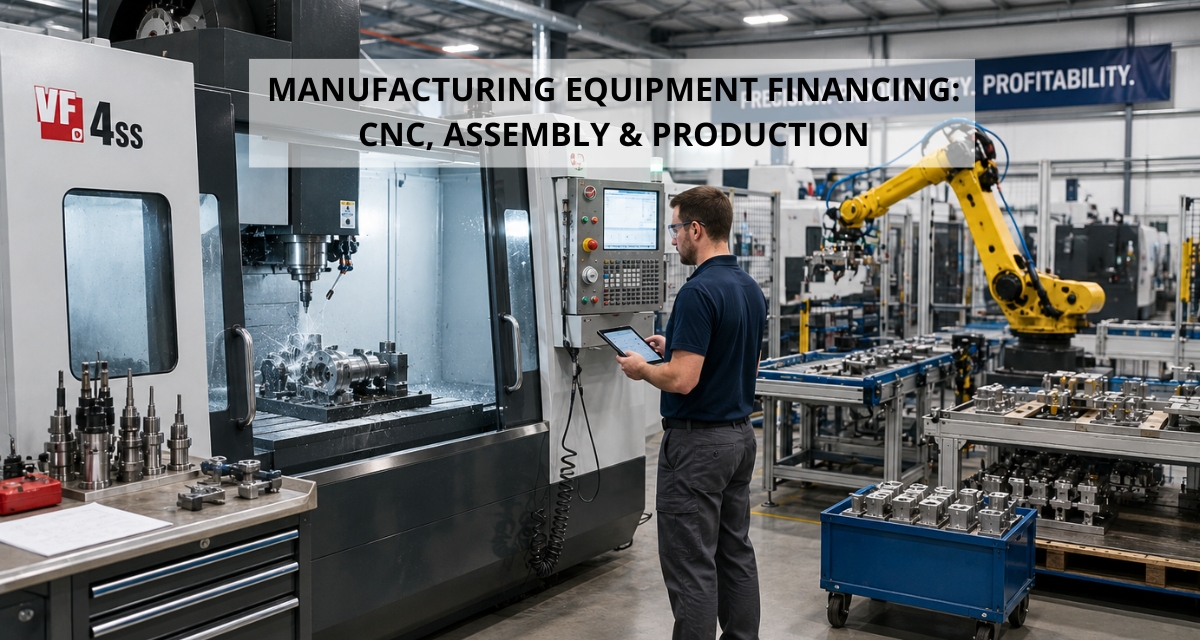
Manufacturing equipment financing covers the purchase or lease of production machinery and industrial technology used in fabrication, processing, and assembly operations, including CNC machines, lathes, press brakes, welding systems, conveyor lines, robotic arms, and quality control equipment. 

Lenders evaluate the business’s credit profile, revenue, and time in operation when structuring a financing arrangement. For manufacturers looking to add capacity or replace aging production assets without tying up working capital, Dimension Funding has been financing commercial and industrial equipment since 1978, with application-only approvals up to $250,000 and same-day funding in most cases.

Dimension Funding finances new and used manufacturing equipment under commercial equipment financing and industrial automation financing programs that bundle equipment, installation, software, and implementation costs into a single fixed monthly payment, with terms extending up to 60 months.

What Manufacturing Equipment Financing Covers

The financeable scope spans the entire production floor. CNC machining centers, lathes, milling machines, press brakes, laser cutters, waterjet systems, injection molding equipment, stamping presses, welding and fabrication systems, robotic assembly cells, conveyor and material-handling systems, inspection and quality-control equipment, and ERP or manufacturing execution system (MES) software all qualify.

Dimension Funding finances entire project costs, including design, implementation, consulting, staff training, and multi-year maintenance and support contracts, not just the equipment itself. When software is included alongside hardware, the application-only threshold rises to $500,000.

Why Manufacturers Finance Equipment

Machinery manufacturing in the U.S. generated $208.6 billion in nominal value added in 2024, according to Bureau of Economic Analysis data. That output runs on capital investment, and most manufacturers treat equipment financing as a standard operating tool.

The Equipment Leasing & Finance Foundation’s 2024 Horizon Report found that 82% of equipment end-users use some form of financing to fund their equipment and software acquisitions. Eight out of ten U.S. businesses use leases, secured loans, or lines of credit when acquiring equipment, according to the Equipment Leasing and Finance Association.

The logic is consistent across shop floors of every size. A CNC machining center or robotic assembly cell generates production throughput from day one. Paying cash for that asset immediately removes capital from circulation. Financing it over 48 or 60 months keeps working capital available for materials, labor, tooling, and the operational costs that run whether the floor is at full capacity or ramping up.

What Lenders Evaluate

Credit score, annual revenue, and time in business are the primary underwriting factors. Established manufacturers with two or more years of operating history move through the process faster. Newer operations or shops undergoing significant capacity expansion are typically asked to provide a business plan or projected revenue documentation.

On collateral: conventional bank financing for manufacturing equipment often involves a blanket lien on all business assets, not just the machines being purchased. Dimension Funding’s equipment financing uses only the financed equipment as security. For manufacturers carrying real estate debt, inventory financing, or other business credit lines, keeping those assets separate from a single equipment purchase matters.

Dimension Funding accepts most credit profiles, from Tier A down to marginal credit. Applications under $250,000 require no financial statements. Transactions above $250,000 involve a review of basic financials and move faster than a conventional bank underwriting cycle.

New Equipment, Used Equipment, Same Program

Dimension Funding finances both new and used manufacturing equipment under the same terms. In many production environments, certified pre-owned CNC machines, press brakes, and injection molding equipment deliver identical output to new units at a lower acquisition cost.

Used equipment qualifies for the same fixed monthly payment structure as new. Delivery, installation, and commissioning costs are included either way. For manufacturers running a rolling replacement schedule across multiple production cells, that consistency in financing structure makes capital planning straightforward.

The Section 179 Dimension

IRS Section 179 interacts directly with manufacturing equipment financing, shifting the effective economics of a purchase. Under 2025 rules, qualifying equipment placed in service before December 31 can be deducted up to $2,500,000 in the year of purchase, per Section179.org. Both new and used equipment qualifies.

A manufacturer that finances a machining center or robotic cell can take the full purchase price as a tax deduction in year one, while the actual cash payments are spread over the financing term. The IRS Section 179 deduction page on Dimension Funding’s site explains how this applies to financed equipment purchases. Confirm specifics with a CPA before filing.

Applying for Manufacturing Equipment Financing

Dimension Funding finances production equipment from the vendor of the manufacturer’s choice. The application is electronic, execution runs through DocuSign, and funding typically follows within 24 hours of approval. Applications under $250,000 require no financial statements. Transactions above $250,000 require recent tax returns and basic financials.

Use Dimension Funding’s payment calculator to model monthly payment ranges before applying. The financing application handles requests from small job shops adding a single CNC machine through mid-sized manufacturers replacing full production lines. The team is reachable at 1.800.755.0585.

Frequently Asked Questions

What types of manufacturing equipment can I finance through Dimension Funding?

Dimension Funding finances virtually any production machinery, including CNC machining centers, lathes, press brakes, laser cutters, injection molding equipment, welding systems, robotic assembly cells, conveyor systems, and quality control equipment. Installation, commissioning, software, training, and multi-year support contracts can all be included in the same financing package.

How much can a manufacturer finance without providing financial statements?

Equipment financing up to $250,000 requires no financial statements. When manufacturing software or automation systems are included alongside hardware, the application-only threshold rises to $500,000. Transactions above those amounts require basic financials but process faster than a conventional bank loan.

What credit score do I need to qualify for financing for manufacturing equipment?

Dimension Funding works with most credit profiles, from strong commercial credit down to marginal ratings. Revenue, time in business, and overall financial picture are weighed alongside credit score. A lower score does not automatically disqualify an application.

Does financing manufacturing equipment put my other business assets at risk?

No. Dimension Funding uses only the financed equipment as security, not a blanket lien on all business assets. That matters for manufacturers carrying real estate debt, inventory lines, or other business credit that should not be tied to a single equipment purchase.

Can I finance used CNC machines or pre-owned production equipment?

Yes. Both new and certified pre-owned manufacturing equipment qualify under the same financing terms. Used CNC machines, press brakes, and injection molding equipment often deliver the same production output as new units at a lower acquisition cost, and financing either option produces the same fixed monthly payment structure.

Does financing manufacturing equipment qualify for an IRS Section 179 deduction?

Financed manufacturing equipment placed in service during the tax year generally qualifies for Section 179, which allows deductions up to $2,500,000 for 2025 per Section179.org. Both new and used equipment qualify. A manufacturer can take the full deduction in year one, while cash payments are spread over the financing term. Confirm eligibility with a CPA before filing.

How long does it take to get approved and funded?

Most approvals come back the same day. Funding typically follows within 24 hours. The entire process is handled electronically via DocuSign, with no physical paperwork required.

Agricultural Equipment Financing: Farm Machinery Loans

Agricultural Equipment Financing

Agricultural Equipment Financing: Farm Machinery Loans

Agricultural equipment financing covers the purchase or lease of machinery used in commercial farming operations, including tractors, combines, planters, tillage equipment, irrigation systems, and harvesting technology. 

Lenders evaluate the operation’s credit profile, farm revenue, and time in business when structuring a financing arrangement. For producers looking to acquire or replace machinery without drawing down working capital, Dimension Funding has been financing commercial equipment since 1978, with application-only approvals up to $250,000 and same-day funding in most cases.

Dimension Funding finances new and used farm equipment under commercial equipment financing terms that bundle delivery, installation, and associated costs into a single fixed monthly payment, with terms extending up to 60 months.

What Agricultural Equipment Financing Covers

Financing applies across the full range of farm machinery. Tractors, combine harvesters, planters, seeders, sprayers, tillage implements, balers, forage equipment, grain handling systems, irrigation infrastructure, livestock handling equipment, and precision agriculture technology all qualify.

Delivery, setup, and associated third-party costs can be bundled into the same package, keeping post-purchase invoices off the farm’s cash position. Farm management software included alongside hardware raises the application-only threshold to $500,000.

The Capital Reality of Modern Farming

Farm machinery and vehicle assets across the U.S. farm sector reached $383.4 billion in 2024, according to USDA Economic Research Service data. That figure reflects how capital-intensive modern agricultural operations have become, where a single tractor, combine, or precision planting system represents a significant commitment before a seed goes in the ground.

The global agricultural equipment finance market was valued at $63.24 billion in 2024, per Grand View Research, with loan structures accounting for 44.1% of total financing volume. Most farm operations, regardless of size, treat equipment financing as standard practice rather than a last resort.

Farm loans at U.S. banks and thrifts hit a decade-high of more than $205 billion in Q4 2024, according to S&P Global Market Intelligence. Producers who manage that financing well keep working capital available for seeds, fuel, labor, and the unpredictable costs that come with every growing season.

How Lenders Evaluate a Farm Financing Application

Credit score, farm revenue, and time in operation are the primary underwriting factors. Established operations with two or more years of tax returns move through faster. New operations carry more underwriting risk and are typically asked for a business plan or projected revenue in place of operating history.

On collateral: standard bank financing for farm equipment often involves a blanket lien on all farm assets, not just the machinery being purchased. Dimension Funding’s equipment financing uses only the financed equipment as security, leaving the rest of the operation’s assets unencumbered. That matters for farms carrying land debt, crop financing, or livestock assets that should not be tied to a single equipment purchase.

Dimension Funding accepts most credit profiles, from Tier A down to marginal credit. Applications under $250,000 require no financial statements. Transactions above $250,000 involve a review of basic financials, though the process moves faster than a conventional bank underwriting cycle.

New Equipment, Used Equipment, Same Program

Dimension Funding finances both new and used farm equipment under the same terms. Used tractors, combines, and implements account for a significant share of agricultural equipment acquisitions, and financing either option yields the same fixed monthly payment structure.

Delivery and installation costs are included either way. For operations replacing aging machinery on a rolling basis, that consistency makes planning straightforward.

Financing vs. Paying Cash

A farm that pays cash for a tractor or combine removes that capital from circulation at the start of the season. The same purchase financed over 48 or 60 months preserves the cash position to cover seed, fertilizer, fuel, crop insurance, and the operating costs that run from planting through harvest.

IRS Section 179 adds a tax dimension worth understanding. Under 2025 rules, qualifying farm equipment placed in service before December 31 can be deducted up to $2,500,000 in the year of purchase, per Section179.org. Both new and used equipment qualifies. A farm can take the full deduction in year one, while the cash payments are spread over the financing term. The IRS Section 179 deduction page on Dimension Funding’s site explains how this applies to financed purchases. Confirm specifics with a CPA before filing.

Applying for Agricultural Equipment Financing

Dimension Funding finances farm equipment from the vendor of the operation’s choice. The application is electronic, execution runs through DocuSign, and funding typically follows within 24 hours of approval. Applications under $250,000 require no financial statements. Transactions above $250,000 require recent tax returns and basic financials.

Use Dimension Funding’s payment calculator to model monthly payment ranges before applying. The financing application handles requests from small family operations adding a single piece of equipment through larger commercial farms replacing full machinery lineups. The team is reachable at 1.800.755.0585.

Frequently Asked Questions

What types of farm equipment can I finance through Dimension Funding?

Dimension Funding finances virtually any agricultural equipment, including tractors, combine harvesters, planters, sprayers, tillage implements, balers, grain handling systems, irrigation infrastructure, and precision agriculture technology. Delivery, setup, and farm management software can be included in the same financing package.

How much can a farm operation finance without providing financial statements?

Equipment financing up to $250,000 requires no financial statements. If farm management software is included alongside hardware, the application-only threshold rises to $500,000. Transactions above those amounts require basic financials but process faster than a conventional bank loan.

What credit score do I need to qualify for agricultural equipment financing?

Dimension Funding works with most credit profiles, from strong commercial credit down to marginal ratings. Farm revenue, time in operation, and overall financial picture are weighed alongside credit score. A lower score does not automatically disqualify an application.

Does financing farm equipment put my other farm assets at risk?

No. Dimension Funding uses only the financed equipment as security, not a blanket lien on all farm assets. That matters for operations carrying land debt, crop financing, or livestock assets that should remain separate from an equipment purchase.

Can I finance used farm equipment?

Yes. Dimension Funding finances both new and used agricultural equipment under the same program terms. Used tractors, combines, and implements qualify for the same fixed monthly payment structure as new purchases, with delivery and setup costs included.

Does financing farm equipment qualify for an IRS Section 179 deduction?

Financed farm equipment placed in service during the tax year generally qualifies for Section 179, which allows deductions up to $2,500,000 for 2025 per Section179.org. Both new and used equipment qualifies. A farm can take the full deduction in year one while the cash payments run across the financing term. Confirm eligibility with a CPA before filing.

How long does it take to get approved and funded?

Most approvals come back the same day. Funding typically follows within 24 hours. The entire process runs electronically through DocuSign with no physical paperwork required.

Lab Equipment Financing: Fund Scientific Instruments & Research Tech

Lab Equipment Financing

Lab Equipment Financing: Fund Scientific Instruments & Research Tech

Lab equipment financing covers the purchase or lease of scientific instruments, analytical tools, and research technology used in commercial, clinical, or applied laboratory settings. Lenders evaluate the organization’s credit profile, time in operation, and revenue when structuring a financing arrangement. 

For labs looking to acquire instruments without tying up working capital, Dimension Funding has been financing commercial equipment since 1978, with application-only approvals up to $250,000 and same-day funding in most cases.

Dimension Funding finances new and used lab equipment under commercial equipment financing terms that bundle delivery, installation, maintenance, and associated costs into a single fixed monthly payment, with terms extending up to 60 months.

What Lab Equipment Financing Covers

The financeable list spans the full range of laboratory instrumentation. Dimension Funding finances analytical instruments, mass spectrometers, chromatography systems, centrifuges, microscopes, PCR machines, spectrophotometers, sequencing equipment, incubators, biosafety cabinets, cleanroom equipment, cryogenic storage, diagnostic analyzers, and laboratory information management systems (LIMS).

Third-party vendor costs, installation, calibration, staff training, and maintenance contracts can all be bundled into the same package. When lab management software is included alongside hardware, the application-only financing threshold rises to $500,000.

The Capital Weight of Equipping a Modern Lab

Global pharmaceutical R&D spending reached nearly $288 billion in 2024, according to Evaluate Pharma. That investment flows directly into demand for laboratory instrumentation, and the global laboratory equipment market reflects it: valued at $23.9 billion in 2025, per Global Market Insights, with pharmaceutical and biotechnology applications accounting for the largest share of purchases.

For individual labs, that demand translates into real capital pressure. A single mass spectrometer, sequencing platform, or flow cytometry system represents a major commitment before a single experiment runs. Equipping a full analytical lab compounds that quickly across multiple instrument categories.

Financing distributes that cost across a fixed monthly payment, keeping working capital available for reagents, staffing, and operational expenses. The equipment produces data and revenue from the moment it is installed, regardless of whether it was purchased outright or financed.

How Lenders Evaluate a Lab Financing Application

Credit score, time in business, and revenue are the primary underwriting factors. Established organizations with two or more years of operating history move through faster. Startups and early-stage labs carry more underwriting risk and are typically asked for a business plan, revenue projections, or grant documentation in place of operating history.

One consideration specific to labs: conventional bank lenders often lack the technical expertise to assess specialized scientific instruments as collateral. Equipment such as a gas chromatograph or a next-generation sequencer is not easily liquidated through standard channels, leading many banks to undervalue the asset or decline the transaction. 

Dimension Funding has been financing specialty commercial equipment for over four decades and works with most credit profiles, from Tier A down to marginal credit.

Applications under $250,000 require no financial statements. Transactions above $250,000 involve a review of basic financials, though the process moves faster than a conventional bank underwriting cycle.

New Equipment, Used Equipment, Same Program

Dimension Funding finances both new and used laboratory equipment under the same terms. In research settings, certified pre-owned instruments, particularly in analytical chemistry, imaging, and genomics, are a practical and widely used path to equipping a lab at a lower acquisition cost.

Used equipment qualifies for the same fixed monthly payment structure as new. Delivery, installation, and calibration costs are included either way, so there are no separate vendor invoices to resolve after the agreement closes.

Equipment Financing vs. Bank Loans: The Collateral Difference

Bank financing for lab equipment typically involves a blanket lien on all corporate assets rather than just the instrument being financed. That structure puts the broader business at risk in the event of a default, including assets unrelated to the financed equipment.

Dimension Funding’s equipment financing uses only the financed lab equipment as security. The rest of the organization’s assets stay unencumbered, which matters for labs managing grant-funded assets, intellectual property, or equipment held in partnership with institutional collaborators.

Financing vs. Paying Cash

A lab that pays cash for a sequencing platform or mass spectrometer removes that capital from circulation on day one. The same purchase financed over 48 months preserves the cash position to cover consumables, salaries, facility costs, and operational expenses that run continuously, whether or not a major instrument purchase has just closed.

IRS Section 179 sharpens that logic. Under 2025 rules, qualifying lab equipment placed in service before December 31 can be deducted up to $2,500,000 in the year of purchase, per Section179.org. Both new and used equipment qualifies. 

A lab can take the full tax deduction in year one, while the cash payments are spread across the financing term. The IRS Section 179 deduction page on Dimension Funding’s site explains how this applies to financed purchases. Confirm specifics with a CPA before filing.

Applying for Lab Equipment Financing

Dimension Funding works directly with labs and research organizations to finance equipment from the vendor of their choice. The application is electronic, execution runs through DocuSign, and funding typically follows within 24 hours of approval. Applications under $250,000 require no financial statements. Transactions above $250,000 require recent tax returns and basic financials.

Use Dimension Funding’s payment calculator to model monthly payment ranges before applying. The financing application handles requests from early-stage startups through established research operations adding capacity or replacing aging instruments. The team is reachable at 1.800.755.0585.

Frequently Asked Questions

What types of lab equipment can I finance through Dimension Funding?

Dimension Funding finances virtually any laboratory equipment, including mass spectrometers, chromatography systems, PCR machines, sequencers, microscopes, centrifuges, diagnostic analyzers, biosafety cabinets, and cryogenic storage systems. Installation, calibration, training, maintenance contracts, and lab management software can all be included in the same financing package.

How much can a lab finance without providing financial statements?

Equipment financing up to $250,000 requires no financial statements. If laboratory management software is included alongside hardware, the application-only threshold rises to $500,000. Transactions above those amounts require basic financials but process faster than a conventional bank loan.

What credit score do I need to qualify for lab equipment financing?

Dimension Funding works with most credit profiles, from strong commercial credit down to marginal ratings. Time in operation, revenue, and overall financial picture are weighed alongside credit score. A lower score does not automatically disqualify an application.

Can a startup lab or early-stage research company qualify for equipment financing?

Yes. Early-stage labs can apply. Startups are typically asked for a business plan, revenue projections, or grant documentation in place of operating history. Organizations with two or more years of tax returns on file move through the process faster.

Does financing lab equipment put my other business assets at risk?

No. Dimension Funding’s equipment financing uses only the financed lab equipment as security, not a blanket lien on all corporate assets. That distinction matters for labs managing grant-funded property, institutional partnerships, or other assets that should remain unencumbered.

Does lab equipment financing qualify for an IRS Section 179 deduction?

Financed lab equipment placed in service during the tax year generally qualifies for Section 179, which allows deductions up to $2,500,000 for 2025 per Section179.org. Both new and used equipment qualifies. A lab can take the full deduction in year one while the cash payments run across the financing term. Confirm eligibility with a CPA before filing.

How long does it take to get approved and funded?

Most approvals come back the same day. Funding typically follows within 24 hours. The entire process runs electronically through DocuSign with no physical paperwork required.