
NetSuite ERP Financing: Implementation, Licensing & Customization
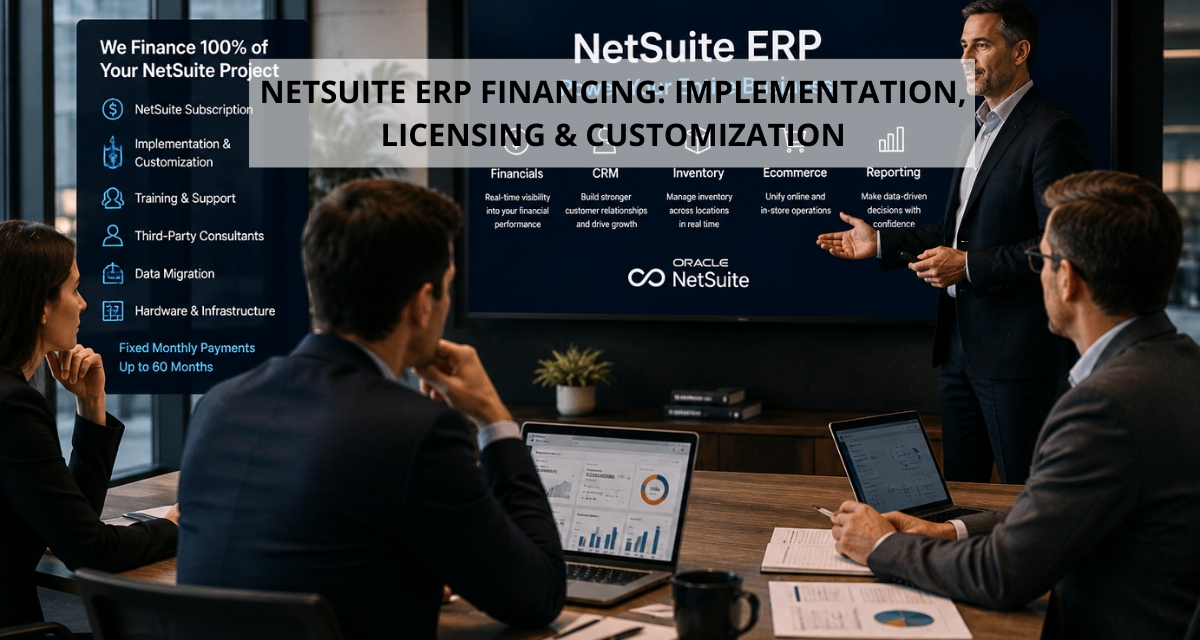
NetSuite ERP financing covers the full cost of a NetSuite deployment, including the annual subscription, implementation services, user training, customization work, third-party consultant fees, and any hardware purchased alongside the software.
Dimension Funding has provided ERP and software financing to small and mid-sized businesses across the U.S. since 1978. It works directly with NetSuite buyers and their implementation partners to structure financing that covers 100% of project costs under a single fixed monthly payment, with applications up to $500k with no financial statements required. Reach out to get a quote tied to your specific project scope.
What a NetSuite Deployment Actually Costs
Panorama Consulting’s 2025 ERP Report puts the average ERP implementation cost at approximately $450,000 for mid-sized organizations, and fewer than a third of implementations finish on time. Those numbers reflect how many cost layers stack on top of the base subscription, and how often businesses underestimate them going in.
NetSuite uses a named-user licensing model, meaning each person who accesses the system requires their own license. Full user licenses, required for roles such as financial controllers and operations managers, are priced at the higher end, while self-service licenses cover employees who need only limited access.
Beyond licensing, businesses add modules for inventory management, revenue recognition, manufacturing, or SuiteCommerce, each carrying its own monthly fee. Add-on modules commonly run between $399 and $999 per module per month according to ERP pricing research published by ERPRundown.
Implementation services are the most variable cost layer. According to the Software Pricing Guide’s 2025 NetSuite cost analysis, a small-business deployment with fewer than 10 users and a single legal entity typically costs between $30,000 and $75,000 for implementation alone.
Mid-market deployments with 20 to 50 users and moderate module complexity range from $75,000 to $200,000, while multi-entity environments using NetSuite OneWorld can reach $150,000 to $350,000. Implementation costs for small businesses also commonly run 1 to 5 times the annual software subscription fee, depending on complexity and partner selection, according to Folio3’s NetSuite pricing guide for 2026.
Training, data migration from legacy systems such as QuickBooks or Sage, and third-party consultant work added after go-live fall outside those figures entirely.
Why Lenders Treat NetSuite Projects Differently Than Equipment Loans
Software has no collateral value. There is no serial number, no resale market, no asset a lender can recover if a deal goes sideways. That is why most traditional banks pass on software financing while specialty lenders structure products specifically built for it.
Software financing through Dimension Funding is structured as a fixed-term agreement, typically lasting up to 60 months, with the entire project bundled into a single monthly payment. The lender underwrites the deal based on the borrowing business’s creditworthiness.
For projects up to $250,000, Dimension Funding’s NetSuite financing requires no financial statements. Deals above $250,000 require some financials but remain a streamlined process rather than a full bank loan review.
The underwriting criteria that matter most are time in business, revenue consistency, and credit profile. A business that has operated for two or more years with steady revenue has a much cleaner path to approval than a startup, regardless of how detailed the NetSuite implementation plan looks on paper.
What Dimension Funding’s NetSuite Financing Covers
A single financing agreement can cover the NetSuite subscription itself, including multi-year contracts that lock in current pricing. Implementation and professional services are included, along with all user training costs for both the deployment team and end users.
Third-party consultant fees are covered even when those vendors are added after the initial agreement is signed. Hardware purchases, servers, workstations, and peripheral technology can be bundled in, as can delivery and maintenance costs tied to any hardware component.
Implementation costs are frequently the largest line item in a NetSuite project, and they often arrive in uneven installments rather than a single upfront invoice. Dimension Funding can include third-party vendor costs added mid-project, preventing businesses from having to renegotiate their financing structure once work is already underway.
Multi-year NetSuite subscriptions can also be financed under a single agreement, converting what would otherwise be a large annual payment into a predictable monthly amount while preserving working capital for operations.
How the Application and Funding Process Works
Software financing approvals at Dimension Funding typically come back within a few hours for straightforward applications. Funding is available within 48 hours of approval in most cases, and same-day funding is available once documentation is complete.
Applications up to $500,000 require no financial statements. Borrowers submit a credit application electronically, and DocuSign handles the agreement. For larger projects, financial statements are required, but the review process remains considerably faster than that for a conventional bank loan.
Dimension Funding has held an A+ rating from the Better Business Bureau since its founding in 1978. The sales team’s average tenure exceeds 20 years, which is relevant in software financing because experience with deal structures matters when bundling complex, multi-vendor cost components into a single agreement.
Subscription Structure and Zero-Percent Options
NetSuite is sold as an annual subscription, which creates a straightforward cash flow problem: the full annual fee is typically due at or near the start of the contract period. Financing converts that obligation into a fixed monthly payment spread over terms of up to 60 months.
Some NetSuite implementation partners offer promotional zero-percent financing on new deployments, typically for 12-month terms, as a sales tool to close deals faster. These arrangements run through the reseller and Oracle’s vendor financing program, and they apply conditions around which services qualify.
Independent financing through a company like Dimension Funding is not structured at zero percent. Still, it provides broader coverage, longer terms, and the ability to bundle third-party costs that a vendor financing program would exclude.
Businesses evaluating both options should compare total coverage rather than headline terms. A 12-month zero-percent promotion that excludes implementation and training costs leaves the two largest project expenses outside the financing agreement.
Financing a NetSuite Renewal or Mid-Cycle Upgrade
NetSuite deployments rarely stay static. Businesses add modules, expand user counts, or engage consultants for customization work throughout the lifecycle of their subscription. Software renewal financing through Dimension Funding covers annual subscription renewals, module additions, and post-implementation customization engagements under the same financing structure as the original deployment.
Renewal invoices often arrive on a schedule that doesn’t match a business’s cash flow cycle. Financing a renewal spreads the obligation over the renewal term and preserves working capital for operations.
Customization costs are often the most unpredictable expense in a NetSuite environment. According to Panorama Consulting’s data, cited in NetSuite’s 2024 ERP statistics, only 7% of organizations run their ERP systems without modification. The remaining 93% require some degree of customization. When those projects are scoped and executed by third-party developers, the invoices can be included in a Dimension Funding financing agreement in the same way as any other project cost.
What to Know Before You Apply
Businesses that go into a NetSuite financing application with a clear picture of their total project scope get better outcomes than those who treat the financing as an afterthought. Before applying, get a detailed project quote from your NetSuite partner that itemizes the subscription, implementation, training, and any third-party consultants. Determine whether hardware will be purchased alongside the software, as it can be bundled into the same agreement. Also decide on your desired term length, longer terms lower the monthly payment but extend the total obligation.
Dimension Funding structures its ERP financing agreements to accommodate projects that span multiple vendors and cost types, so a complete project quote is the right starting document, not just the Oracle subscription invoice.
Use the payment calculator on the Dimension Funding site to estimate monthly payments for a 36-, 48-, or 60-month term. When you’re ready to move forward, apply here or contact the team directly for a quote tied to your project scope.
Frequently Asked Questions
Does NetSuite ERP financing cover implementation costs in addition to the subscription?
Yes. Dimension Funding’s NetSuite financing covers 100% of project costs, including subscription, implementation, professional services, training, third-party consultant fees, and hardware. Costs from third-party vendors can be added to the financing agreement even after the initial subscription has been financed.
How much does a NetSuite implementation typically cost for a small or mid-sized business?
According to the Software Pricing Guide’s 2025 analysis, a small-business deployment with under 10 users and a single legal entity costs between $30,000 and $75,000 for implementation services alone, not including the annual subscription. Mid-market deployments with 20 to 50 users commonly range from $75,000 to $200,000 for implementation. Total first-year costs, including subscriptions, modules, and services, typically range from $25,000 to $300,000, depending on scope.
What credit score do I need to qualify for NetSuite financing?
Dimension Funding works with a broad range of credit profiles and does not publish a minimum score threshold. Businesses with two or more years of operating history and consistent revenue have the most straightforward path to approval. The underwriting reviews the full picture of the business, not a single number.
Can a multi-year NetSuite subscription be financed?
Yes. Multi-year subscriptions can be financed under a single agreement, allowing a business to lock in current subscription pricing and convert the obligation into fixed monthly payments rather than a large annual outlay.
How long does the approval and funding process take?
Most approvals come back within a few hours for standard applications. Funding typically follows within 48 hours of approval, and same-day funding is available when documentation is complete.
What is the maximum financing amount available without financial statements?
Dimension Funding approves NetSuite software financing up to $500,000 on an application-only basis, meaning no financial statements are required. Projects above $500,000 require financials but remain a faster and less paperwork-intensive process than a conventional bank loan.
Can a NetSuite financing agreement cover a renewal invoice that comes up mid-year?
Yes. Dimension Funding offers software renewal financing that covers NetSuite subscription renewals, module additions, and post-implementation customization costs. Renewal financing spreads the annual invoice into monthly payments, preserving working capital for other business needs.