
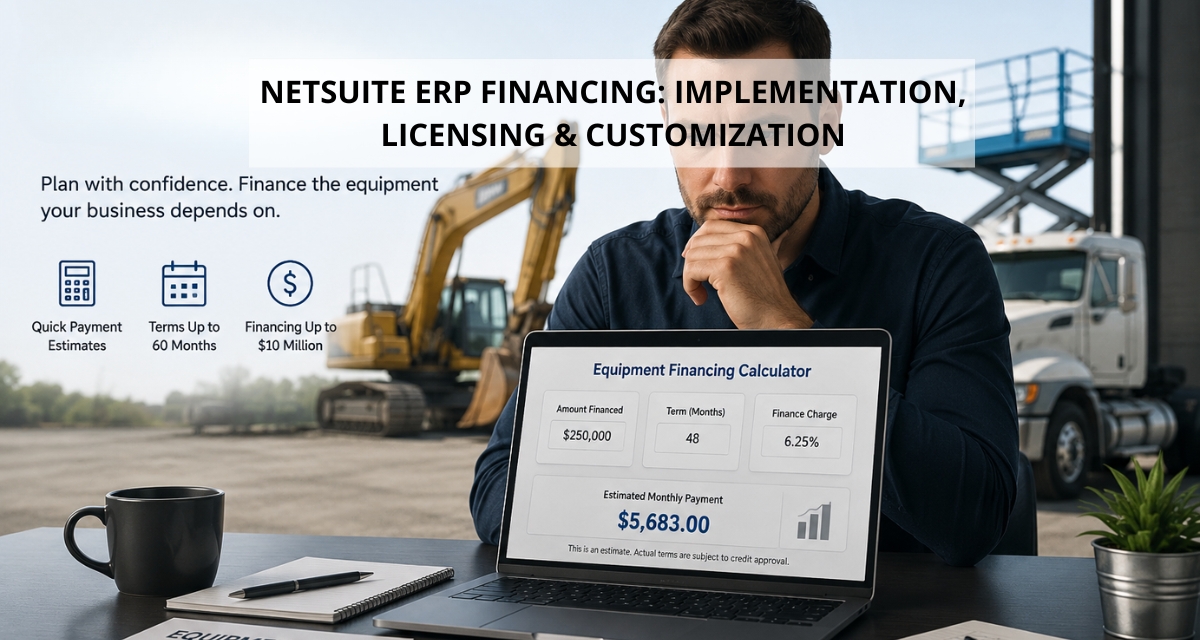
Equipment Financing Calculator: Estimate Monthly Payments (Tool)
An equipment financing calculator estimates the fixed monthly payment for a financed equipment purchase by taking three inputs: the total amount financed, the repayment term in months, and the finance charge applied by the lender.
Knowing that number before applying lets a business compare the monthly obligation against what the equipment is expected to produce. Dimension Funding’s payment calculator covers equipment and software across nearly every commercial category, with terms up to 60 months and financing available up to $10 million.
Use the calculator to estimate your monthly payment, then contact the Dimension Funding team for a formal quote tailored to your specific project.
What the Calculator Actually Computes
The monthly payment on a financed equipment purchase is a function of three variables: amount financed, term length, and the finance charge built into the agreement.
Term length is the most controllable variable for most borrowers. Dimension Funding offers terms of up to 60 months for commercial equipment financing, giving a business real room to adjust the monthly obligation.
A 36-month term on the same financed amount produces a meaningfully higher payment than a 60-month term. The tradeoff is that a longer term means carrying the finance charge over more months. The right term depends on what the equipment produces relative to the monthly cost of carrying it.
The lender sets the finance charge based on the borrowing business’s credit profile, the type of equipment, and whether the application requires financial statements. For projects up to $250,000, Dimension Funding approves equipment financing on an application-only basis. That threshold covers the majority of small and mid-market equipment purchases outright.
The calculator output is an estimate. Actual payment amounts are confirmed when an application is reviewed, and a formal quote is issued.
How to Use the Calculator Effectively
Enter the total project cost, not just the equipment purchase price. If installation, delivery, extended warranty, or accessories are being financed alongside the equipment itself, those amounts should be included in the total financed amount. Dimension Funding’s equipment leasing and financing programs cover soft costs bundled with the equipment purchase.
Run the calculation at two or three different term lengths before deciding which to pursue. A business buying a commercial truck might find that a 48-month term keeps the monthly payment within a target range while a 36-month term pushes it above what the route revenue supports. Seeing both numbers before applying gives the borrower a clearer position going into the application.
Keep the monthly payment in context of the equipment’s productive output. The useful question is whether the equipment generates enough additional revenue or operational savings each month to carry the payment and leave margin. A piece of construction equipment that adds two billable days per month should be evaluated against the financing cost on those terms.
What Equipment Qualifies
Dimension Funding finances almost every category of commercial equipment.
Construction equipment, including excavators, bulldozers, cranes, and dump trucks, is among the most commonly financed categories. According to the Equipment Leasing and Finance Association (ELFA), construction consistently ranks as the top industry by equipment financing volume in the U.S., representing 12 to 15% of total market activity.
Commercial trucks, trailers, and fleet vehicles are financed over a range of terms, depending on vehicle type and expected useful life.
Medical equipment, lab equipment, restaurant and food-processing equipment, brewery equipment, material-handling equipment, IT hardware, and recycling equipment all qualify under the same application structure. New and used equipment are both eligible. Used equipment financing is available for well-maintained, late-model assets with established secondary market value.
The ELFA’s 2024 Equipment Leasing and Finance U.S. Economic Outlook found that more than 8 in 10 U.S. companies use some form of financing when acquiring equipment, including loans, leases, and lines of credit.
Financing vs. Leasing: What Changes in the Calculation
An equipment financing calculator and an equipment lease calculator produce different outputs because their underlying structures differ. In a financing arrangement, the borrower takes ownership of the equipment and repays the full financed amount plus the finance charge over the term.
At the end of the term, the business owns the equipment outright. Monthly payments on a financed purchase are typically higher than lease payments on equivalent equipment because the borrower is paying down the full asset value.
In an equipment lease, the borrower pays for use of the equipment over the term. Lease payments are often lower because they are calculated based on the equipment’s depreciation cost over the lease period rather than its full value. At the end of a standard operating lease, the business returns the equipment. Some lease structures include a purchase option at fair market value or a nominal buyout amount.
Whether financing or leasing yields a lower monthly payment depends on the type of equipment, how long the business expects to use it, and whether ownership at the end of the term matters. Dimension Funding’s calculator reflects a financing structure. For businesses evaluating a lease, the financing team can model both scenarios based on the specific equipment and project cost.
Section 179 and the Monthly Payment Picture
One number the calculator does not model is the tax treatment of the financed equipment. IRS Section 179 allows businesses to deduct the full purchase price of qualifying equipment placed in service during the tax year, up to the annual limit set by the IRS. Dimension Funding’s Section 179 resource page covers the current year limits and how the deduction applies to financed purchases.
A business can take a full-year deduction in the same tax year the equipment is placed in service, even while spreading the actual cash outlay over 36 to 60 monthly payments. This does not change the monthly payment the calculator produces, but it does change how that payment is treated for the business’s tax position for the year. Consulting a tax advisor before finalizing a financed purchase is the right step.
How Dimension Funding Structures the Quote
The payment calculator gives an estimate. A formal quote from Dimension Funding’s financing team gives the actual monthly payment, term options, and any documentation requirements specific to the deal.
For equipment projects up to $250,000, the application requires no financial statements. Approvals typically come back within a few hours. Funding is available within 48 hours of approval in most cases, and same-day funding is available once documentation is complete. For projects above $250,000, financial statements are required, but the process remains considerably faster than a bank loan review.
Dimension Funding has held an A+ rating from the Better Business Bureau and has been operating since 1978. The sales team averages more than 20 years of tenure, which is relevant when a deal involves bundled costs or multiple asset types that need to be structured into a single agreement.
Once a business has its calculator estimate in hand, the next step is to submit a financing application to obtain the actual quote. The application is electronic, agreements are handled through DocuSign, and funding is available within 48 hours of approval.
Frequently Asked Questions
How does an equipment financing calculator estimate monthly payments?
An equipment financing calculator applies a finance charge, derived from the term length and the lender’s credit-based pricing, to the financed amount, then divides the result by the number of months in the term to produce a fixed monthly payment estimate. The output is an approximation — actual payment amounts are confirmed when the lender issues a formal quote after reviewing the application.
What is a good monthly payment for equipment financing?
A practical benchmark is whether the monthly payment is covered by the revenue or cost savings generated by the equipment. If a financed piece of equipment adds consistent billable capacity each month, the payment should be evaluated against that output. Most lenders, including Dimension Funding, structure terms up to 60 months specifically to keep monthly payments within the range a business’s cash flow can support.
Can I finance used equipment with the same calculator?
Yes. Dimension Funding finances both new and used commercial equipment, and the calculator applies to either. Used equipment is evaluated on the asset’s age, condition, and secondary market value. Well-maintained, late-model equipment in categories like construction, commercial trucks, and medical devices is routinely approved.
What is the maximum term available on equipment financing?
Dimension Funding offers terms up to 60 months on commercial equipment financing. Longer terms lower the monthly payment but extend the total financing obligation. The appropriate term length depends on the equipment type, its expected productive life, and the monthly cash flow the business is working within.
How much can I finance without providing financial statements?
Dimension Funding approves equipment financing up to $250,000 on an application-only basis, with no financial statements required. Projects above $250,000 require financial documentation but remain a faster and less document-intensive process than a traditional bank loan.
What is the difference between equipment financing and equipment leasing for monthly payment purposes?
A financing arrangement calculates the monthly payment against the full financed value of the equipment, with ownership transferring to the borrower at the end of the term. A lease calculates payments based on the equipment’s expected depreciation over the lease period, which typically results in a lower monthly payment. Dimension Funding can model both structures for a given equipment purchase.
Does financing equipment affect my Section 179 deduction?
Financed equipment can qualify for the IRS Section 179 deduction in the year it is placed in service, even though the cash outlay is spread across monthly payments over the financing term. The deduction is applied to the full purchase price, not just the portion paid in the tax year. A tax advisor should confirm eligibility for specific purchases and current year deduction limits.