
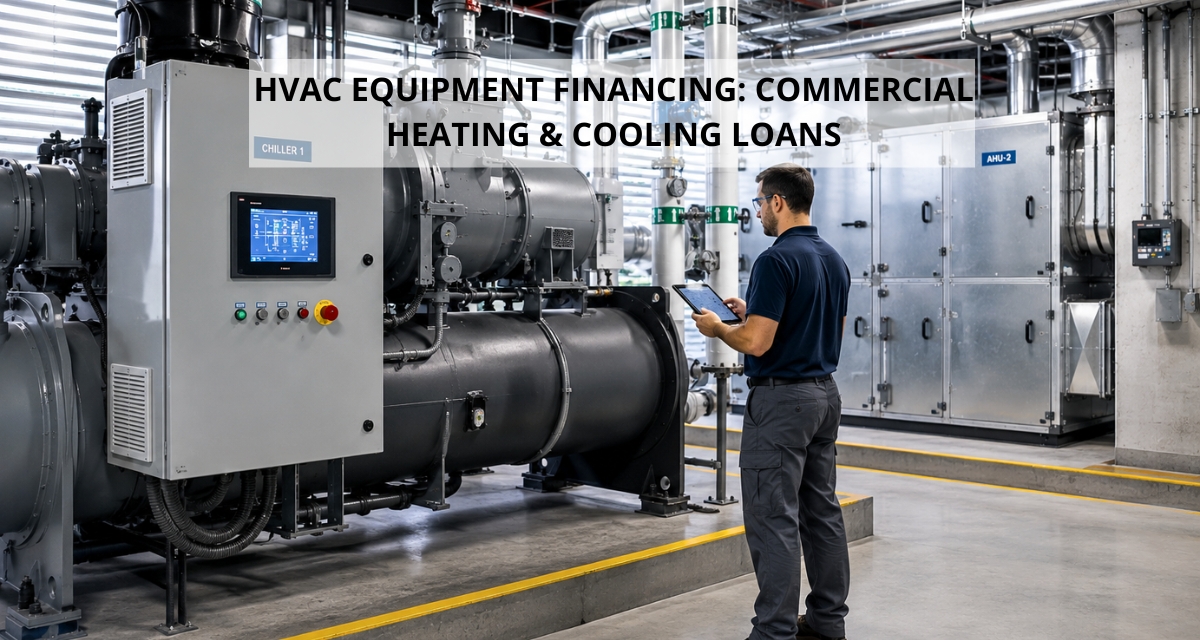
HVAC Equipment Financing: Commercial Heating & Cooling Loans
HVAC equipment financing covers the purchase of commercial heating, ventilation, air conditioning, and refrigeration systems for business facilities, including rooftop units, chillers, boilers, air handling units, heat pumps, and building controls.
For businesses facing a planned or unplanned system replacement, Dimension Funding has financed commercial equipment since 1978, offering application-only approvals up to $250,000 and same-day approvals in most cases. Lenders evaluate time in business, credit profile, and revenue when structuring a financing arrangement.
Dimension Funding finances new and used commercial HVAC equipment under commercial equipment financing terms that bundle equipment, delivery, and installation into a single fixed monthly payment, with terms extending up to 60 months. Deferred payment options are available for businesses that need time before payments begin, subject to program restrictions.
What Commercial HVAC Financing Covers
Dimension Funding finances the full range of commercial heating and cooling systems: rooftop packaged units, chillers, boilers, furnaces, air handling units, variable refrigerant flow (VRF) systems, heat pumps, cooling towers, commercial refrigeration, and building automation controls.
Delivery, installation, and setup costs are bundled into the financing. When building controls software is included alongside hardware, the application-only threshold rises to $500,000.
The Replacement Cycle That Drives Most HVAC Purchases
Most commercial HVAC financing is not about acquiring new capability. It is about replacing equipment that has reached the end of its service life.
According to ASHRAE (the American Society of Heating, Refrigerating and Air-Conditioning Engineers), commercial HVAC systems last an average of 15 to 20 years, with packaged rooftop units averaging 15 years. That timeline is predictable, and it arrives whether or not the budget was ready for it.
The replacement and retrofit segment accounted for 54.9% of the global HVAC market in 2025, per Global Market Insights. The commercial HVAC market was valued at $63 billion in 2024, according to Market Research Future, driven largely by aging installed equipment reaching end of life across office buildings, retail facilities, warehouses, and medical offices. Financing keeps working capital intact when that moment hits, rather than forcing a large cash outlay on the equipment’s schedule rather than the business’s.
How Lenders Evaluate a Commercial HVAC Application
Time in business, credit profile, and revenue are the primary factors. Dimension Funding prefers at least two years in business. Businesses newer than two years with strong credit can still qualify. Applications under $250,000 require no financial statements. Transactions above $250,000 involve a review of basic financials, though the process moves faster than a conventional bank underwriting cycle.
Dimension Funding works with most credit profiles, from Tier A down to marginal credit. That range matters in practice because a system failure does not wait for credit conditions to improve.
Emergency vs. Planned Replacements
Commercial HVAC failures split into two scenarios, and financing works differently in each.
Planned replacements happen when a facility manager identifies aging equipment before it fails. A chiller approaching 20 years, a rooftop unit with declining efficiency, or a boiler past its service window are candidates for proactive replacement. Financing can be structured in advance, payments modeled against budget, and the transition managed on schedule.
Emergency replacements happen when equipment fails without warning, often in high-demand conditions. Speed of financing matters here. Dimension Funding’s same-day approvals and funding within two to three business days are designed for situations where a facility cannot wait through a standard bank loan timeline.
Both scenarios use the same structure: 100% of project costs are financed, with one fixed monthly payment and no large cash outlay when the purchase is forced.
Financing vs. Paying Cash
A commercial rooftop unit or chiller arrives on the equipment’s schedule, not the business’s. For a restaurant, medical office, warehouse, or retail location, a failed system can result in lost productivity, customer discomfort, or noncompliance.
Financing converts that forced capital event into a fixed monthly obligation spread across up to 60 months. The facility operates normally from day one. Working capital stays available for payroll, inventory, and the operating costs that continue regardless.
IRS Section 179 applies here as well. Under 2025 rules, qualifying HVAC equipment placed in service before December 31 can be deducted up to $2,500,000 in the year of purchase, per Section179.org. Both new and used equipment qualifies.
A business can take the full deduction in year one, while cash payments are spread over the financing term. The IRS Section 179 deduction page on Dimension Funding’s site explains how this applies to financed HVAC purchases. Confirm with a CPA before filing.
Applying for Commercial HVAC Financing
Dimension Funding finances commercial HVAC equipment from the contractor or vendor of the business’s choice. The application is electronic; execution runs through DocuSign; approvals come back the same day in most cases, with funding within two to three business days. Applications under $250,000 require no financial statements. Transactions above $250,000 require recent tax returns and basic financials.
Use Dimension Funding’s payment calculator to model monthly payment ranges before applying. The financing application handles requests from single-location businesses through multi-site operators replacing systems across several properties. The team is reachable at 1.800.755.0585.
Frequently Asked Questions
What types of commercial HVAC equipment can I finance through Dimension Funding?
Dimension Funding finances virtually any commercial heating and cooling system, including rooftop packaged units, chillers, boilers, air handling units, VRF systems, heat pumps, cooling towers, and commercial refrigeration. Delivery, installation, and building automation controls can be included in the same financing package.
How much can a business finance without providing financial statements?
Equipment financing up to $250,000 requires no financial statements. When building controls software is included alongside hardware, the application-only threshold rises to $500,000. Transactions above those amounts require basic financials but process faster than a conventional bank loan.
Does my business need to be established to qualify for HVAC financing?
Dimension Funding prefers at least two years in business, though businesses newer than two years with strong credit can still qualify. Time in business, revenue, and credit profile are all considered during the review.
Can I finance a replacement HVAC system on short notice if my current system fails?
Yes. Dimension Funding offers same-day approvals with funding typically within two to three business days. The electronic application and DocuSign execution are designed to move quickly, which matters when a facility cannot operate without a functioning system.
Does financing HVAC equipment qualify for an IRS Section 179 deduction?
Financed commercial HVAC equipment placed in service during the tax year generally qualifies for Section 179, which allows deductions up to $2,500,000 for 2025 per Section179.org. Both new and used equipment qualify. A business can take the full deduction in year one, while cash payments are spread over the financing term. Confirm eligibility with a CPA before filing.
Can I finance used commercial HVAC equipment?
Yes. Dimension Funding finances both new and used commercial HVAC systems under the same program terms. Used chillers, rooftop units, and air handling equipment qualify for the same fixed monthly payment structure as new purchases, with delivery and installation included.
How long does it take to get approved and funded?
Most approvals come back the same day. Funding typically follows within two to three business days. The entire process is handled electronically via DocuSign, with no physical paperwork required.