
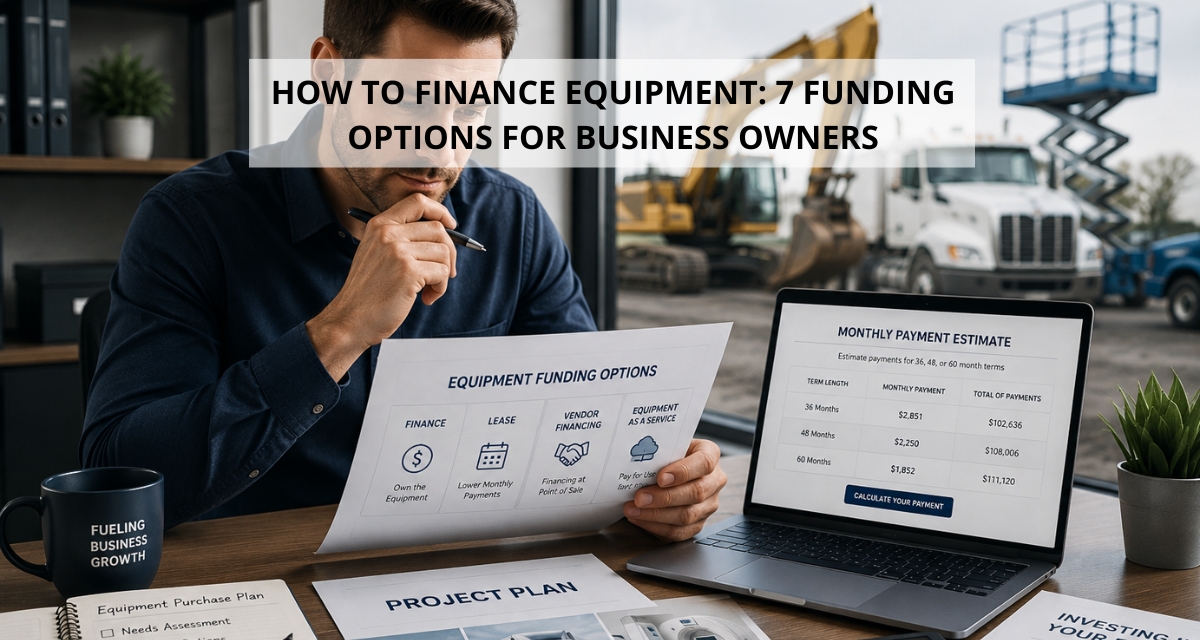
How to Finance Equipment: 7 Funding Options for Business Owners
Financing equipment means spreading the cost of a business asset across a fixed term rather than paying the full amount upfront, preserving working capital while the equipment generates revenue. The right method depends on the type of equipment, how long the business expects to use it, the borrower’s credit profile, and whether ownership at the end of the term matters.
Dimension Funding has provided commercial equipment and software financing to small and mid-sized businesses across the U.S. since 1978, covering everything from construction machinery and medical devices to enterprise software and IT hardware.
According to the Equipment Leasing and Finance Foundation’s 2024 Industry Horizon Report, 82% of businesses that acquired equipment or software in 2023 used at least one form of financing to do so, up from 79% in the 2022 survey. Leasing accounted for 26% of total acquisitions, secured loans 16%, and lines of credit 14%.
Use the Dimension Funding payment calculator to estimate monthly payments for 36-, 48-, or 60-month terms before deciding which funding path best fits your project.
1. Equipment Financing Through a Specialty Lender
An equipment financing agreement from a specialty lender funds the full purchase price of the equipment and converts it into fixed monthly payments over a set term. The lender underwrites the deal based on the borrowing business’s creditworthiness, the type of equipment, and whether the asset has strong secondary-market value. The borrower takes ownership of the equipment and holds it free and clear at the end of the term.
Specialty lenders underwrite based on the business’s credit profile and the equipment’s collateral value, rather than requiring the full financial documentation package that a bank demands. That difference in underwriting approach is why specialty lenders approve deals banks routinely decline, and why approvals come back in hours rather than weeks.
For projects up to $250,000, Dimension Funding approves on an application-only basis with no financial statements required. Funding is typically available within 48 hours, with same-day funding available once documentation is complete.
Terms range from 60 months on commercial equipment financing, and financing is available up to $10 million. New and used equipment both qualify. The application is electronic, and agreements are executed through DocuSign, so the borrower moves from approval to a funded deal without paperwork delays.
Best for:
Businesses that need fast approval, want ownership at the end of the term, and are purchasing equipment with established secondary-market value; construction, medical, trucking, material handling, food processing, and manufacturing are all well served by this structure.
2. Equipment Leasing
An equipment lease gives a business use of the equipment over a defined term without transferring ownership. Monthly payments are typically lower than those under a financing arrangement for equivalent equipment because they are calculated based on the asset’s depreciated value over the lease period rather than the full purchase price.
At the end of a standard operating lease, the business returns the equipment, upgrades to a newer model, or purchases the asset at fair market value. Some lease structures include a $1 buyout option, which effectively functions like a financing agreement but with the lower monthly payment profile of a lease during the term.
Equipment leasing makes the most practical sense for technology-heavy equipment categories where obsolescence is a real cost. IT hardware, diagnostic imaging equipment, and certain lab instruments depreciate faster than their useful life suggests. A lease lets a business stay current without being locked into an asset that has lost most of its market value by the end of the term.
The ELFA’s 2024 data confirms leasing as the most popular acquisition method for equipment and software in the U.S., accounting for 26% of total volume.
Best for:
Technology equipment, medical and diagnostic devices, and any category in which the equipment is likely to become obsolete before the end of a standard financing term.
3. Vendor Financing
Vendor financing is a credit arrangement structured between an equipment manufacturer or dealer and a third-party finance company, offered to the buyer at the point of sale. The buyer applies for financing directly through the vendor’s program, the finance company handles approval and funding, and the vendor receives full payment upfront. The buyer repays the finance company over the agreed term.
Buyers find vendor financing convenient because it happens inside the sales process and doesn’t require sourcing a separate lender. Approval criteria are often calibrated to the specific equipment being purchased, and promotional terms, including deferred payment periods and reduced-payment structures, are sometimes available through manufacturer programs on new equipment.
Dimension Funding’s vendor financing program operates on both sides of this relationship. For equipment vendors and manufacturers, Dimension Funding provides the financing infrastructure that lets them offer payment options directly to buyers. For buyers, vendor financing through Dimension Funding covers 100% of the purchase price, including delivery and installation, with the same application-only threshold up to $250,000.
Best for:
Buyers purchasing from a vendor who already has a financing program in place. Also a strong fit for equipment categories where the manufacturer offers promotional terms on new product lines.
4. Equipment-as-a-Service and Subscription Structures
Equipment-as-a-service (EaaS) is a structure in which a business pays a recurring subscription fee for access to equipment rather than purchasing or leasing it. The vendor retains ownership; the buyer gets full access, typically including maintenance, support, and upgrades within the subscription cost.
Capital expenditure is recognized as an operating expense; the asset never appears on the balance sheet as a capital liability, and the vendor is incentivized to keep the equipment functional because maintenance is bundled in.
EaaS adoption is accelerating. According to the Equipment Leasing and Finance Foundation’s 2024 Horizon Report, half of equipment and software end users already use some form of subscription-based model, with an additional 23% planning to adopt this option.
EaaS is most available in technology, medical, and industrial automation categories. Heavy construction equipment, commercial trucks, and specialized manufacturing machinery are rarely available through subscription models, which is why traditional financing and leasing continue to dominate these verticals.
Dimension Funding’s software financing and SaaS financing programs cover subscription-based software under the same structure as traditional equipment deals, allowing businesses to convert annual software subscription costs into fixed monthly payments.
Best for:
Businesses in technology, healthcare, and industrial automation where the vendor offers an EaaS program and the business prefers operating expense treatment over capital expenditure.
5. Business Line of Credit
A business line of credit gives a company access to a revolving pool of capital up to a set limit. Draws are made as needed, and the business repays what it borrows over time, restoring available credit. For equipment purchases, a line of credit functions similarly to a credit card: the business draws from the line at the point of purchase and repays on its own schedule rather than a fixed term set by the lender.
Lines of credit work well for frequent, lower-cost equipment purchases, where the flexibility to draw and repay on a rolling basis is more useful than a fixed-term loan structure. They are less well-suited to large equipment purchases. A $150,000 excavator financed on a revolving line of credit incurs variable payment obligations and typically carries a higher financing cost than a fixed-term equipment loan for the same amount.
Banks and credit unions offer lines of credit, but their approval criteria are more stringent than those of specialty lenders, and draw periods often come with conditions. Some lines require that the full balance be paid down to zero at least once annually. For businesses with established banking relationships and strong credit, a line of credit is a useful complement to equipment financing for smaller, recurring purchases.
Best for:
Smaller equipment, tools, and accessories purchased repeatedly, where the revolving structure adds more flexibility than a fixed loan. Less suitable as the primary funding source for major equipment acquisitions.
6. Working Capital Loans
A working capital loan is a short-term business loan designed to fund day-to-day operations rather than long-term asset purchases. For equipment, working capital loans are most practical when the purchase is modest in size, and the business needs fast access to cash without the documentation requirements of a traditional bank loan.
Dimension Funding offers working capital loans with a one-page application, weekly or daily repayment plans, and terms up to two years. The structure differs meaningfully from equipment financing: repayment is faster, the term is shorter, and the equipment itself does not secure the loan. That unsecured structure means approval decisions lean heavily on revenue consistency and time in business rather than the collateral value of what’s being purchased.
A two-year repayment term on a $75,000 piece of equipment results in a substantially higher monthly obligation than the same purchase financed over 48 or 60 months through an equipment-specific program. For businesses that need equipment quickly and plan to repay within 12 to 24 months, the structure works. For major capital purchases intended to generate revenue over several years, equipment financing is the more cost-effective structure.
Best for:
Smaller purchases under $50,000 where the business needs fast access to cash and can service a short repayment term. Also useful as a bridge while waiting for an equipment financing application to be funded for a larger deal.
7. Cash Purchase and Section 179 Planning
Paying cash for equipment eliminates monthly payment obligations and, depending on tax position, can be structured to generate a full-year deduction in the year of purchase through IRS Section 179. For 2025, the Section 179 deduction limit is $1,160,000, allowing businesses to write off the full cost of qualifying equipment placed in service during the tax year rather than depreciating it over its useful life.
A contractor who pays $200,000 cash for a crane and eliminates a monthly payment also eliminates $200,000 from working capital that could fund materials, payroll, or a second piece of equipment. Financing the crane and deploying that $200,000 toward revenue-generating activity often produces a better total outcome, particularly when the financed monthly payment is covered by what the crane bills.
The smarter approach is to finance the equipment and take the Section 179 deduction on the financed purchase. As Dimension Funding’s Section 179 resource page explains, financed equipment qualifies for the deduction in the year it is placed in service, even though the cash outlay is spread across monthly payments. A business gets the full tax benefit of ownership in year one while keeping its cash available for operations.
Best for:
Businesses with strong cash positions evaluating a large purchase and looking to optimize tax position. Most effective when combined with a financing arrangement that preserves working capital and captures the Section 179 deduction simultaneously.
Which Option Fits Your Situation
The deciding factors in any equipment purchase are the same: how large the monthly payment obligation is, how long the business plans to use the equipment, whether ownership matters, and what the tax position looks like in the year of purchase. Many businesses use equipment financing as their primary acquisition tool for major assets, maintain a line of credit for smaller recurring purchases, and deploy working capital loans as a bridge when timing requires it.
For most small and mid-sized businesses acquiring commercial equipment with a useful life of three years or more, a fixed-term equipment financing agreement from a specialty lender addresses all of those variables more predictably than cash, a revolving credit line, or a short-term loan.
Dimension Funding has held an A+ rating from the Better Business Bureau since its founding in 1978. Applications up to $250,000 require no financial statements, and the financing team averages more than 20 years of experience structuring deals across every major equipment category. Apply for financing or run your monthly payment estimate on the Dimension Funding calculator before your next equipment purchase.
Frequently Asked Questions
What is the most common way businesses finance equipment?
Leasing is the single most common method for acquiring equipment and software in the U.S., accounting for 26% of total acquisition volume in 2023 according to the Equipment Leasing and Finance Foundation’s 2024 Horizon Report. Secured loans and lines of credit follow at 16% and 14%, respectively. Across all methods combined, 82% of businesses that acquired equipment or software in 2023 used some form of financing rather than paying cash outright.
How much of an equipment purchase can be financed?
Dimension Funding finances 100% of the equipment purchase price, including delivery and installation. Down payments are not required on most commercial equipment deals, though a business with a thinner credit profile may be asked to provide one to reduce the lender’s exposure on larger transactions.
What credit score do I need to finance equipment?
Dimension Funding works with a broad range of credit profiles and does not publish a minimum score threshold. Businesses with two or more years of operating history, consistent revenue, and a clean credit profile have the most straightforward path to approval. For projects up to $250,000, the decision is based on the credit application, with no financial statements required.
Is it better to lease or finance equipment?
Leasing produces a lower monthly payment and keeps the asset off the balance sheet as a capital liability, but the business does not own the equipment at the end of the term. Financing results in a higher monthly payment but transfers full ownership at the end of the term. Leasing makes more sense for equipment that becomes obsolete quickly; financing makes more sense for equipment with a long useful life and strong secondary market value.
Can I finance used equipment?
Yes. Dimension Funding finances both new and used commercial equipment. Used equipment is evaluated on age, condition, and secondary market value. Well-maintained, late-model construction equipment, commercial trucks, and medical devices are routinely approved. Equipment that is more than 10 to 15 years old or has limited resale market may be subject to different underwriting criteria.
How fast can equipment financing be approved and funded?
Through Dimension Funding, most approvals come back within a few hours for standard applications up to $250,000. Funding follows within 48 hours of approval in most cases. Same-day funding is available when documentation is complete. The application is electronic, and agreements are executed through DocuSign.
Can I deduct financed equipment under Section 179?
Yes. Financed equipment qualifies for the IRS Section 179 deduction in the year it is placed in service, even though the actual cash outlay is spread across monthly payments over the financing term. The deduction applies to the full purchase price, not just the amount paid during the tax year. A tax advisor should confirm eligibility for specific equipment categories and verify the current year deduction limits before filing.