
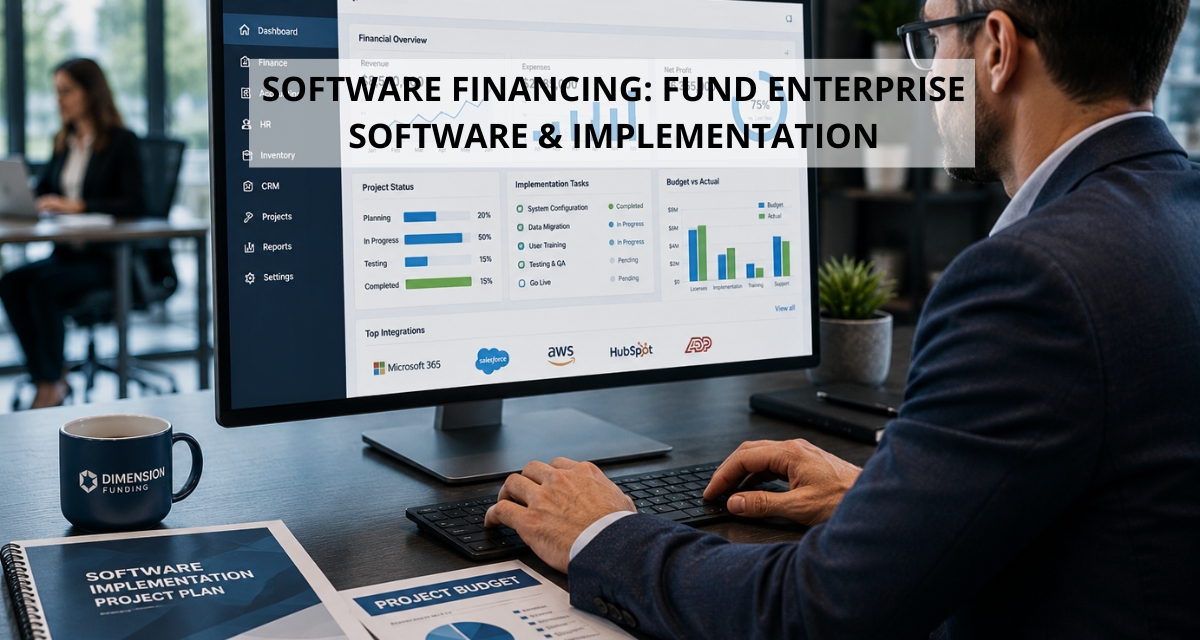
Software Financing: Fund Enterprise Software & Implementation
Software financing covers the full cost of a business software project: the license or subscription, implementation services, staff training, third-party consultants, and associated hardware, all spread over fixed monthly payments rather than a single upfront outlay. Lenders evaluate business credit, time in business, and total project scope when structuring the agreement.
Dimension Funding has provided software financing to small and mid-sized businesses across the U.S. since 1978, with application-only approvals of up to $500,000 that require no financial statements.
Most businesses underestimate what an enterprise software project actually costs. The license or subscription fee is the starting point, not the total. Implementation, data migration, staff training, and third-party consulting routinely match or exceed the cost of the platform itself. Financing covers the entire project, not just the software purchase.
Contact Dimension Funding to get a quote built around your specific project scope.
What a Software Project Actually Bills You For
Enterprise software projects rarely arrive with a single invoice. A business adopting a new ERP system typically receives separate proposals from the platform vendor, an implementation partner, a data migration specialist, and a hardware supplier. Each is a distinct cost center, billed separately, often on different timelines. Financing consolidates all of them into one monthly payment.
Dimension Funding finances every cost category that touches a software deployment:
- Software licenses and SaaS subscription fees, including multi-year commitments
- Implementation and configuration services
- Staff and administrator training
- Third-party consultants and integration specialists
- Hardware, computers, and IT infrastructure tied to the deployment
- Delivery, maintenance, and ongoing support agreements
- Renewal fees on existing platforms
Every one of those line items can go into a single financing agreement rather than hitting your operating budget as separate invoices.
Why the Real Number Is Always Higher Than the Quote
According to research compiled by Sci-Tech Today, 64% of ERP implementations exceed their initial budget, with average cost overruns ranging from 25% to 40% of the original estimate. For a small or mid-sized business, that gap between the quoted figure and the final bill is often what derails the project.
The categories that tend to catch businesses off guard are implementation labor and third-party consulting. A platform like SAP, NetSuite, Odoo, or Acumatica requires configuration work before it reflects a specific company’s processes.
That work is billed by implementation partners at professional services rates, separate from what the software vendor charges. The same is true of staff training. No software project is operational without it, yet training costs are often omitted from the initial budget.
Financing does not reduce those costs. What it does is convert them from a capital event into a monthly operating line. A business that would otherwise deplete its working capital or draw down a credit line to fund a software deployment keeps both intact by financing the full project scope instead.
How ERP and Subscription Software Financing Works
ERP financing covers the full project cost regardless of which platform a business has selected: SAP, Sage, SageIntacct, Odoo, Acumatica, NetSuite, Microsoft Dynamics, Oracle, Workday, Infor, and others all qualify under the same program terms.
For subscription-based software, annual contracts convert into monthly payments. This is particularly useful for multi-year agreements, where a vendor may offer a discount for committing to a longer term upfront. Financing allows a business to capture multi-year pricing without concentrating the full cost in year one.
For total project financing, the structure covers 100% of acquisition costs across all the categories above. Dimension Funding finances projects up to $500,000 on an application-only basis, with no financial statements required. Projects above $500,000 require documentation but move through a similarly direct process.
Terms run up to 60 months. That matters because a software platform a business will use for five years should be paid across five years, not front-loaded into the first invoice cycle. A 60-month term aligns the payment schedule with the asset’s actual useful life rather than a generic bank amortization schedule.
Software Financing by Industry
The cost structure of a software project varies by sector, and so does the financing.
Medical and Healthcare Software
Medical software financing covers EHR and EMR platforms, practice management systems, and implementation costs. Healthcare software transitions carry a specific burden that most other sectors do not: clinical staff must be trained and validated before go-live, which extends the implementation timeline and increases consulting hours. Those costs are eligible for financing alongside the platform itself.
Legal Practice Management Software
Legal practice management software involves substantial data migration from legacy case management systems that most law firms have used for years. The migration work alone can match the licensing cost. Financing covers the full project, including any third-party consultant engaged to manage the transition.
HR, Payroll, and Accounting Software
HR and accounting software deployments frequently involve hardware upgrades alongside the platform switch, since payroll and financial reporting systems have specific processing requirements. Infrastructure costs associated with the deployment are eligible for inclusion in the financing, not treated as a separate line item.
Application-Only Approvals Up to $500,000
Traditional lenders typically require financial statements for any loan above a modest threshold. Dimension Funding’s application-only approval covers software projects up to $500,000 with no financial statements required, which handles a large share of ERP and enterprise software deployments outright.
Approvals come back within a few hours of submitting the application on most transactions. Funding typically follows within 48 hours, with same-day funding available on qualifying deals. Electronic documentation and DocuSign are used throughout.
That speed matters for a practical reason: software vendors commonly require payment before the go-live date, not after. A financing process that takes weeks creates a timing problem in the middle of a procurement cycle with a fixed project schedule. Fast approvals keep the vendor timeline intact.
Four Ways to Structure a Software Financing Agreement
Not every software financing situation has the same shape. Dimension Funding works across four common structures depending on what a business is financing and when.
Bundled project financing combines the software subscription, implementation services, hardware, and third-party vendor costs into one monthly payment. This is the standard structure for a business deploying a new platform from scratch.
Maintenance and services financing covers support or service contracts as a standalone agreement, with the payment term matched to the service contract term. This applies to businesses that have already purchased the underlying software but want to spread recurring support costs over time rather than pay a lump sum each year.
Multi-year subscription financing allows a business to commit to a longer vendor contract, locking in current pricing while paying monthly.
According to Gartner projections reported by Xensam, global enterprise software spending is on track to reach $1.25 trillion in 2025, a 14.2% increase over 2024, with a significant portion of that growth attributable to AI capabilities embedded in existing platforms and driving price increases. Locking in a multi-year contract before those increases take effect, with monthly financing, can yield real savings over the subscription period.
Renewal financing covers the cost of renewing an existing software subscription. This use case is frequently overlooked: a business that financed the original platform purchase often handles the renewal with cash, when the same financing structure is available for the renewal invoice.
Finance Your Full Software Project With Dimension Funding
Dimension Funding structures software financing to cover licenses, implementation, training, hardware, and third-party services in a single monthly payment over terms up to 60 months. Application-only approvals cover projects up to $500,000 and require no financial statements. Most decisions arrive within hours and funding typically follows within 48 hours.
Use the payment calculator to model monthly payments for your project, or submit a financing application to get a quote tailored to your specific software and implementation scope.
Frequently Asked Questions
What types of business software can be financed?
Almost any type of business software qualifies, including ERP platforms such as SAP, NetSuite, Sage, Odoo, and Acumatica, as well as CRM systems, HR and payroll software, legal practice management platforms, medical EHR and EMR systems, and SaaS subscriptions. Dimension Funding also finances renewals on existing platforms.
Does software financing cover implementation and training costs?
Yes. Dimension Funding provides 100% project financing, which includes implementation services, staff training, third-party consultants, data migration, hardware, and IT infrastructure tied to the deployment, not just the license or subscription fee.
How much can I finance without providing financial statements?
Software projects up to $500,000 qualify for application-only financing with no financial statements required. Projects above that threshold undergo a structured review that still proceeds efficiently.
What credit score do I need to qualify for software financing?
Dimension Funding works with a wide range of business credit profiles. Good credit typically produces an approval within a few hours, but businesses with less established credit histories may still qualify. A financing specialist reviews each application individually.
How long does approval and funding take?
Most approvals come through within a few hours of submitting the financing application, with some exceptions for larger or more complex transactions. Funding commonly follows within 48 hours of approval, and same-day funding is available on qualifying projects.
Can I finance a multi-year software subscription on monthly terms?
Yes. Annual and multi-year subscription contracts can be converted into monthly payments through Dimension Funding’s financing program. This lets businesses commit to a longer contract term with the vendor to lock in pricing while paying monthly.
Are software subscription renewals eligible for financing?
Yes. Software renewal financing applies to subscription renewals for ERP, CRM, HR, accounting, legal, and medical software platforms. Businesses facing a renewal invoice can finance it rather than drawing on operating cash or a line of credit.