

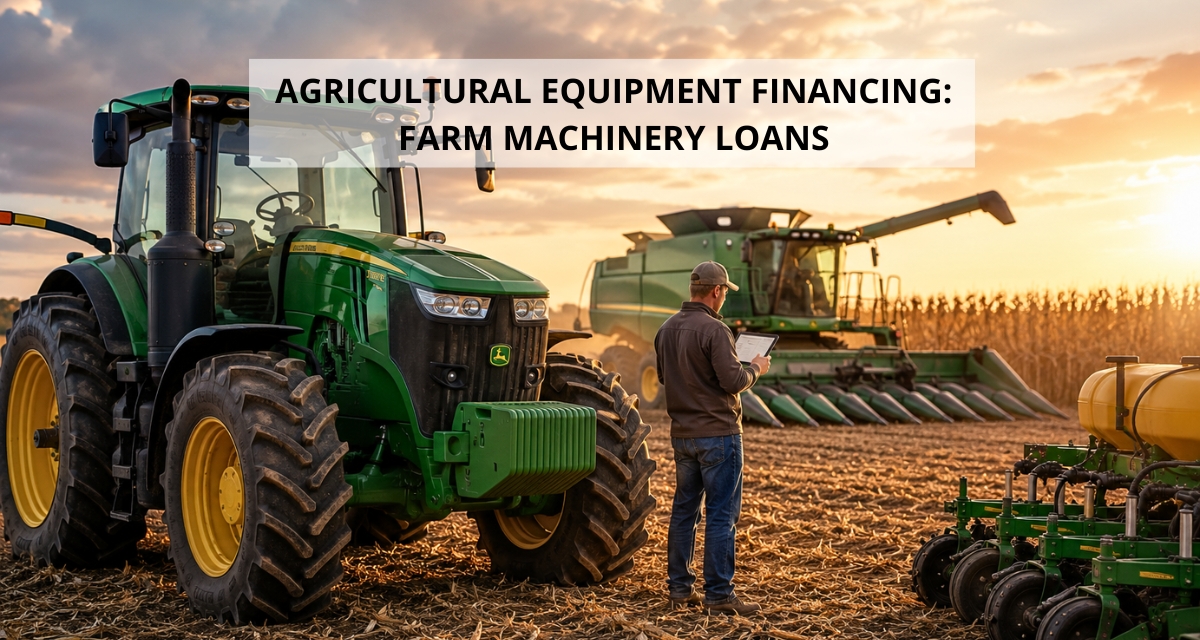
Agricultural Equipment Financing: Farm Machinery Loans
Agricultural equipment financing covers the purchase or lease of machinery used in commercial farming operations, including tractors, combines, planters, tillage equipment, irrigation systems, and harvesting technology.
Lenders evaluate the operation’s credit profile, farm revenue, and time in business when structuring a financing arrangement. For producers looking to acquire or replace machinery without drawing down working capital, Dimension Funding has been financing commercial equipment since 1978, with application-only approvals up to $250,000 and same-day funding in most cases.
Dimension Funding finances new and used farm equipment under commercial equipment financing terms that bundle delivery, installation, and associated costs into a single fixed monthly payment, with terms extending up to 60 months.
What Agricultural Equipment Financing Covers
Financing applies across the full range of farm machinery. Tractors, combine harvesters, planters, seeders, sprayers, tillage implements, balers, forage equipment, grain handling systems, irrigation infrastructure, livestock handling equipment, and precision agriculture technology all qualify.
Delivery, setup, and associated third-party costs can be bundled into the same package, keeping post-purchase invoices off the farm’s cash position. Farm management software included alongside hardware raises the application-only threshold to $500,000.
The Capital Reality of Modern Farming
Farm machinery and vehicle assets across the U.S. farm sector reached $383.4 billion in 2024, according to USDA Economic Research Service data. That figure reflects how capital-intensive modern agricultural operations have become, where a single tractor, combine, or precision planting system represents a significant commitment before a seed goes in the ground.
The global agricultural equipment finance market was valued at $63.24 billion in 2024, per Grand View Research, with loan structures accounting for 44.1% of total financing volume. Most farm operations, regardless of size, treat equipment financing as standard practice rather than a last resort.
Farm loans at U.S. banks and thrifts hit a decade-high of more than $205 billion in Q4 2024, according to S&P Global Market Intelligence. Producers who manage that financing well keep working capital available for seeds, fuel, labor, and the unpredictable costs that come with every growing season.
How Lenders Evaluate a Farm Financing Application
Credit score, farm revenue, and time in operation are the primary underwriting factors. Established operations with two or more years of tax returns move through faster. New operations carry more underwriting risk and are typically asked for a business plan or projected revenue in place of operating history.
On collateral: standard bank financing for farm equipment often involves a blanket lien on all farm assets, not just the machinery being purchased. Dimension Funding’s equipment financing uses only the financed equipment as security, leaving the rest of the operation’s assets unencumbered. That matters for farms carrying land debt, crop financing, or livestock assets that should not be tied to a single equipment purchase.
Dimension Funding accepts most credit profiles, from Tier A down to marginal credit. Applications under $250,000 require no financial statements. Transactions above $250,000 involve a review of basic financials, though the process moves faster than a conventional bank underwriting cycle.
New Equipment, Used Equipment, Same Program
Dimension Funding finances both new and used farm equipment under the same terms. Used tractors, combines, and implements account for a significant share of agricultural equipment acquisitions, and financing either option yields the same fixed monthly payment structure.
Delivery and installation costs are included either way. For operations replacing aging machinery on a rolling basis, that consistency makes planning straightforward.
Financing vs. Paying Cash
A farm that pays cash for a tractor or combine removes that capital from circulation at the start of the season. The same purchase financed over 48 or 60 months preserves the cash position to cover seed, fertilizer, fuel, crop insurance, and the operating costs that run from planting through harvest.
IRS Section 179 adds a tax dimension worth understanding. Under 2025 rules, qualifying farm equipment placed in service before December 31 can be deducted up to $2,500,000 in the year of purchase, per Section179.org. Both new and used equipment qualifies. A farm can take the full deduction in year one, while the cash payments are spread over the financing term. The IRS Section 179 deduction page on Dimension Funding’s site explains how this applies to financed purchases. Confirm specifics with a CPA before filing.
Applying for Agricultural Equipment Financing
Dimension Funding finances farm equipment from the vendor of the operation’s choice. The application is electronic, execution runs through DocuSign, and funding typically follows within 24 hours of approval. Applications under $250,000 require no financial statements. Transactions above $250,000 require recent tax returns and basic financials.
Use Dimension Funding’s payment calculator to model monthly payment ranges before applying. The financing application handles requests from small family operations adding a single piece of equipment through larger commercial farms replacing full machinery lineups. The team is reachable at 1.800.755.0585.
Frequently Asked Questions
What types of farm equipment can I finance through Dimension Funding?
Dimension Funding finances virtually any agricultural equipment, including tractors, combine harvesters, planters, sprayers, tillage implements, balers, grain handling systems, irrigation infrastructure, and precision agriculture technology. Delivery, setup, and farm management software can be included in the same financing package.
How much can a farm operation finance without providing financial statements?
Equipment financing up to $250,000 requires no financial statements. If farm management software is included alongside hardware, the application-only threshold rises to $500,000. Transactions above those amounts require basic financials but process faster than a conventional bank loan.
What credit score do I need to qualify for agricultural equipment financing?
Dimension Funding works with most credit profiles, from strong commercial credit down to marginal ratings. Farm revenue, time in operation, and overall financial picture are weighed alongside credit score. A lower score does not automatically disqualify an application.
Does financing farm equipment put my other farm assets at risk?
No. Dimension Funding uses only the financed equipment as security, not a blanket lien on all farm assets. That matters for operations carrying land debt, crop financing, or livestock assets that should remain separate from an equipment purchase.
Can I finance used farm equipment?
Yes. Dimension Funding finances both new and used agricultural equipment under the same program terms. Used tractors, combines, and implements qualify for the same fixed monthly payment structure as new purchases, with delivery and setup costs included.
Does financing farm equipment qualify for an IRS Section 179 deduction?
Financed farm equipment placed in service during the tax year generally qualifies for Section 179, which allows deductions up to $2,500,000 for 2025 per Section179.org. Both new and used equipment qualifies. A farm can take the full deduction in year one while the cash payments run across the financing term. Confirm eligibility with a CPA before filing.
How long does it take to get approved and funded?
Most approvals come back the same day. Funding typically follows within 24 hours. The entire process runs electronically through DocuSign with no physical paperwork required.