

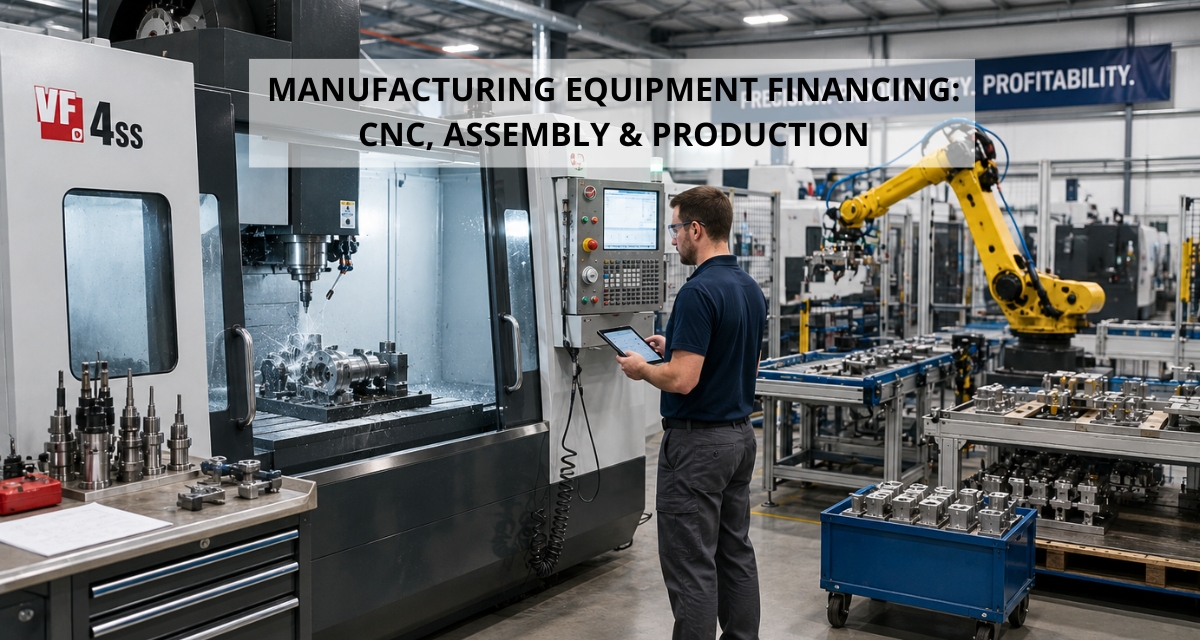
Manufacturing Equipment Financing: CNC, Assembly & Production
Manufacturing equipment financing covers the purchase or lease of production machinery and industrial technology used in fabrication, processing, and assembly operations, including CNC machines, lathes, press brakes, welding systems, conveyor lines, robotic arms, and quality control equipment.
Lenders evaluate the business’s credit profile, revenue, and time in operation when structuring a financing arrangement. For manufacturers looking to add capacity or replace aging production assets without tying up working capital, Dimension Funding has been financing commercial and industrial equipment since 1978, with application-only approvals up to $250,000 and same-day funding in most cases.
Dimension Funding finances new and used manufacturing equipment under commercial equipment financing and industrial automation financing programs that bundle equipment, installation, software, and implementation costs into a single fixed monthly payment, with terms extending up to 60 months.
What Manufacturing Equipment Financing Covers
The financeable scope spans the entire production floor. CNC machining centers, lathes, milling machines, press brakes, laser cutters, waterjet systems, injection molding equipment, stamping presses, welding and fabrication systems, robotic assembly cells, conveyor and material-handling systems, inspection and quality-control equipment, and ERP or manufacturing execution system (MES) software all qualify.
Dimension Funding finances entire project costs, including design, implementation, consulting, staff training, and multi-year maintenance and support contracts, not just the equipment itself. When software is included alongside hardware, the application-only threshold rises to $500,000.
Why Manufacturers Finance Equipment
Machinery manufacturing in the U.S. generated $208.6 billion in nominal value added in 2024, according to Bureau of Economic Analysis data. That output runs on capital investment, and most manufacturers treat equipment financing as a standard operating tool.
The Equipment Leasing & Finance Foundation’s 2024 Horizon Report found that 82% of equipment end-users use some form of financing to fund their equipment and software acquisitions. Eight out of ten U.S. businesses use leases, secured loans, or lines of credit when acquiring equipment, according to the Equipment Leasing and Finance Association.
The logic is consistent across shop floors of every size. A CNC machining center or robotic assembly cell generates production throughput from day one. Paying cash for that asset immediately removes capital from circulation. Financing it over 48 or 60 months keeps working capital available for materials, labor, tooling, and the operational costs that run whether the floor is at full capacity or ramping up.
What Lenders Evaluate
Credit score, annual revenue, and time in business are the primary underwriting factors. Established manufacturers with two or more years of operating history move through the process faster. Newer operations or shops undergoing significant capacity expansion are typically asked to provide a business plan or projected revenue documentation.
On collateral: conventional bank financing for manufacturing equipment often involves a blanket lien on all business assets, not just the machines being purchased. Dimension Funding’s equipment financing uses only the financed equipment as security. For manufacturers carrying real estate debt, inventory financing, or other business credit lines, keeping those assets separate from a single equipment purchase matters.
Dimension Funding accepts most credit profiles, from Tier A down to marginal credit. Applications under $250,000 require no financial statements. Transactions above $250,000 involve a review of basic financials and move faster than a conventional bank underwriting cycle.
New Equipment, Used Equipment, Same Program
Dimension Funding finances both new and used manufacturing equipment under the same terms. In many production environments, certified pre-owned CNC machines, press brakes, and injection molding equipment deliver identical output to new units at a lower acquisition cost.
Used equipment qualifies for the same fixed monthly payment structure as new. Delivery, installation, and commissioning costs are included either way. For manufacturers running a rolling replacement schedule across multiple production cells, that consistency in financing structure makes capital planning straightforward.
The Section 179 Dimension
IRS Section 179 interacts directly with manufacturing equipment financing, shifting the effective economics of a purchase. Under 2025 rules, qualifying equipment placed in service before December 31 can be deducted up to $2,500,000 in the year of purchase, per Section179.org. Both new and used equipment qualifies.
A manufacturer that finances a machining center or robotic cell can take the full purchase price as a tax deduction in year one, while the actual cash payments are spread over the financing term. The IRS Section 179 deduction page on Dimension Funding’s site explains how this applies to financed equipment purchases. Confirm specifics with a CPA before filing.
Applying for Manufacturing Equipment Financing
Dimension Funding finances production equipment from the vendor of the manufacturer’s choice. The application is electronic, execution runs through DocuSign, and funding typically follows within 24 hours of approval. Applications under $250,000 require no financial statements. Transactions above $250,000 require recent tax returns and basic financials.
Use Dimension Funding’s payment calculator to model monthly payment ranges before applying. The financing application handles requests from small job shops adding a single CNC machine through mid-sized manufacturers replacing full production lines. The team is reachable at 1.800.755.0585.
Frequently Asked Questions
What types of manufacturing equipment can I finance through Dimension Funding?
Dimension Funding finances virtually any production machinery, including CNC machining centers, lathes, press brakes, laser cutters, injection molding equipment, welding systems, robotic assembly cells, conveyor systems, and quality control equipment. Installation, commissioning, software, training, and multi-year support contracts can all be included in the same financing package.
How much can a manufacturer finance without providing financial statements?
Equipment financing up to $250,000 requires no financial statements. When manufacturing software or automation systems are included alongside hardware, the application-only threshold rises to $500,000. Transactions above those amounts require basic financials but process faster than a conventional bank loan.
What credit score do I need to qualify for financing for manufacturing equipment?
Dimension Funding works with most credit profiles, from strong commercial credit down to marginal ratings. Revenue, time in business, and overall financial picture are weighed alongside credit score. A lower score does not automatically disqualify an application.
Does financing manufacturing equipment put my other business assets at risk?
No. Dimension Funding uses only the financed equipment as security, not a blanket lien on all business assets. That matters for manufacturers carrying real estate debt, inventory lines, or other business credit that should not be tied to a single equipment purchase.
Can I finance used CNC machines or pre-owned production equipment?
Yes. Both new and certified pre-owned manufacturing equipment qualify under the same financing terms. Used CNC machines, press brakes, and injection molding equipment often deliver the same production output as new units at a lower acquisition cost, and financing either option produces the same fixed monthly payment structure.
Does financing manufacturing equipment qualify for an IRS Section 179 deduction?
Financed manufacturing equipment placed in service during the tax year generally qualifies for Section 179, which allows deductions up to $2,500,000 for 2025 per Section179.org. Both new and used equipment qualify. A manufacturer can take the full deduction in year one, while cash payments are spread over the financing term. Confirm eligibility with a CPA before filing.
How long does it take to get approved and funded?
Most approvals come back the same day. Funding typically follows within 24 hours. The entire process is handled electronically via DocuSign, with no physical paperwork required.