
Working Capital Line of Credit: Draw, Repay, Draw Again

working capital line of credit

Working Capital Line of Credit: Draw, Repay, Draw Again

Cash flow rarely arrives on a predictable schedule, even when a business is healthy and growing. A line of credit solves a different problem than a term loan: it’s not about funding one big need, it’s about having capital ready whenever a need shows up. Draw what you need, repay it, and the available credit resets for the next time.

That flexibility is why so many business owners prefer a line of credit over a lump-sum loan. Dimension Funding has spent over 40 years financing small and mid-sized businesses across the U.S., and its working capital and line of credit programs are built around fast approvals and minimal paperwork. Contact Dimension Funding to see whether draw-repay-draw financing fits your business, or keep reading to understand how it actually works.
Working-Capital-Line-of-Credit-Draw,-Repay,-Draw-Again

What Makes a Line of Credit Different From a Loan

A term loan gives you a lump sum upfront, and you repay it on a fixed schedule regardless of whether you still need the full amount. A line of credit works differently: it gives you access to a set credit limit, and you only draw what you need, when you need it. Repayment obligations typically apply only to the portion you’ve actually used, not the full limit you’re approved for.

This structure matters most for businesses with recurring or unpredictable cash needs, rather than a single, defined expense. A retailer restocking inventory every quarter, a contractor covering payroll between milestone payments, or a seasonal business bridging a slow stretch all benefit from capital that’s available on demand rather than locked into one disbursement.

Understanding the Draw Period vs. the Repayment Period

A business line of credit is often described as “revolving,” but that doesn’t necessarily mean you can borrow indefinitely. Many lines of credit operate in two distinct phases: a draw period, when funds are available to borrow and re-borrow, followed by a repayment period, when new draws stop and the remaining balance must be repaid according to the lender’s schedule.

Phase

What You Can Do

What Changes

Draw Period

Borrow, repay, and borrow again

Available credit replenishes as principal is repaid

Repayment Period

No new draws

Outstanding balance converts into a scheduled payoff until paid in full

How Much of a Line Businesses Actually Draw On

Most businesses don’t run their line anywhere close to the limit, which is worth knowing before assuming a larger approved amount means a larger obligation. The Federal Reserve Bank of Kansas City’s small business lending survey tracks “usage” as the proportion of a line’s committed amount that’s actually drawn at a given time, and as of the fourth quarter of 2025, median usage across surveyed banks sat at 40.1%, down slightly from 41.4% the prior quarter.

That gap between the approved limit and what businesses actually carry is part of the appeal. A line sized generously for a slow month doesn’t cost anything extra to have in reserve; the obligation only shows up once it’s drawn. It’s also why requesting a limit larger than your typical need isn’t wasteful the way over-borrowing on a term loan would be, since unused capacity just sits available rather than accumulating interest.

Why the Transition Between Phases Matters

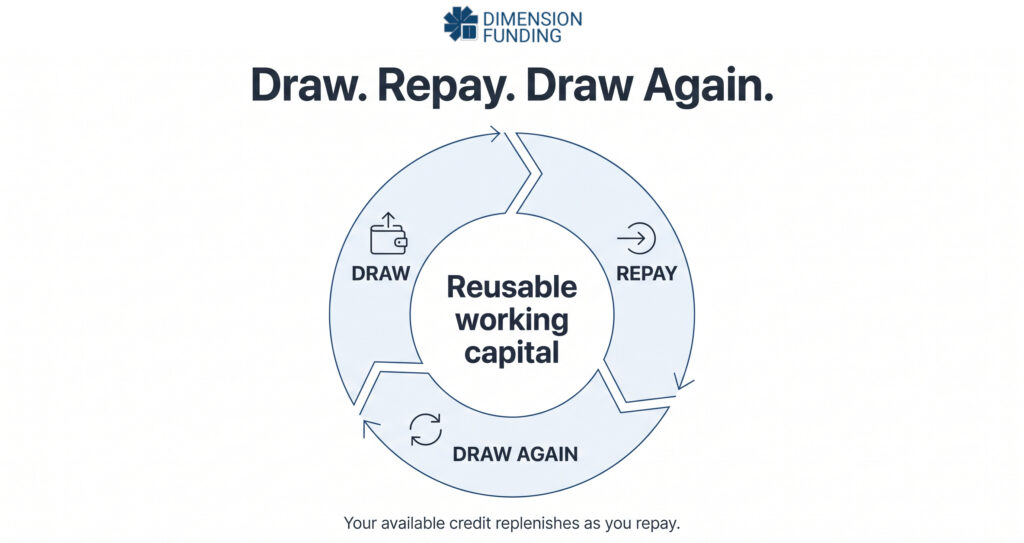
During the draw period, your payment obligation is generally tied only to the amount you’ve actually borrowed, and as that principal is repaid, those funds typically become available to use again.

Once the draw period ends, though, new borrowing stops and the remaining balance shifts into a fixed payoff schedule, which can mean a noticeably different monthly obligation than what you were paying during the draw period. Understanding this distinction ahead of time, rather than discovering it partway through, is one of the simplest ways to avoid a cash flow surprise.

How the Draw-Repay-Draw Cycle Works

The core mechanic of a line of credit is simple: you draw funds against your available limit, make payments according to your repayment schedule, and as you repay, that credit becomes available to draw again. It behaves less like a traditional loan and more like a reusable financial cushion.

Dimension Funding structures its working capital and line of credit offerings with amounts ranging between $5,000 and $200,000, with terms up to 24 months and repayment plans that can be scheduled monthly, weekly, or daily depending on the business. That repayment flexibility is central to how the draw-repay-draw cycle functions in practice: a business repaying weekly frees up credit sooner than one on a monthly schedule, giving faster-moving businesses quicker access to capital for the next draw.

Why Repayment Structure Shapes How Often You Can Draw

The repayment plan you choose doesn’t just affect your periodic obligation, it directly affects how quickly your credit line replenishes. Daily or weekly repayment plans return capital to your available limit faster than monthly plans, which matters if your business cycles through cash needs frequently.

Monthly repayment plans are typically capped at shorter terms and require a stronger credit profile than weekly or daily options, since lenders view monthly structures as carrying more risk over a longer stretch without repayment activity. Businesses with steady, predictable revenue often qualify more easily for monthly terms, while businesses with more variable cash flow may find weekly or daily repayment easier to manage and to qualify for.

What Shapes Approval on a Line of Credit

Approval for a working capital line of credit generally comes down to a handful of core requirements. Most lenders look for annual revenue above a set threshold, majority ownership documentation, and several months of recent bank statements to evaluate cash flow patterns. Larger credit limits typically require deeper documentation, including corporate tax returns for bigger requests.

That fits a broader pattern in how small businesses seek financing. The Federal Reserve’s 2026 Report on Employer Firms found that most applicants were seeking financing to cover operating expenses or pursue an expansion, the same two use cases that drive most line-of-credit draws, rather than financing a single large purchase.

Because the application is a single page supported by bank statements rather than a full financial statement package, approved businesses can often access same-day or next-business-day funding. That speed matters most for the exact kind of unpredictable cash need a line of credit is designed to cover.

Common Ways Businesses Use a Line of Credit

A line of credit isn’t earmarked for one purpose, which is part of its appeal. Businesses use it for daily operating expenses, expanding inventory ahead of a busy season, or covering payroll during a temporary cash flow gap. Because it’s reusable rather than a one-time disbursement, it tends to function as an ongoing safety net rather than a single financial event.

Seasonal businesses often draw on a line of credit during slower months and repay it as revenue picks back up, resetting the cycle for the next slow stretch. Other businesses use it opportunistically, drawing funds to take advantage of a bulk purchase discount or an unexpected growth opportunity, then repaying quickly once the resulting revenue comes in. The reusability is what separates a line of credit from a fixed-term loan built around a single need.

Avoiding the Most Common Line of Credit Mistakes

The most common misstep with a line of credit is treating it like free-flowing cash rather than a financial tool with a cost attached. Drawing repeatedly without a clear repayment plan can leave a business carrying balances longer than intended, eroding the flexibility that made the line appealing in the first place.

Another frequent mistake is choosing a repayment schedule that doesn’t match the business’s actual cash flow. A seasonal business locked into a monthly repayment plan may struggle during its slow months, while a business with daily revenue that chose monthly repayment may be paying for flexibility it doesn’t need. Matching the schedule to your real cash flow pattern, and drawing only what you have a clear plan to repay, keeps the credit line working in your favor rather than against you.

Capital That Moves at Your Business’s Pace

A working capital line of credit isn’t about solving one problem; it’s about staying ready for the next one. Draw when you need it, repay on a schedule that fits your cash flow, and let that credit become available again for whatever comes next. Dimension Funding offers working capital and line of credit financing between $5,000 and $200,000, with terms up to 24 months, same-day or next-business-day funding, and a single-page, bank-statement-based application. Contact Dimension Funding to see what your business qualifies for.

FAQs

How is a line of credit different from a working capital loan?

A line of credit gives you a revolving credit limit you can draw from repeatedly, while a term loan provides a single lump sum repaid on a fixed schedule. Both can support day-to-day business needs, but a line of credit is designed for repeated, ongoing use.

If my business has never used a line of credit before, how do I know what limit to request?

A useful starting point is your typical monthly cash flow gap during your slowest stretch, rather than the largest expense you can imagine. Requesting a limit close to what your bank statements can support tends to move through underwriting faster than an amount that looks disconnected from your actual cash flow.

Can I have a line of credit and a term loan at the same time?

Yes. Many businesses carry both, using a term loan for a defined, one-time need and a line of credit for the ongoing, unpredictable gaps that come up in between. The two products aren’t mutually exclusive and often work well together.

What happens if I don’t use my line of credit for several months?

Unused capacity generally just sits available at no cost, though some lenders periodically review inactive lines to confirm the facility is still needed. There’s typically no penalty for going a stretch without drawing on it.

What repayment schedule should I choose?

The right schedule depends on your cash flow pattern. Daily or weekly repayment tends to suit businesses with frequent revenue, while monthly repayment may fit businesses with steadier, less frequent cash flow, though it typically requires a stronger credit profile.

Does drawing on a line of credit affect my ability to qualify for other financing later?

It can factor into how a future lender views your overall debt load, since most underwriting looks at existing obligations alongside new requests. Keeping your line’s balance from sitting near its limit for extended stretches generally supports a stronger position for future applications.

Can I use a line of credit for any business purpose?

Yes. A working capital line of credit is generally flexible enough to cover daily expenses, inventory purchases, payroll gaps, or unexpected costs, since it isn’t tied to a specific asset purchase like equipment financing.

Bucket Truck Financing: Reliable Solutions for Utility & Tree Care Crews

Bucket Truck Financing

Bucket Truck Financing: Reliable Solutions for Utility & Tree Care Crews

Bucket truck financing splits the cost of a $140,000 insulated unit into a monthly payment sized to what the truck can bring in, not what’s sitting in the bank right now. A 55 foot insulated model runs that price new and about $85,000 used, and a 75 foot material handler starts near $170,000 new, per The Upfit Insider’s bucket truck pricing guide.

Pay cash for one instead, and the truck usually sits on a wish list while a storm restoration contract, or a backlog of tree removal jobs, waits for it.

Dimension Funding finances bucket trucks and other utility and tree care vehicles for businesses across the U.S., from a single replacement unit to a full crew build out. Purchases up to $500,000 can be approved from the credit application alone, and financing runs as high as $10 million or more for larger fleet builds.

Sign electronically and funding can go through within a day or two, so a truck already lined up for a scheduled job doesn’t sit on the lot waiting on approval.

What Bucket Truck Financing Covers

Bucket truck financing covers two structures: a loan that builds toward ownership of the truck, or a lease that spreads the cost of using it over a fixed period. Either one can apply to insulated units built for electrical utility work, non insulated units for tree care and signage crews, or material handlers built for heavier lifts.

Dimension Funding has financed commercial vehicles since 1978, long enough for its underwriting to account for how utility and tree care crews buy in practice. Not on a fixed replacement schedule, but when a contract lands, storm season approaches, or an aging unit finally fails its annual dielectric test.

Loans vs Leases for Bucket Trucks: What Changes

Same monthly payment, different truck at the end of it. A loan finances the purchase, so you own the bucket truck once the term is paid off. Lease the same truck instead, and ownership isn’t part of the deal unless you buy the unit separately once the term is up.

Crestmont Capital’s equipment finance data puts loans at 44 percent of transactions nationally and leases at 38 percent, with lines of credit and sale leaseback arrangements splitting the rest.


Loan

Lease

Ownership

Yes, once paid off

Not automatic

End of term

Truck owned outright

Return, buy out, or upgrade

Best fit

Trucks run for years

Trucks likely to be upgraded

Payment basis

Reflects the full purchase price

Reflects the value used during the term

How a Bucket Truck Loan Works

The lender covers the purchase price of the truck. You repay it in fixed monthly installments, and the truck is yours from the day the loan closes, subject to the lender’s lien until it’s paid off. Once the last payment clears, it’s simply yours, free to keep running calls or sell once you move up to a taller boom.

How a Bucket Truck Lease Works

A lease prices your payment against how much value the truck loses over the lease term, not its full purchase price. That’s why a lease payment often comes in lower than a loan payment on the same unit.

At the end of the term, you return the truck, buy it at a price set when the lease began, or move into a newer model. A utility contractor running the same 55 foot unit for a decade has different priorities than a telecom crew that upgrades boom height every few years as job specs change.

Why Bucket Truck Prices Push Crews Toward Structured Payments

What Different Bucket Truck Classes Cost

Boom height moves the price more than the chassis it’s mounted on. A 40 foot non insulated unit, the entry point before insulation and extra reach push the number higher, runs $85,000 new and $50,000 used, per The Upfit Insider’s pricing breakdown.

$170,000 is roughly the starting point for a 75 foot material handler new, with used units closer to $110,000, and a track mounted unit built for soft ground access can run $200,000 or more. 

Each additional 10 feet of reach adds roughly $15,000 to $20,000 to the price, and hybrid PTOs or added hydraulic tool circuits add another $5,000 to $8,000 on top, according to the same source.

Demand for Aerial Units Keeps Climbing

Global Market Insights projects the global forestry equipment market, which includes the bucket trucks tree care crews rely on, to reach $17 billion by 2026, a figure cited by Custom Truck One Source.

Crestmont Capital’s utility truck financing guide puts federal broadband infrastructure investment at $65 billion, adding to that pressure on the utility and telecom side and pushing more line crews and cable contractors to add aerial units instead of renting them by the week.

What Shapes the Monthly Payment

Boom Height and Term Length

Go taller on the boom or shorter on the term, and your monthly payment climbs faster than you’d expect. Stretch the term out and the payment drops, but you could end up paying on a truck well past the years it’s realistically productive on the job.

Dimension Funding caps terms at 60 months, which usually lines up with how long a bucket truck holds up under regular annual inspection before major boom or hydraulic work costs more than the truck is worth.

New Condition vs Used Condition

New units support longer terms since there’s more working life ahead of them. Choose a used truck instead, especially one with heavy prior boom cycles, and your term shortens to match. The hours logged on the hydraulic system and the results of the last dielectric test matter as much as the model year.

Approval Requirements for Bucket Truck Financing

Application Only Thresholds

Most equipment lenders separate vehicle financing into tiers by dollar amount, and Dimension Funding follows that structure. You can move purchases up to $500,000 on the credit application alone, with no financial statements required.

Above that threshold, underwriting typically asks for recent tax returns and basic financials, and larger crew or fleet build outs can run past that point toward $10 million or more for established contractors.

Credit Profile and Documentation

A bank turning you down for a term loan doesn’t rule out bucket truck financing, since equipment lenders underwrite the truck almost as much as the business behind it. Crestmont Capital’s bucket truck financing data puts minimum credit around 550, with 650 or higher considered strong, and minimum annual revenue typically between $100,000 and $250,000.

Two or more years in business is preferred, though a strong contract backlog or established municipal work can offset a shorter track record.

Matching the Structure to How the Truck Will Be Used

The right structure usually comes down to how the truck fits your work, not which option looks cheaper on the quote. Buying a truck for one storm season has different math behind it than adding a permanent unit to your fleet. Usage, replacement habits, and resale plans tend to settle it:

  • Utilization matters most. A truck running daily service calls or line work usually points toward a loan.
  • Replacement habits vary by crew. Some run the same unit for a decade, others upgrade boom height or insulation rating as contracts change.
  • Resale only matters if you plan to own the truck outright. Otherwise, having a working unit on the lot is enough.

A loan tends to fit if the same truck runs daily calls for years. Contracts that shift in scope, or a crew expecting to move up in boom height as bigger jobs come in, point toward a lease instead. Even a mismatched choice rarely does real damage. You end up paying for flexibility you didn’t need, or owning a truck you’d rather have traded in for something newer.

Building a Bucket Truck Payment Around the Job, Not the Sticker Price

Parked at the yard, a bucket truck isn’t earning you anything, no matter how good the deal was. The sooner it’s on a job site running calls, the sooner the payment stops looking like overhead and starts looking like the reason you could take the contract at all.

Dimension Funding can walk through what a loan or a lease would look like for your specific truck and timeline before any paperwork gets signed. It’s worth a conversation before locking into either structure.

Frequently Asked Questions

Can I finance a used bucket truck, or only new units?

Most equipment lenders finance new and used bucket trucks side by side. A used unit typically gets a shorter term than a new one, since there’s less working life left on the boom and hydraulics to finance, but the purchase itself isn’t treated as a lesser option.

What credit score do I need for bucket truck financing?

No specific credit score guarantees approval, since lenders weigh your business history and contract backlog alongside your personal credit rather than applying a hard cutoff. Dimension Funding works with credit profiles across a wide range, from strong to marginal, rather than screening you out below a fixed number.

How long are typical bucket truck loan or lease terms?

Terms commonly run up to 60 months. The actual length depends on the truck’s boom height and condition, whether it’s new or used, and how long you plan to keep it in service.

Is leasing better than buying for a crew that upgrades boom height often?

Leasing fits better if you expect to upgrade equipment, since you’re not stuck holding an outdated unit once a bigger job calls for more reach. A loan makes more sense if the truck keeps doing the same work at the same boom height for years.

Does insulation testing or upfit work get financed along with the truck?

Yes, most equipment lenders roll upfit costs like insulation, hydraulic tool circuits, or hybrid PTOs into the same financed amount as the truck itself. That way the payment reflects the full working unit, not the base chassis price alone.

What happens at the end of a bucket truck lease?

At the end of a bucket truck lease, you can buy the truck at the price set when the lease began, return it, or roll into a newer model. A unit with years of working life left typically gets bought out, while one that a taller or newer boom would outperform is more often returned or upgraded.

How fast can bucket truck financing be approved?

Approval can come back within a few hours on purchases up to $500,000 when you handle the application and documents electronically. Funding typically follows within a day or two once the paperwork clears, which matters most when you need the truck for a storm response contract or a job that’s already scheduled.

How Working Capital Business Loans Get Underwritten and Approved

working capital business loans

How Working Capital Business Loans Get Underwritten and Approved

Every business owner has hit the same wall: revenue is strong, but cash isn’t sitting in the bank when you need it. A slow season, an unexpected repair, or a sudden growth opportunity can all create the same problem — timing. Working capital loans exist to close that gap, but most business owners have no idea how lenders decide who qualifies or what shapes the terms they’re offered.


That’s where understanding the process pays off. Dimension Funding has spent over 40 years financing small and mid-sized businesses across the U.S., and its working capital program is built around one core idea: fast, transparent approval without unnecessary paperwork. Knowing how underwriting and approval actually work puts you in a stronger position before you ever submit an application, rather than guessing at what a lender wants to see.

How-Working-Capital-Business-Loans-Get-Underwritten-and-Approved

What a Working Capital Loan Actually Covers

A working capital loan isn’t tied to a specific purchase like equipment or software. It’s designed to support the everyday financial rhythm of a business — payroll, inventory, rent, or bridging a slow month. Because the funds aren’t earmarked, lenders evaluate the loan differently than they would an equipment loan tied to collateral, focusing far more on how money moves through the business than on what it will ultimately be spent on.

That flexibility is exactly why so many businesses use it. Whether it’s a seasonal dip in revenue or a sudden expense that can’t wait, a working capital loan gives owners room to breathe without disrupting long-term plans. A landscaping company might use it to cover payroll through a slow winter, while a retailer might use it to stock up before a busy season. The loan doesn’t dictate the use case; the business does.

What Shapes Approval on a Working Capital Loan

Approval on a working capital loan comes down to a handful of factors: business revenue, time in business, bank statement history, and overall credit profile. Lenders aren’t just looking at a credit score in isolation. They’re looking at cash flow trends over the past several months to gauge repayment ability. A business with steady, predictable deposits will typically move through underwriting more smoothly than one with erratic income, even if both have similar credit scores.

Structured, fixed repayment schedules are common in this space because they give both the lender and the borrower predictability. Businesses that compare financing options often find that a fixed-payment working capital loan is easier to plan around than a merchant credit card cash advance, since payments stay consistent rather than fluctuating with sales volume. That predictability alone often decides which financing option a business chooses, since a steady monthly obligation is far easier to budget around than a variable holdback tied to daily card receipts.

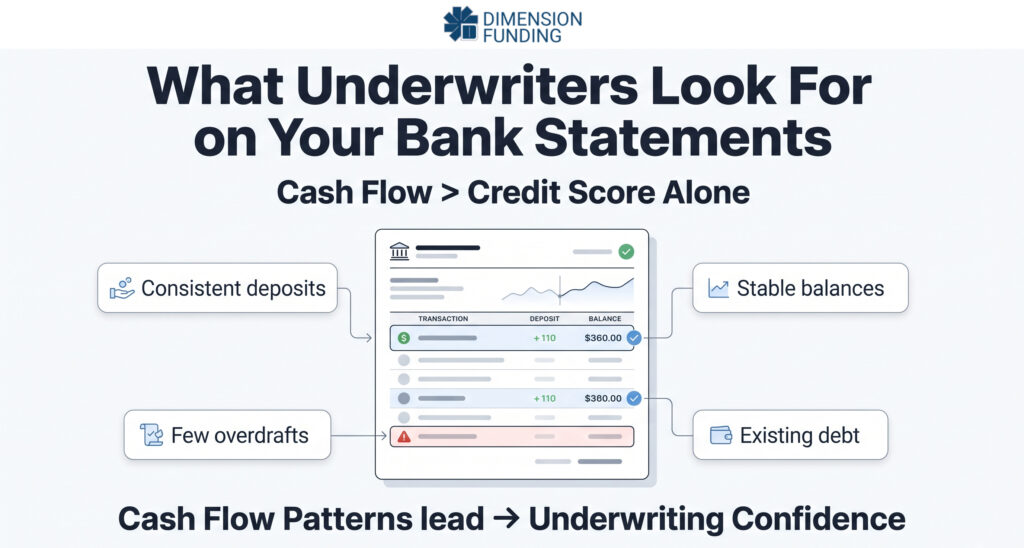
What Underwriters Actually Look at on Your Bank Statements

Many business owners assume lenders only use bank statements to confirm revenue, but underwriting goes much deeper. Bank statements provide a snapshot of how a business manages cash flow over time, helping lenders assess whether loan payments are likely to be made consistently.

Bank Statement Pattern

Why It Matters

Monthly deposits

Demonstrates consistent business revenue

Average daily balance

Indicates whether the business maintains a financial cushion

Negative balance days

May signal cash flow instability or liquidity issues

NSF or overdraft fees

Suggest difficulty managing available funds and may increase perceived lending risk

Large one-time deposits

Often require documentation to verify they are recurring business income rather than unusual transactions

Existing loan withdrawals

Help lenders evaluate current debt obligations and repayment capacity

Rather than focusing on a single credit score, underwriters evaluate the overall pattern of financial activity. Consistent deposits, stable balances, and limited overdrafts can demonstrate responsible cash management even with an imperfect credit history.

This broader approach lines up with the Office of the Comptroller of the Currency’s guidance, which states that for most small business loans, the primary source of repayment is the cash flow of the business, and a bank’s cash flow analysis should cover current and expected cash flows over a reasonable range of future conditions. A business that can show it consistently manages its account well often has more leverage in the underwriting conversation than one relying on credit score alone, as legal industry coverage of small business lending standards has also noted.

Repayment Terms and Structure

Working capital loans typically run on shorter terms than equipment financing, often up to 24 months. Within that window, lenders usually offer weekly, monthly, or daily repayment options, and the right fit depends heavily on the type of business. Choosing the wrong structure can turn a manageable loan into a cash flow strain, even if the terms themselves were competitive.

A seasonal contractor might prefer weekly payments that ease during slow months, while a restaurant with steady daily transactions might choose daily repayment to match cash flow. Matching the repayment schedule to the business’s actual revenue pattern is one of the most overlooked ways to keep a loan manageable, and it’s worth discussing directly with a lender before signing rather than defaulting to whatever structure is offered first.

What Approval Actually Requires

Approval for working capital financing generally hinges on a few baseline requirements. Lenders typically look for annual revenue above a set threshold, majority ownership documentation, and recent bank statements, usually three to six months, depending on the loan size. Larger requests may also require corporate tax returns, since the added scrutiny reflects the larger risk exposure on both sides of the transaction.

The appeal of this financing type is the simplicity of the application itself. Many lenders, including Dimension Funding, use a single-page application supported by bank statements rather than a lengthy financial statement package. That structure is what allows some approvals and fundings to happen same-day or the next business day, which matters most when the need for capital is already urgent.

Why Approval Speed Varies So Much

Not every working capital loan closes at the same pace. Speed depends on how quickly documentation is submitted, how clean the bank statement history looks, and whether the loan amount triggers additional underwriting steps like tax return verification. A request under $50,000 with clean statements moves faster than a $200,000 request requiring deeper financial review, since underwriting depth scales with the size of the exposure.

Businesses that prepare their documents in advance, including recent statements, ownership records, and basic financials, consistently see faster turnaround. It’s less about the lender’s process and more about how ready the applicant is when the application lands on someone’s desk. Gathering bank statements and ownership paperwork before starting the application, rather than after, is one of the simplest ways to shave days off the timeline.

Common Mistakes That Slow Down Approval

Even straightforward applications can stall when a few avoidable mistakes creep in. Submitting incomplete bank statements, applying under the wrong business entity name, or leaving large unexplained deposits undocumented are among the most common reasons underwriting takes longer than expected. Each of these forces a lender to pause and request clarification, adding days to a process that could otherwise move quickly.

Another frequent misstep is applying for an amount that doesn’t align with documented revenue. Requesting $150,000 against inconsistent monthly deposits of $20,000 invites more scrutiny than a request sized appropriately to the business’s actual cash flow. Being realistic about loan size from the outset, and having a clear explanation ready for any unusual transactions, keeps the underwriting conversation short and the funding timeline on track.

Turning Cash Flow Timing Into a Non-Issue

Working capital loans exist to solve a timing problem, not a viability problem, and understanding how underwriting and approval work takes the guesswork out of applying. Revenue history, bank statement patterns, and loan amount all shape the terms you’re offered, but the process itself doesn’t have to be complicated once you know what a lender is actually evaluating.

Dimension Funding offers working capital loans between $25,000 and $250,000, with terms up to 24 months and repayment plans that flex around your business model, backed by same-day or next-business-day funding and a single-page, bank-statement-based application. Contact Dimension Funding to find out what your business qualifies for.

How long does it take to get approved for a working capital loan?

Approval timelines vary based on loan size and documentation, but many lenders can approve and fund same-day or the next business day once bank statements and application details are submitted. Larger loan amounts requiring tax returns may take slightly longer to clear underwriting.

What credit score do I need to qualify?

Most working capital lenders evaluate the whole financial picture, not just credit score. Strong, consistent bank statement history and revenue can offset a less-than-perfect credit profile in many cases, since cash flow often carries more weight than the score itself.

How much can my business borrow?

Working capital loan amounts typically range from $25,000 to $250,000, depending on revenue, time in business, and documented cash flow. Larger requests usually require more extensive documentation, including corporate tax returns.

Does the lender care which bank the business uses, or just the statement history?

Most lenders are agnostic about which bank a business uses and focus entirely on the statement history itself. What matters is a consistent, verifiable record of deposits and balances rather than the specific institution the account is held at.

What do underwriters look for on bank statements?

Underwriters review deposit consistency, average daily balance, negative balance days, overdraft fees, and existing loan withdrawals to gauge overall cash flow health rather than relying on credit score alone.

What documents do I need to apply?

Typically, you’ll need a completed application, three to six months of bank statements depending on loan size, and, for larger requests, corporate tax returns and proof of majority ownership.

If my business has one unusually large deposit, will that hurt my application?

Not necessarily, but it will likely require documentation. Underwriters generally just need to confirm whether a large one-time deposit reflects recurring business income or a one-off event, since unexplained deposits are a common reason applications stall.

Business Machinery Loans: Rates, Terms & Approval Requirements

business machinery loans

Business Machinery Loans: Rates, Terms & Approval Requirements

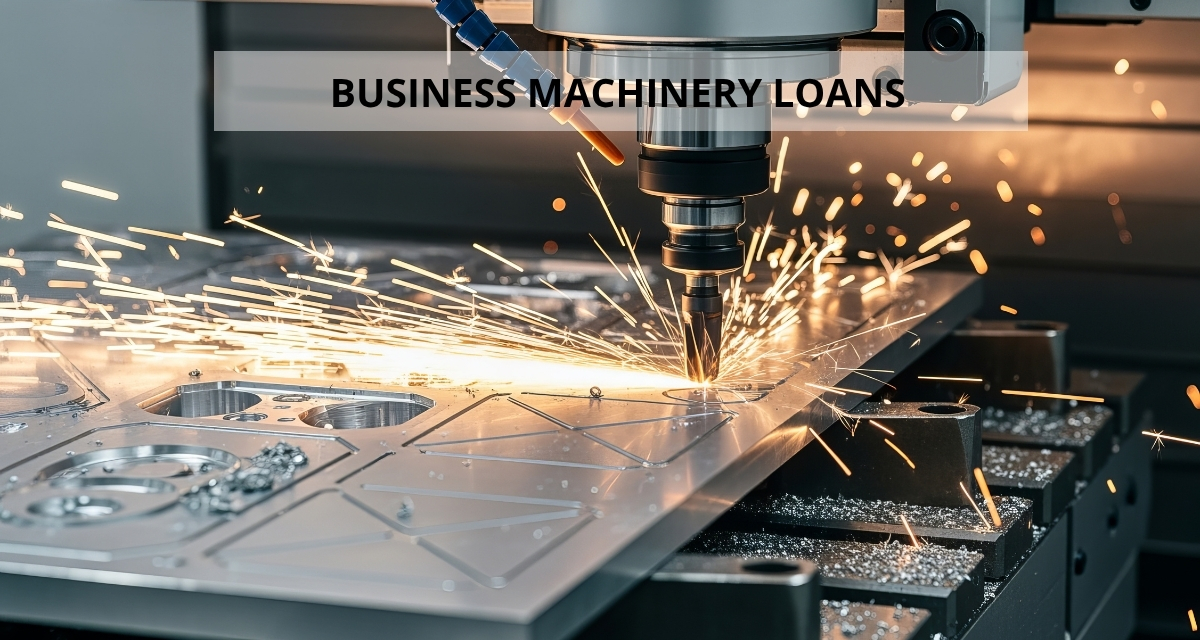
Business machinery loans turn a $150,000 CNC mill into a payment a business can absorb, not a check that empties the account. $100,000 to $250,000 buys a mid range machining center new, and a 5 axis platform clears $500,000, per Ellison Technologies’ 2026 CNC pricing guide.

Pay cash for a machine like that, and the tooling, the electrical work to run it, and the training that comes with it often don’t make the budget.

Dimension Funding finances manufacturing and industrial machinery for businesses across the U.S., from a single CNC mill to a full line addition. Up to $250,000, the purchase can move on the credit application alone, no financial statements needed. Bundle in software or related technology and that ceiling climbs to $500,000.

Documents get signed electronically, and funding usually follows within a day or two of approval, quick enough that a machine tied to a contract already in motion doesn’t sit crated at the vendor waiting on paperwork.

What Business Machinery Loans Cover

CNC mills and lathes, press brakes, laser and waterjet cutters, injection molding machines, stamping presses, welding systems, robotic cells, conveyors, inspection equipment: that’s the range a business machinery loan covers. A loan builds toward ownership. A lease spreads the cost of using that same machine over a fixed period instead.

Dimension Funding has financed equipment since 1978. In that time, its underwriting has adapted to a pattern specific to machinery: shops rarely buy on a schedule, they buy when a contract lands or a bottleneck on the floor gets expensive enough to fix.

Loans vs Leases for Business Machinery: What Changes

Same monthly number, completely different deal once the term ends. That’s the gap between a loan and a lease. A loan finances the purchase, so ownership transfers once it’s paid off. Lease the same machine instead, and ownership only happens if the business buys it separately once the term is up.

Crestmont Capital’s 2026 equipment finance data puts loans at 44 percent of transactions nationally and leases at 38 percent, with lines of credit and sale leaseback arrangements splitting the rest.


Loan

Lease

Ownership

Yes, once paid off

Not automatic

End of term

Machine owned outright

Return, buy out, or upgrade

Best fit

Machines run for years

Machines likely to be swapped or upgraded

Payment basis

Reflects the full purchase price

Reflects the value used during the term

How a Machinery Loan Works

The lender covers the purchase price of the machine. The business repays it in fixed monthly installments, and the equipment belongs to the business from the day the loan closes, subject to the lender’s lien until it’s paid off. Once the last payment clears, the machine is simply owned, free to keep running or sell as production needs shift.

How a Machinery Lease Works

A lease prices the payment against how much value the machine loses over the lease term, not its full purchase price. That’s why a lease payment often comes in lower than a loan payment on the same equipment.

At the end of the term, the business returns the unit, buys it at a price set when the lease began, or moves into a newer model. A shop running the same mill for fifteen years has different priorities than a fabricator who trades up every few production cycles, and that difference typically decides which structure fits.

Why Machinery Prices Push Businesses Toward Structured Payments

What Different Machine Types Cost

Two CNC mills from different builders can price within a few thousand dollars of each other. Size and capability class move the number far more than the brand on the door.

Ellison Technologies’ pricing breakdown puts entry level vertical machining centers at $50,000 to $100,000 new, with mid range models landing between $100,000 and $250,000. Step up to a 5 axis platform and the range widens fast: $200,000 to $800,000, typically financed over 60 to 84 months, per Crestmont Capital’s data.

Injection molding machines cover a similarly wide band, $50,000 to over $1 million depending on tonnage, per the same Crestmont report. Add tooling or a conveyor feed system to any of these and the number financed climbs past the base price on the quote.

Machine Tool Orders Are Climbing

The Association for Manufacturing Technology’s USMTO report puts U.S. manufacturing technology orders at $3.44 billion in the first half of 2026, a 36 percent jump over the same stretch in 2025.

More orders today mean more machines due on shop floors before the year is out, and financing is how most of those purchases get paid for.

Financing Activity Industry Wide

Crestmont Capital puts total U.S. equipment and software investment at $3.4 trillion in 2024, and financing covered more than 79 percent of that year’s new equipment acquisitions. Roughly four out of five buyers skipped the lump sum entirely.

The 60 day delinquency rate on equipment finance receivables sat at 1.64 percent in Q4 2025, below the 10 year average of 1.89 percent, according to Crestmont Capital’s statistics. That’s a lower default rate than the segment has averaged over the past decade, one reason lenders keep approving machinery deals at a solid pace.

What Shapes the Monthly Payment

Machine Type and Term Length

A higher purchase price or a shorter term raises the monthly payment. Stretch the term out and the payment drops, but the business could end up paying on a machine well past its most productive years.

Dimension Funding caps terms at 60 months, which usually lines up with how many productive years a given machine class has left before it’s due for replacement or a rebuild.

New Condition vs Used Condition

A new machine supports a longer term since it has more productive life ahead of it. Choose used, especially a unit with heavy prior run hours, and financing shortens to match. The hours already logged on a machine’s controller matter as much as its age.

Approval Requirements for Business Machinery Loans

Application Only Thresholds

Most equipment lenders separate machinery financing into tiers by dollar amount, and Dimension Funding follows that structure: purchases up to $250,000 can move on the credit application alone, with no financial statements required. Bundle software or related technology into the same purchase and that application only ceiling extends to $500,000.

Above those thresholds, underwriting typically asks for recent tax returns and basic financials before the machine gets funded.

Credit Profile and Documentation

Getting turned down by a bank for a term loan doesn’t rule out machine financing, since equipment lenders underwrite the machine almost as much as the business behind it. Dimension Funding works with credit profiles from strong Tier A down to marginal, rather than applying a single hard cutoff.

Two or more years in business is preferred, though strong credit can offset a shorter track record.

Crestmont Capital’s lender data puts specialty equipment lender approval at roughly 78 percent, well above the 58 percent rate typical of large national banks. A bank turndown isn’t necessarily a dead end. It often means the business needs a lender built around equipment instead of general credit.

Matching the Structure to How the Machine Will Be Used

The right structure usually comes down to how the machine fits the business, not which option looks cheaper on the quote. Buying a machine for one large production run has different math behind it than adding a permanent line. Usage, replacement habits, and resale plans are what settle it:

  • Utilization matters most. A machine running multiple shifts daily usually points toward a loan.
  • Replacement habits vary by shop. Some run the same equipment for fifteen years, others upgrade every time a new model improves cycle time.
  • Resale only matters if owning the machine outright is part of the plan. Otherwise, having working equipment on the floor is enough.

A loan tends to fit when the same machine runs the floor every day for years. Contracts that come and go point toward a lease instead, especially if the business doesn’t want to get stuck holding equipment nobody wants to buy used. Even a mismatched choice rarely does real damage. It usually means paying for flexibility the business didn’t need, or owning a machine it would rather have traded in.

Building a Machinery Payment Around the Output, Not the Sticker Price

Crated at the loading dock, a machine isn’t earning anything, no matter how good the deal was. The sooner it’s bolted to the floor and running parts, the sooner the payment stops looking like overhead and starts looking like the reason the order got filled.

Dimension Funding can walk through what a loan or a lease would look like for a specific machine and timeline before any paperwork gets signed. It’s worth a conversation before locking into either structure.

Frequently Asked Questions

Can I finance used machinery, or only new equipment?

Most equipment lenders finance new and used machinery side by side. A used machine typically gets a shorter term than a new one, since there’s less productive life left to finance, but the purchase itself isn’t treated as a lesser option.

What credit score do I need for a business machinery loan?

No specific credit score guarantees approval. Lenders weigh business history alongside personal credit rather than applying a hard cutoff, and on purchases up to $250,000, Dimension Funding can often approve from the application alone, without pulling additional financials.

How long are typical business machinery loan or lease terms?

Terms commonly run up to 60 months. The actual length depends on the machine type, whether it’s new or used, and how long the business plans to keep it in production.

Is leasing better than buying for machinery that becomes outdated quickly?

Leasing tends to fit equipment with a short competitive life better, since the business isn’t stuck holding an outdated machine once a newer model changes the math. A loan makes more sense for machinery that keeps doing its job at the same pace for years.

Does installation and setup get financed along with the machine?

Yes, most equipment lenders roll design, installation, and training costs into the same financed amount as the machine itself. That way the payment reflects the full working setup on the shop floor, not the equipment price alone on the invoice.

What happens at the end of a machinery lease?

At the end of a machinery lease, the business can buy the machine at the price set when the lease began, return it, or roll into a newer model. A machine with years of productive work left typically gets bought out, while one that a newer model would outrun on cycle time is more often returned or upgraded.

How fast can a business machinery loan be approved?

Approval can come back within a few hours for machinery purchases up to $250,000 when the application and documents are handled electronically. Funding typically follows within a day or two once the paperwork clears, which matters most when a machine is needed for a production run that’s already scheduled.


Fleet Truck Financing: Custom Options for Fleet Growth & Upgrades

Fleet Truck Financing

Fleet Truck Financing: Custom Options for Fleet Growth & Upgrades

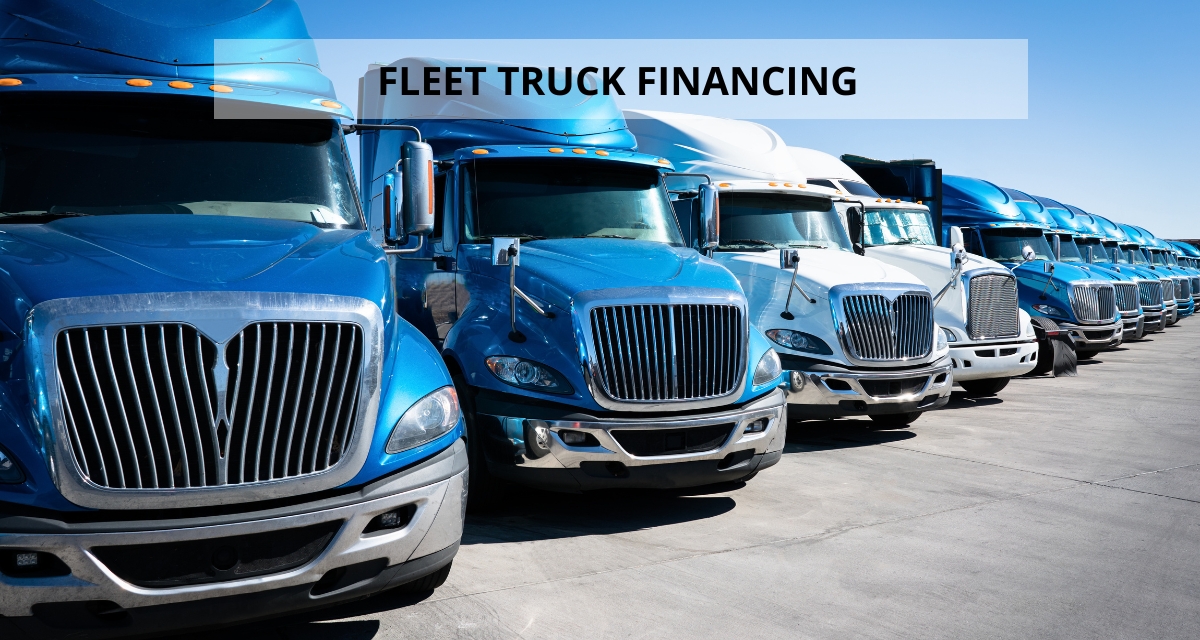
Fleet truck financing turns a six or seven figure purchase into a payment your business can plan around. A single new Class 8 truck can run past $160,000 before it drives a mile, and adding three or four trucks at once multiplies that fast.

Paying that out of cash reserves can stall the growth the trucks were supposed to support.

Dimension Funding finances commercial trucks and trailers for fleets across the U.S., from a single replacement unit to a multi truck build out. Smaller purchases can move on application only approval up to $500,000, while larger fleet financing runs up to $10 million or more.

Sign the paperwork electronically and funding can go through the same day, so a truck you need for a new contract doesn’t sit on a lot while paperwork catches up.

What Fleet Truck Financing Covers

Fleet truck financing covers two structures: a loan that builds toward ownership of each truck, or a lease that spreads the cost of using it over a fixed period. Either one can apply across a mix of new and used trucks in the same fleet.

Dimension Funding has been financing commercial vehicles since 1978. That’s long enough for their underwriting to handle fleet builds that come in phases, three trucks this quarter, two more once a new contract starts, instead of one predictable order.

Loans vs Leases for Fleet Trucks: What Changes

The mechanics differ more than the monthly number on the invoice. A loan finances the purchase, so you own each truck once its term ends. A lease finances the use of the truck for a set period, and what happens when that period ends is where the difference from a loan shows up.


Loan

Lease

Ownership

Yes, once paid off

Not automatic

End of term

Truck is owned outright

Return, buy out, or upgrade

Best fit

Trucks you’ll run for years

Trucks likely to be rotated or upgraded

Payment basis

Reflects the full purchase price

Reflects the value used during the term

How a Fleet Truck Loan Works

The lender covers the purchase price for each truck. You repay it in fixed monthly installments, and the truck is yours from the day the loan closes, subject to the lender’s lien until you pay it off.

Once the last payment clears on a given truck, it’s yours, free to keep running or sell as your fleet’s needs shift.

How a Fleet Truck Lease Works

A lease prices your payment against the truck’s value over the lease term, not its full purchase price. That’s why a lease payment can look different from a loan payment on the same truck.

At the end of the term, you return the unit, buy it at a price set when the lease began, or roll into a newer model.

Neither structure is the automatic right call. A regional delivery fleet that replaces trucks every three years has different priorities than a hauler who wants to run the same truck for a decade.

Why Truck Prices Are Pushing Fleets Toward Structured Payments

What Different Truck Classes Cost

Truck class moves the number more than brand does. A light duty Class 2 or 3 truck runs $45,000 to $90,000 new, and $25,000 to $60,000 used, according to Logrock’s 2026 cost breakdown.

Medium duty Class 4 through 7 trucks land between $70,000 and $160,000 new, with used units running $35,000 to $110,000. A heavy duty Class 8 day cab starts around $130,000 new, and a sleeper cab can run past $300,000 once it’s fully equipped.

The cheapest truck on the lot isn’t always the cheapest to run. The truck that stays on the road and keeps cost per mile predictable tends to win out over the lowest sticker price, according to the same Logrock analysis.

Why Replacement Cycles Are Accelerating

Truck prices haven’t stood still either. The average Class 8 truck cost about $120,000 in 2019, and by 2024 that had climbed to $170,000 to $190,000, according to Crestmont Capital’s financing data. That’s a jump of 40 to 58 percent in five years.

That same Crestmont Capital report puts the average commercial truck on the road today at 12.5 years old. Aging fleets and climbing replacement costs are pushing more of these purchases toward financing instead of cash.

Financing Activity Industry Wide

Trucks move more than 72 percent of all freight tonnage in the U.S. each year. Commercial vehicle loan originations top $120 billion annually, with roughly $600 billion in commercial vehicle loans outstanding nationally, per Crestmont Capital.

Lease and lease to own arrangements account for 30 to 35 percent of new fleet acquisitions industry wide. Spreading a truck purchase into a monthly payment is standard practice in this industry, not the exception.

What Shapes the Monthly Payment

Truck Class and Term Length

A higher purchase price or a shorter term raises the monthly payment. Stretch the term out and the payment drops, but you could end up paying on a truck well past its most productive years.

Dimension Funding runs terms as long as 60 months, long enough to match your schedule to how many years a given truck class realistically has left in it.

New Condition vs Used Condition

A new truck supports a longer term since it has more work ahead of it. Choose used, especially with higher mileage already on it, and you’ll usually get financed over a shorter stretch. The miles on the odometer matter as much as the model year.

What Upfitting Adds to the Financed Amount

Most fleet trucks don’t leave the lot bare. A service body runs $9,000 to $25,000, and a dump body adds $15,000 to $35,000, according to The Upfit Insider.

A plow and spreader setup lands between $9,000 and $28,000, and a crane or mechanic’s body can add $30,000 to $85,000. A refrigerated box for cold chain work runs $18,000 to $40,000, and a roll-off system for waste or recycling work adds $45,000 to $85,000, per the same source.

Buy a $90,000 truck with a $20,000 service body, and you’re financing closer to $110,000, not $90,000.

Roll the upfit into the same loan or lease and the payment reflects the full working truck, not the bare chassis.

Credit Profile and Business Documentation

Fleet truck financing doesn’t always ask for what a bank loan does. Dimension Funding can approve amounts up to $500,000 on the application alone, and works with most types of credit rather than requiring a long, clean financial history.

Larger fleet build outs, the kind that run past that threshold, move into full underwriting, with financing available up to $10 million or more for established fleets.

Growing a Fleet vs Replacing One Truck: How the Financing Picture Changes

New Truck Sales Are Slowing

New Class 8 truck sales fell 24 percent year over year in January 2026, to 12,287 units, according to Transport Topics’ tracking of ACT Research data. Freightliner still led the market that month with 4,314 units, ahead of Peterbilt at 1,918 and Kenworth at 1,798.

Mack and Volvo rounded out the top tier with 947 and 810 units, per the same tracking.

Orders Are Climbing Anyway

January 2026 orders climbed 27 percent year over year to 32,500 units, on top of a 21 percent increase in December. Fleets are ordering ahead of need even while retail sales cool, which points to financing decisions getting made well before a truck shows up on the lot.

Matching the Structure to How the Fleet Runs

The right structure usually comes down to how each truck fits into the fleet, not which option looks cheaper on paper. Adding one truck for a new route has different math behind it than replacing half the fleet at once. A few things tend to settle it:

  • Route type matters most. A truck racking up long haul miles daily usually points toward a loan.
  • Replacement habits vary a lot. Some fleets rotate the same trucks on a fixed schedule, while others run them until they’re not worth fixing, which tends to favor a lease.
  • Resale only comes into play if owning the truck outright is the goal. Otherwise, a truck that’s still running is enough.

Which Way Most Fleets Lean

Run a route daily for years with the same truck, and a loan usually fits. If routes shift, contracts come and go, or you don’t want to be stuck holding aging trucks, a lease usually fits better.

Get the call wrong and it’s rarely a disaster. You end up paying for flexibility you didn’t need, or owning trucks you were ready to rotate out.

Building a Fleet Payment Around the Routes, Not the Sticker Price

A fleet truck earns its cost back by running routes, not sitting on a lot while a business saves up for it. Every week it’s parked is a week the payment has nothing to show for itself.

If your business is planning a fleet purchase or upgrade, Dimension Funding can walk through what a loan or a lease would look like across your specific trucks and timeline. Reach out and talk through the numbers before you commit to either one.

Frequently Asked Questions

Can I finance a mix of new and used trucks in the same fleet order?

Most equipment lenders finance new and used trucks side by side in the same fleet order. Each truck gets underwritten on its own terms, so a newer truck can carry a longer term while a used one on the same order runs shorter, based on how much life is left in each.

What credit score do I need for fleet truck financing?

There’s no single score that guarantees approval. Lenders weigh your business history alongside personal credit rather than applying a hard cutoff. On amounts up to $500,000, Dimension Funding can often make that call from your application alone.

How long are typical fleet truck loan or lease terms?

Terms commonly run up to 60 months. The actual length depends on the truck class, whether it’s new or used, and how long you plan to keep it in the fleet. A longer term brings the monthly payment down, but it also means paying on that truck for more months overall.

Does upfitting get financed along with the truck?

Lenders typically roll upfit costs like service bodies, dump bodies, or plow setups into the total financed amount. That way the payment reflects what the truck can do on the job, not its base price alone.

Confirm this with your lender before the order is finalized, since not every lender handles it the same way.

Is leasing better than buying for a fleet that grows and shrinks with contracts?

Leasing tends to fit fluctuating fleets better, since you’re not stuck holding trucks once a contract ends. A loan makes more sense for trucks running steady, predictable routes year after year.

What happens at the end of a fleet truck lease?

It depends mostly on the mileage and condition of the truck by then. If it’s still got plenty of life left, buying it at the price set when the lease began often makes the most sense.

If it’s worn down, or a newer model would run more efficiently, handing it back or rolling into something newer usually wins out.

How fast can fleet truck financing be approved for multiple trucks at once?

Approval can happen the same day on qualifying applications when documents are signed electronically. That speed matters most when a fleet needs trucks on the road for a contract that’s already started, not one still being negotiated.

Skid Steer Financing: Comparing Loans, Leases & Monthly Rates

Skid Steer Financing

Skid Steer Financing: Comparing Loans, Leases & Monthly Rates

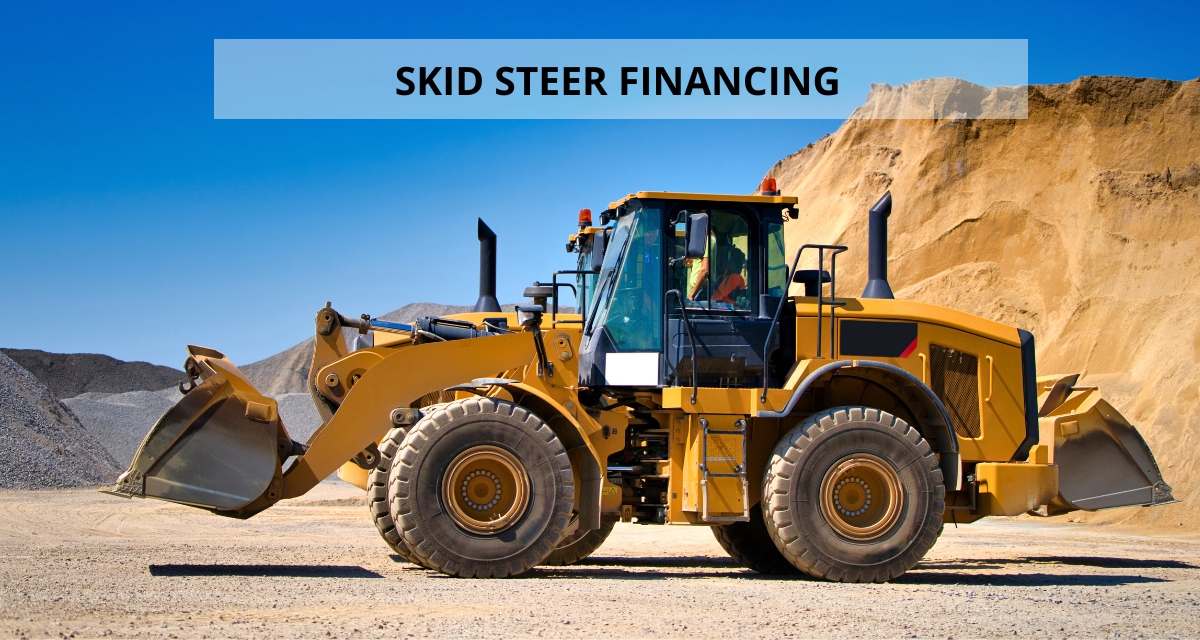
Skid steer financing turns a machine that costs tens of thousands of dollars into a monthly payment you can plan for. A new mid-size unit runs past $50,000 before you even add attachments.

A used one in decent shape still clears $30,000 more often than not. Pay in cash and you tie up money you need for payroll, materials, or the next bid.

Dimension Funding finances construction equipment, including skid steers, for businesses across the U.S. Your loan or lease can run up to 60 months, and approval can move fast since it doesn’t always take a full set of financial statements to get a decision.

Sign the paperwork electronically and your funding can go through the same day. Find the right unit this week, and you’re not stuck waiting on it.

What Skid Steer Financing Covers

You’re choosing between two structures here: a loan that builds toward ownership, or a lease that spreads the cost of using the machine over a fixed period. Either one works for new or used equipment.

Dimension Funding has been financing equipment since 1978. That’s long enough for their underwriting to adjust to how contractors like you buy machines: in bursts, tied to a job, not on some long planning cycle.

Loans vs Leases: What Changes

The mechanics differ more than the monthly number on the page. A loan finances the purchase, so you own the skid steer once the term ends. A lease finances the use of the equipment for a set period, and what happens when that period ends is where the real difference from a loan shows up.


Loan

Lease

Ownership

Yes, once paid off

Not automatic

End of term

Machine is owned outright

Return, buy out, or upgrade

Best fit

Long term fleet additions

Equipment likely to be swapped or upgraded

Payment basis

Reflects the full purchase price

Reflects the value used during the term

How a Skid Steer Loan Works

The lender covers the purchase price. You repay it in fixed monthly installments, and the machine is yours from the day the loan closes, subject to the lender’s lien until you pay it off. No return process. No buyout decision at the end. Once your last payment clears, it’s simply yours.

How a Skid Steer Lease Works

A lease prices your payment against the equipment’s value over the lease term, not its full purchase price. That’s why a lease payment can look different from a loan payment on the same machine.

At the end of the term, you return the unit, buy it at a price set when the lease began, or roll into something newer.

Neither structure is the automatic right call. A landscaping company running the same skid steer for a decade has different priorities than a contractor who wants a newer, lower hour machine every couple of years.

Why Skid Steer Prices Push You Toward Structured Payments

What Different Size Classes Cost

Size class moves the number more than brand does. A small frame unit like the Bobcat S70 runs about $23,000 new and $18,300 used, according to Heavy Equipment Appraisal’s 2026 value guide.

Step up to a mid-size machine like the John Deere 312GR or Kubota SSV75, and new pricing lands between $50,600 and $54,500, with used units running $25,000 to $36,500 depending on hours. Komatsu’s comparable model prices close to $50,000 new and around $29,750 used, right in that same band.

High-output machines push higher still. The Caterpillar 226D3 and Case SV300 both list around $63,000 to $65,000 new, dropping to about $30,000 used. Know which class your job needs before you shop, since jumping one tier up can add $15,000 or more to what you’re financing.

Renting Against Financing

You might be weighing renting against financing too. The numbers explain why renting rarely wins beyond a short job. A skid steer typically rents for around $300 a day, $1,200 a week, or $3,000 a month, per the same Heavy Equipment Appraisal guide.

Keep renting for three or four months on a longer project and the total can pass what a loan payment would have cost. You’re left without a machine to show for it either way.

A rental still makes sense for a single week-long job or a one-off task. Financing pays off once the machine is earning its keep across more than one job.

Financing Activity Industry Wide

Financing activity across the equipment industry has been picking up as well. The Equipment Leasing and Finance Association’s Monthly Confidence Index climbed to 64.6 in January 2026, up from 58.3 the month before, inside a U.S. equipment finance market the association sizes at $1.3 trillion.

Skid steers are a small piece of that number, but the same math applies to your purchase too: a payment instead of a lump sum.

What Shapes Your Monthly Payment

Equipment Price and Term Length

A higher purchase price or a shorter term raises the monthly payment. Stretch the term out and the payment drops, but you could end up paying on a machine well past its most productive years.

Dimension Funding runs terms as long as 60 months, long enough to match your schedule to how much work the equipment still has left in it.

New Condition vs Used Condition

A new skid steer supports a longer term since it has more work ahead of it. Choose used, especially with higher hours already on it, and you’ll usually get financed over a shorter stretch. The hours on the meter matter as much as the age on the title.

What Attachments Add to the Financed Amount

Attachments change the number more than people expect. Pallet forks run $500 to $1,000, and a basic bucket adds another $750 to $1,000, according to Skid Pro’s pricing breakdown.

An auger lands between $2,000 and $2,500, and heavier attachments like brooms, trenchers, or stump grinders run $4,000 to $7,000 each. A dozer blade or snow plow sits in the same range, $3,000 to $6,000, per Skid Pro’s breakdown.

Buy a $50,000 skid steer with a $6,000 broom and a $2,000 auger, and you’re financing closer to $58,000, not $50,000. Roll attachments into the same loan or lease and the payment reflects the full package, not the base machine alone.

Credit Profile and Business Documentation

Skid steer financing doesn’t always ask for what a bank loan does. Dimension Funding can approve amounts up to $500,000 on the application alone, and works with most types of credit rather than requiring a long, clean financial history.

That matters most if you’re a newer business that hasn’t had time to build the track record a traditional bank usually wants before signing off on an equipment purchase.

New vs Used: How the Financing Picture Changes

Used skid steers aren’t a fallback option. They’re a normal part of how this equipment gets financed.

Bobcat led new unit financing with more than 28 percent of the market between May 2025 and April 2026, yet new volume overall slipped nearly 10 percent industry wide over that same stretch, according to Equipment World’s tracking of financed sales.

Deere and Case CE round out the next tier, each holding under 14 percent of new units financed over that stretch, per Equipment World’s brand breakdown. No single brand runs away with the used market either.

Used prices held closer to $39,900 on average in early 2026, well under what most new units run. If you’re cross-shopping, that gap changes your numbers fast.

Matching the Structure to How You’ll Use the Machine

The right structure usually comes down to how the equipment fits your business, not which option looks cheaper on paper. Buy a skid steer to run one long contract and the math looks different than keeping one around for whatever job shows up next. A few things tend to settle it:

  • Weekly hours matter. Run the machine daily, all season, and the math leans toward a loan.
  • Some businesses keep the same machine for years. Others trade in for something newer every time the job changes.
  • Resale only matters if owning the equipment outright is part of your plan. Otherwise, having a working machine on site is enough.

Which Way Most Businesses Lean

Run a skid steer daily across multiple job sites for years, and a loan usually fits. If your equipment needs to shift with the season, or you don’t want to get stuck holding an aging machine, a lease usually fits better.

Get the call wrong and it’s rarely a disaster. You end up paying for flexibility you didn’t need, or owning a machine you were ready to trade in.

Building a Payment Around the Job, Not the Sticker Price

Your skid steer earns its cost back by being on the job site, not sitting in a lot while you save up for it. The faster it’s working, the sooner the payment stops feeling like a cost and starts looking like the reason the job got done.

If your business is weighing a new or used skid steer purchase, Dimension Funding can walk through what a loan or a lease would look like for that specific machine and timeline. Reach out and talk through the numbers before you commit to either one.

Frequently Asked Questions

Can I finance a used skid steer, or only new units?

Most equipment lenders finance both. The used market moves enough volume that it’s a normal way to buy, not a consolation prize. The Case CE SV280B alone accounted for 533 financed units in early 2026. Used equipment loans typically run shorter terms than new ones too, since there’s less life left on the machine to finance.

What credit score do I need for skid steer financing?

There’s no single score that guarantees approval. Lenders weigh your business history alongside personal credit rather than applying a hard cutoff. On amounts up to $500,000, Dimension Funding can often make that call from your application alone.

How long are typical skid steer loan or lease terms?

Terms commonly run up to 60 months. The actual length depends on whether your equipment is new or used, and how long you plan to keep it. Stretch the term out and your monthly payment drops, but you keep paying longer, so match it to how much life is left in the machine.

Is leasing a skid steer better than buying if I only need it seasonally?

Leasing tends to fit seasonal work better. You’re not stuck holding equipment that sits idle for months at a stretch. A loan makes more sense when the same machine sees steady use all year.

Do skid steer attachments get financed together with the machine?

Usually, yes. Lenders roll attachments you buy alongside the skid steer into the total financed amount, since the payment covers the full equipment cost, not the base machine alone. Confirm this with your lender before the purchase closes, since not every lender handles it the same way.

What happens at the end of a skid steer lease?

It depends mostly on how many hours the machine has on it by then. If it’s still got plenty left in it, buying it at the price set when your lease began often makes the most sense. If it’s worn down, or a newer model would move the job along faster, handing it back or stepping into something newer usually wins out.

How fast can skid steer financing be approved?

Approval can happen the same day when you handle the application and signatures electronically. That speed matters more with used equipment especially, since a specific used unit won’t necessarily still be sitting there next week.

Renewal Financing: Turning Subscription Renewals Into a Retention Mechanic

Renewal Financing: Turning Subscription Renewals Into a Retention Mechanic

Renewal Financing: Turning Subscription Renewals Into a Retention Mechanic

A subscription renewal invoice arrives on a schedule the vendor sets, not the customer’s budget cycle, and that mismatch can be enough on its own to cost a vendor a renewal that had nothing to do with the product. Dimension Funding finances the renewal itself, not just the original purchase, converting the annual or multi-year invoice into a fixed monthly payment while paying the vendor in full at signing.

The same structure applies here as with a new software deployment: subscription fees, implementation, and third-party services bundled into one payment, with application-only approval available up to $500,000 and no financial statements required. For a vendor whose renewal conversation keeps stalling on price rather than product fit, that’s the lever that changes the outcome.

Why a Renewal Date Becomes a Churn Event

The SaaS market is on track to grow from $464.7 billion to $530.0 billion this year alone, on its way to $1.1 trillion by 2033. A renewal lost to invoice timing rather than dissatisfaction disappears from that growth curve for a reason that had nothing to do with the product it was attached to.

The Federal Reserve’s 2024 Small Business Credit Survey found that 56% of employer firms cited paying operating expenses as a financial challenge, with 51% citing uneven cash flow. A renewal invoice landing against that backdrop is competing with payroll and fixed costs for the same limited cash, and a vendor offering only a lump-sum renewal is asking the customer to solve that timing problem unassisted, on a deadline the vendor set.

What Dimension Funding Finances at Renewal

Renewal financing through Dimension Funding covers more than the base subscription line:

  • Annual and multi-year SaaS renewals, spread across monthly payments matched to the actual renewal term rather than billed as a lump sum
  • ERP and CRM platform renewals, the category carrying the largest per-invoice cost inside a U.S. software publishing industry that’s grown to $583.9 billion in 2026 
  • Added seats or modules introduced at renewal, folded into the same monthly payment as the base subscription rather than invoiced separately
  • Multiple renewals due in the same quarter, combined into a single financed transaction when a customer runs more than one platform through the same vendor relationship

A business renewing a $60,000 ERP platform and a $15,000 CRM add-on in the same billing window doesn’t need two separate financing conversations. Structured as one combined request under Dimension Funding’s SaaS financing program, it clears one underwriting event instead of two. Application-only financing remains available up to $750,000 in many cases, so a combined request that exceeds the standard $500,000 software ceiling doesn’t automatically require a full financial-statement review, though deals above $750,000 do. 

Timing the Conversation Before the Invoice Lands

Dimension Funding structures renewals fastest when the conversation starts at the account review stage, before the invoice has gone out and before a customer’s own budget cycle has forced a decision either way.

Dimension Funding’s 90-day deferred payment program extends that runway further: a qualifying customer renews, keeps the platform running without interruption, and owes no payment for the first 90 days. For a renewal date that lands ahead of a customer’s own fiscal cycle, that gap alone can prevent a non-renewal caused purely by the invoice date falling before the customer’s own budget cycle allowed for it.

Multi-year renewals carry a second advantage worth raising in the same conversation. Locking a customer into a longer subscription term at renewal typically secures a lower per-year price than a repeated annual renewal would, and financing that multi-year commitment removes the objection that would otherwise keep a customer on the shorter, more expensive cycle. That makes the case for a three-year renewal easier to make, since the larger commitment doesn’t require a larger payment up front. 

Zero Percent Financing as a Renewal-Specific Lever

Zero percent financing works better at renewal than at initial sale, since the decision at that point is close to a pure price-and-timing question rather than a feature comparison against a competing platform. Structured directly through Dimension Funding’s vendor partner program as a vendor-sponsored offer, it gives a customer a reason to renew on current terms instead of shopping the category during exactly the moment they’re reconsidering the relationship.

It works best scoped narrowly. Applying it across an entire renewal book erodes margin on accounts that were never at risk. Applying it to platform tiers or specific accounts flagged as renewal risks keeps it available where it actually changes the outcome. The vendor absorbs the program’s cost as a customer acquisition and retention expense rather than a financing charge, since Dimension Funding is still paid the full renewal amount at signing regardless of the zero percent terms extended to the customer. 

Building Renewal Financing Into the Account Cycle

A vendor partnership builds renewal financing into account management so it surfaces automatically ahead of every renewal date, rather than depending on whichever account manager happens to raise it. Running a specific renewal amount through Dimension Funding’s payment calculator ahead of the call gives an account manager an exact monthly figure to bring to the customer, rather than a vague reference to “financing options” the customer then has to ask about.

For a vendor whose renewal book runs across dozens or hundreds of accounts, the application-only thresholds aren’t the ceiling to watch: Dimension Funding’s total financing capacity extends past $10 million. Section 179 is worth mentioning where relevant, since qualifying software falls under the 2026 deduction limit of $2,560,000, phasing out above $4,090,000, though the customer’s own accountant should confirm how it applies to a specific renewal. Dimension Funding has run vendor financing programs long enough to have seen most versions of this conversation, detailed on the About Us page for vendors sizing up a long-term partner rather than a one-off transaction.

Making the Renewal Date Work for Retention

A renewal date doesn’t have to put an account at risk. Spreading the invoice into a monthly payment matched to the subscription term keeps the account in place through the exact point it would otherwise get re-evaluated against every other line item competing for that budget.

Contact Dimension Funding to build renewal financing into a specific subscription book, or to set up a standing vendor partnership ahead of the next renewal cycle.

Frequently Asked Questions

Can a renewal be financed if the original subscription purchase was paid in cash rather than financed?

Yes. Renewal financing through Dimension Funding doesn’t depend on how the original term was paid for. A customer who paid the first year in cash can still finance the renewal on its own terms, since each renewal is underwritten independently of how the previous term was paid. 

Does financing a multi-year renewal require the customer to commit to the full term upfront?

The customer commits to the subscription term as they would with any multi-year renewal. Dimension Funding underwrites the full term at signing, so a vendor gets paid the complete renewal value upfront even though the customer’s payment obligation runs monthly across multiple years. 

Can seats or modules added at renewal be financed alongside the base subscription?

Yes, provided the added seats or modules are priced and included in the renewal invoice submitted with the application. Pricing finalized after the underwriting decision typically requires a separate add-on request rather than being folded into the original approval. 

How does combining multiple renewals into one financed transaction affect the application-only threshold?

The combined total across all renewals in a single request counts toward the $500,000 application-only ceiling. This applies when all renewals run through the same vendor relationship; if a customer is renewing platforms from two unrelated vendors, each is submitted as its own request even if the invoices land in the same quarter. 

Does a renewal financed at a lower multi-year price lock that price in for the full term?

Yes, in the sense that the payment amount is fixed once the financing agreement is signed. The multi-year pricing itself is set by the vendor’s contract terms, not by Dimension Funding, but financing that fixed price avoids the repricing that typically comes with repeated annual renewals. If the vendor’s contract includes a built-in price increase partway through the term, the monthly payment is set at signing based on that schedule rather than renegotiated when the increase takes effect. 

Is renewal financing available for a downgraded or reduced-scope renewal?

Yes. A renewal that reduces seat count or scope compared to the prior term can still be financed, based on the actual renewal invoice rather than the original contract value.

What happens if a renewal financing request doesn’t clear at standard terms?

Restructuring the request, whether by separating add-on modules into their own agreement, adjusting the term length, or starting the conversation earlier in the renewal cycle, resolves most declines that looked final on the first attempt. Most restructures are handled as an amendment to the existing application rather than a new submission, which keeps the original review timeline instead of restarting it. 

Financing the Integration, Not the Robot: Where Automation Project Cost Sits

Financing the Integration, Not the Robot: Where Automation Project Cost Sits

Financing the Integration, Not the Robot: Where Automation Project Cost Sits

The robot on the automation quote is rarely the number that breaks the deal. Dimension Funding finances entire automation projects, not just the hardware line item, because the programming, controls, safety systems, and commissioning work wrapped around a robot typically costs as much as the robot itself, sometimes even more.

Grand View Research valued the global industrial robotics market, the robots themselves, at $33.9 billion in 2024. The same research firm separately values the global robotics system integration market—the design, programming, controls, and commissioning work required to put those robots to work—at $74.56 billion for the same year. More than double the hardware figure. For a vendor selling automation, financing that only covers the robot is financing less than a third of what the customer is buying.

Why the Integration Bill Outgrows the Hardware Bill

The integration work behind a cell rarely comes from just one vendor. A robot manufacturer, a systems integrator handling controls and commissioning, and a separate safety equipment supplier might each invoice the same project independently, which is usually the point where a customer ends up financing the robot alone and paying everything else in cash. Dimension Funding underwrites the combined project as a single transaction regardless of how many vendors are billing it, provided the full scope is submitted together rather than piecemeal as each invoice comes in.

Mordor Intelligence puts the global industrial automation services market, including the design, integration, commissioning, and support work layered around automation hardware, at $187.49 billion in 2026, projecting growth to $339.18 billion by 2031 at a 12.58% compound annual rate. That growth outpaces hardware spending because a manufacturer is paying for a working cell, and getting a cell to run is mostly integration work rather than the robot itself. 

What a Single Financed Application Covers

Dimension Funding structures an automation project through an industrial automation financing program as one transaction rather than a hardware purchase with separate integration invoices trailing behind it. That includes:

  • Design and engineering for the cell layout, including simulation and virtual commissioning before anything ships
  • Controls integration, covering PLC and HMI programming, vision system calibration, and safety system installation
  • Physical commissioning, including installation, alignment, and the on-site labor to bring the cell to a running state
  • Staff training, so the customer’s own operators and maintenance staff can run and service the cell without depending on the integrator indefinitely
  • Multi-year maintenance and support contracts, paid at the time of purchase rather than billed annually as separate service invoices

Application-only approval covers combined equipment-and-software automation projects up to $500,000. Larger integration projects, including multi-cell production lines, remain eligible for a streamlined review process rather than a full bank-style underwriting cycle.

Why the Integration Number Keeps Climbing 

Part of the gap between the hardware bill and the integration bill comes down to who’s available to do the work. The Bureau of Labor Statistics projects industrial machinery mechanics will add more new jobs than any other manufacturing occupation between 2024 and 2034, with 41,200 positions driven specifically by the continued adoption of automated machinery that needs skilled people to keep it running. Demand for that labor is growing faster than the hardware itself.

For a vendor quoting a project today, that shows up as commissioning timelines running longer than a customer expects, and integrators pricing labor-heavy phases higher than they would have a few years ago. Financing the full labor-heavy scope alongside the hardware matters more in that environment, not less, since the portion of a project’s cost that’s hardest to compress is exactly the portion most likely to keep growing.

The 90-Day Deferral and Section 179 Together

A qualifying automation purchase can be delivered, installed, and put into production for 90 days before the first payment comes due. That runway matters specifically for automation projects, where commissioning and ramp-up can take weeks before a cell is running at full output, and a customer making payments on equipment that isn’t yet producing revenue is a harder sale than one who isn’t.

Pairing that deferral with Section 179 strengthens the pitch further. Qualifying automation equipment and software placed in service during the tax year can be deducted under the 2026 Section 179 limit of $2,560,000, phasing out above $4,090,000, and under the bonus depreciation provisions restored by the One Big Beautiful Bill Act, per IRS Publication 946, equipment placed in service after January 19, 2025 can qualify for 100% bonus depreciation on any amount above the Section 179 cap. A customer can take the deduction in the same year the cell goes live, while the actual cash payments haven’t started yet.

Zero Percent Financing for Automation Vendors and Integrators

Automation sales often stall on the same objection regardless of how well-engineered the cell is: the customer likes the solution but isn’t sure the payback justifies committing capital this year. A zero percent program, offered directly through Dimension Funding’s vendor partner application, gives a vendor a way to answer that objection without cutting the project price itself.

It tends to do the most work when tied to a specific technology a vendor is trying to get a customer to adopt for the first time, a newer cobot line, a vision-guided system, or any category the customer hasn’t bought before and is naturally more cautious about committing capital to. Once a customer has deployed and validated one cell, the incentive matters less on the next purchase than the track record from the first one does.

What Showing a Monthly Number Changes at the Customer’s End

A proposal that shows a monthly figure next to the project scope can change who at the customer’s organization has to approve it. A capital request large enough to trigger a full committee review sometimes clears faster once it’s presented as a fixed monthly payment rather than a lump sum, since it can move through the budget the way an operating expense does instead of a capital appropriation. Getting that monthly number into the proposal from the first conversation, rather than introducing it after the customer has already seen the total price, is what keeps that path open.

A vendor can run the full project cost, hardware, integration, and multi-year support together through Dimension Funding’s payment calculator before the proposal goes out, and bring the customer an exact monthly number. A vendor connecting an automation cell to a customer’s existing ERP or MES environment can also fold that integration cost into the same request, since ERP financing covers the same categories of implementation and configuration work as the automation project itself.

Quoting the Whole Project Instead of Just the Hardware

An automation quote that only prices the robot understates what the customer is buying, and a financing structure that only covers the robot understates what Dimension Funding can do for that deal. Structuring the full project, hardware, integration, controls, training, and support, as one financed transaction gives a vendor a stronger proposal and a customer a payment that matches what they’re receiving.

Contact Dimension Funding to structure financing around a specific automation project, or to set up a standing vendor partnership ahead of the next quote.

Frequently Asked Questions

Does the $500,000 application-only threshold apply to the integration cost alone, or to the combined project total?

It applies to the combined total, not any single line item. Application-only approval covers projects up to $500,000, and in many cases that threshold extends to $750,000 before financial statements are required, so a project spanning several vendor invoices doesn’t necessarily need full underwriting just because the sum crosses the standard ceiling.

Does financing a multi-vendor project require separate approval from each company involved?

No. The financing is tied to the customer submitting the request, not to any of the vendors billing the project, so the robot manufacturer, the integrator, and any other suppliers involved don’t need their own credit approval or separate sign-off for the application to move forward.

If a customer already owns the robot and only needs the integration work financed, does that qualify?

Yes. Integration, controls work, and commissioning can be financed on their own when the robot itself was already purchased separately, structured around the integration invoice rather than requiring the hardware to be part of the same request.

Does financing the support contract separately from the original project cost anything, compared to bundling it upfront?

Bundling a multi-year support contract into the original financed transaction avoids a separate underwriting event later, since it’s evaluated as part of the same combined project rather than its own line item. Financing it separately after the fact would require a new application tied to that specific service invoice. 

Can a vendor offer zero percent financing on the integration portion only, while the customer pays cash for the robot itself?

Yes. A zero percent program can be scoped to specific cost categories within a project, including the integration and controls work alone, without extending the same terms to the hardware portion.

Does a used or refurbished robot change how the surrounding integration work is financed?

No. Integration, controls, and commissioning costs are financed the same way regardless of whether the robot itself is new or used, since the underwriting is based on the full project rather than the age of the hardware component.

What happens if the actual integration costs run higher than the original quote once the project is underway?

Material cost increases discovered mid-project typically require a supplemental request rather than being absorbed into the original agreement, so vendors quoting complex integrations are better served getting a firm number from the integrator before the initial application is submitted.

When a Vendor Financing Deal Gets Declined: Second-Look Options

When a Vendor Financing Deal Gets Declined: Second-Look Options

When a Vendor Financing Deal Gets Declined: Second-Look Options

A declined financing application doesn’t necessarily mean a sale is lost. More often it just means the deal didn’t fit the box it was put in, not that the buyer can’t get financed.

Dimension Funding works with credit profiles ranging from strong Tier A commercial credit down to marginal credit, and application-only financing, meaning no financial statements required, covers equipment purchases up to $250,000 and combined equipment-plus-software deals up to $500,000. That kind of range is exactly why a decline at one tier isn’t the end of the conversation.

Industry-wide, roughly one in five equipment finance applications don’t clear on a first pass: the Equipment Leasing & Finance Association’s CapEx Finance Index showed the industry-wide credit approval rate at 79.5% in June 2026, approaching an all-time high. For a vendor selling regularly, that means declines are routine, and how a vendor handles them shapes how many of those buyers eventually close.

Why Financing Applications Get Declined

Most declines trace back to a small set of factors: credit history, time in business, and how a buyer’s existing debt load and cash flow look on paper. The Federal Reserve’s Small Business Credit Survey found that while 41% of applicants received all the financing they sought, 36% received just some, and 24% received none, with firms increasingly likely to say they were denied because they already had too much debt. 

A Decline Isn’t Necessarily Final

A decline at the standard equipment-only tier doesn’t automatically apply to every structure a buyer could submit. Adding software, implementation costs, or a service contract to the same transaction shifts it into the combined threshold, which runs up to $500,000 without financial statements. A buyer whose equipment-only request stalled at $260,000 may fit comfortably once the software component that was going to be purchased separately gets combined into the same financing application.

Deal size is also worth revisiting before assuming a decline is permanent. Application-only financing remains available up to $750,000 in many cases, with transactions above that requiring basic financials rather than a full bank-style underwriting cycle. A buyer initially structured for a larger purchase may qualify cleanly once the request is scoped to what they need on day one, with a second phase financed separately later. Running the numbers through Dimension Funding’s payment calculator before resubmitting removes the guesswork and gives a vendor a realistic monthly figure to present to the buyer.

Restructuring Before Resubmitting

What tends to move a declined deal forward is a change to the structure itself:

  • Extending the term to lower the monthly payment relative to the buyer’s cash flow, rather than keeping the original repayment schedule fixed
  • Narrowing the equipment list to what the buyer needs immediately, with additional items financed as a second phase later
  • Separating software from hardware into distinct applications, since bundling assets with very different useful lives can work against a combined request
  • Financing a software renewal on its own terms, built around the contract length rather than treated as a lump-sum expense alongside physical equipment
  • Pulling the service or maintenance contract out on its own, financed as a standalone agreement matched to the contract’s length rather than bundled into the equipment or software term 

For a vendor whose buyer got declined on a combined hardware-and-software request, splitting the two into separate applications is often a faster path than waiting on the original one. Dimension Funding finances software renewals and multi-year licensing agreements under software renewal terms structured around the contract itself, which changes how a buyer’s obligations look on paper compared to a single bundled request. 

A multi-year support or maintenance contract attached to a declined deal doesn’t have to move with the rest of the transaction. Dimension Funding can finance that contract on its own, matched to the service term rather than the equipment it supports. That’s a smaller, more targeted request than resubmitting the full package, and easier to qualify for since it’s evaluated against a smaller total. 

Working Capital as a Fallback Structure

Not every declined equipment or software request needs to be resubmitted as equipment or software financing. Dimension Funding’s working capital loans run from $25,000 to $250,000 for businesses with annual revenue above $150,000, structured around the business’s cash flow rather than a specific asset purchase. For a buyer whose equipment application stalled because the collateral didn’t fully support the request, a working capital structure evaluated on revenue and bank statements instead can sometimes get to “yes” where an asset-based application couldn’t.

It isn’t a universal substitute, and the decline reason should drive whether it’s worth raising. A decline tied to collateral, where the equipment itself didn’t fully support the request, rarely resolves through a working capital structure, since the same buyer still has to qualify on cash flow alone. 

Zero Percent Financing and the 90-Day Deferral

For vendors selling software or higher-margin equipment lines, a zero percent financing offer can reopen a deal that stalled on price sensitivity rather than credit. Structured directly through Dimension Funding as a vendor-sponsored program, it gives a buyer another reason to move forward on the same purchase price rather than shopping the deal to a competitor. Vendors interested in setting one up can start with the vendor partner application, which also sets up a standing second-look process instead of handling declines one at a time. 

A 90-day deferral works differently: a qualifying buyer can take delivery of equipment or software, put it to use, and not owe a first payment for 90 days. For a buyer waiting on their own incoming revenue or a budget cycle to open up, that runway alone sometimes resolves what looked like a decline-worthy cash flow gap on the original application.

What a Second Look Means for a Vendor’s Close Rate

A vendor that treats every decline as final is walking away from deals a different structure would have closed. Following up with a revised application, a working capital alternative, or a deferral option gets more out of the same pipeline without spending a dollar more to generate it. Dimension Funding has run vendor financing programs for more than four decades, and sales teams that build a second-look habit into their process tend to see it pay off across more of their pipeline than a one-and-done application approach ever will. 

Section 179 applies the same way to a restructured deal as it did to the original one, and a buyer weighing a shorter term against a smaller current-year deduction sometimes needs that tradeoff spelled out before deciding whether to keep pushing. 

Turning a Decline Into a Structured Follow-Up

A declined application is information about the deal as submitted, not a verdict on the buyer. Reworking the structure, the deal size, or the documentation attached to it is usually a shorter path back to yes than starting over somewhere else. Contact Dimension Funding to talk through what a specific declined deal would look like restructured, or to set up a standing process for handling declines as part of an ongoing vendor partnership.

Frequently Asked Questions

Does a decline on an equipment-only application affect how a combined equipment-and-software resubmission is reviewed?

No. Each structure is evaluated on its own terms. A buyer declined at the $250,000 equipment-only tier can be resubmitted under the combined threshold, which runs up to $500,000, without the earlier decision carrying over.

Can a vendor resubmit a declined application without the buyer starting the paperwork over from scratch?

In most cases, yes. The original application details can carry into a restructured resubmission, since the underlying business information typically hasn’t changed, only the deal structure being proposed.

Does a partial approval count as a decline for restructuring purposes? 

No. A partial approval, where a buyer is cleared for less than the original request, is a different outcome than a decline and doesn’t require the same restructuring approach. In that case, the buyer can choose to move forward at the approved amount, cover the difference with a down payment, or revisit the request using the same restructuring options that apply to a full decline. 

Can a co-signer or guarantor change the outcome on a declined application?

Adding a qualified guarantor can strengthen an application where the original decline was tied to the primary applicant’s credit profile specifically. It’s most useful when the business itself has reasonable revenue but the ownership’s personal credit was the limiting factor.

Does financing a trade-in as part of the deal affect approval odds on a resubmission?

It can help. Applying a trade-in’s value toward the purchase reduces the total amount being financed, which sometimes moves a deal back under an application-only threshold it had previously exceeded.

If a buyer’s deal gets declined, does that affect the vendor’s own standing in the vendor partnership?

No. Approval decisions are tied to the buyer’s application, not the vendor’s account. A vendor’s partnership terms and access to financing tools for other customers aren’t affected by an individual buyer’s outcome.

Can a declined software subscription financing request be restructured as a shorter-term agreement instead?

Yes. A multi-year subscription request that gets declined can sometimes be resubmitted as financing tied to a single renewal term instead, which changes the total obligation being evaluated without changing what the buyer is purchasing.

Equipment Financing in the Quote: Integrating Vendor Programs at CPQ

Equipment Financing in the Quote: Integrating Vendor Programs at CPQ

Equipment Financing in the Quote: Integrating Vendor Programs at CPQ

A quote generated by CPQ software can price out configuration, delivery, and installation down to the dollar, but the monthly payment a buyer would pay if they financed it usually isn’t anywhere on the page.

Dimension Funding has worked with equipment and software vendors for more than four decades on getting financing into that sales conversation earlier, rather than leaving it for a follow-up call after the quote already went out.

The stakes here are larger than one sales team’s habits. The Configure Price and Quote market was valued at $3.63 billion in 2026 and is projected to reach $7.55 billion by 2031, according to Mordor Intelligence, as more vendors move quoting off spreadsheets and onto structured platforms that compress quote turnaround from days to mere minutes. That monthly number is the one thing the buyer still has to go find on their own. 

Where Financing Fits Into a CPQ Workflow Today

A CPQ platform prices the deal. It doesn’t answer what that price costs on a monthly basis if the buyer finances it instead of paying the total upfront. 

The Equipment Leasing & Finance Foundation’s Horizon Report found the top reasons end-users chose to finance equipment and software acquisitions were:

  • Optimizing cash flow, cited by 62% of end-users
  • Protecting against equipment obsolescence, cited by 55%
  • Capturing tax advantages, cited by 51%

A quote that only shows a lump sum addresses none of those things directly, which pushes the buyer toward a separate conversation instead of a decision they can make from the document already in front of them.

What Dimension Funding Provides at the Quote Stage

Dimension Funding doesn’t plug into a CPQ platform as a native module the way a tax calculation or shipping rate engine might. What it provides instead sits alongside a vendor’s existing quoting system rather than inside it:

  • A payment calculator that turns a purchase price and term into an estimated monthly payment
  • A financing widget a vendor can add to its own website so a buyer can start an application independently of the quote itself
  • A co-branded application and landing page carrying the vendor’s own product line

Configuration, pricing, and discount approval stay entirely inside whatever CPQ platform a vendor already runs. The credit decision, funding, and signature process stay with Dimension Funding. Nothing about that split requires the two systems to exchange data directly, since the only thing that actually needs to move from one to the other is a monthly number a rep can drop into a quote line.

Building the Calculator Into the Quote Template

Adding the monthly figure to a quote isn’t something a rep does from memory deal by deal. Dimension Funding works with a vendor’s account manager to build a reusable calculator link tied to that vendor’s typical deal sizes and terms, so a rep pulls a number from a preset tool rather than estimating one.

For vendors selling multiple product lines at different price points, that setup can be scoped by line rather than built once for the whole catalog, an equipment line and a software line can carry separate calculator links reflecting each one’s own typical deal size and term. Once it’s built, the link sits inside the vendor’s own quote template permanently, so a rep isn’t requesting a fresh estimate from Dimension Funding on every quote.

Equipment and Software on the Same Quote

Equipment and software often show up on the same quote. Application-only financing, meaning no financial statements required, tops out at $250,000 for equipment alone, but that limit jumps to $500,000 once software is part of the deal. A configuration that bundles both can qualify for the higher threshold even when the equipment portion by itself would have exceeded the lower one. 

Software lines carry an additional wrinkle equipment lines don’t: renewals. A subscription quoted through CPQ for a multi-year term finances against the full contract value, not a single year’s invoice, so the monthly figure a rep pulls for a three-year SaaS deployment reflects that whole term rather than one annual renewal amount. On a three-year SaaS deployment, a one-year number and the actual monthly figure can be far enough apart to change how the buyer reads the deal. Getting that right is part of what software financing has to account for on a multi-year quote. 

Zero Percent as a Quote-Level Lever

A zero percent offer works best when it’s visible at the exact moment the buyer is comparing numbers, which is the quote itself rather than a follow-up email. The same way a calculator link gets built into a vendor’s quote template, a zero percent promotion can be set up as a toggle on that same template rather than something a rep has to call Dimension Funding to arrange on each individual deal.

Vendors running the promotion selectively benefit most from this. A software line facing a competitive renewal decision might carry the toggle, while a routine equipment replacement on the same quote template doesn’t. Once it’s built into the template by line, a rep switches it on or off at the configuration step itself instead of managing it as a separate conversation outside the quote.

Where CPQ Meets the Buyer’s Decision

CPQ platforms rarely operate in isolation. Most connect back to a CRM or ERP system to pull customer records and push closed deals into billing, part of a broader enterprise software layer that includes business analytics and CRM publishing—a category growing at a 14.3% compound annual rate between 2021 and 2026, according to IBISWorld, dominated by the same handful of platforms that also lead the CPQ market itself.

None of that infrastructure is where a buyer makes the call to move forward. That happens on the quote, in the moment a price becomes a number the buyer can compare against a budget line. Whatever system produces the document, the monthly figure belongs on it rather than in a system the buyer never sees. A quote that gets forwarded internally for approval should carry that number with it.

Getting Financing Into the Next Quote

None of this requires a vendor to rebuild a CPQ template from scratch or wait on a formal integration that doesn’t exist yet, so it’s worth talking through directly: Contact Dimension Funding to see how the payment calculator and financing widget fit into a specific CPQ setup or product line.

Adding the monthly number is a habit change for a sales team more than a technical project, and the tools already exist to make pulling that figure fast enough to do on every quote instead of just the ones where a buyer asks first.

Frequently Asked Questions

Does adding a financing line to a CPQ-generated quote require changing the platform’s approval workflow?

No. Pricing and discount approval logic stay entirely inside the CPQ platform. The financing figure is a reference number pulled in alongside the quote rather than something that touches the platform’s own approval or discounting rules.

If a CPQ template already shows a total contract value, does the monthly financed number need to be recalculated every time the configuration changes?

Yes. The payment calculator reflects whatever total and term are entered, so a configuration change that alters the price means pulling a fresh number rather than leaving an earlier estimate attached to a revised quote.

Can a reseller running its own separate CPQ instance use the same payment calculator as the manufacturer’s direct sales team?

Yes. The calculator isn’t tied to a specific CPQ platform or account, so a reseller on entirely different quoting software can point buyers to the same calculator and application without any manufacturer-side setup.

Does a renewal on an existing software subscription get quoted the same way as a brand-new deployment?

Yes. A renewal runs through the same calculator and the same underwriting sequence as a new deployment. The difference is timing, since a renewal needs to be quoted and signed before the existing contract lapses, not the mechanics of how the monthly figure gets calculated.

Does the CPQ platform need to store or transmit a buyer’s financial information for a financing option to appear on the quote?

No. The quote only needs to reference the estimated monthly payment. The buyer’s actual financial details are submitted separately during the application step, so nothing sensitive passes through the CPQ platform itself.

If a deal quoted through CPQ changes in scope, does the financing estimate need a new application?

Only if the change happens after an application was already submitted. A configuration change made while a quote is still in draft just means pulling a new estimate before sending it, not restarting a formal application.

Is there a cost to a vendor for using the payment calculator or financing widget in their own quoting materials?

No. Both are part of the standard vendor partner program at no separate cost, distinct from a promotional structure like zero percent financing, where the vendor covers that specific promotion rather than the tools themselves carrying a charge.