Renewal Financing: Turning Subscription Renewals Into a Retention Mechanic

Renewal Financing: Turning Subscription Renewals Into a Retention Mechanic

Renewal Financing: Turning Subscription Renewals Into a Retention Mechanic

A subscription renewal invoice arrives on a schedule the vendor sets, not the customer’s budget cycle, and that mismatch can be enough on its own to cost a vendor a renewal that had nothing to do with the product. Dimension Funding finances the renewal itself, not just the original purchase, converting the annual or multi-year invoice into a fixed monthly payment while paying the vendor in full at signing.

The same structure applies here as with a new software deployment: subscription fees, implementation, and third-party services bundled into one payment, with application-only approval available up to $500,000 and no financial statements required. For a vendor whose renewal conversation keeps stalling on price rather than product fit, that’s the lever that changes the outcome.

Why a Renewal Date Becomes a Churn Event

The SaaS market is on track to grow from $464.7 billion to $530.0 billion this year alone, on its way to $1.1 trillion by 2033. A renewal lost to invoice timing rather than dissatisfaction disappears from that growth curve for a reason that had nothing to do with the product it was attached to.

The Federal Reserve’s 2024 Small Business Credit Survey found that 56% of employer firms cited paying operating expenses as a financial challenge, with 51% citing uneven cash flow. A renewal invoice landing against that backdrop is competing with payroll and fixed costs for the same limited cash, and a vendor offering only a lump-sum renewal is asking the customer to solve that timing problem unassisted, on a deadline the vendor set.

What Dimension Funding Finances at Renewal

Renewal financing through Dimension Funding covers more than the base subscription line:

  • Annual and multi-year SaaS renewals, spread across monthly payments matched to the actual renewal term rather than billed as a lump sum
  • ERP and CRM platform renewals, the category carrying the largest per-invoice cost inside a U.S. software publishing industry that’s grown to $583.9 billion in 2026 
  • Added seats or modules introduced at renewal, folded into the same monthly payment as the base subscription rather than invoiced separately
  • Multiple renewals due in the same quarter, combined into a single financed transaction when a customer runs more than one platform through the same vendor relationship

A business renewing a $60,000 ERP platform and a $15,000 CRM add-on in the same billing window doesn’t need two separate financing conversations. Structured as one combined request under Dimension Funding’s SaaS financing program, it clears one underwriting event instead of two. Application-only financing remains available up to $750,000 in many cases, so a combined request that exceeds the standard $500,000 software ceiling doesn’t automatically require a full financial-statement review, though deals above $750,000 do. 

Timing the Conversation Before the Invoice Lands

Dimension Funding structures renewals fastest when the conversation starts at the account review stage, before the invoice has gone out and before a customer’s own budget cycle has forced a decision either way.

Dimension Funding’s 90-day deferred payment program extends that runway further: a qualifying customer renews, keeps the platform running without interruption, and owes no payment for the first 90 days. For a renewal date that lands ahead of a customer’s own fiscal cycle, that gap alone can prevent a non-renewal caused purely by the invoice date falling before the customer’s own budget cycle allowed for it.

Multi-year renewals carry a second advantage worth raising in the same conversation. Locking a customer into a longer subscription term at renewal typically secures a lower per-year price than a repeated annual renewal would, and financing that multi-year commitment removes the objection that would otherwise keep a customer on the shorter, more expensive cycle. That makes the case for a three-year renewal easier to make, since the larger commitment doesn’t require a larger payment up front. 

Zero Percent Financing as a Renewal-Specific Lever

Zero percent financing works better at renewal than at initial sale, since the decision at that point is close to a pure price-and-timing question rather than a feature comparison against a competing platform. Structured directly through Dimension Funding’s vendor partner program as a vendor-sponsored offer, it gives a customer a reason to renew on current terms instead of shopping the category during exactly the moment they’re reconsidering the relationship.

It works best scoped narrowly. Applying it across an entire renewal book erodes margin on accounts that were never at risk. Applying it to platform tiers or specific accounts flagged as renewal risks keeps it available where it actually changes the outcome. The vendor absorbs the program’s cost as a customer acquisition and retention expense rather than a financing charge, since Dimension Funding is still paid the full renewal amount at signing regardless of the zero percent terms extended to the customer. 

Building Renewal Financing Into the Account Cycle

A vendor partnership builds renewal financing into account management so it surfaces automatically ahead of every renewal date, rather than depending on whichever account manager happens to raise it. Running a specific renewal amount through Dimension Funding’s payment calculator ahead of the call gives an account manager an exact monthly figure to bring to the customer, rather than a vague reference to “financing options” the customer then has to ask about.

For a vendor whose renewal book runs across dozens or hundreds of accounts, the application-only thresholds aren’t the ceiling to watch: Dimension Funding’s total financing capacity extends past $10 million. Section 179 is worth mentioning where relevant, since qualifying software falls under the 2026 deduction limit of $2,560,000, phasing out above $4,090,000, though the customer’s own accountant should confirm how it applies to a specific renewal. Dimension Funding has run vendor financing programs long enough to have seen most versions of this conversation, detailed on the About Us page for vendors sizing up a long-term partner rather than a one-off transaction.

Making the Renewal Date Work for Retention

A renewal date doesn’t have to put an account at risk. Spreading the invoice into a monthly payment matched to the subscription term keeps the account in place through the exact point it would otherwise get re-evaluated against every other line item competing for that budget.

Contact Dimension Funding to build renewal financing into a specific subscription book, or to set up a standing vendor partnership ahead of the next renewal cycle.

Frequently Asked Questions

Can a renewal be financed if the original subscription purchase was paid in cash rather than financed?

Yes. Renewal financing through Dimension Funding doesn’t depend on how the original term was paid for. A customer who paid the first year in cash can still finance the renewal on its own terms, since each renewal is underwritten independently of how the previous term was paid. 

Does financing a multi-year renewal require the customer to commit to the full term upfront?

The customer commits to the subscription term as they would with any multi-year renewal. Dimension Funding underwrites the full term at signing, so a vendor gets paid the complete renewal value upfront even though the customer’s payment obligation runs monthly across multiple years. 

Can seats or modules added at renewal be financed alongside the base subscription?

Yes, provided the added seats or modules are priced and included in the renewal invoice submitted with the application. Pricing finalized after the underwriting decision typically requires a separate add-on request rather than being folded into the original approval. 

How does combining multiple renewals into one financed transaction affect the application-only threshold?

The combined total across all renewals in a single request counts toward the $500,000 application-only ceiling. This applies when all renewals run through the same vendor relationship; if a customer is renewing platforms from two unrelated vendors, each is submitted as its own request even if the invoices land in the same quarter. 

Does a renewal financed at a lower multi-year price lock that price in for the full term?

Yes, in the sense that the payment amount is fixed once the financing agreement is signed. The multi-year pricing itself is set by the vendor’s contract terms, not by Dimension Funding, but financing that fixed price avoids the repricing that typically comes with repeated annual renewals. If the vendor’s contract includes a built-in price increase partway through the term, the monthly payment is set at signing based on that schedule rather than renegotiated when the increase takes effect. 

Is renewal financing available for a downgraded or reduced-scope renewal?

Yes. A renewal that reduces seat count or scope compared to the prior term can still be financed, based on the actual renewal invoice rather than the original contract value.

What happens if a renewal financing request doesn’t clear at standard terms?

Restructuring the request, whether by separating add-on modules into their own agreement, adjusting the term length, or starting the conversation earlier in the renewal cycle, resolves most declines that looked final on the first attempt. Most restructures are handled as an amendment to the existing application rather than a new submission, which keeps the original review timeline instead of restarting it. 

Financing the Integration, Not the Robot: Where Automation Project Cost Sits

Financing the Integration, Not the Robot: Where Automation Project Cost Sits

Financing the Integration, Not the Robot: Where Automation Project Cost Sits

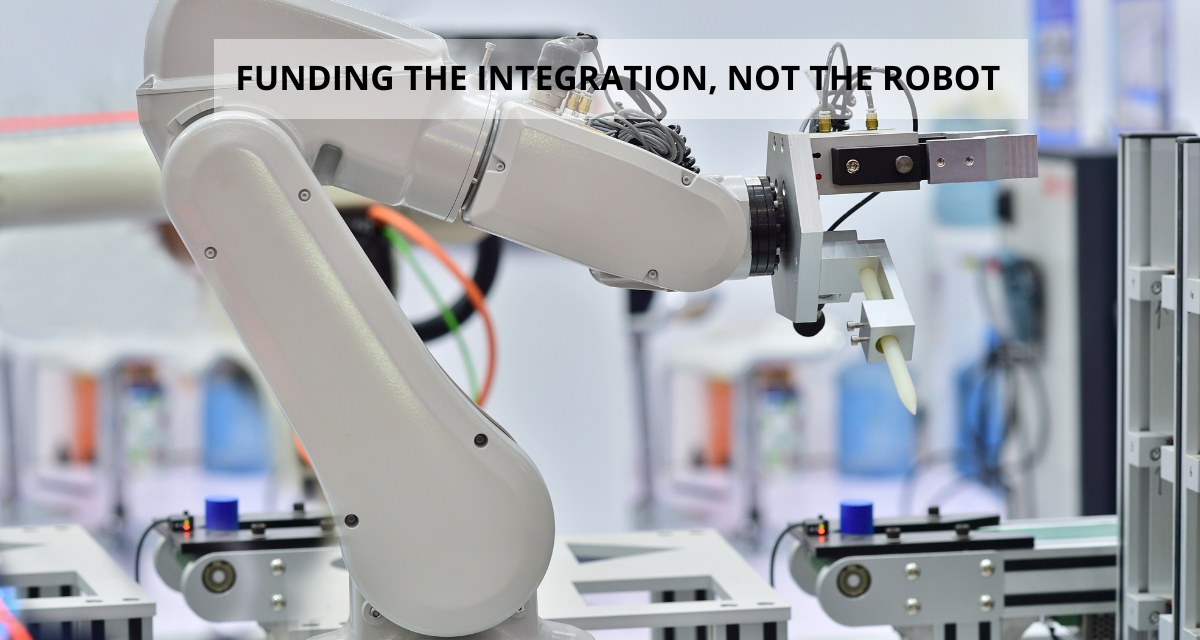
The robot on the automation quote is rarely the number that breaks the deal. Dimension Funding finances entire automation projects, not just the hardware line item, because the programming, controls, safety systems, and commissioning work wrapped around a robot typically costs as much as the robot itself, sometimes even more.

Grand View Research valued the global industrial robotics market, the robots themselves, at $33.9 billion in 2024. The same research firm separately values the global robotics system integration market—the design, programming, controls, and commissioning work required to put those robots to work—at $74.56 billion for the same year. More than double the hardware figure. For a vendor selling automation, financing that only covers the robot is financing less than a third of what the customer is buying.

Why the Integration Bill Outgrows the Hardware Bill

The integration work behind a cell rarely comes from just one vendor. A robot manufacturer, a systems integrator handling controls and commissioning, and a separate safety equipment supplier might each invoice the same project independently, which is usually the point where a customer ends up financing the robot alone and paying everything else in cash. Dimension Funding underwrites the combined project as a single transaction regardless of how many vendors are billing it, provided the full scope is submitted together rather than piecemeal as each invoice comes in.

Mordor Intelligence puts the global industrial automation services market, including the design, integration, commissioning, and support work layered around automation hardware, at $187.49 billion in 2026, projecting growth to $339.18 billion by 2031 at a 12.58% compound annual rate. That growth outpaces hardware spending because a manufacturer is paying for a working cell, and getting a cell to run is mostly integration work rather than the robot itself. 

What a Single Financed Application Covers

Dimension Funding structures an automation project through an industrial automation financing program as one transaction rather than a hardware purchase with separate integration invoices trailing behind it. That includes:

  • Design and engineering for the cell layout, including simulation and virtual commissioning before anything ships
  • Controls integration, covering PLC and HMI programming, vision system calibration, and safety system installation
  • Physical commissioning, including installation, alignment, and the on-site labor to bring the cell to a running state
  • Staff training, so the customer’s own operators and maintenance staff can run and service the cell without depending on the integrator indefinitely
  • Multi-year maintenance and support contracts, paid at the time of purchase rather than billed annually as separate service invoices

Application-only approval covers combined equipment-and-software automation projects up to $500,000. Larger integration projects, including multi-cell production lines, remain eligible for a streamlined review process rather than a full bank-style underwriting cycle.

Why the Integration Number Keeps Climbing 

Part of the gap between the hardware bill and the integration bill comes down to who’s available to do the work. The Bureau of Labor Statistics projects industrial machinery mechanics will add more new jobs than any other manufacturing occupation between 2024 and 2034, with 41,200 positions driven specifically by the continued adoption of automated machinery that needs skilled people to keep it running. Demand for that labor is growing faster than the hardware itself.

For a vendor quoting a project today, that shows up as commissioning timelines running longer than a customer expects, and integrators pricing labor-heavy phases higher than they would have a few years ago. Financing the full labor-heavy scope alongside the hardware matters more in that environment, not less, since the portion of a project’s cost that’s hardest to compress is exactly the portion most likely to keep growing.

The 90-Day Deferral and Section 179 Together

A qualifying automation purchase can be delivered, installed, and put into production for 90 days before the first payment comes due. That runway matters specifically for automation projects, where commissioning and ramp-up can take weeks before a cell is running at full output, and a customer making payments on equipment that isn’t yet producing revenue is a harder sale than one who isn’t.

Pairing that deferral with Section 179 strengthens the pitch further. Qualifying automation equipment and software placed in service during the tax year can be deducted under the 2026 Section 179 limit of $2,560,000, phasing out above $4,090,000, and under the bonus depreciation provisions restored by the One Big Beautiful Bill Act, per IRS Publication 946, equipment placed in service after January 19, 2025 can qualify for 100% bonus depreciation on any amount above the Section 179 cap. A customer can take the deduction in the same year the cell goes live, while the actual cash payments haven’t started yet.

Zero Percent Financing for Automation Vendors and Integrators

Automation sales often stall on the same objection regardless of how well-engineered the cell is: the customer likes the solution but isn’t sure the payback justifies committing capital this year. A zero percent program, offered directly through Dimension Funding’s vendor partner application, gives a vendor a way to answer that objection without cutting the project price itself.

It tends to do the most work when tied to a specific technology a vendor is trying to get a customer to adopt for the first time, a newer cobot line, a vision-guided system, or any category the customer hasn’t bought before and is naturally more cautious about committing capital to. Once a customer has deployed and validated one cell, the incentive matters less on the next purchase than the track record from the first one does.

What Showing a Monthly Number Changes at the Customer’s End

A proposal that shows a monthly figure next to the project scope can change who at the customer’s organization has to approve it. A capital request large enough to trigger a full committee review sometimes clears faster once it’s presented as a fixed monthly payment rather than a lump sum, since it can move through the budget the way an operating expense does instead of a capital appropriation. Getting that monthly number into the proposal from the first conversation, rather than introducing it after the customer has already seen the total price, is what keeps that path open.

A vendor can run the full project cost, hardware, integration, and multi-year support together through Dimension Funding’s payment calculator before the proposal goes out, and bring the customer an exact monthly number. A vendor connecting an automation cell to a customer’s existing ERP or MES environment can also fold that integration cost into the same request, since ERP financing covers the same categories of implementation and configuration work as the automation project itself.

Quoting the Whole Project Instead of Just the Hardware

An automation quote that only prices the robot understates what the customer is buying, and a financing structure that only covers the robot understates what Dimension Funding can do for that deal. Structuring the full project, hardware, integration, controls, training, and support, as one financed transaction gives a vendor a stronger proposal and a customer a payment that matches what they’re receiving.

Contact Dimension Funding to structure financing around a specific automation project, or to set up a standing vendor partnership ahead of the next quote.

Frequently Asked Questions

Does the $500,000 application-only threshold apply to the integration cost alone, or to the combined project total?

It applies to the combined total, not any single line item. Application-only approval covers projects up to $500,000, and in many cases that threshold extends to $750,000 before financial statements are required, so a project spanning several vendor invoices doesn’t necessarily need full underwriting just because the sum crosses the standard ceiling.

Does financing a multi-vendor project require separate approval from each company involved?

No. The financing is tied to the customer submitting the request, not to any of the vendors billing the project, so the robot manufacturer, the integrator, and any other suppliers involved don’t need their own credit approval or separate sign-off for the application to move forward.

If a customer already owns the robot and only needs the integration work financed, does that qualify?

Yes. Integration, controls work, and commissioning can be financed on their own when the robot itself was already purchased separately, structured around the integration invoice rather than requiring the hardware to be part of the same request.

Does financing the support contract separately from the original project cost anything, compared to bundling it upfront?

Bundling a multi-year support contract into the original financed transaction avoids a separate underwriting event later, since it’s evaluated as part of the same combined project rather than its own line item. Financing it separately after the fact would require a new application tied to that specific service invoice. 

Can a vendor offer zero percent financing on the integration portion only, while the customer pays cash for the robot itself?

Yes. A zero percent program can be scoped to specific cost categories within a project, including the integration and controls work alone, without extending the same terms to the hardware portion.

Does a used or refurbished robot change how the surrounding integration work is financed?

No. Integration, controls, and commissioning costs are financed the same way regardless of whether the robot itself is new or used, since the underwriting is based on the full project rather than the age of the hardware component.

What happens if the actual integration costs run higher than the original quote once the project is underway?

Material cost increases discovered mid-project typically require a supplemental request rather than being absorbed into the original agreement, so vendors quoting complex integrations are better served getting a firm number from the integrator before the initial application is submitted.

When a Vendor Financing Deal Gets Declined: Second-Look Options

When a Vendor Financing Deal Gets Declined: Second-Look Options

When a Vendor Financing Deal Gets Declined: Second-Look Options

A declined financing application doesn’t necessarily mean a sale is lost. More often it just means the deal didn’t fit the box it was put in, not that the buyer can’t get financed.

Dimension Funding works with credit profiles ranging from strong Tier A commercial credit down to marginal credit, and application-only financing, meaning no financial statements required, covers equipment purchases up to $250,000 and combined equipment-plus-software deals up to $500,000. That kind of range is exactly why a decline at one tier isn’t the end of the conversation.

Industry-wide, roughly one in five equipment finance applications don’t clear on a first pass: the Equipment Leasing & Finance Association’s CapEx Finance Index showed the industry-wide credit approval rate at 79.5% in June 2026, approaching an all-time high. For a vendor selling regularly, that means declines are routine, and how a vendor handles them shapes how many of those buyers eventually close.

Why Financing Applications Get Declined

Most declines trace back to a small set of factors: credit history, time in business, and how a buyer’s existing debt load and cash flow look on paper. The Federal Reserve’s Small Business Credit Survey found that while 41% of applicants received all the financing they sought, 36% received just some, and 24% received none, with firms increasingly likely to say they were denied because they already had too much debt. 

A Decline Isn’t Necessarily Final

A decline at the standard equipment-only tier doesn’t automatically apply to every structure a buyer could submit. Adding software, implementation costs, or a service contract to the same transaction shifts it into the combined threshold, which runs up to $500,000 without financial statements. A buyer whose equipment-only request stalled at $260,000 may fit comfortably once the software component that was going to be purchased separately gets combined into the same financing application.

Deal size is also worth revisiting before assuming a decline is permanent. Application-only financing remains available up to $750,000 in many cases, with transactions above that requiring basic financials rather than a full bank-style underwriting cycle. A buyer initially structured for a larger purchase may qualify cleanly once the request is scoped to what they need on day one, with a second phase financed separately later. Running the numbers through Dimension Funding’s payment calculator before resubmitting removes the guesswork and gives a vendor a realistic monthly figure to present to the buyer.

Restructuring Before Resubmitting

What tends to move a declined deal forward is a change to the structure itself:

  • Extending the term to lower the monthly payment relative to the buyer’s cash flow, rather than keeping the original repayment schedule fixed
  • Narrowing the equipment list to what the buyer needs immediately, with additional items financed as a second phase later
  • Separating software from hardware into distinct applications, since bundling assets with very different useful lives can work against a combined request
  • Financing a software renewal on its own terms, built around the contract length rather than treated as a lump-sum expense alongside physical equipment
  • Pulling the service or maintenance contract out on its own, financed as a standalone agreement matched to the contract’s length rather than bundled into the equipment or software term 

For a vendor whose buyer got declined on a combined hardware-and-software request, splitting the two into separate applications is often a faster path than waiting on the original one. Dimension Funding finances software renewals and multi-year licensing agreements under software renewal terms structured around the contract itself, which changes how a buyer’s obligations look on paper compared to a single bundled request. 

A multi-year support or maintenance contract attached to a declined deal doesn’t have to move with the rest of the transaction. Dimension Funding can finance that contract on its own, matched to the service term rather than the equipment it supports. That’s a smaller, more targeted request than resubmitting the full package, and easier to qualify for since it’s evaluated against a smaller total. 

Working Capital as a Fallback Structure

Not every declined equipment or software request needs to be resubmitted as equipment or software financing. Dimension Funding’s working capital loans run from $25,000 to $250,000 for businesses with annual revenue above $150,000, structured around the business’s cash flow rather than a specific asset purchase. For a buyer whose equipment application stalled because the collateral didn’t fully support the request, a working capital structure evaluated on revenue and bank statements instead can sometimes get to “yes” where an asset-based application couldn’t.

It isn’t a universal substitute, and the decline reason should drive whether it’s worth raising. A decline tied to collateral, where the equipment itself didn’t fully support the request, rarely resolves through a working capital structure, since the same buyer still has to qualify on cash flow alone. 

Zero Percent Financing and the 90-Day Deferral

For vendors selling software or higher-margin equipment lines, a zero percent financing offer can reopen a deal that stalled on price sensitivity rather than credit. Structured directly through Dimension Funding as a vendor-sponsored program, it gives a buyer another reason to move forward on the same purchase price rather than shopping the deal to a competitor. Vendors interested in setting one up can start with the vendor partner application, which also sets up a standing second-look process instead of handling declines one at a time. 

A 90-day deferral works differently: a qualifying buyer can take delivery of equipment or software, put it to use, and not owe a first payment for 90 days. For a buyer waiting on their own incoming revenue or a budget cycle to open up, that runway alone sometimes resolves what looked like a decline-worthy cash flow gap on the original application.

What a Second Look Means for a Vendor’s Close Rate

A vendor that treats every decline as final is walking away from deals a different structure would have closed. Following up with a revised application, a working capital alternative, or a deferral option gets more out of the same pipeline without spending a dollar more to generate it. Dimension Funding has run vendor financing programs for more than four decades, and sales teams that build a second-look habit into their process tend to see it pay off across more of their pipeline than a one-and-done application approach ever will. 

Section 179 applies the same way to a restructured deal as it did to the original one, and a buyer weighing a shorter term against a smaller current-year deduction sometimes needs that tradeoff spelled out before deciding whether to keep pushing. 

Turning a Decline Into a Structured Follow-Up

A declined application is information about the deal as submitted, not a verdict on the buyer. Reworking the structure, the deal size, or the documentation attached to it is usually a shorter path back to yes than starting over somewhere else. Contact Dimension Funding to talk through what a specific declined deal would look like restructured, or to set up a standing process for handling declines as part of an ongoing vendor partnership.

Frequently Asked Questions

Does a decline on an equipment-only application affect how a combined equipment-and-software resubmission is reviewed?

No. Each structure is evaluated on its own terms. A buyer declined at the $250,000 equipment-only tier can be resubmitted under the combined threshold, which runs up to $500,000, without the earlier decision carrying over.

Can a vendor resubmit a declined application without the buyer starting the paperwork over from scratch?

In most cases, yes. The original application details can carry into a restructured resubmission, since the underlying business information typically hasn’t changed, only the deal structure being proposed.

Does a partial approval count as a decline for restructuring purposes? 

No. A partial approval, where a buyer is cleared for less than the original request, is a different outcome than a decline and doesn’t require the same restructuring approach. In that case, the buyer can choose to move forward at the approved amount, cover the difference with a down payment, or revisit the request using the same restructuring options that apply to a full decline. 

Can a co-signer or guarantor change the outcome on a declined application?

Adding a qualified guarantor can strengthen an application where the original decline was tied to the primary applicant’s credit profile specifically. It’s most useful when the business itself has reasonable revenue but the ownership’s personal credit was the limiting factor.

Does financing a trade-in as part of the deal affect approval odds on a resubmission?

It can help. Applying a trade-in’s value toward the purchase reduces the total amount being financed, which sometimes moves a deal back under an application-only threshold it had previously exceeded.

If a buyer’s deal gets declined, does that affect the vendor’s own standing in the vendor partnership?

No. Approval decisions are tied to the buyer’s application, not the vendor’s account. A vendor’s partnership terms and access to financing tools for other customers aren’t affected by an individual buyer’s outcome.

Can a declined software subscription financing request be restructured as a shorter-term agreement instead?

Yes. A multi-year subscription request that gets declined can sometimes be resubmitted as financing tied to a single renewal term instead, which changes the total obligation being evaluated without changing what the buyer is purchasing.

Equipment Financing in the Quote: Integrating Vendor Programs at CPQ

Equipment Financing in the Quote: Integrating Vendor Programs at CPQ

Equipment Financing in the Quote: Integrating Vendor Programs at CPQ

A quote generated by CPQ software can price out configuration, delivery, and installation down to the dollar, but the monthly payment a buyer would pay if they financed it usually isn’t anywhere on the page.

Dimension Funding has worked with equipment and software vendors for more than four decades on getting financing into that sales conversation earlier, rather than leaving it for a follow-up call after the quote already went out.

The stakes here are larger than one sales team’s habits. The Configure Price and Quote market was valued at $3.63 billion in 2026 and is projected to reach $7.55 billion by 2031, according to Mordor Intelligence, as more vendors move quoting off spreadsheets and onto structured platforms that compress quote turnaround from days to mere minutes. That monthly number is the one thing the buyer still has to go find on their own. 

Where Financing Fits Into a CPQ Workflow Today

A CPQ platform prices the deal. It doesn’t answer what that price costs on a monthly basis if the buyer finances it instead of paying the total upfront. 

The Equipment Leasing & Finance Foundation’s Horizon Report found the top reasons end-users chose to finance equipment and software acquisitions were:

  • Optimizing cash flow, cited by 62% of end-users
  • Protecting against equipment obsolescence, cited by 55%
  • Capturing tax advantages, cited by 51%

A quote that only shows a lump sum addresses none of those things directly, which pushes the buyer toward a separate conversation instead of a decision they can make from the document already in front of them.

What Dimension Funding Provides at the Quote Stage

Dimension Funding doesn’t plug into a CPQ platform as a native module the way a tax calculation or shipping rate engine might. What it provides instead sits alongside a vendor’s existing quoting system rather than inside it:

  • A payment calculator that turns a purchase price and term into an estimated monthly payment
  • A financing widget a vendor can add to its own website so a buyer can start an application independently of the quote itself
  • A co-branded application and landing page carrying the vendor’s own product line

Configuration, pricing, and discount approval stay entirely inside whatever CPQ platform a vendor already runs. The credit decision, funding, and signature process stay with Dimension Funding. Nothing about that split requires the two systems to exchange data directly, since the only thing that actually needs to move from one to the other is a monthly number a rep can drop into a quote line.

Building the Calculator Into the Quote Template

Adding the monthly figure to a quote isn’t something a rep does from memory deal by deal. Dimension Funding works with a vendor’s account manager to build a reusable calculator link tied to that vendor’s typical deal sizes and terms, so a rep pulls a number from a preset tool rather than estimating one.

For vendors selling multiple product lines at different price points, that setup can be scoped by line rather than built once for the whole catalog, an equipment line and a software line can carry separate calculator links reflecting each one’s own typical deal size and term. Once it’s built, the link sits inside the vendor’s own quote template permanently, so a rep isn’t requesting a fresh estimate from Dimension Funding on every quote.

Equipment and Software on the Same Quote

Equipment and software often show up on the same quote. Application-only financing, meaning no financial statements required, tops out at $250,000 for equipment alone, but that limit jumps to $500,000 once software is part of the deal. A configuration that bundles both can qualify for the higher threshold even when the equipment portion by itself would have exceeded the lower one. 

Software lines carry an additional wrinkle equipment lines don’t: renewals. A subscription quoted through CPQ for a multi-year term finances against the full contract value, not a single year’s invoice, so the monthly figure a rep pulls for a three-year SaaS deployment reflects that whole term rather than one annual renewal amount. On a three-year SaaS deployment, a one-year number and the actual monthly figure can be far enough apart to change how the buyer reads the deal. Getting that right is part of what software financing has to account for on a multi-year quote. 

Zero Percent as a Quote-Level Lever

A zero percent offer works best when it’s visible at the exact moment the buyer is comparing numbers, which is the quote itself rather than a follow-up email. The same way a calculator link gets built into a vendor’s quote template, a zero percent promotion can be set up as a toggle on that same template rather than something a rep has to call Dimension Funding to arrange on each individual deal.

Vendors running the promotion selectively benefit most from this. A software line facing a competitive renewal decision might carry the toggle, while a routine equipment replacement on the same quote template doesn’t. Once it’s built into the template by line, a rep switches it on or off at the configuration step itself instead of managing it as a separate conversation outside the quote.

Where CPQ Meets the Buyer’s Decision

CPQ platforms rarely operate in isolation. Most connect back to a CRM or ERP system to pull customer records and push closed deals into billing, part of a broader enterprise software layer that includes business analytics and CRM publishing—a category growing at a 14.3% compound annual rate between 2021 and 2026, according to IBISWorld, dominated by the same handful of platforms that also lead the CPQ market itself.

None of that infrastructure is where a buyer makes the call to move forward. That happens on the quote, in the moment a price becomes a number the buyer can compare against a budget line. Whatever system produces the document, the monthly figure belongs on it rather than in a system the buyer never sees. A quote that gets forwarded internally for approval should carry that number with it.

Getting Financing Into the Next Quote

None of this requires a vendor to rebuild a CPQ template from scratch or wait on a formal integration that doesn’t exist yet, so it’s worth talking through directly: Contact Dimension Funding to see how the payment calculator and financing widget fit into a specific CPQ setup or product line.

Adding the monthly number is a habit change for a sales team more than a technical project, and the tools already exist to make pulling that figure fast enough to do on every quote instead of just the ones where a buyer asks first.

Frequently Asked Questions

Does adding a financing line to a CPQ-generated quote require changing the platform’s approval workflow?

No. Pricing and discount approval logic stay entirely inside the CPQ platform. The financing figure is a reference number pulled in alongside the quote rather than something that touches the platform’s own approval or discounting rules.

If a CPQ template already shows a total contract value, does the monthly financed number need to be recalculated every time the configuration changes?

Yes. The payment calculator reflects whatever total and term are entered, so a configuration change that alters the price means pulling a fresh number rather than leaving an earlier estimate attached to a revised quote.

Can a reseller running its own separate CPQ instance use the same payment calculator as the manufacturer’s direct sales team?

Yes. The calculator isn’t tied to a specific CPQ platform or account, so a reseller on entirely different quoting software can point buyers to the same calculator and application without any manufacturer-side setup.

Does a renewal on an existing software subscription get quoted the same way as a brand-new deployment?

Yes. A renewal runs through the same calculator and the same underwriting sequence as a new deployment. The difference is timing, since a renewal needs to be quoted and signed before the existing contract lapses, not the mechanics of how the monthly figure gets calculated.

Does the CPQ platform need to store or transmit a buyer’s financial information for a financing option to appear on the quote?

No. The quote only needs to reference the estimated monthly payment. The buyer’s actual financial details are submitted separately during the application step, so nothing sensitive passes through the CPQ platform itself.

If a deal quoted through CPQ changes in scope, does the financing estimate need a new application?

Only if the change happens after an application was already submitted. A configuration change made while a quote is still in draft just means pulling a new estimate before sending it, not restarting a formal application.

Is there a cost to a vendor for using the payment calculator or financing widget in their own quoting materials?

No. Both are part of the standard vendor partner program at no separate cost, distinct from a promotional structure like zero percent financing, where the vendor covers that specific promotion rather than the tools themselves carrying a charge.

When Vendors Get Paid: Equipment Financing Funding Timelines

Private Label vs Referral Financin

When Vendors Get Paid: Equipment Financing Funding Timelines

Approval, funding, and vendor payout are three separate events in an equipment financing deal, and they don’t move on the same clock.

Dimension Funding has been running that sequence for equipment and software vendors for more than four decades, breaking it into the same handful of stages on every deal.

Not every deal clears the first one right away, either. The Equipment Leasing and Finance Association’s 2024 Survey of Equipment Finance Activity found that 77.5% of applications submitted industry-wide were approved in 2023. Underwriting still has to happen before the funding clock starts. It’s not just a rubber stamp on the way through 

From Application to Approval: The First Gate

Dimension Funding typically returns a credit decision within a few hours of a completed application, whether that application comes from the buyer directly or through a vendor’s own financing widget. Speed at this stage depends on the file being complete, not on which door it came through.

Which review path a deal takes from there depends on size. Application-only review, meaning no financial statements required, covers deals up to $250,000 for equipment and up to $500,000 once software is part of the transaction. Above those figures, the buyer supplies tax returns and basic financials, which is the point where a deal’s timeline starts to depend on how quickly that paperwork comes together rather than on the credit decision itself.

From Approval to Funding: What the Clock Looks Like

Once approved, the buyer signs, and funding typically follows within 48 hours, with same-day funding common once signed documents are back. The stages run in a fixed order regardless of deal size, though the time each one takes can vary.

Stage

What happens

Typical timing

Application submitted

Buyer or vendor submits deal details

Same day

Credit decision

Underwriting reviews the file

A few hours

Documents signed

Buyer signs through DocuSign

Same day, once sent

Funding released

Money moves to close the deal

Within 48 hours of approval, often same-day

Vendor paid

Vendor receives the purchase price in full

Within 24 hours of funding

Why Credit Decisions Move This Fast Industry-Wide

A few hours for a credit decision isn’t unique to Dimension Funding; it reflects where equipment finance underwriting has moved industry-wide. The 2025 SEFA found that credit underwriting is now tied with sales for the highest AI implementation rate of any function in the equipment finance industry, at 45%, with another 65% of surveyed companies actively exploring AI specifically for underwriting on top of that.

That shift explains why hours-based decisions have become standard for application-only deals rather than an exception. It also explains the other half of the picture: once a file needs human review of tax returns and financials, that same speed advantage doesn’t apply, which is part of why deals above the application-only threshold move on a slower, less predictable timeline than the ones under it.

The 24 Hours That Matter Most to Vendors

Once funding closes, Dimension Funding pays the vendor the full purchase price within 24 hours, independent of whatever payment schedule the buyer is on for the rest of the term.

That matters more once you look at how small businesses experience cash flow. More than half of employer firms, 51%, cited uneven cash flow as a financial challenge in the Federal Reserve’s 2025 Report on Employer Firms, and a vendor’s own receivables sit squarely inside that kind of timing risk. A sale that pays out on a fixed 24-hour clock removes that specific variable from one line of the business, even if invoicing elsewhere still runs on 30- or 60-day terms.

Where Third-Party Collection Usually Breaks Down 

Roughly four of every five small firms report payments-related challenges, according to the Federal Reserve’s 2024 Report on Payments. For firms that collect payment through a third party rather than directly from the customer, the report found that delays in settlement and the availability of funds are the single biggest obstacle they face, more than fees and more than processing friction. 

A financed equipment or software sale is, structurally, a third-party collection arrangement: the vendor isn’t collecting from the buyer directly; Dimension Funding is. That’s exactly the problem 24-hour payout gets rid of. 

The Payout Doesn’t Reverse Later

The 24-hour figure isn’t a provisional payment that could later come back. Once Dimension Funding pays the vendor, that transaction is closed on the vendor’s side regardless of what happens afterward, including if the buyer later falls behind or defaults on the remaining term. The credit risk on the rest of the payment schedule sits with Dimension Funding, not the vendor.

Equipment vs. Software: Does the Clock Run Differently

Equipment Deals

Equipment financing runs on the sequence above regardless of category, from a single forklift to a multi-unit fleet order. The application-only threshold and documentation requirements are the variables that matter, not the type of equipment itself.

Software Deals

Software deals follow the same underwriting sequence, though the $500,000 application-only threshold already accounts for licensing, implementation, and training bundled together, which is often what pushes a software deal above the equipment-only figure in the first place. A renewal runs through that same clock as a brand-new deployment, so a vendor has room to get it signed before the old contract lapses.

A zero percent promotion layered on top of either an equipment or software deal changes what the buyer owes, not how fast the vendor gets paid, since Dimension Funding still funds the full purchase price on the same schedule.

What Slows a Deal Down

Deal composition works in a buyer’s favor here more often than against it. A $300,000 equipment purchase on its own would exceed the $250,000 equipment-only threshold and need financials, but the same purchase paired with a software component shifts the whole transaction to the $500,000 combined threshold, keeping it application-only in a case where the equipment alone would not have qualified. Vendors who understand that distinction can flag it to a buyer before financials get requested unnecessarily.

Used equipment shifts what slows a file down in a different way than deal size does. Documentation carries more weight here than it does on new equipment, since service records, an inspection, or verified usage history are what a lender leans on in place of a manufacturer’s original specs. A buyer who already has maintenance logs and inspection paperwork on hand will move through a review faster than one who has to go track that down after a lender asks for it.

Building the Timeline Into a Sales Conversation

None of these stages require a vendor to track underwriting personally. The sequence runs the same way whether a vendor mentions financing once a year or on every quote, and the 24-hour payout clock starts the moment funding closes regardless of deal volume.

Contact Dimension Funding to see how the timeline applies to a specific deal size or product line.

Frequently Asked Questions

Does a deal ever fund faster than the typical 48-hour window, and what makes that happen?

Same-day funding happens most often when a buyer signs documents promptly after approval and no outstanding financials are needed. The 48-hour figure is a typical outer range rather than a fixed wait, so a clean file with a quick signature routinely closes faster.

If a buyer needs to submit financial statements, does that reset the credit decision or just add a step?

It adds a step rather than resetting anything. The initial credit decision still comes back on its usual timeline. The additional time exists specifically for reviewing the financials, not for re-running underwriting that already happened.

Does choosing a longer repayment term change how fast the vendor gets paid?

No. Term length changes the buyer’s monthly payment amount, not when Dimension Funding funds the deal or pays the vendor. A 24-month term and a 60-month term move through the same funding sequence.

Does a 90-day payment deferral for the buyer change when the vendor is paid?

No. A deferral program changes when the buyer’s first payment is due, not when the vendor receives the purchase price. The vendor is still paid in full within 24 hours of funding regardless of the buyer’s own payment schedule.

Does a multi-unit order take longer to fund than a single piece of equipment?

Not inherently. A multi-unit order runs through the same sequence as a single piece of equipment. The variable that matters is total deal value, since a large combined order can cross into the range that requires financials, which is a function of size rather than the number of units involved.

Does applying through a vendor’s own website widget change the approval timeline compared to a buyer applying directly?

No. A vendor’s widget is a front-end entry point into the same application and underwriting process a buyer would go through applying directly, so the timeline doesn’t change based on which entry point was used.

Does the 24-hour payout apply the same way to a partial shipment or a multi-phase delivery? 

Not automatically. Funding and the 24-hour payout are tied to what’s actually been delivered and signed off on, so a deal delivered in phases pays out as each phase funds rather than as one lump sum at the end. A vendor shipping a large order in stages should structure the agreement around that upfront rather than assume the full amount is funded at once.

Private Label vs Referral Financing: Vendor Program Models Compared

Private Label vs Referral Financin

Private Label vs Referral Financing: Vendor Program Models Compared

The choice between private label and referral financing comes down to how much of the buyer relationship stays under the vendor’s own name. Dimension Funding works with vendors under both structures, and the difference between them shows up in what the buyer sees and remembers, not just on the application screen. Dealers and vendors evaluating the two can compare program structures directly at Dimension Funding, a family-owned business that’s run vendor financing programs since 1978.

Where These Two Approaches Sit in the Broader Industry Framework

The Equipment Leasing and Finance Association’s Manufacturer & Vendor Resource Center frames vendor financing as a set of structural choices rather than a single product: a manufacturer or dealer can build financing capability in-house, enter a formal partnership with a finance source, or rely on an informal partnership with multiple finance sources as deals come up. A private label arrangement sits in the formal-partnership category, and simply pointing a buyer toward a standard application is the informal version of that same relationship. Dimension Funding has run its own vendor programs under this same formal-partnership structure since 1978. 

That’s important framing to consider, because the two approaches sit in genuinely different categories rather than different levels of polish on the same product. A vendor starting with a plain referral today isn’t just locked into it permanently. Moving to a private label setup later means adding materials to an existing relationship, not restarting one, so the lighter starting point doesn’t have to be a permanent ceiling. 

What a Private Label Setup With Dimension Funding Includes

A private label arrangement includes co-branded landing pages built on Dimension Funding’s site carrying the vendor’s own logo and value proposition, along with a personalized link a vendor can distribute directly to prospects. It also includes co-branded advertising flyers and datasheets, put together with a vendor’s account manager rather than handed over as a generic template. The full scope of what’s included is outlined in Dimension Funding’s Vendor Partner Toolkit.

That’s meaningfully more setup than sending a buyer to a plain application link, and it’s also more than cosmetic. A vendor whose name and materials stay in front of the buyer through the entire financing conversation is positioned differently than one who hands the buyer off to a page carrying someone else’s branding.

Applying Without Leaving the Vendor’s Own Site 

A buyer doesn’t have to leave a vendor’s own site to apply, either. Dimension Funding builds a financing widget combining a payment calculator and a credit application in one embed, placed directly on the vendor’s website rather than hosted only on the co-branded landing page. A prospect can run a monthly payment estimate and start an application without going anywhere else. 

Ongoing Promotion Beyond the Initial Setup 

The materials don’t stop at launch. Beyond a standing zero percent offer, a vendor can work with Dimension Funding on a custom promotion built around a specific product line or a particular type of prospect, something structured for that vendor rather than pulled from a template. 

Dimension Funding will also work with a vendor on white papers or other literature, then distribute that content through social media, a quarterly newsletter, and email marketing, putting a vendor’s message in front of an audience it didn’t have to build on its own. None of that exists on the plain referral side, since there’s no vendor-specific content for Dimension Funding to promote in the first place.

The Informal Route

Lack of demand is the most common reason a company relies on an informal arrangement instead of building a formal vendor relationship, and manufacturers who choose that route typically depend on their dealer to arrange financing only when a customer need comes up, through an informal, deal-by-deal approach rather than a structured program. 

In practice, that means pointing a buyer to Dimension Funding’s standard financing application instead of a page carrying the vendor’s own name. The application takes about six minutes to complete and moves through DocuSign the same way a private label deal does. A vendor still has an account manager to call about a specific deal or promotion, just without the landing page, personalized link, or ongoing content built around the relationship. 

Payout and Underwriting Stay the Same 

Dimension Funding pays the vendor in full once the deal funds, regardless of which route brought the buyer in. A referral vendor isn’t accepting a slower process, a weaker credit decision, or less certainty of getting paid by skipping the formal setup. What it doesn’t get is a reason for the buyer to connect that speed and simplicity back to the vendor specifically, since nothing on a generic application signals who sent them there. 

How Zero Percent Promotions Work Under Each Approach

A zero percent financing promotion is evaluated deal by deal either way, with the vendor covering the cost of the promotion rather than the buyer. What changes is how that promotion gets presented to a buyer. Under a private label setup, a zero percent offer can be built directly into the co-branded landing page as a standing, visible promotion, often paired with messaging about how a purchase can qualify for a deduction of up to $2,560,000 in the year it’s placed in service under IRS Publication 946, before the phase-out threshold of $4,090,000.

Under a plain referral, there’s no dedicated landing page to feature either message on. A vendor can still arrange zero percent financing on a specific deal by working directly with their account manager, but it has to be raised and confirmed each time rather than sitting in front of every buyer automatically. For a vendor running the same promotion repeatedly, that difference in visibility adds up.

How Long Setup Takes 

A plain referral has no setup timeline at all. A vendor can point a buyer to a standard application the same day the relationship starts, with nothing to build, approve, or wait on before it becomes usable.

A private label arrangement takes longer to get live, since the co-branded landing page, personalized link, and flyers get built with a vendor’s account manager rather than generated automatically. That upfront coordination is the real cost of the heavier option, not a slower deal process once it’s running, since both routes send a submitted application through the same review at Dimension Funding from that point on.

What Changes Operationally

Factor

Private Label

Plain Referral

Repeat-buyer relationship

Stays under the vendor’s own name

Routes back through a generic link each time

Buyer-facing materials

Co-branded landing page, personalized link, flyers and datasheets

Standard Dimension Funding application

Zero percent promotion visibility

Featured directly on the co-branded landing page

Arranged deal by deal with an account manager

Return on setup effort

Pays off with regular deal volume

Better fit for occasional financing

Equipment-Only vs. Software-Inclusive Programs Under Either Approach

Both approaches work the same way whether Dimension Funding is financing equipment alone or bundling in software, implementation, and training. The application-only thresholds, $250,000 for equipment, $500,000 when software is part of the deal, don’t shift based on which approach a vendor uses. What shifts is who’s positioned to capture the repeat relationship the financing creates, not the underlying terms buyers qualify for. 

Choosing Based on Where Your Program Is Headed

The decision comes down to whether a vendor wants a plain referral arrangement as a permanent, low-effort option, or wants the co-branded structure that keeps more of the buyer relationship and promotion visibility under its own name. Contact Dimension Funding to talk through which approach fits your sales process.

Frequently Asked Questions

Does a private label setup require an exclusivity agreement with Dimension Funding?

No. A vendor can run a private label program with Dimension Funding without committing to exclusivity, which means a vendor can still send some deals through a plain referral or maintain other financing relationships alongside the co-branded setup.

Can a manufacturer run different approaches across different regions of its dealer network?

Yes. A manufacturer isn’t required to standardize on one approach nationwide. Regional dealers with higher volume can justify a co-branded private label setup while lower-volume regions rely on plain referral, without requiring the whole network to match.

If a vendor moves from plain referral to a private label setup, do deals already in progress need to be redone?

No. Deals already submitted or funded through Dimension Funding under a plain referral arrangement aren’t affected by a later move to private label. The transition applies to new deals going forward rather than requiring existing transactions to be restructured.

Who handles compliance disclosures differently between the two approaches?

Required financing disclosures identify Dimension Funding as the funding source either way, since that’s a legal requirement tied to the underlying agreement rather than the branding layer. What differs is how much of the surrounding sales messaging, promotions, and tax information the vendor controls before that disclosure point.

Does a private label setup change who the buyer contacts for service after the deal funds?

Not necessarily. Post-funding servicing, like payment processing and account questions, is generally handled the same way regardless of approach, since that servicing sits with the financing agreement rather than the sales-facing branding layer.

Does a private label setup need to cover a vendor’s entire product catalog, or can it be scoped to one line? 

It can be scoped narrower. A vendor can set up co-branded materials for one product line or a single high-volume category rather than committing every product to the same landing page and flyers, and can add more lines later without rebuilding what’s already running. 

Is there a minimum number of annual deals a vendor needs before Dimension Funding will set up a private label program? 

There’s no strict volume requirement. The setup conversation focuses more on whether the co-branded materials will see consistent use than on hitting a specific deal count, so a vendor unsure whether its volume justifies the setup can raise that directly rather than assuming it’s out of reach.

How to Set Up a Financing Program for Your Equipment Dealership

How to Set Up a Financing Program for Your Equipment Dealership

How to Set Up a Financing Program for Your Equipment Dealership

Setting up a vendor financing program is less about paperwork and more about a handful of decisions made up front. Dimension Funding has spent over four decades building these programs for equipment dealers, and the process moves faster than most owners expect once those decisions are made. Dealers who want to see what a vendor program could look like for their specific equipment line can start at Dimension Funding.

Deciding What the Program Will Cover

The first real decision is scope: equipment only, or equipment plus software, implementation, and services bundled into the same transaction. That choice affects which application-only threshold applies with Dimension Funding, meaning how much a buyer can finance without submitting financial statements.

For equipment-only deals, Dimension Funding generally offers application-only approval up to $250,000. When software, implementation, or training rides along with the equipment, Dimension Funding’s software financing option raises that threshold to $500,000. A dealership selling machines that increasingly ship with control software or an ERP integration should account for this before assuming every deal fits the lower tier.

What to Evaluate in a Financing Partner

With Dimension Funding, the dealership is paid the full purchase price at funding, before the buyer has made a single payment. If a buyer later falls behind or stops paying, that’s a matter between the buyer and Dimension Funding, not something that unwinds the dealership’s own payment. The receivable is settled at closing rather than sitting on the dealership’s books waiting to be collected. 

Captive Financing vs. an Independent Vendor Partner

Some dealerships already have access to a manufacturer’s own captive financing arm, a company set up specifically to finance that manufacturer’s equipment. Captive programs work well for a dealership selling almost entirely new inventory from a single manufacturer, since the financing is built around that one product line.

The limitation shows up once a dealership’s inventory gets more mixed. A captive program typically doesn’t extend to used equipment, trade-ins, or a second manufacturer’s line the same dealership might also carry. An independent partner like Dimension Funding finances across all of that under one program, which matters for a dealership that isn’t purely single-brand or purely new inventory, which describes most dealerships carrying more than one product line.

The Application and Onboarding Steps

Getting a program running with Dimension Funding starts with a conversation about what the dealership sells, typical deal size, and how the sales team currently handles the payment question. From there, the process moves through a defined sequence rather than an open-ended negotiation.

Step

What Happens

Typical Duration

Initial application

Dealership submits basic business details and a typical transaction profile

Same day

Program structuring

Financing partner builds terms around deal size and buyer credit mix

1 to 3 business days

Tools and materials setup

Marketing collateral, payment calculator, and application widget configured

Varies by dealership

Sales team briefing

Reps trained on how and when to introduce financing in a sales conversation

1 business day

Launch

Sales team begins offering financing at the point of sale

Immediate after setup

A dealership moves through this faster when it can describe its typical deal size, whether software or services usually accompany the equipment sale, and roughly what credit profile its buyer base tends to have. None of this requires a formal report. A sales manager who already runs the floor can usually answer all of it in a single call. From there, the vendor partner application gets the program moving. 

Tools That Come With the Program

Once a program is active, a dealership isn’t handed a phone number to call when a buyer asks about payment. Dimension Funding’s vendor partner program includes a financing widget that a dealership can add to its own site, putting an application and a payment calculator directly in front of a buyer before they ever speak with a salesperson. 

Marketing Support Doesn’t End at Launch

A program includes ongoing marketing support beyond the initial setup, not just a one-time configuration. That typically includes co-branded materials built around the dealership’s specific equipment line, along with inclusion in broader outreach like newsletters and social posts aimed at the same buyer base the dealership is already trying to reach.

That distinction matters for a dealership deciding whether a program is worth the setup effort. A financing relationship that only provides an application form gives a dealership less ongoing value than one that keeps generating exposure to prospective buyers after the initial launch is done.

Preparing the Sales Team

Tools matter less than when a sales team brings financing into the conversation. Dealerships that introduce it alongside the quote, rather than after a buyer balks at the price, tend to get more use out of a program than dealerships that treat it as a fallback.

That means a short internal conversation before launch: who mentions financing first, whether it’s included by default on every quote, and how a rep answers the most common buyer questions about approval speed and paperwork. Full program benefits are best reviewed with the sales team directly, not summarized secondhand.

When a Rep Isn’t Sure a Deal Qualifies for Application-Only Treatment

Reps don’t need to calculate eligibility themselves before quoting financing. The application-only thresholds are based on the total transaction, equipment plus any bundled software or services, so a rep who isn’t sure whether a specific deal falls under $250,000 or $500,000 can simply submit it and let the review process sort out which tier applies. Treating every deal as a candidate for application-only financing, rather than pre-screening deals informally on the floor, keeps reps from talking themselves out of raising financing on a deal that would have qualified.

Why More Dealerships Are Adding This Now

Vendor and manufacturer financing, sometimes called captive financing, is already a meaningful share of how equipment gets paid for. Of the total market for financing in 2023, banks accounted for 59% of financed acquisitions; captives, meaning manufacturer or vendor financing, accounted for 17%; independents comprised 15%; and fintechs 7%, according to the Equipment Leasing and Finance Association. That 17% isn’t a niche corner of the market. It represents a real share of deals going to dealerships that already built financing into their sales process.

The Equipment Leasing & Finance Foundation’s 2024 Horizon Report also found that end-users expect to increase equipment and software acquisitions in 2025, with 42% anticipating growth against just 15% expecting a decline. Dealerships without a financing program in place are positioned to capture less of that expected growth than ones already offering it at the point of sale.

What This Means for a Dealership Without a Program Yet

A dealership relying on buyers to arrange their own financing is effectively outsourcing part of its close rate to whatever lender that buyer happens to find, with no visibility into approval odds or timeline. The Federal Reserve’s 2025 Small Business Credit Survey found that roughly half of firms had their financing needs fully met, while about a third faced a funding gap despite applying. SBA-backed loan programs offer another path for buyers who don’t qualify through a bank, but those routes generally move slower than a financing partner already built into the sale.

Getting a Program Running

A dealership doesn’t need an in-house finance team or an existing lender relationship to start working with Dimension Funding. The structure gets built around how the dealership already sells, whether that’s mostly new equipment, mostly used, or a mix that increasingly includes a software component.

Contact Dimension Funding to scope a vendor program for your specific equipment line.

Frequently Asked Questions

Does a dealership need a minimum sales volume to qualify for a vendor partner program?

There’s no strict volume requirement. Smaller dealerships with a modest deal count can still set up a program, though the structuring conversation focuses more on typical deal size and buyer credit mix than on total annual volume.

Is there a cost to the dealership for joining a vendor partner program?

The program itself doesn’t charge the dealership a setup fee. Costs only come into play if a dealership chooses to offer a promotional structure like zero percent financing, where the dealership covers that promotion’s cost rather than the buyer.

Does adding a financing program require the dealership to change its existing quoting or CRM software?

No. A vendor partner program operates through its own application widget and portal rather than requiring integration into the dealership’s existing systems, so it can run alongside whatever quoting or CRM tools are already in place.

What happens if a buyer’s deal exceeds the application-only threshold?

Deals above the application-only thresholds move to a streamlined review rather than a full bank-style underwriting process. The dealership isn’t involved in that review beyond providing the initial deal information.

Does the dealership have any say in which buyers get approved?

No. Credit decisions are made independently of the dealership, which keeps the dealership out of the position of vouching for or denying a specific buyer.

Can a dealership limit the vendor program to certain product lines rather than its full catalog?

Yes. A dealership can scope the program to specific equipment categories or a subset of its catalog rather than committing every product line from the outset.

How quickly can a new dealership employee start using the program without additional setup?

Once a program is active, using it doesn’t require per-employee onboarding. A new sales hire can start quoting financing alongside equipment as soon as they’re trained on the dealership’s own process, since the tools and application sit at the point of sale rather than requiring individual account access.

SaaS Financing for Software Vendors | Dimension Funding

SaaS Financing for Software Vendors | Dimension Funding

SaaS Financing for Software Vendors | Dimension Funding

If you sell software, you’ve likely had this conversation before. A prospective buyer loves the product, the demo goes well, and then the invoice lands on their desk but the deal stalls out. Implementation fees, a multi-year subscription commitment, and third-party integration costs are making the deal difficult to finalize, and the whole process gets dragged out for weeks.

Offering financing at the point of sale changes that dynamic. Instead of asking a potential buyer to write one large check, or piece together their own funding, you give them a fixed monthly payment and let them start using the software right away. Dimension Funding has spent over four decades building financing programs specifically for vendors selling equipment and software, and subscription-based platforms are a growing part of that business.

Why Vendors Are Building Financing Into the Sales Process

The SaaS market itself explains a lot of this shift. Mordor Intelligence’s software as a service market report puts the global market at $435.41 billion in 2026, growing at a compound annual rate of 17.55% toward an estimated $976.61 billion by 2031. That level of growth means more vendors competing for the same buyers, and pricing pressures that make a clean, friction-free purchase experience a genuine differentiator.

At the same time, buyers have grown more comfortable paying for software the way they pay for everything else: on a schedule as opposed to all at once. A subscription renewal that used to be a single annual invoice is becoming something a finance team wants spread out. When a vendor can offer that kind of structure directly, instead of leaving the customer to try to find their own financing, the sales conversation stays focused on the product rather than the payment. 

How Vendor Financing Works With Dimension Funding

Dimension Funding’s vendor financing program is built around a simple structure. The vendor gets paid in full shortly after funding closes, while the customer makes one fixed monthly payment over an agreed term. The vendor isn’t waiting on installment payments or chasing down a customer who’s behind on an invoice. That risk sits with Dimension Funding, not the seller.

For software specifically, the software financing program covers the full scope of what a software deal costs, not just the license fee. That includes:

  • Subscription and licensing costs, including multi-year commitments
  • Implementation and configuration work
  • Staff training
  • Third-party vendor and consulting fees
  • Hardware needed to run the software 

Application-Only Approval Limits

One of the more practical advantages for vendors is speed. Application-only financing, meaning no financial statements required from the buyer, is available up to $500,000 when software is part of the deal. That threshold matters for vendors selling mid-market ERP, CRM, or vertical SaaS platforms, where a full implementation frequently lands well above what a typical equipment-only deal would cost.

Deals above that threshold still move through a streamlined process rather than a traditional bank underwriting cycle. Approvals typically come back within hours, and funding often follows within a day or two, which means a signed deal doesn’t sit in limbo while paperwork works its way through a credit committee.

Zero Percent Financing as a Sales Tool

Dimension Funding’s zero percent financing program requires the vendor to cover the cost of the promotion, typically through a modest discount on their end, rather than the customer paying anything extra for the payment structure. Qualification is evaluated deal by deal rather than offered as a blanket rate, so a vendor typically works through their account manager to confirm which transactions qualify before presenting to a customer.

The program covers the same full scope as standard financing: the software itself, implementation, training, professional services, third-party vendor costs, and hardware, all under one monthly payment. That matters for a vendor comparing it against a manufacturer’s own promotional financing, which often only covers the software license and excludes the implementation and training costs that make up a large share of total project cost.

Subscription and Multi-Year SaaS Deals

Dimension Funding finances subscription renewals the same way it finances a new deployment: implementation, training, and third-party costs bundled into a single monthly payment rather than one large annual bill. For vendors, that means a renewal conversation can turn into an upsell conversation instead of a retention scramble, since the customer isn’t staring down a lump-sum invoice that competes against other budget priorities.

This applies across ERP, CRM, HR and accounting platforms, EMR and EHR systems, and most categories of business software. Dimension Funding’s ERP financing program, for example, extends the same structure to platforms like NetSuite, Sage Intacct, Acumatica, and Microsoft Dynamics, where implementation and data migration costs frequently exceed the license cost itself.

How Subscription Costs Get Deducted

Most SaaS subscriptions don’t run through Section 179 at all. According to Section179.org, subscription arrangements are typically treated as ordinary business expenses under IRC Section 162 rather than purchased property, since the customer is paying for access to the software rather than acquiring it outright. That means a subscription cost is usually already fully deductible in the year it’s paid, without needing any special election.

Section 179 becomes relevant when a deal includes something the customer owns outright, like perpetual software licenses or bundled hardware. Businesses can deduct up to $2,560,000 in qualifying costs for those owned components in the year placed in service, phasing out above $4,090,000. Implementation and configuration costs tied to that owned property can typically be included in its capitalized basis, extending the same treatment to the setup work rather than qualifying as a separate deduction on their own. 

Why Multi-Year Prepayments Work Differently

Even as an ordinary expense, a subscription cost isn’t automatically deductible in full the year it’s paid. IRS Publication 538 sets a twelve-month rule: a prepaid expense can be deducted in full in the year paid only if the benefit doesn’t extend beyond twelve months from when it starts, or the end of the following tax year, whichever is earlier. A single annual renewal clears that easily. A two- or three-year prepayment doesn’t, and the buyer’s accountant has to capitalize and amortize it instead.

That’s usually how a multi-year deal stalls, not because of the product, but because the buyer’s finance team wasn’t expecting an amortization schedule. Financing the term into monthly payments through Dimension Funding sidesteps that question entirely, since there’s no lump-sum prepayment triggering the capitalization issue in the first place.

Getting a Vendor Program Started

Setting up a vendor financing relationship starts with a conversation: what you sell, your typical deal size, and how your sales process currently handles the payment conversation. From there, Dimension Funding builds a program suited to your specific offering, whether that’s a single software product, a suite of implementation services, or a mix of hardware and software sold together.

Contact Dimension Funding to start scoping a program for your sales process.

Frequently Asked Questions

Does Dimension Funding work with vendors outside the U.S., or only domestic software companies?

Dimension Funding works with vendors and end customers across the U.S. and Canada. A software company selling into both markets doesn’t need a separate financing partner for each side of the border.

If a customer wants to add seats, modules, or a third-party integration mid-contract, does the existing financing agreement need to be redone from scratch?

Not necessarily. Additional components purchased later, whether that’s more licenses, a new integration, or equipment from a different manufacturer, can typically be structured as a supplemental agreement rather than unwinding the original one. This is one of the more common reasons vendors bring Dimension Funding into an expansion conversation rather than just an initial sale.

What happens to the financing agreement if a customer cancels their subscription or stops using the software mid-term? 

Cancellation of the software agreement and the financing agreement are two separate things. Because Dimension Funding pays the vendor upfront, the customer’s payment obligation runs on its own terms regardless of whether they keep using the software, similar to how a car loan doesn’t disappear if the car sits in the driveway. Vendors who want subscription cancellation to trigger an early payoff or a different outcome need to build that into their own customer contract, since the financing agreement won’t address it on its own. 

What does a vendor need to have ready before submitting a customer’s first deal?

The intake process is intentionally light, but a few things speed it up:

  • Basic details on the end customer (business name, contact, and what’s being purchased)
  • A quote or proposal showing the total project cost, including implementation and any third-party fees
  • Whether software, hardware, or both are involved, since that affects which application-only threshold applies
  • Any multi-year or renewal terms already discussed with the customer

Most of this is information a vendor’s sales team already has on hand by the time a deal is ready to close.

Can a customer who already purchased software without financing come back later and finance the remaining term or an upcoming renewal?

Yes. A subscription that’s already active isn’t locked out of financing. It’s common for a customer to pay cash initially, then finance a renewal or a scope expansion once the recurring cost becomes harder to justify as a lump sum.

Is there a minimum deal size for a vendor financing program to make sense?

There’s no strict floor, but the option tends to matter most once a customer’s total project cost, license plus implementation plus any hardware, moves into the five-figure range or higher, where the payment itself becomes a real factor in the buying decision rather than a rounding error.

Does the twelve-month prepayment rule apply to quarterly or semi-annual billing, or only annual and multi-year terms? 

Quarterly and semi-annual billing generally fall well inside the window IRS Publication 538 allows, since the benefit period is well under twelve months either way. The capitalization question mostly comes up with annual prepayments that straddle two tax years and becomes unavoidable with multi-year prepayments. Vendors selling on shorter billing cycles rarely run into this at all, which is worth knowing if a customer’s finance team raises the concern reflexively without checking their actual billing frequency. 

Commercial Truck Financing for Dealers | Dimension Funding

Commercial Truck Financing for Dealers | Dimension Funding

Commercial Truck Financing for Dealers | Dimension Funding

A truck sitting on the lot isn’t making anyone money. Most of the time, the deciding factor between a customer buying today and driving home to think it over isn’t the price tag. It’s whether financing is already in the picture when they’re deciding.

Dimension Funding structures financing around trucks and trailers specifically, rather than a generic equipment loan retrofitted to fit a vehicle. A customer sits down, sees a monthly payment number, and signs, instead of leaving to call three banks first.

Dealers running a lot can talk through what a program would look like for their own inventory, from used truck age limits to how upfitting costs get folded into the payment.

Most Truck Buyers Don’t Pay Cash

Between the vehicle, aftermarket upfitting, and the labor to get it road-ready, the total cost of a work-ready truck adds up fast, and few small or mid-sized businesses want to tie up that much working capital in a single purchase.

The Federal Reserve has found that financing motor vehicles and other business equipment accounts for roughly 80% of outstanding business finance company debt, making it the primary reason businesses use finance companies at all. When a dealer can present financing at the moment a customer is deciding, the sale stays in the dealer’s hands instead of stalling out while the buyer goes looking for a lender elsewhere.

Loan, Lease, or Lease-Purchase

Dimension Funding includes truck financing as an equipment loan, a true lease, or a lease-purchase. An equipment loan gives the customer full ownership once payments are complete. A true lease finances the truck’s use rather than its full value, which lowers the monthly payment. A lease-purchase, common in carrier-sponsored programs, applies a portion of each payment toward eventual ownership rather than requiring a full buyout at the end.

Why Medium-Duty Orders Are Running Hot Right Now

Classes 5-7 truck orders, the segment covering most of what a dealer selling Class 6 and 7 trucks carries, rose 32% year-over-year to 19,000 units in May 2026, according to ACT Research. Analysts tie a meaningful part of that increase to dealers stocking inventory ahead of the EPA’s 2027 emissions standards taking effect, rather than pure organic demand growth.

A dealer moving that inventory faster than usual needs financing that can keep pace. Dimension Funding approves most transactions without financial statements and funds same-day, regardless of what’s driving the volume.

What a Dealer Financing Program Covers

New and Used Trucks and Trailers

Dimension Funding finances new and used vocational vehicles and trailers, including Class 6 and 7 trucks, box trucks, boom trucks, vacuum and pumper trucks, and standard truck and trailer combinations. Terms run up to 60 months on qualifying new and used vehicles, with 100% financing available on qualifying transactions, meaning no down payment is required to close the deal.

New Class 8 semis typically run $120,000 to $180,000 for standard configurations. Used semis generally range from $40,000 to $90,000 depending on year, mileage, and condition, and NADA reports that new heavy-duty truck sales declined roughly 9.9% at the end of 2024, which has kept quality used inventory more available at accessible price points.

Aftermarket Work, Upfitting, and Associated Costs

It’s rare a truck leaves the lot exactly as it arrived from the manufacturer. Liftgates, refrigeration units, custom bodies, shelving, and other upfitting work are common, and so is delivery and installation labor. Dimension Funding bundles these costs, along with taxes and delivery, into the same financing agreement as the vehicle itself. That way the customer ends up with one fixed monthly payment covering the entire transaction rather than a separate invoice.

Software and Subscription Tools

Financing isn’t limited to vehicles. Dealers running fleet management software, DMS platforms, or other subscription-based tools can work with Dimension Funding to finance those costs too, turning an annual software renewal into a predictable monthly payment instead of a lump-sum expense. Software financing also covers implementation, training, and third-party vendor costs bundled into the same agreement, which is worth knowing for a dealership weighing its own back-office technology alongside a customer-facing financing program.

How the Application-Only Process Works

Speed is one of the biggest selling points of Dimension Funding’s dealer program, and for most transactions no financial statements are required at all. Application-only financing is available up to $250,000, with larger fleet transactions typically requiring financial statements above that line. Qualifying transactions can also be financed at 100%, meaning a customer doesn’t need to bring a down payment to close the deal.

Approvals are often same-day, and the entire process runs electronically, so a customer can sign documents from a phone or laptop without a trip to a bank branch. On qualifying box truck transactions, Dimension Funding also offers no payments for 90 days, giving a customer time to get the vehicle generating revenue before the first payment is due.

For fleet purchases that exceed the application-only threshold, SBA 7(a) loans are an alternative to consider, though they typically involve more documentation and a longer approval timeline than Dimension Funding offers directly.

Where the Weight Class Matters for the Deduction

Financing a truck doesn’t cost a buyer the tax advantage of owning it outright. Under the 2026 Section 179 deduction, eligible businesses can immediately write off up to $2,560,000 of qualifying equipment placed in service during the year, phasing out once total qualifying purchases exceed $4,090,000.

One distinction worth flagging to a customer: Section 179 caps certain heavy SUVs and passenger-style trucks between roughly 6,001 and 14,000 pounds GVWR at $32,000. Class 6 and 7 work trucks run well above that weight class, so they’re not subject to that cap and qualify for the same uncapped treatment as any other commercial equipment. Vehicle-specific rules can still apply beyond that general framework, so pointing a customer toward a CPA for anything outside the basics is the right move.

Setting Up a Vendor Partnership

Dealers who want to build financing into their sales process formally can apply to become a vendor partner. As a vendor partner, dealers get sales and marketing assistance to help close deals, along with joint marketing efforts and program support. In practice, that includes:

  • Co-branded literature and digital tools sales teams can use directly with customers
  • A payment calculator that can be added to the dealer’s own website
  • Ongoing account management from consistent team members, rather than a rotating point of contact

Dimension Funding prepares the paperwork, with DocuSign available on most transactions, so the customer only has to sign a few pages to complete the deal. For a sales team, that means less time spent on financing logistics and more time focused on the vehicle itself. Dealers interested in the program can apply directly through the vendor partner application.

Ask About Your Specific Inventory 

A dealer running new inventory, used inventory, or a mix of both doesn’t need a separate financing conversation for each. Dimension Funding has structured vehicle financing programs for over 40 years, and the fastest way to see what a partnership would look like for a specific inventory mix is to ask directly. Contact Dimension Funding to get started. 

Frequently Asked Questions

Can a trailer be financed separately from the truck pulling it?

Yes. Trailer financing is available as a standalone product, so a tractor and trailer can be financed independently or structured together in the same deal, depending on what the customer already owns and what’s being added.

Does a lease-purchase agreement qualify for Section 179 the same way a loan does?

Not automatically. Section 179 generally applies to equipment the buyer owns or is building toward ownership of, which covers a standard equipment loan and can apply to a lease-purchase depending on how it’s structured, but typically doesn’t apply to a true lease, where ownership never transfers. This is worth confirming with a CPA before the deal is structured.

Is there a difference in how Class 6 and 7 trucks are financed compared to lighter commercial vehicles?

Not in the underlying program structure. Class 6 and 7 trucks run through the same application-only process as lighter vehicles, though documentation requirements can vary by price point and whether the vehicle is new or used.

Does the 90-day payment deferral apply to every truck type, or just box trucks?

It’s currently confirmed for box truck transactions. Terms can vary by vehicle category, so it’s worth confirming directly for other truck types rather than assuming the same deferral applies across the board.

Is there an age or mileage cutoff for a used truck to qualify for financing?

There’s no single universal cutoff. Age caps on used equipment commonly fall in the 10 to 15 year range, though vehicles with strong resale demand and documented maintenance histories can sometimes qualify beyond that. Condition and service records typically matter more than age alone.

Does the Section 179 weight-based cap that applies to heavy SUVs also apply to trailers?

No. That cap specifically targets passenger-style SUVs and pickups between roughly 6,001 and 14,000 pounds GVWR. Trailers aren’t passenger vehicles, so they follow the same uncapped Section 179 treatment as other business equipment, regardless of weight.

How large is the market for financed commercial trucks and trailers?

Trucks, buses, and truck trailer investment totaled $234.7 billion in 2024, according to ELFA’s transportation industry data, based on U.S. Bureau of Economic Analysis figures.

Forklift and Material Handling Financing for Dealers

Forklift and Material Handling Financing for Dealers

Forklift and Material Handling Financing for Dealers

Material handling equipment moves fast, or at least it’s supposed to. A dealer with the right forklift, racking system, or conveyor line in stock should be able to close a sale in days instead of weeks. What usually gets in the way is rarely the equipment or the price. It’s whether the dealer walks in with a financing answer already in hand, or leaves the buyer to go find one on their own.

Dealers selling forklifts, pallet trucks, order pickers, warehouse racking, conveyors, and packaging equipment can put that answer directly into the quote through Dimension Funding‘s vendor partner program, built around how material handling deals operate: fast decisions, tight timelines, and buyers who often can’t wait on a bank’s underwriting cycle.

Why Material Handling Runs on a Different Clock

Material handling purchases move on a shorter timeline than most commercial equipment financing is built to accommodate. A financing process that takes weeks rather than days can kill a sale regardless of price. 

According to the Industrial Truck Association, the industrial truck industry generated a total GDP impact of $36.6 billion in 2023 and supported more than 257,000 jobs—a scale that reflects how much of this equipment moves through dealers tied to active warehouse operations rather than a slow capital-planning cycle. The 2025 MHI Annual Industry Report found that 42% of supply chain leaders surveyed planned to invest in forklifts and handling equipment.

What a Dealer Sells Under the Program

Rolling Stock and Fixed Systems 

Most of what a material handling dealer carries qualifies for Dimension Funding’s program, which has run vendor partnerships across equipment and material handling dealers for over 40 years. New or used, it all runs through the same structure. 

  • On the equipment side: lift trucks, pallet jacks, platform trucks, order pickers, and side loaders.
  • On the fixed-infrastructure side: warehouse storage racks, shelving, cranes, conveyors, and hoists. 
  • On the packaging side: filling, labeling, palletizing, and wrapping systems. 

Installation and labor costs can be included in the same monthly payment as the equipment itself. That’s important for a racking system or conveyor line in particular, since the labor to install and commission it can run close to the cost of the equipment. A buyer comparing cash against financing should be looking at the full project cost rather than a stripped unit price.

Why Rolling Stock and Fixed Systems Don’t Share a Term

Rolling stock and fixed infrastructure age differently, which is worth factoring into term length rather than defaulting to the same structure for both. A forklift fleet is also in the middle of a real shift in the equipment itself. Mordor Intelligence’s US Forklift Market report found that lithium-ion battery systems held 54.62% of US forklift market revenue in 2025 and are forecast to keep growing through 2031. That kind of shift can affect how long a buyer wants to hold a given unit in a way that wasn’t really a factor with combustion fleets.

Racking, conveyors, and other fixed systems don’t carry that same pressure. A conveyor line installed this year isn’t getting displaced by a battery chemistry change the way a forklift might be. Dimension Funding structures both under the same up-to-60-month terms, but that full term is worth a second look for a rolling-stock order rather than defaulting to it the way it might for fixed infrastructure. 

The Software Riding Along With the Hardware

Warehouse equipment increasingly ships with a software layer attached: a WMS upgrade, an inventory tracking platform, or fleet management software for a growing lift truck fleet. That software can be bundled into the same financed transaction as the equipment. A dealer partnering with a software vendor on the deal can consolidate both into one agreement instead of two separate purchase decisions.

The US Forklift Market report from Mordor Intelligence points to why that software layer keeps showing up in these deals. The report notes that 90% of logistics providers now budget for digital supply chain upgrades, and that end-users increasingly evaluate forklifts on data compatibility as much as lift capacity.

Bringing a Program Online

A vendor partner application is the starting point, and from there Dimension Funding builds the structure around specifics: how big a typical order runs, what a dealer’s buyer base looks like, and how quickly deals usually need to move from quote to close. No in-house finance team required on the dealer’s end.

Marketing materials and sales support come with an active partnership, so financing sits inside the standard quote instead of getting raised only when a buyer brings up price.

Getting Paid Without Carrying the Risk

A dealer quotes the equipment, the buyer submits an application, and once approved, Dimension Funding pays the dealer the full purchase price directly. The dealer isn’t carrying the paper, isn’t chasing a monthly payment, and isn’t exposed if the buyer’s business hits a rough stretch later in the term. Applications run electronically, with signatures through DocuSign, so a deal that’s ready to close doesn’t sit waiting on paperwork.

The numbers worth knowing before a sales conversation:

  • Up to $250,000: application-only financing, no financial statements required.
  • Above $250,000: still available and still streamlined, though some financial documentation is needed.
  • Terms: fixed payments extending up to 60 months, spreading a full project cost, including installation, over the equipment’s working life.
  • Credit: most credit types accepted, Tier A down to marginal.
  • Timeline: approvals usually returned within a few hours, with funding typically following in two to three business days.

Dealers can run rough numbers for a buyer through Dimension Funding’s payment calculator before formal approval. 

Cash vs. Financing for a Fleet Purchase

Paying cash for a fleet of reach trucks or a full racking system ties up capital that could otherwise cover payroll during a seasonal ramp-up or an unplanned repair.

Section 179 adds a tax incentive on top of it. Under current IRS rules, qualifying equipment placed in service during a tax year beginning in 2026 can be deducted up to $2,560,000 in the year of purchase, phasing out dollar-for-dollar above $4,090,000 in total qualifying purchases and disappearing entirely above $6,650,000, according to Section179.org.

Both new and used material handling equipment qualify. A buyer financing the purchase can take the full deduction in year one while the actual cash payments are spread across the term, which is often the detail that turns a “maybe next quarter” into a signed order before year-end.

Financing as Part of the Quote, Not an Afterthought

A dealer selling a mix of new and used equipment, or bringing a software vendor into the deal, doesn’t need a separate conversation for each scenario. Dimension Funding has worked with equipment and material handling dealers for over 40 years, and the fastest way to see how a partnership would work for a specific product line is to ask directly. Contact Dimension Funding to get started. 

Frequently Asked Questions

If an order combines new and used equipment, does the mixed total still count toward the $250,000 application-only threshold, or is the used portion evaluated separately? 

The combined order amount is what counts, not new and used values evaluated separately. A quote combining $180,000 in new forklifts with $60,000 in certified pre-owned units still falls under one application-only threshold as a single $240,000 transaction, rather than being split into two. 

At what point does the dealer get paid: when the buyer signs, when the equipment ships, or after installation?

Funding generally follows a sequence rather than a single moment.

At application: the buyer applies and the credit decision comes back within hours.

At signing: documents are executed electronically through DocuSign once approved.

At funding: payment to the dealer follows within two to three business days of that signed agreement, typically tied to confirmation that the equipment has been delivered.

Does the dealer have to relay financial details back and forth between the buyer and Dimension Funding, or does the buyer apply directly?

The buyer applies and submits any required documentation directly, so the dealer isn’t stuck in the middle of a credit conversation or handling sensitive financial paperwork on someone else’s behalf. That keeps the dealer’s role limited to the sale itself, with the underwriting conversation happening independently between the buyer and Dimension Funding.

Can a large order, like a fleet of ten forklifts, be financed if the units are delivered in batches over several weeks rather than all at once?

Multi-unit orders are common in this category, and a staggered delivery schedule doesn’t require splitting the purchase into separate financing agreements. The full order can typically be structured as a single financed transaction, with funding tracking the delivery schedule rather than requiring every unit on-site before the deal can close.

If a buyer is trading in older equipment as part of a new purchase, does that complicate the financing?

Not typically. A trade-in simply reduces the amount being financed, and the remaining balance moves through the same application-only process as a standard purchase. Dealers handling trade-ins don’t need to structure the financing side any differently than they would for a straightforward sale.

Is there a minimum order size to make a vendor partnership worthwhile for a dealer?

No fixed minimum applies. Programs are built around how a specific dealer sells, whether that’s occasional single-unit sales to small operations or recurring fleet deals with larger distribution and logistics accounts.

Does a buyer who’s already financed equipment through Dimension Funding move faster on a follow-on order? 

Generally, yes. An existing financed relationship gives Dimension Funding payment history to reference, which typically speeds up approval on a follow-on purchase. That also gives a dealer a legitimate reason to check in with past buyers ahead of a fleet expansion or seasonal add-on.