
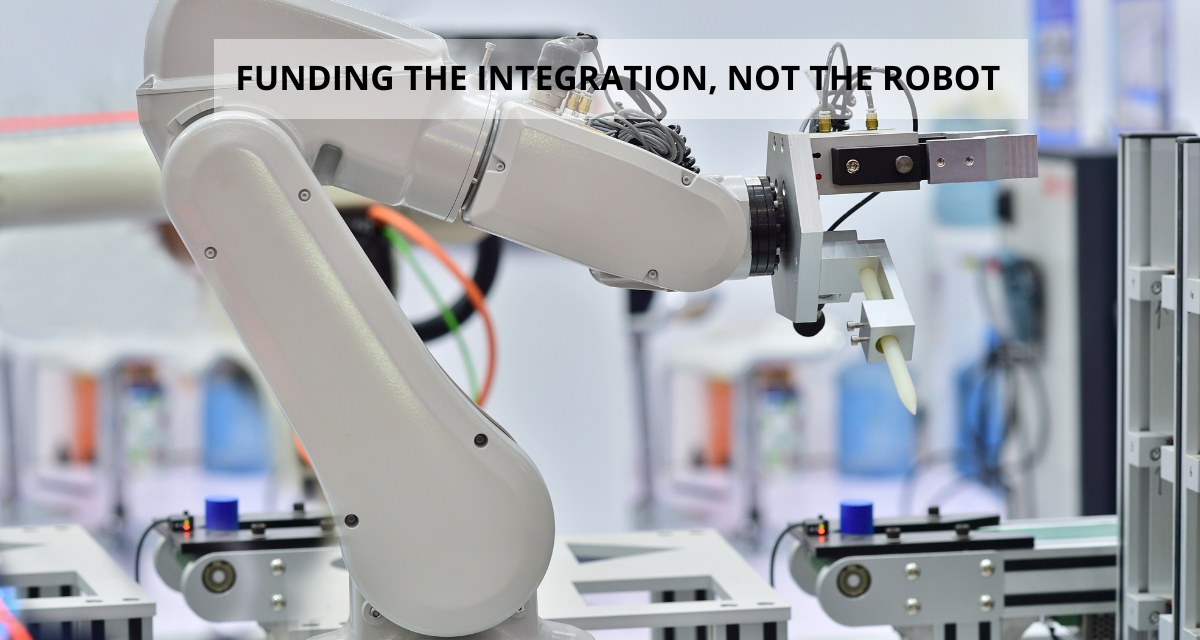
Financing the Integration, Not the Robot: Where Automation Project Cost Sits

Financing the Integration, Not the Robot: Where Automation Project Cost Sits

Financing the Integration, Not the Robot: Where Automation Project Cost Sits

The robot on the automation quote is rarely the number that breaks the deal. Dimension Funding finances entire automation projects, not just the hardware line item, because the programming, controls, safety systems, and commissioning work wrapped around a robot typically costs as much as the robot itself, sometimes even more.

Grand View Research valued the global industrial robotics market, the robots themselves, at $33.9 billion in 2024. The same research firm separately values the global robotics system integration market—the design, programming, controls, and commissioning work required to put those robots to work—at $74.56 billion for the same year. More than double the hardware figure. For a vendor selling automation, financing that only covers the robot is financing less than a third of what the customer is buying.

Why the Integration Bill Outgrows the Hardware Bill

The integration work behind a cell rarely comes from just one vendor. A robot manufacturer, a systems integrator handling controls and commissioning, and a separate safety equipment supplier might each invoice the same project independently, which is usually the point where a customer ends up financing the robot alone and paying everything else in cash. Dimension Funding underwrites the combined project as a single transaction regardless of how many vendors are billing it, provided the full scope is submitted together rather than piecemeal as each invoice comes in.

Mordor Intelligence puts the global industrial automation services market, including the design, integration, commissioning, and support work layered around automation hardware, at $187.49 billion in 2026, projecting growth to $339.18 billion by 2031 at a 12.58% compound annual rate. That growth outpaces hardware spending because a manufacturer is paying for a working cell, and getting a cell to run is mostly integration work rather than the robot itself. 

What a Single Financed Application Covers

Dimension Funding structures an automation project through an industrial automation financing program as one transaction rather than a hardware purchase with separate integration invoices trailing behind it. That includes:

  • Design and engineering for the cell layout, including simulation and virtual commissioning before anything ships
  • Controls integration, covering PLC and HMI programming, vision system calibration, and safety system installation
  • Physical commissioning, including installation, alignment, and the on-site labor to bring the cell to a running state
  • Staff training, so the customer’s own operators and maintenance staff can run and service the cell without depending on the integrator indefinitely
  • Multi-year maintenance and support contracts, paid at the time of purchase rather than billed annually as separate service invoices

Application-only approval covers combined equipment-and-software automation projects up to $500,000. Larger integration projects, including multi-cell production lines, remain eligible for a streamlined review process rather than a full bank-style underwriting cycle.

Why the Integration Number Keeps Climbing 

Part of the gap between the hardware bill and the integration bill comes down to who’s available to do the work. The Bureau of Labor Statistics projects industrial machinery mechanics will add more new jobs than any other manufacturing occupation between 2024 and 2034, with 41,200 positions driven specifically by the continued adoption of automated machinery that needs skilled people to keep it running. Demand for that labor is growing faster than the hardware itself.

For a vendor quoting a project today, that shows up as commissioning timelines running longer than a customer expects, and integrators pricing labor-heavy phases higher than they would have a few years ago. Financing the full labor-heavy scope alongside the hardware matters more in that environment, not less, since the portion of a project’s cost that’s hardest to compress is exactly the portion most likely to keep growing.

The 90-Day Deferral and Section 179 Together

A qualifying automation purchase can be delivered, installed, and put into production for 90 days before the first payment comes due. That runway matters specifically for automation projects, where commissioning and ramp-up can take weeks before a cell is running at full output, and a customer making payments on equipment that isn’t yet producing revenue is a harder sale than one who isn’t.

Pairing that deferral with Section 179 strengthens the pitch further. Qualifying automation equipment and software placed in service during the tax year can be deducted under the 2026 Section 179 limit of $2,560,000, phasing out above $4,090,000, and under the bonus depreciation provisions restored by the One Big Beautiful Bill Act, per IRS Publication 946, equipment placed in service after January 19, 2025 can qualify for 100% bonus depreciation on any amount above the Section 179 cap. A customer can take the deduction in the same year the cell goes live, while the actual cash payments haven’t started yet.

Zero Percent Financing for Automation Vendors and Integrators

Automation sales often stall on the same objection regardless of how well-engineered the cell is: the customer likes the solution but isn’t sure the payback justifies committing capital this year. A zero percent program, offered directly through Dimension Funding’s vendor partner application, gives a vendor a way to answer that objection without cutting the project price itself.

It tends to do the most work when tied to a specific technology a vendor is trying to get a customer to adopt for the first time, a newer cobot line, a vision-guided system, or any category the customer hasn’t bought before and is naturally more cautious about committing capital to. Once a customer has deployed and validated one cell, the incentive matters less on the next purchase than the track record from the first one does.

What Showing a Monthly Number Changes at the Customer’s End

A proposal that shows a monthly figure next to the project scope can change who at the customer’s organization has to approve it. A capital request large enough to trigger a full committee review sometimes clears faster once it’s presented as a fixed monthly payment rather than a lump sum, since it can move through the budget the way an operating expense does instead of a capital appropriation. Getting that monthly number into the proposal from the first conversation, rather than introducing it after the customer has already seen the total price, is what keeps that path open.

A vendor can run the full project cost, hardware, integration, and multi-year support together through Dimension Funding’s payment calculator before the proposal goes out, and bring the customer an exact monthly number. A vendor connecting an automation cell to a customer’s existing ERP or MES environment can also fold that integration cost into the same request, since ERP financing covers the same categories of implementation and configuration work as the automation project itself.

Quoting the Whole Project Instead of Just the Hardware

An automation quote that only prices the robot understates what the customer is buying, and a financing structure that only covers the robot understates what Dimension Funding can do for that deal. Structuring the full project, hardware, integration, controls, training, and support, as one financed transaction gives a vendor a stronger proposal and a customer a payment that matches what they’re receiving.

Contact Dimension Funding to structure financing around a specific automation project, or to set up a standing vendor partnership ahead of the next quote.

Frequently Asked Questions

Does the $500,000 application-only threshold apply to the integration cost alone, or to the combined project total?

It applies to the combined total, not any single line item. Application-only approval covers projects up to $500,000, and in many cases that threshold extends to $750,000 before financial statements are required, so a project spanning several vendor invoices doesn’t necessarily need full underwriting just because the sum crosses the standard ceiling.

Does financing a multi-vendor project require separate approval from each company involved?

No. The financing is tied to the customer submitting the request, not to any of the vendors billing the project, so the robot manufacturer, the integrator, and any other suppliers involved don’t need their own credit approval or separate sign-off for the application to move forward.

If a customer already owns the robot and only needs the integration work financed, does that qualify?

Yes. Integration, controls work, and commissioning can be financed on their own when the robot itself was already purchased separately, structured around the integration invoice rather than requiring the hardware to be part of the same request.

Does financing the support contract separately from the original project cost anything, compared to bundling it upfront?

Bundling a multi-year support contract into the original financed transaction avoids a separate underwriting event later, since it’s evaluated as part of the same combined project rather than its own line item. Financing it separately after the fact would require a new application tied to that specific service invoice. 

Can a vendor offer zero percent financing on the integration portion only, while the customer pays cash for the robot itself?

Yes. A zero percent program can be scoped to specific cost categories within a project, including the integration and controls work alone, without extending the same terms to the hardware portion.

Does a used or refurbished robot change how the surrounding integration work is financed?

No. Integration, controls, and commissioning costs are financed the same way regardless of whether the robot itself is new or used, since the underwriting is based on the full project rather than the age of the hardware component.

What happens if the actual integration costs run higher than the original quote once the project is underway?

Material cost increases discovered mid-project typically require a supplemental request rather than being absorbed into the original agreement, so vendors quoting complex integrations are better served getting a firm number from the integrator before the initial application is submitted.

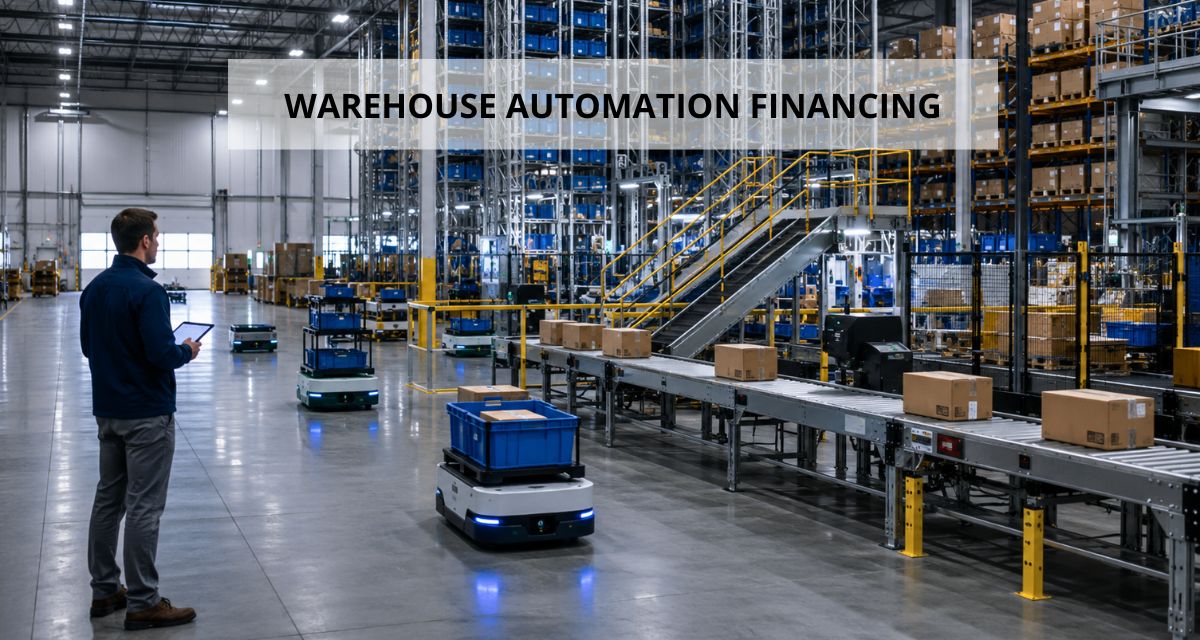
Warehouse Automation Financing: Systems, ROI & Financing Options

warehouse automation

Warehouse Automation Financing: Systems, ROI & Financing Options

It is peak season, order volume just spiked well past what the schedule was built for, and the warehouse manager is short four pickers with no applicants in the pipeline. 

Overtime is already maxed out, error rates are climbing, and the shipping deadline does not move. This is the moment most operations stop talking about warehouse automation and actually start pricing it out.

What Is Warehouse Automation?

Warehouse automation means using software and machinery to handle tasks that were previously done by hand, receiving, storing, picking, packing, and shipping. That can mean a full automated storage and retrieval system running around the clock, or something as simple as a warehouse management system that tells staff exactly where to walk and what to grab.

Most operations do not jump straight to a fully automated building. They add automation in layers, usually starting with software, then picking support, then heavier equipment, as volume and budget justify each step.

Types of Warehouse Automation Systems

Different systems solve different bottlenecks. Here is where most warehouses start.

Warehouse management systems (WMS). Software that tracks inventory, assigns tasks, and directs staff or equipment to the right location. A WMS is often the foundation everything else connects to, including warehouse execution and control systems that coordinate robots and conveyors on the floor.

Automated storage and retrieval systems (ASRS). These systems store inventory in dense racking and retrieve it automatically, using shuttles, cranes, or vertical lift modules to bring product to a person instead of sending a person to product.

Conveyor and sortation systems. Conveyors move goods through receiving, picking, packing, and shipping, while sortation systems automatically route items to the correct dock door, chute, or order based on barcode or RFID data.

Pick-to-light and voice picking. Light-directed and voice-directed picking point workers straight to the right bin and quantity, cutting down the time spent searching and double checking an order.

AGVs and AMRs. Automated guided vehicles and autonomous mobile robots move pallets, carts, and totes around the floor without a forklift operator, either along a fixed route or navigating around obstacles on their own.

Robotic piece picking. Robotic arms equipped with vision systems and grippers can pick individual items out of a bin and place them into an order container, a task that used to require a person standing at that station for an entire shift.

Fixed systems like conveyors, sortation lines, and ASRS work best in buildings with a stable layout and predictable volume. They cost more upfront and are harder to reconfigure later, but they handle high, steady throughput extremely well. 

Robots and mobile systems trade some of that raw throughput for flexibility, which matters more in a facility whose layout or order profile changes often.

How to Think About ROI on Warehouse Automation

Every automation vendor has a payback number ready to quote, and most of those numbers come from someone else’s best week, not your building. A more useful approach is to look at the same four categories every automation project affects and estimate them for your own operation.

Labor. Automation reduces the number of people needed for repetitive transport and picking tasks, but it rarely eliminates staff entirely. The real savings usually show up in reduced overtime, lower reliance on temporary labor during peak season, and fewer open positions competing for a shrinking pool of warehouse workers.

Accuracy and returns. Manual picking and packing carry a natural error rate. Systems that direct or verify each pick, such as pick-to-light or barcode scanning tied to a WMS, tend to cut down on mis-ships and the return shipping, restocking, and customer service costs that come with them.

Throughput and space. Automated storage can pack more inventory into the same square footage than open aisles built for forklift access, and consistent equipment speed makes daily output easier to forecast. That matters most for operations paying for warehouse space by the square foot or facing a lease renewal.

Total cost versus total payment. The number that actually matters for a purchase decision is not the sticker price of the equipment. It is whether the monthly financing payment is lower than what the automation replaces in labor, error, and space costs each month. When it is, the project pays for itself from day one instead of after some multi-year break-even point on a spreadsheet.

Any of these estimates should be built with your integrator and finance team using your own order volume, labor costs, and building constraints, not a vendor’s generic case study.

Signs Your Warehouse Is Ready for Automation

A few patterns tend to show up before a warehouse is ready to automate. Order volume has outpaced the ability to hire and train new staff, and the same pallet or tote routes get run so often that a fixed path could handle them without anyone walking the floor. 

Peak season leans hard on overtime and temp labor just to hit shipping deadlines, and picking or packing errors are common enough to show up in customer complaints or return rates.

If none of that sounds familiar yet, automation may still be premature. A warehouse with constantly shifting layouts, low and unpredictable volume, or highly irregular one-off orders often gets more value from process changes or a lighter WMS upgrade before committing to heavier equipment.

What Does Warehouse Automation Cost?

Cost depends entirely on scope. A WMS or picking software rollout costs far less than a conveyor and sortation system, and a full ASRS installation with racking, shuttles, and integration is a much larger project than a handful of AGVs added to an existing floor plan.

Beyond the equipment itself, most projects include software licensing, installation, integration with existing systems, staff training, and ongoing maintenance and support. Those costs add up fast, and they are often underestimated when a business budgets only for the hardware.

Timeline matters too. A WMS rollout can go live in a matter of weeks, while a conveyor and sortation system tied into building construction or a facility expansion can take months of planning before the first pallet ever moves through it. Financing terms should account for that gap between when the payments start and when the system is fully operational and delivering savings.

That combined price tag is usually the reason automation projects stall at the budget approval stage, even when the operational case is clear. Financing closes that gap.

Financing Your Warehouse Automation Project with Dimension Funding

Dimension Funding has financed industrial and material handling equipment for over 40 years, working with manufacturers and distributors who need to modernize a facility without tying up cash reserves. Both industrial automation financing and material handling equipment financing cover this kind of project directly.

Instead of paying for a warehouse automation rollout in cash, financing turns the entire project into one fixed monthly payment. Approvals up to $500,000 are available without financial statements, and credit approvals for larger automation projects run from $25,000 up to $25,000,000. Terms extend up to 60 months, with no penalty for paying off the balance early.

The financing is not limited to the physical equipment. Software licensing for a WMS or execution system, IT and technology costs, integration, staff training, and ongoing maintenance can all be rolled into the same payment, so a project is not funded piecemeal out of different budgets.

Businesses financing this kind of equipment may also be able to write off a meaningful portion of the cost under IRS Section 179 in the same tax year the system goes live, which can offset part of the investment before the first full year of operation is even finished.

Automation integrators, WMS vendors, and equipment manufacturers who want to offer financing directly to their own clients can look into Dimension Funding’s vendor partner programs, which give sales teams a way to answer the budget objection on the spot instead of losing momentum waiting on a customer’s finance department.

Frequently Asked Questions About Warehouse Automation

What is warehouse automation?

It means using software and equipment, a WMS, conveyors, ASRS, AGVs, robotic picking, to handle receiving, storage, picking, and shipping tasks that used to be done by hand.

What is the ROI of warehouse automation?

It depends on your labor costs, order volume, and building constraints, so there is no single number that applies to every warehouse. The categories worth measuring are labor, accuracy, throughput and space, and whether the financing payment is lower than what automation replaces each month.

How much does warehouse automation cost?

It ranges widely. A WMS or picking software rollout costs far less than a conveyor and sortation system, and a full ASRS installation is a bigger project than adding a handful of AGVs to an existing floor. Software licensing, integration, training, and maintenance are usually part of the total, not just the hardware.

Can warehouse automation be financed?

Yes. Dimension Funding finances the equipment, software, integration, training, and maintenance involved in a warehouse automation project as one fixed monthly payment, rather than requiring the full cost upfront.

What does Dimension Funding’s warehouse automation financing cover?

WMS or execution system software, physical equipment such as conveyors, ASRS, or AGVs, integration and installation, staff training, and ongoing maintenance, all rolled into a single payment.

How long does approval take?

Approvals up to $500,000 don’t require financial statements, and most credit decisions come back within a few hours. Larger automation projects, up to $25,000,000, involve more documentation but are handled by the same team from quote to funding.

If overtime, error rates, or missed shipping deadlines are becoming a pattern rather than a one-off, use the payment calculator to see what a monthly payment would look like for your project, or start a financing application to get a quote, usually within a few hours.