
Automated Material Handling: Equipment Types & Implementation Costs
A plant manager watches the same pallet get touched by four different people between the production line and the truck, each handoff adding time, a chance for damage, and a chance for someone to get hurt lifting something they should not be lifting by hand.
Automated material handling cuts that kind of repetitive handling out of the process, whether it runs inside a manufacturing plant, a distribution center, or both.
What Is Automated Material Handling?
Automated material handling covers the equipment and systems that move, store, and control the flow of goods without a person doing the physical work at each step. That includes everything from a conveyor line running product between two machines to a fully automated storage system that stores and retrieves pallets on its own.
Most facilities do not automate everything at once. A common starting point is automating the single biggest bottleneck, whether that is a manual palletizing station, a storage area that has run out of usable space, or a transport route that ties up too much labor, then expanding from there once the first piece proves itself out.
Types of Automated Material Handling Equipment
Conveyors
Belt, roller, and overhead conveyors move product continuously between stations without anyone carrying it by hand. They form the backbone of most automated lines, connecting other equipment like palletizers, sortation systems, and packaging machines into a single continuous flow.
Automated Storage and Retrieval Systems (AS/RS)
AS/RS use cranes, shuttles, or vertical lift modules to store and retrieve palletized or unit-level inventory inside dense racking, bringing product to a person or a downstream process instead of sending a person into the racks to get it.
Automated Guided Vehicles and Autonomous Mobile Robots
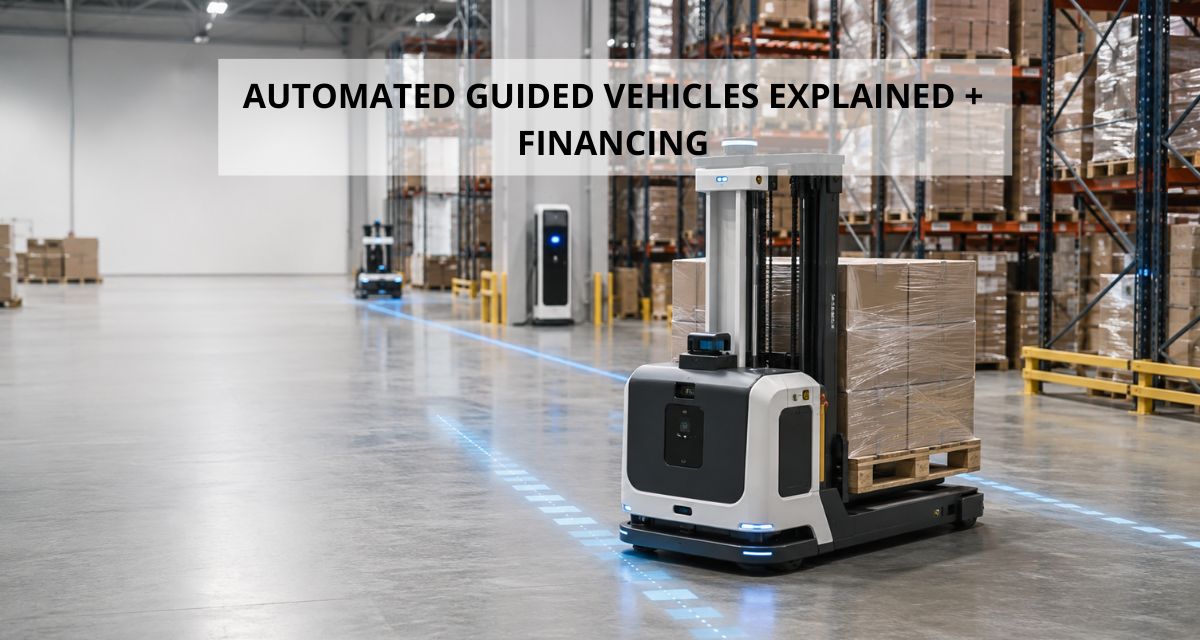
AGVs follow a fixed route to move pallets, carts, or totes between two points, while AMRs use sensors and mapping software to navigate more freely and reroute around obstacles. Both replace the manual forklift or cart trips that eat up labor hours on repetitive transport.
Robotic Palletizers and Depalletizers
These systems stack cases, bags, or totes onto a pallet, or break a loaded pallet back down, using robotic arms fitted with vacuum, clamp, or fork-style end effectors depending on what is being handled. Palletizing is repetitive and physically hard on a person’s back, which makes it one of the more common starting points for automation.
Sortation Systems
Sortation equipment routes items to the correct destination, whether that is a shipping lane, a production cell, or a specific order, using diverters, tilt trays, or cross-belt mechanisms tied to a barcode or RFID read.
Carousels and Vertical Lift Modules
Horizontal carousels and vertical lift modules rotate shelves or trays to bring stored items directly to an operator, cutting down on the walking and searching that eats up time in a manual picking operation.
Robotic Piece Picking
Robotic arms equipped with vision systems and grippers can identify and pick individual items out of a bin, a task that historically required a person standing at that station for an entire shift.
How Automated Material Handling Gets Implemented
Implementation is a process, not a delivery date, and it usually runs through the same general phases regardless of which equipment is involved.
It starts with an assessment of current material flow, cycle times, and facility constraints, since the right equipment depends entirely on what is actually moving through the building and how. From there, engineers design the system layout and the control architecture that will run it, followed by procurement and installation of the physical equipment itself.
Integration is where the automation gets connected to a warehouse management system, a manufacturing execution system, or an ERP, so the equipment knows what to do and when. Testing, often done in stages at the vendor’s facility and again once the equipment is on-site, confirms everything works before it touches live production.
The last phase, ramp-up, is easy to underestimate. Employees are still learning the system, throughput builds gradually rather than hitting full speed on day one, and it takes real operating time before a new automated process runs as smoothly as the manual one it replaced. A payback estimate that skips this adjustment period and assumes instant results is usually the first number that turns out to be wrong.
Signs a Process Is Ready to Automate
Not every manual task needs a robot. A few patterns tend to show up in the processes that actually pay off once automated.
The clearest candidates are repetitive and predictable, the same motion or route run hundreds of times a day with little variation, and physical enough to drive injuries, workers’ compensation claims, or turnover, palletizing and repetitive lifting being classic examples.
A role nobody can keep staffed no matter what it pays is another strong signal, and so is a single station that bottlenecks everything downstream regardless of how well the rest of the line runs.
A process that changes constantly, handles highly irregular product, or runs at low enough volume that the payback period stretches for years is usually a poor first candidate. Starting with the clearest bottleneck, rather than the most impressive piece of equipment, tends to produce the better outcome.
What Drives Implementation Costs
The equipment itself is usually not the biggest surprise in a material handling automation budget. A few other cost drivers tend to catch businesses off guard.
Integration software and controls, the layer that connects new equipment to an existing WMS, MES, or ERP, can cost as much as the physical hardware depending on how custom the connection needs to be. Facility modifications, things like reinforced flooring for a heavy AS/RS installation, added power capacity, or building changes to fit a new conveyor line, are often underestimated when a project is first budgeted.
Training and change management matter too. Staff need to learn new workflows, and a facility usually needs updated safety procedures once people are working alongside automated equipment rather than doing the task themselves. Ongoing maintenance and support, whether handled in-house or through a service contract, is a real recurring cost rather than a one-time line item.
Taken together, these costs are frequently a large share of total project spend, not a minor addition to the price of the machinery.
Financing Your Automated Material Handling Project with Dimension Funding
Dimension Funding has financed industrial equipment and technology for over 40 years, and both industrial automation financing and material handling equipment financing are set up to cover a multi-phase project like the one described above, not just a single piece of equipment.
Instead of funding a project in pieces out of different budgets, financing rolls the entire scope, equipment, integration, installation, and training, into one fixed monthly payment.
Approvals up to $500,000 are available without financial statements, and credit approvals for larger automation projects range from $25,000 up to $25,000,000. Terms extend up to 60 months, with no penalty for paying off the balance early.
The software and controls layer that connects new equipment to existing systems can be financed too, alongside the physical equipment, through Dimension Funding’s IT and technology financing. That matters given how much of an automation budget lives in integration rather than steel and motors.
Businesses financing this kind of project may also be able to write off a significant portion of the cost under IRS Section 179 in the same tax year the equipment goes into service, which can offset a meaningful part of the investment before the first full year of operation wraps up.
Automation integrators and equipment manufacturers who want to offer financing directly to their own clients can look into Dimension Funding’s vendor partner programs, which give a sales team a way to answer the budget question on the spot instead of waiting on a customer’s internal approval process.
Frequently Asked Questions About Automated Material Handling
What is automated material handling?
Equipment and systems, conveyors, AS/RS, AGVs and AMRs, robotic palletizers, sortation, that move, store, and control the flow of goods without a person doing the physical work at each step.
What equipment counts as automated material handling?
Conveyors, automated storage and retrieval systems, automated guided vehicles and autonomous mobile robots, robotic palletizers and depalletizers, sortation systems, carousels and vertical lift modules, and robotic piece-picking arms are the main categories.
How much does it cost to implement?
It depends on scope, but the equipment itself is rarely the biggest surprise. Integration software, facility modifications like reinforced flooring or added power, training, and ongoing maintenance often make up a large share of the total.
How long does implementation take?
It varies by project. A single piece of equipment added to an existing line moves faster than a project that spans assessment, design, procurement, integration, and a multi-week ramp-up before it reaches full production volume.
Can automated material handling be financed?
Yes. Dimension Funding finances the equipment, integration software, installation, and training involved in a project as one fixed monthly payment instead of requiring the full cost upfront.
How long does approval take?
Approvals up to $500,000 don’t require financial statements, and most credit decisions come back within a few hours. Larger projects, up to $25,000,000, involve more documentation but are handled by the same team from quote to funding.
If a manual process is costing more in labor, damage, or injuries than it should, use the payment calculator to see what a monthly payment could look like, or start a financing application to get a quote, usually within a few hours.