
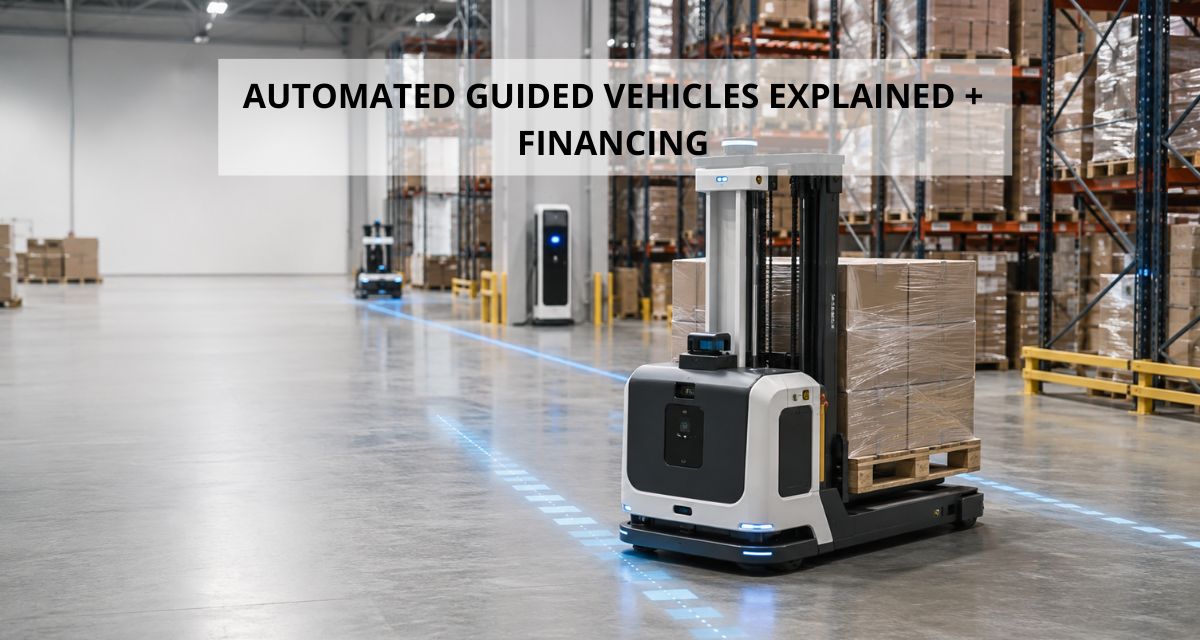
What Is an AGV? Automated Guided Vehicles Explained + Financing
A warehouse manager watches the same forklift operator make the same trip across the floor for the tenth time that hour, carrying a pallet from receiving to a storage rack forty feet away. Multiply that trip by every shift, every day, and the labor cost adds up fast, especially when open forklift positions sit unfilled for weeks. That repetitive trip is exactly what an AGV replaces.
What Is an AGV (Automated Guided Vehicle)?
An AGV, short for automated guided vehicle, is a self-driving vehicle that moves materials through a warehouse, distribution center, or manufacturing plant without a human driver. It follows a set path between two points, picks up a load, and delivers it the same way, every time.
AGVs are not a new idea. Manufacturers and distributors have used them for decades to move pallets, carts, and raw materials along fixed routes. What has changed is the range of AGV types now available and how affordable the technology has become for mid-sized operations, not just large enterprise plants.
How Do AGVs Work?
An AGV reads its environment through a guidance system, follows a pre-mapped route, and communicates with a warehouse management system or fleet controller that assigns it tasks. When a pallet needs to move from dock door 3 to rack aisle 12, the system dispatches the nearest available AGV, which then navigates the route, picks up the load, and drops it at the destination.
Guidance and Navigation Methods
Most AGVs rely on one of a few navigation approaches. Magnetic tape or embedded floor wires guide the vehicle along a fixed track. Laser targets placed around the facility let the AGV triangulate its position.
QR code markers on the floor give the vehicle fixed reference points. Some newer AGVs use vision systems or LiDAR to read the surrounding environment while still operating along a defined route.
AGVs run on rechargeable batteries, usually lithium-ion or lead-acid, and most fleet management software automatically routes a vehicle to a charging station once its battery runs low, so operations rarely need to stop for charging.
Types of Automated Guided Vehicles
Not every AGV looks or works the same. The right type depends on what is being moved and how far it needs to travel.
Forklift AGVs handle pallets the same way a traditional forklift does, lifting and placing loads on racks, but without an operator in the seat.
Tow or tugger AGVs pull a line of carts behind them, similar to a small train, which makes them efficient for moving several loads across long distances in one trip.
Unit load AGVs carry a single load, such as a pallet or a bin, on a flat deck or conveyor top, and are common in manufacturing lines that feed parts to a workstation.
Automated guided carts (AGCs) are the simplest and most affordable AGV type, often used for sorting, cross-docking, or moving smaller items around a facility.
Heavy burden carriers are built for oversized or overweight loads, such as coils, rolls, or large industrial components, and are common in steel, paper, and heavy manufacturing.
AGV vs AMR: What Is the Difference?
AGV and AMR (autonomous mobile robot) get used interchangeably, but they are not the same thing. An AGV follows a fixed path set by tape, wire, or laser targets, and it needs a human to clear the way if something blocks its route.
An AMR uses sensors and mapping software to build its own understanding of the facility and can reroute itself around an obstacle without stopping the whole operation.
AGVs tend to fit facilities with a stable, repeatable layout where the same route is run thousands of times a day. AMRs make more sense when a facility’s layout changes often or when flexibility matters more than raw throughput. Many operations end up running both, using AGVs for high volume repetitive routes and AMRs for tasks that need more adaptability.
Benefits of Adding AGVs to Your Operation
The case for AGVs usually comes down to a handful of practical changes that show up on the floor within the first few months.
Lower labor costs. Fewer people are tied up running repetitive material transport, so the staff who remain can focus on work that actually needs a person, like quality control or order accuracy.
Fewer errors. An AGV runs the same route the same way every time, so the product damage and misplaced inventory that come with manual handling tend to drop off.
Fewer safety incidents. Cutting down on forklift trips through pedestrian areas removes one of the more common causes of warehouse accidents.
More predictable output. An AGV does not take breaks, slow down near the end of a shift, or need retraining when someone new is hired, which keeps throughput steadier during peak season.
Industries That Use AGVs
AGVs show up well beyond automotive plants these days. Manufacturers rely on them to feed parts to assembly lines and move finished goods to shipping. Distribution centers and 3PLs use them to shuttle pallets between receiving, storage, and staging.
Food and beverage facilities run them through cold storage without adding staff to a tough environment. Pharmaceutical and medical manufacturers lean on them because a fixed, documented route holds up better under compliance review than a manual one.
Signs Your Operation Is Ready for AGVs
AGVs work best in facilities with a layout that does not change every few weeks and routes that repeat often enough to justify the investment. A few signals point to a good fit.
The same pallet path gets run dozens or hundreds of times a shift. Forklift operator positions sit open for weeks at a time, and existing staff are stretched thin covering routine transport. Damage claims or near miss incidents keep showing up in the same aisles, which points to a human error problem more than an equipment problem.
A facility that reconfigures its layout constantly, or handles mostly irregular loads, will likely get more value from AMRs or a mix of both vehicle types. A quick walkthrough with an automation integrator usually settles which approach fits before any money changes hands.
What Does an AGV Cost?
AGV pricing depends heavily on the type of vehicle, the number of units in a fleet, and how much site work is needed for navigation infrastructure, software integration, and staff training.
A single forklift AGV costs more than a traditional forklift, and a full fleet with fleet management software, charging infrastructure, and integrator support represents a significant capital project for most mid-sized businesses.
That upfront cost is usually the biggest obstacle standing between a warehouse manager who wants AGVs and a finance team that has to approve the purchase. This is exactly where financing changes the math.
Financing Your AGV Investment with Dimension Funding
Dimension Funding has provided industrial automation financing and material handling equipment financing for over 40 years, working with manufacturers and distributors who need to add robotics and automation without draining working capital.
Rather than paying for an AGV project in cash, financing spreads the cost of the vehicles, software, installation, training, and multiple years of support into one fixed monthly payment.
Approvals up to $500,000 are available without financial statements, and credit approvals range from $25,000 up to $25,000,000 for larger automation projects. Terms extend up to 60 months, and there are no prepayment penalties if a business wants to pay off the balance early.
Financing can also cover the full project cost, not just the vehicles themselves. Design, implementation, consulting, training, and maintenance can all be rolled into the same fixed payment, so a business is not stuck paying separately for the parts of an AGV rollout that make it actually work on day one.
Businesses that finance equipment purchases may also be able to write off a significant portion of the cost under IRS Section 179, which can offset a meaningful part of the investment in the same tax year the AGVs go into service.
AGV manufacturers, integrators, and dealers looking to offer financing to their own clients can also explore Dimension Funding’s vendor partner programs, which help close deals faster by removing the “how do we pay for this” objection from the sales conversation.
Frequently Asked Questions About AGVs
What is an AGV used for?
Moving materials, pallets, carts, bins, or raw stock, between fixed points on a floor. It’s the job that would otherwise tie up a forklift operator for an entire shift.
What’s the difference between an AGV and an AMR?
An AGV follows a set path (tape, wire, or laser targets) and needs a clear route to keep moving. An AMR reads its surroundings and reroutes itself around obstacles without anyone stepping in.
How much does an AGV cost?
It varies by vehicle type, fleet size, and how much site work the integration needs. A single unit runs more than a standard forklift, and a full fleet with fleet management software and charging infrastructure is enough of an investment that most businesses finance it instead of paying cash upfront.
Can AGVs be financed?
Yes. Dimension Funding finances AGVs and other industrial automation equipment, along with the software, installation, training, and support that come with them, as one fixed monthly payment.
What does AGV financing from Dimension Funding cover?
The vehicles themselves, plus design, implementation, consulting, training, and multiple years of maintenance and support, all rolled into a single payment instead of billed separately as the project moves along.
How long does approval take?
Approvals up to $500,000 don’t require financial statements, and most credit decisions come back within a few hours. Larger automation projects, up to $25,000,000, involve more paperwork but are still handled by the same team from quote to funding.
If your operation is ready to move materials with fewer people, fewer errors, and less downtime, use the payment calculator to see what a monthly payment could look like, or start a financing application to get a quote, usually within a few hours.