
Remanufactured Equipment Vendor Programs | Dimension Funding

Remanufactured Equipment Vendor Programs

Remanufactured Equipment Vendor Programs | Dimension Funding

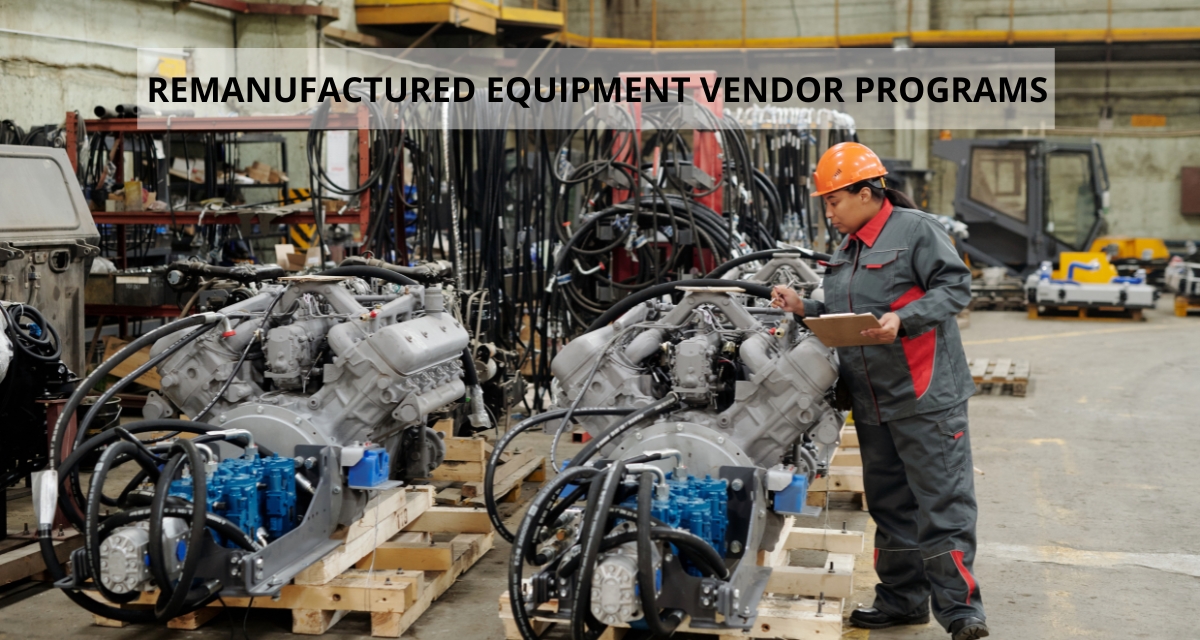
Remanufactured equipment is rebuilt to original manufacturer specifications, not simply repaired or resold, and that distinction changes how a lender looks at the collateral compared to ordinary used equipment.

Dimension Funding finances new and used equipment on the same application-only basis, up to $250,000 for equipment alone and $500,000 when software is part of the deal, and that structure extends to remanufactured units without a separate approval track. Most remanufacturers already know financing exists. What they need to know is whether a rebuilt unit gets treated the same way a new one does. 

The backdrop is a large and steady replacement cycle. The global off-highway vehicle engine market, covering construction, agricultural, and mining equipment, stood at $47.94 billion and is projected to reach $66.21 billion by 2031, according to Mordor Intelligence, driven by replacement cycles and emission-compliance retrofits that keep older machines in service longer.

Alongside that sits a related but distinct market: machinery maintenance and heavy equipment repair services in the US reached $59.9 billion in 2025, per IBISWorld. Keeping aging equipment running, whether through repair or a full rebuild, is a large and active part of the economy, not a niche behind new-equipment sales. 

The Programs Available to Remanufacturers

Remanufacturers draw on the same core set of programs as any other equipment vendor, applied to a category of collateral that behaves differently on paper. Standard equipment financing covers the rebuilt unit itself, zero percent financing is available as a vendor-sponsored option, and working capital loans run separately, funding the vendor’s own operation rather than a specific sale.

Dimension Funding generally prefers at least two years in business from the applicant, whether that’s a remanufacturer financing its own shop equipment or a buyer financing a purchase from one, though strong credit can substitute for a shorter history. Credit requirements themselves are flexible too, covering most types from strong commercial credit down to marginal, which matters for a newer rebuild shop or a buyer whose credit took a hit during a slow stretch.

Why Remanufactured Equipment Isn’t Financed Like Ordinary Used Equipment

A machine that’s simply used has depreciated in an uneven, hard-to-predict way, which is part of why lenders often ask for more documentation on it. A remanufactured unit has gone through a controlled teardown-and-rebuild process to original specification and typically carries a warranty comparable to a new unit’s, which gives the collateral a more predictable value profile than a random used machine of the same age.

That’s why remanufactured equipment can usually support the same term lengths available on new equipment, up to 60 months, rather than the shortened terms a lender might apply to equipment nearing the end of its useful life.

Financing a Component vs. a Whole Unit

A significant share of remanufacturing happens below the level of a complete machine: engines, transmissions, and hydraulic pumps rebuilt and installed into equipment the buyer already owns, rather than sold as a standalone unit. That changes what gets financed. The component going into the machine, plus the labor to remove the old one and install the rebuild, is the asset, not the host machine itself. 

That distinction carries into the tax treatment too. A rebuilt component installed into equipment the buyer already owns is itself the qualifying property for Section 179 purposes, not the host machine, so the deduction is based on what the component and its installation cost, not the original price of the machine it’s going into. 

Section 179 and Bonus Depreciation on Remanufactured Equipment

Per IRS Publication 946, the 2026 Section 179 limit is $2,560,000, phased down once qualifying purchases exceed $4,090,000, and it applies to remanufactured equipment the same as new. Dimension Funding covers the current-year figures under Section 179 and how the deduction applies to financed equipment.

Bonus depreciation carries a separate wrinkle worth knowing before a buyer assumes both deductions work identically. Since the 2017 Tax Cuts and Jobs Act, bonus depreciation applies to used property only if it wasn’t used by the taxpayer or a predecessor at any time before the acquisition. A buyer who sends in their own worn unit as the core and receives back the remanufactured version is arguably reacquiring equipment they already had a depreciable interest in, which can put that specific transaction’s bonus depreciation eligibility in question even though Section 179 wouldn’t carry the same restriction. That’s a detail worth flagging to a buyer’s accountant before the deduction gets assumed rather than confirmed.

Stacking the 90-Day Deferral With the Tax Deduction

A remanufactured unit purchased and financed through Dimension Funding can also use the No Payments for 90 Days promotion, which lets a buyer take delivery, put the rebuilt unit to work, and wait 90 days before the first payment is due.

That timing lines up with the tax question above. A buyer can place a qualifying rebuilt unit in service, start claiming Section 179 or bonus depreciation for the year, and do both before making a single payment on it. For a buyer weighing a rebuilt unit against a full-price new one, that combination often closes the gap in ways a straight price comparison doesn’t capture.

Zero Percent Financing for Remanufactured Equipment Vendors

Remanufactured equipment already competes on price against two different sellers at once: new-equipment dealers arguing full capability justifies full price, and other remanufacturers rebuilding the same models. A zero percent offer lets a vendor hold the line on the sale price instead of discounting the unit itself to win a price-sensitive buyer.

Setting one up runs through Dimension Funding’s vendor partner application, the same starting point for any vendor financing arrangement, and from there the promotion can be scoped to specific product lines rather than applied across the board.

Bringing a Remanufacturing Program Online

None of this asks a remanufacturer to restructure how a rebuild gets quoted or sold. It asks for a financing partner that treats a remanufactured unit’s collateral value the way the rebuild process earns it, rather than defaulting to the documentation and term-length assumptions built for ordinary used equipment.

A vendor can run a sample deal through Dimension Funding’s payment calculator or start an application directly. Contact Dimension Funding to talk through what a vendor program would look like for a specific remanufactured product line.

Frequently Asked Questions

Does equipment need to come from an OEM-certified remanufacturing program to qualify, or does independently remanufactured equipment qualify too?

Dimension Funding’s equipment financing applies broadly to new and used equipment without requiring a specific certifying body, so independently remanufactured equipment qualifies on the same basis as an OEM-authorized rebuild, provided documentation on the rebuild itself is available with the application.

Is the 90-day payment deferral available on any remanufactured unit, or does it depend on the product line?

It’s generally available across financed equipment and software, though exceptions apply, so it’s worth confirming eligibility for a specific remanufactured product line before assuming it’s included in a given deal.

Can financing on a remanufactured unit include the remanufacturer’s own warranty or an extended service plan, not just the equipment itself?

Yes. Associated costs including installation, labor, and maintenance can be bundled into the same fixed payment as the equipment, and a remanufacturer’s own warranty or service plan can be included the same way rather than billed as a separate line item.

Can a remanufacturer use working capital financing for its own operation, such as sourcing cores or building inventory, separate from financing a specific buyer’s purchase?

Yes. Working capital loans, available from $25,000 to $250,000 for businesses with annual revenue above $150,000, are structured around the business itself rather than a specific transaction, which makes them usable for a remanufacturer’s own operating needs rather than only for financing a buyer’s equipment purchase.

Do the same application-only thresholds, $250,000 for equipment and $500,000 with software included, apply to remanufactured equipment as they do to new equipment?

Yes. The application-only thresholds apply based on transaction size and structure, not on whether the equipment is new, used, or remanufactured, so a remanufactured unit financed on its own or bundled with software qualifies under the same limits.

Is a remanufactured unit financed only as a purchase, or can it be structured as a lease the same way new equipment can?

Both structures are available. Dimension Funding offers equipment leasing alongside standard finance agreements, and a remanufactured unit can go through either one the same way a new unit would, depending on whether the buyer wants ownership at the end of the term or lower payments with the option to upgrade.

Can a remanufacturer finance the equipment used to run its own rebuild operation, such as test benches or diagnostic tooling, separately from financing a buyer’s purchase?

Yes. That equipment is financed the same way any other commercial equipment purchase would be, with the remanufacturer as the applicant rather than the buyer. It’s a separate transaction from financing offered to a customer purchasing a rebuilt unit, though both can run through Dimension Funding.


What Is Vendor Financing? A Guide for Equipment and Software Sellers

Winery Equipment Vendor Financing

What Is Vendor Financing? A Guide for Equipment and Software Sellers

Vendor financing is when a seller arranges payment terms for the buyer instead of collecting the full price upfront. The seller still gets paid in full, usually within a day or two of closing. The buyer pays it off over time, through a third party set up to handle exactly that.

That changes the conversation. A $40,000 machine or a $60,000 software rollout stops being one number a buyer has to justify all at once, and turns into a monthly payment that fits inside a normal budget. Dimension Funding runs vendor financing programs for equipment dealers and software companies across the U.S.

Sellers who use it well bring it up early, before price turns into an objection, not after a buyer has already started backing away.

How Vendor Financing Programs Operate

Three parties touch the deal, though the buyer usually only deals with one. The seller closes the sale like normal. A finance company funds it and pays the seller upfront, then collects from the buyer on the agreed terms. First Citizens Bank frames it simply: the seller closes without taking on the buyer’s repayment risk.

That’s the real difference between this and a seller just offering their own payment plan. The seller isn’t the one who eats it if the buyer stops paying, and isn’t sitting on money tied up in accounts receivable for months.

Who Gets Paid, and When

Approval on a financed purchase can come back within hours, and once the paperwork is signed electronically, the seller can be paid in full within 24 hours of funding. The buyer never sees that part of the process.

Three Ways Vendor Financing Programs Get Structured

Vendor financing programs typically fall into one of three structures. The main difference is simply which brand appears on the buyer’s paperwork.

Structure

Whose Brand Leads

Typical Fit

Private label

The seller’s brand only

Sellers with strong name recognition who want financing to feel native to their own checkout

Co-branded

Both the seller and the finance partner

Sellers who want the credibility of a named finance partner alongside their own brand

Referral

The finance partner’s brand

Sellers who want financing available without building it into their own sales materials

The buyer pays the same either way. What changes is how much of the financing conversation lands on the seller’s own team versus gets handed off to the finance partner.

Why Equipment Sellers Build Financing Into the Deal

Equipment dealers run into a blunt version of this problem. The gear is expensive, and buyers usually need it now, not after months of saving up. A contractor who needs a mini excavator next week isn’t going to sit around waiting on a bank loan.

Dimension Funding’s vendor programs cover construction machinery, medical and hospital equipment, HVAC systems, restaurant equipment, and industrial automation, with terms that commonly run up to 60 months. Banks still write most of that market, about 55 percent of new equipment finance volume according to ELFA, with captive and independent lenders splitting what’s left.

A few things tend to change once a dealer offers it directly at the point of sale:

  • Bigger tickets. A buyer already financing the base unit is more likely to add the warranty or a second attachment.
  • Fewer deals that die in a “let me check with someone.” Financing answers that objection on the spot.
  • Less time between quote and signature, since the financing question gets settled inside the sales conversation instead of after it.

Matching Terms to How Long the Equipment Lasts

Term length usually tracks how long the equipment stays useful, not some fixed default. A machine with a decade of work left in it supports a longer term than one that gets swapped out every couple of years. Get that wrong, and a buyer’s still making payments on a machine that’s already been traded in.

How Software Sellers Utilize Vendor Financing

A software deal rarely comes down to just the license fee. Implementation, training, professional services, and whatever hardware or third-party tools come with the rollout all get folded into the total, and that total is a harder sell as one lump sum than a piece of equipment a buyer could resell.

Financing built for software covers that whole package instead of carving out just the license. Capchase’s glossary on vendor financing notes that software sellers increasingly use it to spread multi-year contract value over time rather than billing one upfront number, which matters most for ERP, CRM, and similar systems where the license is often the smallest part of the bill.

The Benefits of Consolidated Billing

The buyer ends up with one payment instead of several invoices landing on different schedules, which is often the bigger selling point than the financing itself. A buyer signing off on one number is an easier yes than approving a license fee now and an implementation invoice two months later.

How Financing Changes the Sales Conversation

Price objections usually aren’t about the product. They’re about not wanting to write one big check right now, and financing solves that directly instead of forcing a discount.

Sellers offering financing at the point of sale see conversion increases of 20 to 30 percent, according to Zip’s 2026 analysis of point-of-sale financing, mostly by winning back deals that would’ve stalled on price alone. The same analysis found average order values climbing about 15 percent when financing comes up early instead of after a buyer objects to cost.

A Market That’s Already Moving This Way

The Equipment Leasing and Finance Association forecasts 2026 U.S. equipment finance volume will hit $129 billion, the highest total since it started tracking the number in 2006, according to ELFA’s forecast. More of the market finances purchases every year, so a seller without that option is asking buyers to be the exception, not the rule.

Setting Up a Vendor Financing Program the Right Way

Getting a program running doesn’t mean becoming a lender. It means picking a finance partner and building the offer into how the sales team already talks about price.

Dimension Funding has been doing this since 1978, and one thing that’s carried over is how little paperwork a buyer needs. A lot of applications get approved on the strength of the application alone, no financial statements, on amounts up to $500,000. That matters for sellers whose customers haven’t built up years of financial history yet.

What Sellers Need to Get Started

A finance partner wants to know what’s being sold, the average transaction size, and how the seller currently handles price pushback. After that, the underwriting happens deal by deal, on the buyer’s side, not the seller’s.

Make Financing Part of the Pitch, Not a Fallback

The sellers who get the most out of this stop treating it as a rescue plan for a stalled deal. It works better as a standard part of the pitch, mentioned in the same breath as price, not held in reserve for the buyer who’s already hesitating.

If your business sells equipment or software and price is what’s stalling deals that should otherwise close, Dimension Funding works with vendors to build financing into the sale itself. Reach out and walk through what a program would look like for what you sell.

Frequently Asked Questions

What is vendor financing in simple terms?

It’s a seller arranging payment terms for a buyer instead of asking for the full amount upfront, usually through a finance partner that pays the seller and collects from the buyer over time. It’s standard in equipment sales and increasingly common in software and services deals too.

Is vendor financing the same thing as a lease?

Not quite. A lease is one way to structure vendor financing, but it can also take the form of a loan or another payment arrangement depending on what’s being sold. Which one fits usually comes down to whether the buyer wants to own the equipment or software outright once the term ends.

Do I need to be a large company to offer vendor financing to customers?

No. The finance partner extends the credit and takes on repayment risk, not the seller, so a program scales down to a small dealer as easily as it scales up to a large one. A two-person equipment shop can run the same kind of program as a national dealer.

How fast can a vendor financing program get a deal approved?

The seller is usually the one who notices the speed, since it gets paid before the buyer’s payment schedule even starts. Approval can come back within hours, and once that’s done, the seller is typically funded within 24 hours, regardless of how long the buyer’s own repayment term runs.

Can software companies finance subscription contracts, or is this only for equipment?

Software sellers can finance subscription and license agreements along with implementation, training, and any related services or hardware. It’s become more common as software deals bundle more cost categories into one purchase instead of billing a license fee on its own.

What happens if a financed customer cancels or returns a purchase?

That comes down to the finance partner’s agreement, since the buyer’s contract is with the finance company, not the seller, once funding closes. Cancellation and return terms are usually spelled out in the vendor agreement upfront, so it’s worth confirming before a program launches.

Does offering vendor financing cost the seller anything?

Most programs pay the seller in full at the time of sale and don’t take a cut out of that amount, so the seller isn’t the one absorbing the cost of extending credit. Some programs do build in fees or adjusted margins depending on the structure, which is worth checking before signing rather than assuming.