

Every business owner has hit the same wall: revenue is strong, but cash isn’t sitting in the bank when you need it. A slow season, an unexpected repair, or a sudden growth opportunity can all create the same problem — timing. Working capital loans exist to close that gap, but most business owners have no idea how lenders decide who qualifies or what shapes the terms they’re offered.
That’s where understanding the process pays off. Dimension Funding has spent over 40 years financing small and mid-sized businesses across the U.S., and its working capital program is built around one core idea: fast, transparent approval without unnecessary paperwork. Knowing how underwriting and approval actually work puts you in a stronger position before you ever submit an application, rather than guessing at what a lender wants to see.
What a Working Capital Loan Actually Covers
A working capital loan isn’t tied to a specific purchase like equipment or software. It’s designed to support the everyday financial rhythm of a business — payroll, inventory, rent, or bridging a slow month. Because the funds aren’t earmarked, lenders evaluate the loan differently than they would an equipment loan tied to collateral, focusing far more on how money moves through the business than on what it will ultimately be spent on.
That flexibility is exactly why so many businesses use it. Whether it’s a seasonal dip in revenue or a sudden expense that can’t wait, a working capital loan gives owners room to breathe without disrupting long-term plans. A landscaping company might use it to cover payroll through a slow winter, while a retailer might use it to stock up before a busy season. The loan doesn’t dictate the use case; the business does.
What Shapes Approval on a Working Capital Loan
Approval on a working capital loan comes down to a handful of factors: business revenue, time in business, bank statement history, and overall credit profile. Lenders aren’t just looking at a credit score in isolation. They’re looking at cash flow trends over the past several months to gauge repayment ability. A business with steady, predictable deposits will typically move through underwriting more smoothly than one with erratic income, even if both have similar credit scores.
Structured, fixed repayment schedules are common in this space because they give both the lender and the borrower predictability. Businesses that compare financing options often find that a fixed-payment working capital loan is easier to plan around than a merchant credit card cash advance, since payments stay consistent rather than fluctuating with sales volume. That predictability alone often decides which financing option a business chooses, since a steady monthly obligation is far easier to budget around than a variable holdback tied to daily card receipts.
What Underwriters Actually Look at on Your Bank Statements
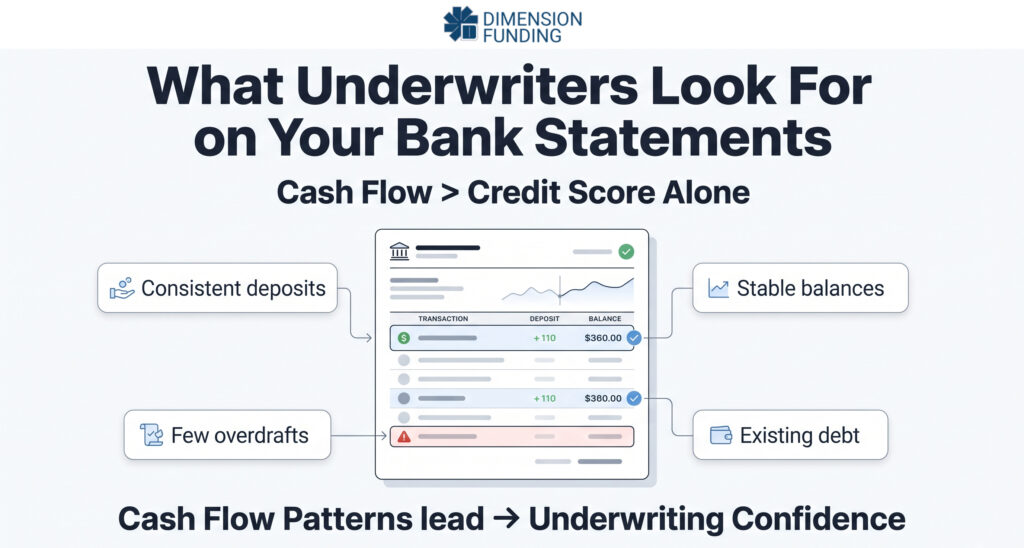
Many business owners assume lenders only use bank statements to confirm revenue, but underwriting goes much deeper. Bank statements provide a snapshot of how a business manages cash flow over time, helping lenders assess whether loan payments are likely to be made consistently.
Bank Statement Pattern | Why It Matters |
Monthly deposits | Demonstrates consistent business revenue |
Average daily balance | Indicates whether the business maintains a financial cushion |
Negative balance days | May signal cash flow instability or liquidity issues |
NSF or overdraft fees | Suggest difficulty managing available funds and may increase perceived lending risk |
Large one-time deposits | Often require documentation to verify they are recurring business income rather than unusual transactions |
Existing loan withdrawals | Help lenders evaluate current debt obligations and repayment capacity |
Rather than focusing on a single credit score, underwriters evaluate the overall pattern of financial activity. Consistent deposits, stable balances, and limited overdrafts can demonstrate responsible cash management even with an imperfect credit history.
This broader approach lines up with the Office of the Comptroller of the Currency’s guidance, which states that for most small business loans, the primary source of repayment is the cash flow of the business, and a bank’s cash flow analysis should cover current and expected cash flows over a reasonable range of future conditions. A business that can show it consistently manages its account well often has more leverage in the underwriting conversation than one relying on credit score alone, as legal industry coverage of small business lending standards has also noted.
Repayment Terms and Structure
Working capital loans typically run on shorter terms than equipment financing, often up to 24 months. Within that window, lenders usually offer weekly, monthly, or daily repayment options, and the right fit depends heavily on the type of business. Choosing the wrong structure can turn a manageable loan into a cash flow strain, even if the terms themselves were competitive.
A seasonal contractor might prefer weekly payments that ease during slow months, while a restaurant with steady daily transactions might choose daily repayment to match cash flow. Matching the repayment schedule to the business’s actual revenue pattern is one of the most overlooked ways to keep a loan manageable, and it’s worth discussing directly with a lender before signing rather than defaulting to whatever structure is offered first.
What Approval Actually Requires
Approval for working capital financing generally hinges on a few baseline requirements. Lenders typically look for annual revenue above a set threshold, majority ownership documentation, and recent bank statements, usually three to six months, depending on the loan size. Larger requests may also require corporate tax returns, since the added scrutiny reflects the larger risk exposure on both sides of the transaction.
The appeal of this financing type is the simplicity of the application itself. Many lenders, including Dimension Funding, use a single-page application supported by bank statements rather than a lengthy financial statement package. That structure is what allows some approvals and fundings to happen same-day or the next business day, which matters most when the need for capital is already urgent.
Why Approval Speed Varies So Much
Not every working capital loan closes at the same pace. Speed depends on how quickly documentation is submitted, how clean the bank statement history looks, and whether the loan amount triggers additional underwriting steps like tax return verification. A request under $50,000 with clean statements moves faster than a $200,000 request requiring deeper financial review, since underwriting depth scales with the size of the exposure.
Businesses that prepare their documents in advance, including recent statements, ownership records, and basic financials, consistently see faster turnaround. It’s less about the lender’s process and more about how ready the applicant is when the application lands on someone’s desk. Gathering bank statements and ownership paperwork before starting the application, rather than after, is one of the simplest ways to shave days off the timeline.
Common Mistakes That Slow Down Approval
Even straightforward applications can stall when a few avoidable mistakes creep in. Submitting incomplete bank statements, applying under the wrong business entity name, or leaving large unexplained deposits undocumented are among the most common reasons underwriting takes longer than expected. Each of these forces a lender to pause and request clarification, adding days to a process that could otherwise move quickly.
Another frequent misstep is applying for an amount that doesn’t align with documented revenue. Requesting $150,000 against inconsistent monthly deposits of $20,000 invites more scrutiny than a request sized appropriately to the business’s actual cash flow. Being realistic about loan size from the outset, and having a clear explanation ready for any unusual transactions, keeps the underwriting conversation short and the funding timeline on track.
Turning Cash Flow Timing Into a Non-Issue
Working capital loans exist to solve a timing problem, not a viability problem, and understanding how underwriting and approval work takes the guesswork out of applying. Revenue history, bank statement patterns, and loan amount all shape the terms you’re offered, but the process itself doesn’t have to be complicated once you know what a lender is actually evaluating.
Dimension Funding offers working capital loans between $25,000 and $250,000, with terms up to 24 months and repayment plans that flex around your business model, backed by same-day or next-business-day funding and a single-page, bank-statement-based application. Contact Dimension Funding to find out what your business qualifies for.
How long does it take to get approved for a working capital loan?
Approval timelines vary based on loan size and documentation, but many lenders can approve and fund same-day or the next business day once bank statements and application details are submitted. Larger loan amounts requiring tax returns may take slightly longer to clear underwriting.
What credit score do I need to qualify?
Most working capital lenders evaluate the whole financial picture, not just credit score. Strong, consistent bank statement history and revenue can offset a less-than-perfect credit profile in many cases, since cash flow often carries more weight than the score itself.
How much can my business borrow?
Working capital loan amounts typically range from $25,000 to $250,000, depending on revenue, time in business, and documented cash flow. Larger requests usually require more extensive documentation, including corporate tax returns.
Does the lender care which bank the business uses, or just the statement history?
Most lenders are agnostic about which bank a business uses and focus entirely on the statement history itself. What matters is a consistent, verifiable record of deposits and balances rather than the specific institution the account is held at.
What do underwriters look for on bank statements?
Underwriters review deposit consistency, average daily balance, negative balance days, overdraft fees, and existing loan withdrawals to gauge overall cash flow health rather than relying on credit score alone.
What documents do I need to apply?
Typically, you’ll need a completed application, three to six months of bank statements depending on loan size, and, for larger requests, corporate tax returns and proof of majority ownership.
If my business has one unusually large deposit, will that hurt my application?
Not necessarily, but it will likely require documentation. Underwriters generally just need to confirm whether a large one-time deposit reflects recurring business income or a one-off event, since unexplained deposits are a common reason applications stall.