
Working Capital Term Loans: Fixed Payment, Fixed End Date

working capital term loan

Working Capital Term Loans: Fixed Payment, Fixed End Date

Some business owners want financing that adapts and flexes with every fluctuation in cash flow. Others want the opposite: a number they can circle on the calendar and a payment that never changes between now and then. A working capital term loan is built for the second kind of business owner, one who values certainty over flexibility.

Dimension Funding has spent over 40 years financing small and mid-sized businesses across the U.S., and its working capital loans are structured around exactly that kind of predictability. Contact Dimension Funding to see if a fixed structure fits your business, or keep reading to understand how it actually works.
Working-Capital-Term-Loans-Fixed-Payment,-Fixed-End-Date

What Makes a Term Loan “Fixed”

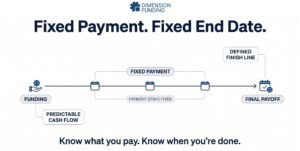
A working capital term loan disburses a lump sum upfront and sets a fixed repayment schedule from day one. The payment amount, the total financing cost, and the final payoff date are all established at the start of the loan and don’t move, regardless of how the business performs during the term.

This is fundamentally different from revolving financing, where the balance and the payment can shift depending on how much is drawn and repaid. With a term loan, there’s no guessing at what next month’s payment will be. The number on the schedule today is the same number six months or a year from now.

What Your Payment Is Actually Made Of

One of the biggest misconceptions about a fixed-payment working capital term loan is that every payment reduces the loan balance by the same amount. In reality, while your payment amount stays the same throughout the loan, how that payment is allocated changes over time. Early payments cover a larger share of financing cost and a smaller share of principal, because the outstanding balance is at its highest early in the term.

Payment Period

Financing Cost Portion

Principal Portion

Early in term

Higher

Lower

Middle of term

Moderate

Moderate

Late in term

Lower

Higher

This process is known as amortization. The Consumer Financial Protection Bureau’s explanation of how loan paydown works notes that in an amortizing loan, a greater percentage of each payment goes toward financing cost early in the term, while a greater percentage goes toward principal as the term progresses, which is also why a longer loan term lowers the payment amount but increases the total financing cost paid over the life of the loan. 

For business owners, understanding this structure makes it easier to track progress toward becoming debt-free: the monthly payment never changes, but each payment reduces the remaining balance by a larger amount than the one before it, so the loan balance declines more quickly in the later stages of repayment.

Why a Fixed Payment Matters for Budgeting

Predictability has real value beyond peace of mind. When a business knows its exact loan payment months in advance, it can build that number directly into cash flow projections without leaving room for surprises. That certainty makes it easier to plan payroll, inventory purchases, and other recurring expenses around a known obligation.

This is especially valuable compared to financing tied to sales volume, like a merchant cash advance, where the amount withdrawn each day shifts with revenue. A slow sales month with a merchant cash advance still pulls a percentage of whatever comes in, but a fixed-payment term loan stays exactly the same, which can actually make a slow month easier to manage rather than harder.

Why a Fixed End Date Matters Just as Much

A fixed end date gives a business a clear finish line. There’s no ambiguity about when the obligation will be paid off, which makes it far easier to plan around, whether that means budgeting for when cash flow frees up or timing a future financing need around the loan’s payoff.

Dimension Funding’s working capital loans run on terms up to 24 months, giving businesses a defined window rather than an open-ended obligation. Knowing exactly when a loan closes out, down to the month, removes one more variable from long-term financial planning.

How Repayment Frequency Fits Into a Fixed Structure

Even within a fixed-payment, fixed-term loan, businesses have some control over how that structure is scheduled. Repayment can typically be set up weekly, daily, or monthly, depending on which cadence best matches the business’s revenue pattern, without changing the fact that the total payment and payoff date remain fixed.

A seasonal business might prefer weekly payments that ease pressure during slower months, while a business with steady daily transactions might choose daily repayment to match its cash flow rhythm. Regardless of the schedule chosen, the fixed nature of the loan means the borrower always knows the total obligation and when it ends.

Qualifying for a Fixed-Payment Term Loan

Approval for a working capital term loan generally comes down to a handful of core requirements: annual revenue above a set threshold, majority ownership documentation, and recent bank statements to establish cash flow history. Larger loan requests typically require additional documentation, such as corporate tax returns.

Many lenders, including Dimension Funding, use a single-page application supported by bank statements rather than a lengthy financial statement package, which keeps the process fast without sacrificing the fixed structure borrowers are choosing this loan type for. Because underwriting reviews cash flow directly, businesses without extensive collateral or years of credit history can still qualify for predictable, fixed terms.

Fixed Term Loans vs. Variable-Cost Alternatives

The clearest way to see the value of a fixed structure is to compare it against financing where the cost moves with the business. A merchant cash advance, for example, ties repayment to a percentage of daily sales, which means the total cost and repayment timeline can both shift depending on how the business performs.

Businesses that compare the two often find that a fixed-payment working capital loan can cost considerably less than a merchant cash advance, since the payment amount and end date stay locked in regardless of sales fluctuations. That stability is often worth more to a business than the theoretical upside of a variable structure that could, in a strong sales month, cost less, since it can also cost significantly more in a weak one.

When a Fixed Term Loan Is the Right Fit

A fixed-payment, fixed-end-date loan works best for a defined, one-time need: covering a known expense, bridging a specific cash flow gap, or funding a project with a clear scope. Because the loan amount and schedule are set upfront, it’s less suited to a business that expects to need repeated access to capital over time.

For recurring or unpredictable capital needs, a revolving line of credit may be a better match, since it allows repeated draws rather than a single lump sum. The right choice comes down to whether your business needs one clearly bounded loan or ongoing, flexible access to funds.

Certainty You Can Plan Around

A working capital term loan offers something a lot of financing options can’t: total certainty about what you’ll pay and when you’ll be done paying it. That fixed payment and fixed end date make it easier to plan every other part of the business around one known obligation. Dimension Funding offers working capital loans between $25,000 and $250,000, with terms up to 24 months and same-day or next-business-day funding. Contact Dimension Funding to find out what your business qualifies for.

If my business’s cash flow improves, can I pay off a fixed term loan early?

Many lenders allow early payoff, though it’s worth confirming whether there’s any early payoff provision before signing. The CFPB’s general guidance on loan terms notes that some lenders include prepayment penalties that offset part of the savings from paying early, so reviewing the loan agreement’s prepayment language before signing, rather than after, is the more reliable way to know what an early payoff would actually save.

Does a fixed term loan report to business credit bureaus the same way a line of credit does?

Generally, yes. Most term loans and lines of credit are both reported to business credit bureaus, though the specifics depend on the individual lender’s reporting practices. It’s worth confirming with any lender before assuming either product affects credit reporting differently.

Can I request a second term loan while still repaying a current one?

It depends on the lender’s underwriting and how much of the current loan remains outstanding. Some businesses qualify for an additional loan based on updated cash flow, while others may need to wait until the existing balance is further paid down.

What happens if a payment is missed on a fixed term loan?

Policies vary by lender, but a missed payment typically triggers a grace period before late fees or other consequences apply. Contacting the lender proactively if a payment is going to be late is generally more productive than letting it pass without notice.

Is a fixed term loan reported differently depending on the repayment frequency I choose?

No. Whether repayment is scheduled weekly, daily, or monthly, the loan itself is still reported as a single fixed obligation. The repayment cadence affects cash flow timing, not how the loan appears on a credit report.

Can the loan amount be adjusted after the term loan has already funded?

Typically not without a separate application. Since the amount, schedule, and payoff date are all fixed at origination, a business that needs more capital after funding usually applies for additional financing rather than modifying the existing loan.

Does a fixed term loan make sense for a business that’s just starting to build credit history?

It can, since many working capital lenders weigh recent cash flow and bank statement history more heavily than an extensive credit record. A newer business with strong, consistent revenue may still qualify even without years of established credit.


Working Capital Line of Credit: Draw, Repay, Draw Again

working capital line of credit

Working Capital Line of Credit: Draw, Repay, Draw Again

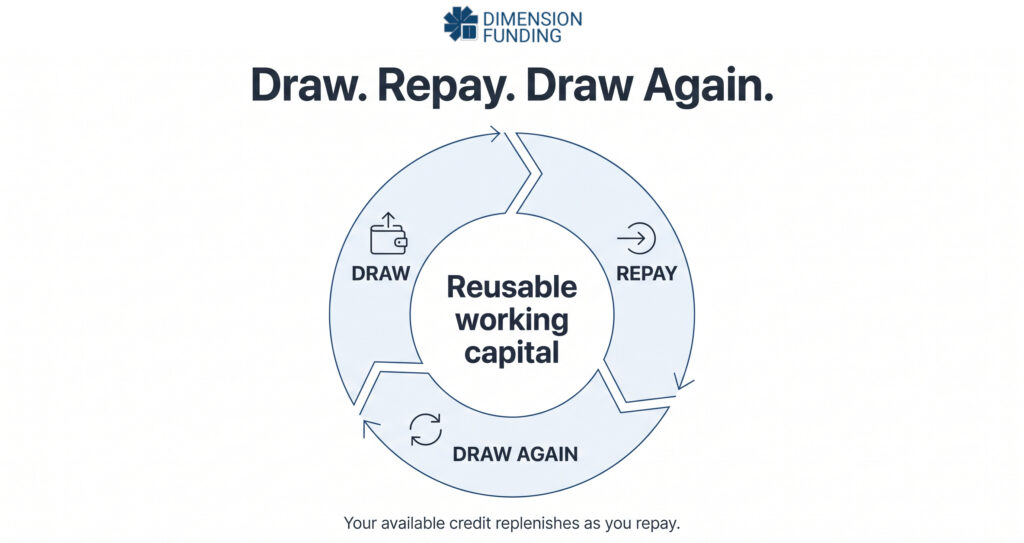
Cash flow rarely arrives on a predictable schedule, even when a business is healthy and growing. A line of credit solves a different problem than a term loan: it’s not about funding one big need, it’s about having capital ready whenever a need shows up. Draw what you need, repay it, and the available credit resets for the next time.

That flexibility is why so many business owners prefer a line of credit over a lump-sum loan. Dimension Funding has spent over 40 years financing small and mid-sized businesses across the U.S., and its working capital and line of credit programs are built around fast approvals and minimal paperwork. Contact Dimension Funding to see whether draw-repay-draw financing fits your business, or keep reading to understand how it actually works.

Working-Capital-Line-of-Credit-Draw,-Repay,-Draw-Again

What Makes a Line of Credit Different From a Loan

A term loan gives you a lump sum upfront, and you repay it on a fixed schedule regardless of whether you still need the full amount. A line of credit works differently: it gives you access to a set credit limit, and you only draw what you need, when you need it. Repayment obligations typically apply only to the portion you’ve actually used, not the full limit you’re approved for.

This structure matters most for businesses with recurring or unpredictable cash needs, rather than a single, defined expense. A retailer restocking inventory every quarter, a contractor covering payroll between milestone payments, or a seasonal business bridging a slow stretch all benefit from capital that’s available on demand rather than locked into one disbursement.

Understanding the Draw Period vs. the Repayment Period

A business line of credit is often described as “revolving,” but that doesn’t necessarily mean you can borrow indefinitely. Many lines of credit operate in two distinct phases: a draw period, when funds are available to borrow and re-borrow, followed by a repayment period, when new draws stop and the remaining balance must be repaid according to the lender’s schedule.

Phase

What You Can Do

What Changes

Draw Period

Borrow, repay, and borrow again

Available credit replenishes as principal is repaid

Repayment Period

No new draws

Outstanding balance converts into a scheduled payoff until paid in full

How Much of a Line Businesses Actually Draw On

Most businesses don’t run their line anywhere close to the limit, which is worth knowing before assuming a larger approved amount means a larger obligation. The Federal Reserve Bank of Kansas City’s small business lending survey tracks “usage” as the proportion of a line’s committed amount that’s actually drawn at a given time, and as of the fourth quarter of 2025, median usage across surveyed banks sat at 40.1%, down slightly from 41.4% the prior quarter.

That gap between the approved limit and what businesses actually carry is part of the appeal. A line sized generously for a slow month doesn’t cost anything extra to have in reserve; the obligation only shows up once it’s drawn. It’s also why requesting a limit larger than your typical need isn’t wasteful the way over-borrowing on a term loan would be, since unused capacity just sits available rather than accumulating interest.

Why the Transition Between Phases Matters

During the draw period, your payment obligation is generally tied only to the amount you’ve actually borrowed, and as that principal is repaid, those funds typically become available to use again.

Once the draw period ends, though, new borrowing stops and the remaining balance shifts into a fixed payoff schedule, which can mean a noticeably different monthly obligation than what you were paying during the draw period. Understanding this distinction ahead of time, rather than discovering it partway through, is one of the simplest ways to avoid a cash flow surprise.

How the Draw-Repay-Draw Cycle Works

The core mechanic of a line of credit is simple: you draw funds against your available limit, make payments according to your repayment schedule, and as you repay, that credit becomes available to draw again. It behaves less like a traditional loan and more like a reusable financial cushion.

Dimension Funding structures its working capital and line of credit offerings with amounts ranging between $5,000 and $200,000, with terms up to 24 months and repayment plans that can be scheduled monthly, weekly, or daily depending on the business. That repayment flexibility is central to how the draw-repay-draw cycle functions in practice: a business repaying weekly frees up credit sooner than one on a monthly schedule, giving faster-moving businesses quicker access to capital for the next draw.

Why Repayment Structure Shapes How Often You Can Draw

The repayment plan you choose doesn’t just affect your periodic obligation, it directly affects how quickly your credit line replenishes. Daily or weekly repayment plans return capital to your available limit faster than monthly plans, which matters if your business cycles through cash needs frequently.

Monthly repayment plans are typically capped at shorter terms and require a stronger credit profile than weekly or daily options, since lenders view monthly structures as carrying more risk over a longer stretch without repayment activity. Businesses with steady, predictable revenue often qualify more easily for monthly terms, while businesses with more variable cash flow may find weekly or daily repayment easier to manage and to qualify for.

What Shapes Approval on a Line of Credit

Approval for a working capital line of credit generally comes down to a handful of core requirements. Most lenders look for annual revenue above a set threshold, majority ownership documentation, and several months of recent bank statements to evaluate cash flow patterns. Larger credit limits typically require deeper documentation, including corporate tax returns for bigger requests.

That fits a broader pattern in how small businesses seek financing. The Federal Reserve’s 2026 Report on Employer Firms found that most applicants were seeking financing to cover operating expenses or pursue an expansion, the same two use cases that drive most line-of-credit draws, rather than financing a single large purchase.

Because the application is a single page supported by bank statements rather than a full financial statement package, approved businesses can often access same-day or next-business-day funding. That speed matters most for the exact kind of unpredictable cash need a line of credit is designed to cover.

Common Ways Businesses Use a Line of Credit

A line of credit isn’t earmarked for one purpose, which is part of its appeal. Businesses use it for daily operating expenses, expanding inventory ahead of a busy season, or covering payroll during a temporary cash flow gap. Because it’s reusable rather than a one-time disbursement, it tends to function as an ongoing safety net rather than a single financial event.

Seasonal businesses often draw on a line of credit during slower months and repay it as revenue picks back up, resetting the cycle for the next slow stretch. Other businesses use it opportunistically, drawing funds to take advantage of a bulk purchase discount or an unexpected growth opportunity, then repaying quickly once the resulting revenue comes in. The reusability is what separates a line of credit from a fixed-term loan built around a single need.

Avoiding the Most Common Line of Credit Mistakes

The most common misstep with a line of credit is treating it like free-flowing cash rather than a financial tool with a cost attached. Drawing repeatedly without a clear repayment plan can leave a business carrying balances longer than intended, eroding the flexibility that made the line appealing in the first place.

Another frequent mistake is choosing a repayment schedule that doesn’t match the business’s actual cash flow. A seasonal business locked into a monthly repayment plan may struggle during its slow months, while a business with daily revenue that chose monthly repayment may be paying for flexibility it doesn’t need. Matching the schedule to your real cash flow pattern, and drawing only what you have a clear plan to repay, keeps the credit line working in your favor rather than against you.

Capital That Moves at Your Business’s Pace

A working capital line of credit isn’t about solving one problem; it’s about staying ready for the next one. Draw when you need it, repay on a schedule that fits your cash flow, and let that credit become available again for whatever comes next. Dimension Funding offers working capital and line of credit financing between $5,000 and $200,000, with terms up to 24 months, same-day or next-business-day funding, and a single-page, bank-statement-based application. Contact Dimension Funding to see what your business qualifies for.

FAQs

How is a line of credit different from a working capital loan?

A line of credit gives you a revolving credit limit you can draw from repeatedly, while a term loan provides a single lump sum repaid on a fixed schedule. Both can support day-to-day business needs, but a line of credit is designed for repeated, ongoing use.

If my business has never used a line of credit before, how do I know what limit to request?

A useful starting point is your typical monthly cash flow gap during your slowest stretch, rather than the largest expense you can imagine. Requesting a limit close to what your bank statements can support tends to move through underwriting faster than an amount that looks disconnected from your actual cash flow.

Can I have a line of credit and a term loan at the same time?

Yes. Many businesses carry both, using a term loan for a defined, one-time need and a line of credit for the ongoing, unpredictable gaps that come up in between. The two products aren’t mutually exclusive and often work well together.

What happens if I don’t use my line of credit for several months?

Unused capacity generally just sits available at no cost, though some lenders periodically review inactive lines to confirm the facility is still needed. There’s typically no penalty for going a stretch without drawing on it.

What repayment schedule should I choose?

The right schedule depends on your cash flow pattern. Daily or weekly repayment tends to suit businesses with frequent revenue, while monthly repayment may fit businesses with steadier, less frequent cash flow, though it typically requires a stronger credit profile.

Does drawing on a line of credit affect my ability to qualify for other financing later?

It can factor into how a future lender views your overall debt load, since most underwriting looks at existing obligations alongside new requests. Keeping your line’s balance from sitting near its limit for extended stretches generally supports a stronger position for future applications.

Can I use a line of credit for any business purpose?

Yes. A working capital line of credit is generally flexible enough to cover daily expenses, inventory purchases, payroll gaps, or unexpected costs, since it isn’t tied to a specific asset purchase like equipment financing.