
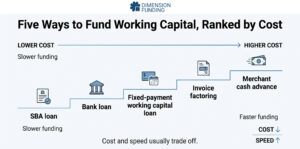
Not all working capital financing costs the same, and the differences are often bigger than business owners expect. The same $75,000 need can cost a few thousand dollars with one option and tens of thousands with another, depending entirely on which financing tool you choose. Ranking the major options by cost helps you see where your business actually fits.
Dimension Funding has spent over 40 years financing small and mid-sized businesses across the U.S., and its fixed-payment working capital loans sit firmly on the lower-cost end of this spectrum. Contact Dimension Funding to see where your business fits, or keep reading to understand how each option’s cost is actually built.
Total Borrowing Cost vs. Advertised Terms
A low headline number can make one financing option appear less expensive than another, but the true cost of borrowing depends on much more than what’s advertised. Guarantee fees, origination fees, invoice discounts, and holdback multiples all contribute to what a business ultimately repays over the life of the financing. Comparing only the advertised terms can lead business owners to underestimate the actual cost of accessing working capital.
Financing Type | Cost Structure to Compare |
SBA loan | Base borrowing cost plus SBA guarantee fees and other applicable loan fees |
Bank loan | Base borrowing cost plus origination and closing fees |
Fixed-payment working capital loan | Total borrowing cost plus any lender fees, fixed regardless of usage |
Invoice factoring | Discount fee deducted from each invoice purchased |
Merchant cash advance | Total repayment amount set as a multiple of the amount advanced |
For example, an SBA loan may advertise a low base cost, but borrowers should also account for the SBA guarantee fee and any lender-imposed closing costs when calculating the total amount repaid.
Likewise, invoice factoring may not carry a traditional financing cost, yet repeated invoice discount fees can significantly increase costs over time. Merchant cash advances can be especially misleading because they’re commonly structured around a repayment multiple rather than a fixed cost, making it essential to compare the total repayment amount instead of focusing on the advance itself.
The U.S. Small Business Administration’s loan programs page is a useful starting point for understanding how loan fees and repayment terms factor into the total cost of financing, since comparing the total dollar cost of each option provides a far more accurate picture than the advertised terms alone.
SBA-Backed Working Capital Loans: The Lowest Cost, The Longest Wait
SBA-backed loans, such as those issued through the SBA 7(a) loan program, generally carry the lowest cost of the options on this list because a government guarantee reduces the lender’s risk. That lower risk translates directly into more favorable terms and longer repayment periods for the borrower, making SBA financing attractive for businesses that can afford to wait.
Part of that lower cost comes from how the program is structured on the lender’s side. SBA guidance on lender terms and eligibility explains that lenders pay a guarantee fee for each loan the agency backs, and while lenders are permitted to pass that cost on to the borrower, the SBA caps how much can be charged. That guarantee is also what lets a lender extend financing to a borrower who might not clear a conventional bank’s collateral requirements on their own.
The tradeoff is speed and paperwork. SBA loans typically require extensive documentation, financial statements, and a review process that can take weeks or months rather than days. For a business facing an urgent, short-term cash flow gap, the lowest-cost option on paper often isn’t the most practical one in practice.
Traditional Bank Term Loans: Low Cost, Strict Qualification
A traditional bank term loan is usually the next most affordable option, offering costs well below what most alternative lenders charge. Banks structure these loans around strong underwriting standards, which keeps the cost low for businesses that clear the bar.
That underwriting bar is the catch. Banks generally require multiple years in business, strong credit, and often collateral, which shuts out newer businesses or those with less-than-perfect financials. Approval timelines also tend to run longer than most working capital needs can comfortably wait for.
Fixed-Payment Working Capital Loans: The Middle Ground That Works for Most Businesses
Fixed-payment working capital loans from alternative lenders sit in the middle of the cost spectrum, but they close the gap that banks and SBA loans leave open. Because approval is based on cash flow and bank statement history rather than years in business or hard collateral, more businesses qualify, and they qualify faster.
Dimension Funding’s working capital loans range from $25,000 to $250,000 with terms up to 24 months and fixed payments that don’t change over the life of the loan. That fixed structure means the cost is known upfront, approved businesses can access same-day or next-business-day funding, and the total cost stays predictable regardless of how the business performs during repayment.
Invoice Factoring: Fast Cash, but a Real Cost Per Invoice
Invoice factoring involves selling outstanding invoices to a third party at a discount, typically receiving 70% to 90% of face value upfront in exchange for immediate cash. The factoring company then collects directly from the business’s customers, recovering the remaining balance minus fees.
The cost here is less obvious than a stated financing charge, since it’s built into the discount taken on each invoice. For businesses with long payment cycles and strong receivables, factoring can be a reasonable trade-off, but the effective cost, especially when factoring repeatedly, often runs higher than a fixed-payment working capital loan, and it can affect customer relationships since the factoring company deals with them directly.
Merchant Cash Advances: The Fastest and Most Expensive Option
A merchant cash advance sits at the top of the cost ranking, and by a wide margin. Repayment is tied to a percentage of daily sales, often called a holdback, with the total repayment amount set as a multiple of the amount advanced, commonly 1.2 to 1.5 times the cash received.
Because that multiple applies regardless of how quickly the advance is repaid, the effective cost of a merchant cash advance frequently outpaces every other option on this list, sometimes dramatically. Businesses that compare this type of financing against a fixed-payment working capital loan often find they can save considerably by choosing the fixed-payment option instead, since payments stay level rather than fluctuating with sales volume.
Why Speed and Cost Usually Trade Off Against Each Other
Looking at this list end to end, a pattern emerges: the cheapest options tend to take the longest to fund, and the fastest options tend to cost the most. SBA and bank loans sit at the low-cost, slow-funding end, while merchant cash advances sit at the high-cost, fast-funding end.
Fixed-payment working capital loans occupy a genuinely useful middle position: priced closer to bank-level cost while funding on a timeline closer to a merchant cash advance. For businesses that need capital within days rather than weeks but don’t want to pay merchant cash advance pricing, that middle ground is often the most practical choice.
Matching the Option to the Actual Need
The right choice usually comes down to how urgent the need is and how the business plans to repay it. A defined, time-bound gap, such as waiting on a large receivable, might justify a faster, pricier option if the repayment source is clear and short-lived. An ongoing operating need is better served by a lower-cost option that won’t compound in cost the longer it’s used.
It’s also worth resisting the pull toward whichever option is fastest simply because it’s fastest. A business that takes on a merchant cash advance for a need that could have waited two extra days for a fixed-payment loan approval often ends up paying far more than necessary for that convenience.
Choosing Cost Over Convenience
Every option on this list can solve a working capital gap, but they don’t solve it at the same price. The lowest-cost financing takes the longest to arrive, the fastest financing costs the most, and a fixed-payment working capital loan often gives businesses the best balance of speed and affordability in between.
Dimension Funding offers working capital loans between $25,000 and $250,000, with same-day or next-business-day funding and a single-page, bank-statement-based application. Contact Dimension Funding to find the option that fits your business’s actual need.
FAQs
Why does a government guarantee make SBA loans cheaper if the government isn’t the one lending the money?
The guarantee reduces the lender’s risk if a borrower defaults, since a portion of the loss is covered. That lower risk lets lenders offer more favorable terms than they would on an unguaranteed loan of similar size, even though a bank or approved lender is still funding it directly.
Can a business use more than one of these financing types at the same time?
Yes, and it’s fairly common. A business might use a fixed-payment working capital loan for ongoing operating needs while occasionally factoring a specific large invoice with a long payment cycle, rather than relying on one financing type for every situation.
Does a business’s industry affect which of these options makes the most sense?
It can. Businesses with long receivable cycles, like B2B service providers, tend to see more value from invoice factoring, while businesses with high daily card volume, like restaurants or retailers, are more often targeted by merchant cash advance providers, whether or not that’s actually their best fit.
If a business has been declined for an SBA or bank loan, does that hurt its chances with alternative lenders?
Not necessarily. Alternative lenders generally weigh cash flow and bank statement history more heavily than the stricter collateral and years-in-business requirements that banks and SBA lenders emphasize, so a decline from one doesn’t automatically predict the outcome with the other.
How often do businesses end up using invoice factoring repeatedly rather than as a one-time solution?
It varies, but factoring often becomes a recurring tool for businesses with consistently long payment cycles rather than a single-use option. That repetition is exactly why the discount fee’s cumulative effect matters more than it might appear on a single invoice.
Is there a minimum amount of time in business required to qualify for any of these options?
Requirements vary widely by option. SBA and bank loans typically expect several years of operating history, while fixed-payment working capital loans, invoice factoring, and merchant cash advances are often accessible to newer businesses with a shorter track record but consistent recent cash flow.
What’s the biggest mistake businesses make when comparing these five options?
Comparing them by speed alone, without weighing the total cost over the life of the financing. The fastest option to fund is rarely the cheapest, and choosing based only on how quickly cash arrives often means paying significantly more than a slightly slower option would have cost.