How to Set Up a Financing Program for Your Equipment Dealership

How to Set Up a Financing Program for Your Equipment Dealership

How to Set Up a Financing Program for Your Equipment Dealership

Setting up a vendor financing program is less about paperwork and more about a handful of decisions made up front. Dimension Funding has spent over four decades building these programs for equipment dealers, and the process moves faster than most owners expect once those decisions are made. Dealers who want to see what a vendor program could look like for their specific equipment line can start at Dimension Funding.

Deciding What the Program Will Cover

The first real decision is scope: equipment only, or equipment plus software, implementation, and services bundled into the same transaction. That choice affects which application-only threshold applies with Dimension Funding, meaning how much a buyer can finance without submitting financial statements.

For equipment-only deals, Dimension Funding generally offers application-only approval up to $250,000. When software, implementation, or training rides along with the equipment, Dimension Funding’s software financing option raises that threshold to $500,000. A dealership selling machines that increasingly ship with control software or an ERP integration should account for this before assuming every deal fits the lower tier.

What to Evaluate in a Financing Partner

With Dimension Funding, the dealership is paid the full purchase price at funding, before the buyer has made a single payment. If a buyer later falls behind or stops paying, that’s a matter between the buyer and Dimension Funding, not something that unwinds the dealership’s own payment. The receivable is settled at closing rather than sitting on the dealership’s books waiting to be collected. 

Captive Financing vs. an Independent Vendor Partner

Some dealerships already have access to a manufacturer’s own captive financing arm, a company set up specifically to finance that manufacturer’s equipment. Captive programs work well for a dealership selling almost entirely new inventory from a single manufacturer, since the financing is built around that one product line.

The limitation shows up once a dealership’s inventory gets more mixed. A captive program typically doesn’t extend to used equipment, trade-ins, or a second manufacturer’s line the same dealership might also carry. An independent partner like Dimension Funding finances across all of that under one program, which matters for a dealership that isn’t purely single-brand or purely new inventory, which describes most dealerships carrying more than one product line.

The Application and Onboarding Steps

Getting a program running with Dimension Funding starts with a conversation about what the dealership sells, typical deal size, and how the sales team currently handles the payment question. From there, the process moves through a defined sequence rather than an open-ended negotiation.

Step

What Happens

Typical Duration

Initial application

Dealership submits basic business details and a typical transaction profile

Same day

Program structuring

Financing partner builds terms around deal size and buyer credit mix

1 to 3 business days

Tools and materials setup

Marketing collateral, payment calculator, and application widget configured

Varies by dealership

Sales team briefing

Reps trained on how and when to introduce financing in a sales conversation

1 business day

Launch

Sales team begins offering financing at the point of sale

Immediate after setup

A dealership moves through this faster when it can describe its typical deal size, whether software or services usually accompany the equipment sale, and roughly what credit profile its buyer base tends to have. None of this requires a formal report. A sales manager who already runs the floor can usually answer all of it in a single call. From there, the vendor partner application gets the program moving. 

Tools That Come With the Program

Once a program is active, a dealership isn’t handed a phone number to call when a buyer asks about payment. Dimension Funding’s vendor partner program includes a financing widget that a dealership can add to its own site, putting an application and a payment calculator directly in front of a buyer before they ever speak with a salesperson. 

Marketing Support Doesn’t End at Launch

A program includes ongoing marketing support beyond the initial setup, not just a one-time configuration. That typically includes co-branded materials built around the dealership’s specific equipment line, along with inclusion in broader outreach like newsletters and social posts aimed at the same buyer base the dealership is already trying to reach.

That distinction matters for a dealership deciding whether a program is worth the setup effort. A financing relationship that only provides an application form gives a dealership less ongoing value than one that keeps generating exposure to prospective buyers after the initial launch is done.

Preparing the Sales Team

Tools matter less than when a sales team brings financing into the conversation. Dealerships that introduce it alongside the quote, rather than after a buyer balks at the price, tend to get more use out of a program than dealerships that treat it as a fallback.

That means a short internal conversation before launch: who mentions financing first, whether it’s included by default on every quote, and how a rep answers the most common buyer questions about approval speed and paperwork. Full program benefits are best reviewed with the sales team directly, not summarized secondhand.

When a Rep Isn’t Sure a Deal Qualifies for Application-Only Treatment

Reps don’t need to calculate eligibility themselves before quoting financing. The application-only thresholds are based on the total transaction, equipment plus any bundled software or services, so a rep who isn’t sure whether a specific deal falls under $250,000 or $500,000 can simply submit it and let the review process sort out which tier applies. Treating every deal as a candidate for application-only financing, rather than pre-screening deals informally on the floor, keeps reps from talking themselves out of raising financing on a deal that would have qualified.

Why More Dealerships Are Adding This Now

Vendor and manufacturer financing, sometimes called captive financing, is already a meaningful share of how equipment gets paid for. Of the total market for financing in 2023, banks accounted for 59% of financed acquisitions; captives, meaning manufacturer or vendor financing, accounted for 17%; independents comprised 15%; and fintechs 7%, according to the Equipment Leasing and Finance Association. That 17% isn’t a niche corner of the market. It represents a real share of deals going to dealerships that already built financing into their sales process.

The Equipment Leasing & Finance Foundation’s 2024 Horizon Report also found that end-users expect to increase equipment and software acquisitions in 2025, with 42% anticipating growth against just 15% expecting a decline. Dealerships without a financing program in place are positioned to capture less of that expected growth than ones already offering it at the point of sale.

What This Means for a Dealership Without a Program Yet

A dealership relying on buyers to arrange their own financing is effectively outsourcing part of its close rate to whatever lender that buyer happens to find, with no visibility into approval odds or timeline. The Federal Reserve’s 2025 Small Business Credit Survey found that roughly half of firms had their financing needs fully met, while about a third faced a funding gap despite applying. SBA-backed loan programs offer another path for buyers who don’t qualify through a bank, but those routes generally move slower than a financing partner already built into the sale.

Getting a Program Running

A dealership doesn’t need an in-house finance team or an existing lender relationship to start working with Dimension Funding. The structure gets built around how the dealership already sells, whether that’s mostly new equipment, mostly used, or a mix that increasingly includes a software component.

Contact Dimension Funding to scope a vendor program for your specific equipment line.

Frequently Asked Questions

Does a dealership need a minimum sales volume to qualify for a vendor partner program?

There’s no strict volume requirement. Smaller dealerships with a modest deal count can still set up a program, though the structuring conversation focuses more on typical deal size and buyer credit mix than on total annual volume.

Is there a cost to the dealership for joining a vendor partner program?

The program itself doesn’t charge the dealership a setup fee. Costs only come into play if a dealership chooses to offer a promotional structure like zero percent financing, where the dealership covers that promotion’s cost rather than the buyer.

Does adding a financing program require the dealership to change its existing quoting or CRM software?

No. A vendor partner program operates through its own application widget and portal rather than requiring integration into the dealership’s existing systems, so it can run alongside whatever quoting or CRM tools are already in place.

What happens if a buyer’s deal exceeds the application-only threshold?

Deals above the application-only thresholds move to a streamlined review rather than a full bank-style underwriting process. The dealership isn’t involved in that review beyond providing the initial deal information.

Does the dealership have any say in which buyers get approved?

No. Credit decisions are made independently of the dealership, which keeps the dealership out of the position of vouching for or denying a specific buyer.

Can a dealership limit the vendor program to certain product lines rather than its full catalog?

Yes. A dealership can scope the program to specific equipment categories or a subset of its catalog rather than committing every product line from the outset.

How quickly can a new dealership employee start using the program without additional setup?

Once a program is active, using it doesn’t require per-employee onboarding. A new sales hire can start quoting financing alongside equipment as soon as they’re trained on the dealership’s own process, since the tools and application sit at the point of sale rather than requiring individual account access.

Commercial Truck Financing for Dealers | Dimension Funding

Commercial Truck Financing for Dealers | Dimension Funding

Commercial Truck Financing for Dealers | Dimension Funding

A truck sitting on the lot isn’t making anyone money. Most of the time, the deciding factor between a customer buying today and driving home to think it over isn’t the price tag. It’s whether financing is already in the picture when they’re deciding.

Dimension Funding structures financing around trucks and trailers specifically, rather than a generic equipment loan retrofitted to fit a vehicle. A customer sits down, sees a monthly payment number, and signs, instead of leaving to call three banks first.

Dealers running a lot can talk through what a program would look like for their own inventory, from used truck age limits to how upfitting costs get folded into the payment.

Most Truck Buyers Don’t Pay Cash

Between the vehicle, aftermarket upfitting, and the labor to get it road-ready, the total cost of a work-ready truck adds up fast, and few small or mid-sized businesses want to tie up that much working capital in a single purchase.

The Federal Reserve has found that financing motor vehicles and other business equipment accounts for roughly 80% of outstanding business finance company debt, making it the primary reason businesses use finance companies at all. When a dealer can present financing at the moment a customer is deciding, the sale stays in the dealer’s hands instead of stalling out while the buyer goes looking for a lender elsewhere.

Loan, Lease, or Lease-Purchase

Dimension Funding includes truck financing as an equipment loan, a true lease, or a lease-purchase. An equipment loan gives the customer full ownership once payments are complete. A true lease finances the truck’s use rather than its full value, which lowers the monthly payment. A lease-purchase, common in carrier-sponsored programs, applies a portion of each payment toward eventual ownership rather than requiring a full buyout at the end.

Why Medium-Duty Orders Are Running Hot Right Now

Classes 5-7 truck orders, the segment covering most of what a dealer selling Class 6 and 7 trucks carries, rose 32% year-over-year to 19,000 units in May 2026, according to ACT Research. Analysts tie a meaningful part of that increase to dealers stocking inventory ahead of the EPA’s 2027 emissions standards taking effect, rather than pure organic demand growth.

A dealer moving that inventory faster than usual needs financing that can keep pace. Dimension Funding approves most transactions without financial statements and funds same-day, regardless of what’s driving the volume.

What a Dealer Financing Program Covers

New and Used Trucks and Trailers

Dimension Funding finances new and used vocational vehicles and trailers, including Class 6 and 7 trucks, box trucks, boom trucks, vacuum and pumper trucks, and standard truck and trailer combinations. Terms run up to 60 months on qualifying new and used vehicles, with 100% financing available on qualifying transactions, meaning no down payment is required to close the deal.

New Class 8 semis typically run $120,000 to $180,000 for standard configurations. Used semis generally range from $40,000 to $90,000 depending on year, mileage, and condition, and NADA reports that new heavy-duty truck sales declined roughly 9.9% at the end of 2024, which has kept quality used inventory more available at accessible price points.

Aftermarket Work, Upfitting, and Associated Costs

It’s rare a truck leaves the lot exactly as it arrived from the manufacturer. Liftgates, refrigeration units, custom bodies, shelving, and other upfitting work are common, and so is delivery and installation labor. Dimension Funding bundles these costs, along with taxes and delivery, into the same financing agreement as the vehicle itself. That way the customer ends up with one fixed monthly payment covering the entire transaction rather than a separate invoice.

Software and Subscription Tools

Financing isn’t limited to vehicles. Dealers running fleet management software, DMS platforms, or other subscription-based tools can work with Dimension Funding to finance those costs too, turning an annual software renewal into a predictable monthly payment instead of a lump-sum expense. Software financing also covers implementation, training, and third-party vendor costs bundled into the same agreement, which is worth knowing for a dealership weighing its own back-office technology alongside a customer-facing financing program.

How the Application-Only Process Works

Speed is one of the biggest selling points of Dimension Funding’s dealer program, and for most transactions no financial statements are required at all. Application-only financing is available up to $250,000, with larger fleet transactions typically requiring financial statements above that line. Qualifying transactions can also be financed at 100%, meaning a customer doesn’t need to bring a down payment to close the deal.

Approvals are often same-day, and the entire process runs electronically, so a customer can sign documents from a phone or laptop without a trip to a bank branch. On qualifying box truck transactions, Dimension Funding also offers no payments for 90 days, giving a customer time to get the vehicle generating revenue before the first payment is due.

For fleet purchases that exceed the application-only threshold, SBA 7(a) loans are an alternative to consider, though they typically involve more documentation and a longer approval timeline than Dimension Funding offers directly.

Where the Weight Class Matters for the Deduction

Financing a truck doesn’t cost a buyer the tax advantage of owning it outright. Under the 2026 Section 179 deduction, eligible businesses can immediately write off up to $2,560,000 of qualifying equipment placed in service during the year, phasing out once total qualifying purchases exceed $4,090,000.

One distinction worth flagging to a customer: Section 179 caps certain heavy SUVs and passenger-style trucks between roughly 6,001 and 14,000 pounds GVWR at $32,000. Class 6 and 7 work trucks run well above that weight class, so they’re not subject to that cap and qualify for the same uncapped treatment as any other commercial equipment. Vehicle-specific rules can still apply beyond that general framework, so pointing a customer toward a CPA for anything outside the basics is the right move.

Setting Up a Vendor Partnership

Dealers who want to build financing into their sales process formally can apply to become a vendor partner. As a vendor partner, dealers get sales and marketing assistance to help close deals, along with joint marketing efforts and program support. In practice, that includes:

  • Co-branded literature and digital tools sales teams can use directly with customers
  • A payment calculator that can be added to the dealer’s own website
  • Ongoing account management from consistent team members, rather than a rotating point of contact

Dimension Funding prepares the paperwork, with DocuSign available on most transactions, so the customer only has to sign a few pages to complete the deal. For a sales team, that means less time spent on financing logistics and more time focused on the vehicle itself. Dealers interested in the program can apply directly through the vendor partner application.

Ask About Your Specific Inventory 

A dealer running new inventory, used inventory, or a mix of both doesn’t need a separate financing conversation for each. Dimension Funding has structured vehicle financing programs for over 40 years, and the fastest way to see what a partnership would look like for a specific inventory mix is to ask directly. Contact Dimension Funding to get started. 

Frequently Asked Questions

Can a trailer be financed separately from the truck pulling it?

Yes. Trailer financing is available as a standalone product, so a tractor and trailer can be financed independently or structured together in the same deal, depending on what the customer already owns and what’s being added.

Does a lease-purchase agreement qualify for Section 179 the same way a loan does?

Not automatically. Section 179 generally applies to equipment the buyer owns or is building toward ownership of, which covers a standard equipment loan and can apply to a lease-purchase depending on how it’s structured, but typically doesn’t apply to a true lease, where ownership never transfers. This is worth confirming with a CPA before the deal is structured.

Is there a difference in how Class 6 and 7 trucks are financed compared to lighter commercial vehicles?

Not in the underlying program structure. Class 6 and 7 trucks run through the same application-only process as lighter vehicles, though documentation requirements can vary by price point and whether the vehicle is new or used.

Does the 90-day payment deferral apply to every truck type, or just box trucks?

It’s currently confirmed for box truck transactions. Terms can vary by vehicle category, so it’s worth confirming directly for other truck types rather than assuming the same deferral applies across the board.

Is there an age or mileage cutoff for a used truck to qualify for financing?

There’s no single universal cutoff. Age caps on used equipment commonly fall in the 10 to 15 year range, though vehicles with strong resale demand and documented maintenance histories can sometimes qualify beyond that. Condition and service records typically matter more than age alone.

Does the Section 179 weight-based cap that applies to heavy SUVs also apply to trailers?

No. That cap specifically targets passenger-style SUVs and pickups between roughly 6,001 and 14,000 pounds GVWR. Trailers aren’t passenger vehicles, so they follow the same uncapped Section 179 treatment as other business equipment, regardless of weight.

How large is the market for financed commercial trucks and trailers?

Trucks, buses, and truck trailer investment totaled $234.7 billion in 2024, according to ELFA’s transportation industry data, based on U.S. Bureau of Economic Analysis figures.

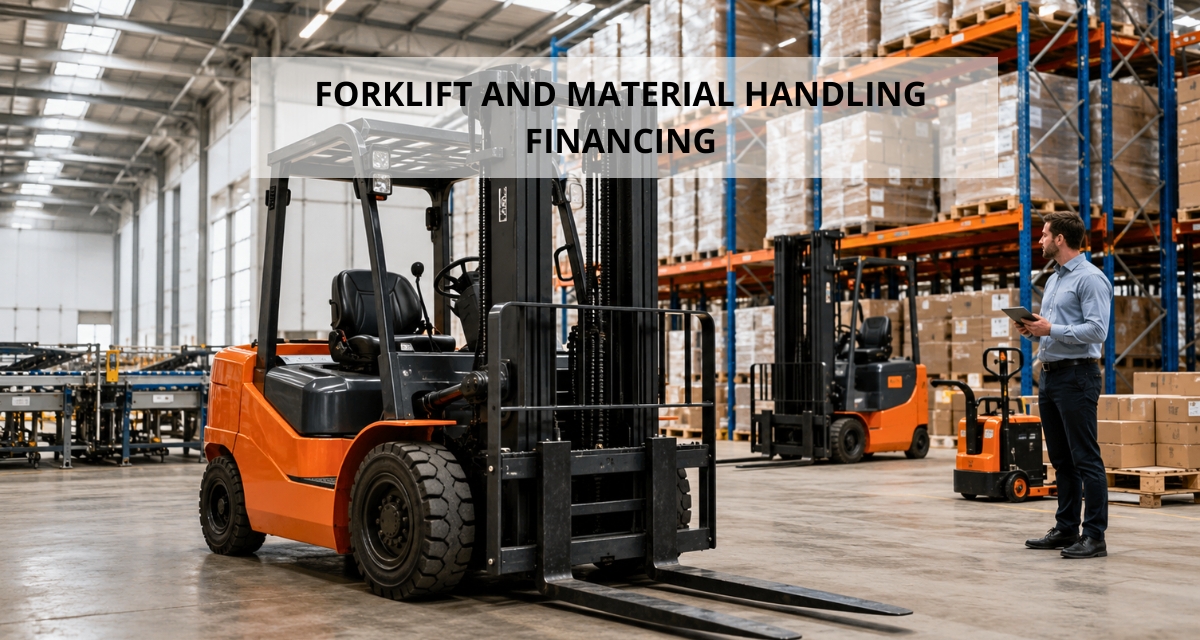
Forklift and Material Handling Financing for Dealers

Forklift and Material Handling Financing for Dealers

Forklift and Material Handling Financing for Dealers

Material handling equipment moves fast, or at least it’s supposed to. A dealer with the right forklift, racking system, or conveyor line in stock should be able to close a sale in days instead of weeks. What usually gets in the way is rarely the equipment or the price. It’s whether the dealer walks in with a financing answer already in hand, or leaves the buyer to go find one on their own.

Dealers selling forklifts, pallet trucks, order pickers, warehouse racking, conveyors, and packaging equipment can put that answer directly into the quote through Dimension Funding‘s vendor partner program, built around how material handling deals operate: fast decisions, tight timelines, and buyers who often can’t wait on a bank’s underwriting cycle.

Why Material Handling Runs on a Different Clock

Material handling purchases move on a shorter timeline than most commercial equipment financing is built to accommodate. A financing process that takes weeks rather than days can kill a sale regardless of price. 

According to the Industrial Truck Association, the industrial truck industry generated a total GDP impact of $36.6 billion in 2023 and supported more than 257,000 jobs—a scale that reflects how much of this equipment moves through dealers tied to active warehouse operations rather than a slow capital-planning cycle. The 2025 MHI Annual Industry Report found that 42% of supply chain leaders surveyed planned to invest in forklifts and handling equipment.

What a Dealer Sells Under the Program

Rolling Stock and Fixed Systems 

Most of what a material handling dealer carries qualifies for Dimension Funding’s program, which has run vendor partnerships across equipment and material handling dealers for over 40 years. New or used, it all runs through the same structure. 

  • On the equipment side: lift trucks, pallet jacks, platform trucks, order pickers, and side loaders.
  • On the fixed-infrastructure side: warehouse storage racks, shelving, cranes, conveyors, and hoists. 
  • On the packaging side: filling, labeling, palletizing, and wrapping systems. 

Installation and labor costs can be included in the same monthly payment as the equipment itself. That’s important for a racking system or conveyor line in particular, since the labor to install and commission it can run close to the cost of the equipment. A buyer comparing cash against financing should be looking at the full project cost rather than a stripped unit price.

Why Rolling Stock and Fixed Systems Don’t Share a Term

Rolling stock and fixed infrastructure age differently, which is worth factoring into term length rather than defaulting to the same structure for both. A forklift fleet is also in the middle of a real shift in the equipment itself. Mordor Intelligence’s US Forklift Market report found that lithium-ion battery systems held 54.62% of US forklift market revenue in 2025 and are forecast to keep growing through 2031. That kind of shift can affect how long a buyer wants to hold a given unit in a way that wasn’t really a factor with combustion fleets.

Racking, conveyors, and other fixed systems don’t carry that same pressure. A conveyor line installed this year isn’t getting displaced by a battery chemistry change the way a forklift might be. Dimension Funding structures both under the same up-to-60-month terms, but that full term is worth a second look for a rolling-stock order rather than defaulting to it the way it might for fixed infrastructure. 

The Software Riding Along With the Hardware

Warehouse equipment increasingly ships with a software layer attached: a WMS upgrade, an inventory tracking platform, or fleet management software for a growing lift truck fleet. That software can be bundled into the same financed transaction as the equipment. A dealer partnering with a software vendor on the deal can consolidate both into one agreement instead of two separate purchase decisions.

The US Forklift Market report from Mordor Intelligence points to why that software layer keeps showing up in these deals. The report notes that 90% of logistics providers now budget for digital supply chain upgrades, and that end-users increasingly evaluate forklifts on data compatibility as much as lift capacity.

Bringing a Program Online

A vendor partner application is the starting point, and from there Dimension Funding builds the structure around specifics: how big a typical order runs, what a dealer’s buyer base looks like, and how quickly deals usually need to move from quote to close. No in-house finance team required on the dealer’s end.

Marketing materials and sales support come with an active partnership, so financing sits inside the standard quote instead of getting raised only when a buyer brings up price.

Getting Paid Without Carrying the Risk

A dealer quotes the equipment, the buyer submits an application, and once approved, Dimension Funding pays the dealer the full purchase price directly. The dealer isn’t carrying the paper, isn’t chasing a monthly payment, and isn’t exposed if the buyer’s business hits a rough stretch later in the term. Applications run electronically, with signatures through DocuSign, so a deal that’s ready to close doesn’t sit waiting on paperwork.

The numbers worth knowing before a sales conversation:

  • Up to $250,000: application-only financing, no financial statements required.
  • Above $250,000: still available and still streamlined, though some financial documentation is needed.
  • Terms: fixed payments extending up to 60 months, spreading a full project cost, including installation, over the equipment’s working life.
  • Credit: most credit types accepted, Tier A down to marginal.
  • Timeline: approvals usually returned within a few hours, with funding typically following in two to three business days.

Dealers can run rough numbers for a buyer through Dimension Funding’s payment calculator before formal approval. 

Cash vs. Financing for a Fleet Purchase

Paying cash for a fleet of reach trucks or a full racking system ties up capital that could otherwise cover payroll during a seasonal ramp-up or an unplanned repair.

Section 179 adds a tax incentive on top of it. Under current IRS rules, qualifying equipment placed in service during a tax year beginning in 2026 can be deducted up to $2,560,000 in the year of purchase, phasing out dollar-for-dollar above $4,090,000 in total qualifying purchases and disappearing entirely above $6,650,000, according to Section179.org.

Both new and used material handling equipment qualify. A buyer financing the purchase can take the full deduction in year one while the actual cash payments are spread across the term, which is often the detail that turns a “maybe next quarter” into a signed order before year-end.

Financing as Part of the Quote, Not an Afterthought

A dealer selling a mix of new and used equipment, or bringing a software vendor into the deal, doesn’t need a separate conversation for each scenario. Dimension Funding has worked with equipment and material handling dealers for over 40 years, and the fastest way to see how a partnership would work for a specific product line is to ask directly. Contact Dimension Funding to get started. 

Frequently Asked Questions

If an order combines new and used equipment, does the mixed total still count toward the $250,000 application-only threshold, or is the used portion evaluated separately? 

The combined order amount is what counts, not new and used values evaluated separately. A quote combining $180,000 in new forklifts with $60,000 in certified pre-owned units still falls under one application-only threshold as a single $240,000 transaction, rather than being split into two. 

At what point does the dealer get paid: when the buyer signs, when the equipment ships, or after installation?

Funding generally follows a sequence rather than a single moment.

At application: the buyer applies and the credit decision comes back within hours.

At signing: documents are executed electronically through DocuSign once approved.

At funding: payment to the dealer follows within two to three business days of that signed agreement, typically tied to confirmation that the equipment has been delivered.

Does the dealer have to relay financial details back and forth between the buyer and Dimension Funding, or does the buyer apply directly?

The buyer applies and submits any required documentation directly, so the dealer isn’t stuck in the middle of a credit conversation or handling sensitive financial paperwork on someone else’s behalf. That keeps the dealer’s role limited to the sale itself, with the underwriting conversation happening independently between the buyer and Dimension Funding.

Can a large order, like a fleet of ten forklifts, be financed if the units are delivered in batches over several weeks rather than all at once?

Multi-unit orders are common in this category, and a staggered delivery schedule doesn’t require splitting the purchase into separate financing agreements. The full order can typically be structured as a single financed transaction, with funding tracking the delivery schedule rather than requiring every unit on-site before the deal can close.

If a buyer is trading in older equipment as part of a new purchase, does that complicate the financing?

Not typically. A trade-in simply reduces the amount being financed, and the remaining balance moves through the same application-only process as a standard purchase. Dealers handling trade-ins don’t need to structure the financing side any differently than they would for a straightforward sale.

Is there a minimum order size to make a vendor partnership worthwhile for a dealer?

No fixed minimum applies. Programs are built around how a specific dealer sells, whether that’s occasional single-unit sales to small operations or recurring fleet deals with larger distribution and logistics accounts.

Does a buyer who’s already financed equipment through Dimension Funding move faster on a follow-on order? 

Generally, yes. An existing financed relationship gives Dimension Funding payment history to reference, which typically speeds up approval on a follow-on purchase. That also gives a dealer a legitimate reason to check in with past buyers ahead of a fleet expansion or seasonal add-on. 

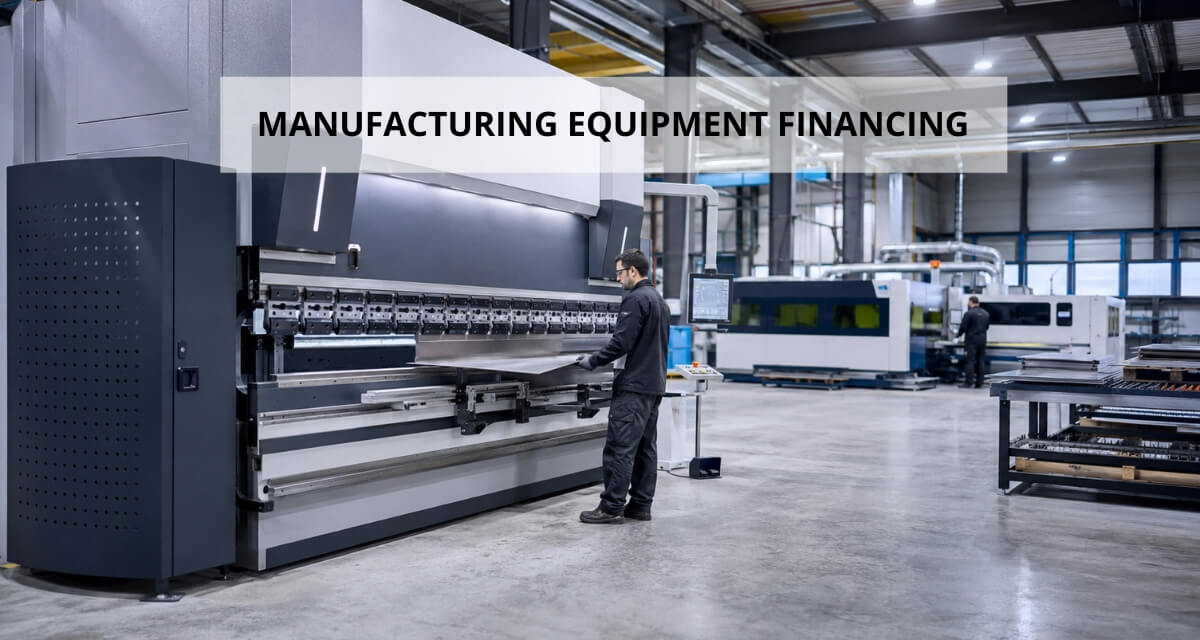
Manufacturing Equipment Financing for Dealers | Dimension Funding

Manufacturing Equipment Financing for Dealers

Manufacturing Equipment Financing for Dealers | Dimension Funding

Manufacturing equipment financing lets a dealer offer a monthly payment alongside the quote instead of leaving a buyer to arrange financing on their own after the sale stalls on price.

Dimension Funding works with dealers selling CNC machines, press brakes, injection molding equipment, robotic assembly cells, and material handling systems, financing terms up to 60 months on standard equipment and total capacity extending past $10 million for larger capital purchases.

That range matters more in manufacturing than in most equipment categories, since a single-machine purchase and a multi-machine production line order can sit at completely different scales. 

How Often Manufacturing Equipment Gets Financed 

The Equipment Leasing & Finance Foundation’s 2024 Horizon Report found that 82% of equipment end-users already use some form of financing to acquire equipment and software, and that of the $2.3 trillion in equipment and software investment tracked in 2023, roughly 58% was financed rather than paid in cash.

Industrial and manufacturing equipment specifically ranks among the top five most-financed asset categories tracked by the Equipment Leasing and Finance Association’s Survey of Equipment Finance Activity, alongside transportation, agriculture, and construction. 

How the Dealer Partnership Works Day to Day

The mechanics are designed to stay out of a dealer’s way rather than add a second job on top of selling machines. A dealer quotes the equipment, the buyer submits an application, and once approved, Dimension Funding pays the dealer the full purchase price directly.

That last detail is more important than it sounds. The dealer isn’t carrying the balance, chasing payments from the buyer over the life of the term, or exposed if the buyer’s business hits a rough stretch two or three years in. Dimension Funding’s equipment vendor financing program absorbs the credit decision and the collection risk. The dealer’s relationship with the buyer stays focused on the machine, the install, and the service relationship that follows.

Getting Paid Without the Paperwork Delay

Applications run electronically, and signatures happen through DocuSign, so a deal that’s otherwise ready to close doesn’t sit waiting on paperwork or a signature that has to travel between offices. 

What Qualifies for Financing

Production Machinery

The financeable list covers most of what a manufacturing equipment dealer sells: CNC machining centers, lathes, milling machines, press brakes, laser cutters, waterjet systems, injection molding equipment, stamping presses, welding and fabrication systems, robotic assembly cells, and conveyor or material-handling systems. Both new and used units qualify under the same program, with the same approval process either way.

Delivery, installation, commissioning, and multi-year maintenance contracts can all be consolidated into one monthly payment alongside the machine itself. 

The Software Layer

Machine sales increasingly arrive with a software component attached: control software on the machine itself, or an update to the buyer’s ERP or manufacturing execution system (MES) so it can communicate with the new equipment. Dealers selling that software alongside the hardware, or partnering with a software vendor on the deal, can fold both into one financed transaction rather than presenting them as separate purchases with separate decisions attached.

Software subscriptions are financeable on their own terms as well. Annual SaaS renewals and multi-year MES or ERP licensing agreements can be converted into fixed monthly payments through Dimension Funding’s ERP financing programs, which is increasingly relevant given how many equipment purchases now arrive bundled with a platform subscription rather than a one-time software license.

The US material handling leasing and financing market is projected to grow from $1.54 billion in 2025 to $3.63 billion by 2031, according to Mordor Intelligence, driven in part by automation adoption and the spread of equipment-as-a-service contracts that lower balance-sheet exposure for smaller manufacturers. 

Approval Thresholds and Timelines Dealers Should Know

  • Equipment only: application-only approval, no financial statements required, up to $250,000.
  • Equipment plus software: the application-only threshold rises to $500,000 for the combined transaction.
  • Larger transactions: a streamlined process remains available up to $750,000; above that, buyers provide basic financials, though the review still moves faster than a conventional bank underwriting cycle.
  • Terms: 12 to 60 months depending on deal size and structure, with total financing capacity extending well past $10 million for large capital equipment purchases.

Most approvals come back within hours, and funding typically follows within 48 hours, sometimes the same day. Dealers can run a prospective deal through Dimension Funding’s payment calculator before a sales call, so they walk in with a realistic monthly figure instead of a rough estimate that might not hold up once the buyer starts asking specifics.

Section 179 and Bonus Depreciation, Layered 

The One Big Beautiful Bill Act permanently restored 100% bonus depreciation for qualifying equipment placed in service after January 19, 2025, per IRS Publication 946. Unlike Section 179, bonus depreciation carries no dollar cap and no business-income limitation, which matters for a shop financing a large order in a lower-income year.


Section 179

Bonus depreciation

2026 limit

$2,560,000, phasing out above $4,090,000

No dollar cap

New or used equipment

Both qualify

Both qualify (must be first use by the buyer)

Income limitation

Limited to business taxable income

None

Typical use

Applied first, gives control over which assets get expensed

Covers remaining basis after Section 179, or anything above the 179 cap

The standard approach is to apply Section 179 first, since it lets a buyer choose which specific machines get expensed, then let bonus depreciation absorb whatever falls outside that cap. As always, the specifics belong with a buyer’s accountant, not the sales floor. 

Ready to Add Financing to the Sales Process

Becoming a vendor partner doesn’t require an in-house finance team or an existing lender relationship to bring to the table. The process starts with a vendor partner application, and Dimension Funding builds the program around how a specific dealer sells: typical transaction size, the credit profile of their buyers, and how fast deals generally need to move. Once that relationship is in place, dealers get marketing materials and sales-team support so financing becomes a standard part of every pitch.

A dealer selling mostly new machines, mostly used, or a mix of both doesn’t need a different program for each. The same application and approval process covers a single CNC mill or a phased production line with a software vendor attached. Contact Dimension Funding to see what that looks like for a specific product line.

Frequently Asked Questions

If a buyer defaults, does the machine come back to the dealer or stay with Dimension Funding? 

It stays with Dimension Funding. The financing agreement, not the original sale, governs what happens to the equipment, so a defaulted machine doesn’t become the dealer’s problem to repossess, resell, or otherwise handle. 

Does bonus depreciation apply the same way to leased equipment as it does to a finance agreement? 

Generally, no. Bonus depreciation applies to equipment the buyer owns, so a true lease, where the leasing company retains ownership, typically doesn’t pass the deduction to the buyer the way a finance agreement does. That’s a meaningful distinction to flag to a buyer weighing a large order against both deductions, since assuming a lease carries the same tax treatment as ownership can lead to a surprise at filing time. 

Can a full production line delivered and installed in phases be financed under one agreement, or only single-machine purchases?

Multi-stage projects qualify. Dimension Funding finances entire project costs, including design, implementation, consulting, staff training, and multi-year maintenance and support contracts, not just a single piece of equipment. For larger automation projects specifically, costs like multi-year support and maintenance can be structured as part of Dimension Funding’s early commencement funding program, so a dealer selling a phased line rollout can present the whole project as one financed transaction rather than a series of separate purchases billed as they occur. 

If the equipment and software come from two different vendors, does that change which application-only threshold applies? 

No. The combined transaction still qualifies under the $500,000 equipment-plus-software threshold regardless of how many vendors are involved, as long as it’s submitted as one deal. A dealer working with a separate software or automation vendor doesn’t need to worry about the vendor count itself changing the underwriting tier. 

What credit profiles can a dealer’s buyers have and still qualify?

Dimension Funding works with most credit profiles, from strong Tier A commercial credit down to marginal credit. A buyer with a thinner credit file isn’t automatically disqualified, which matters for dealers selling to newer shops or businesses in a growth phase. Newer businesses without an established credit history are typically asked to provide a business plan or revenue projections in place of extensive financials, and shops with two or more years of operating history and tax returns on file tend to move through approval faster.

Is zero percent financing available on equipment-only deals, or only when a software vendor is part of the transaction? 

It’s specific to the software layer. Zero percent programs on manufacturing deals are structured around a software or automation vendor covering the arrangement, so an equipment-only purchase with no software component wouldn’t carry the same offer. 

If a multi-year maintenance contract renews before the equipment’s financing term ends, does that need a separate financing agreement? 

Not necessarily. A renewal can typically be added into the existing agreement rather than opened as a new one, since it’s an extension of a cost already built into the original financed transaction rather than a separate purchase. 

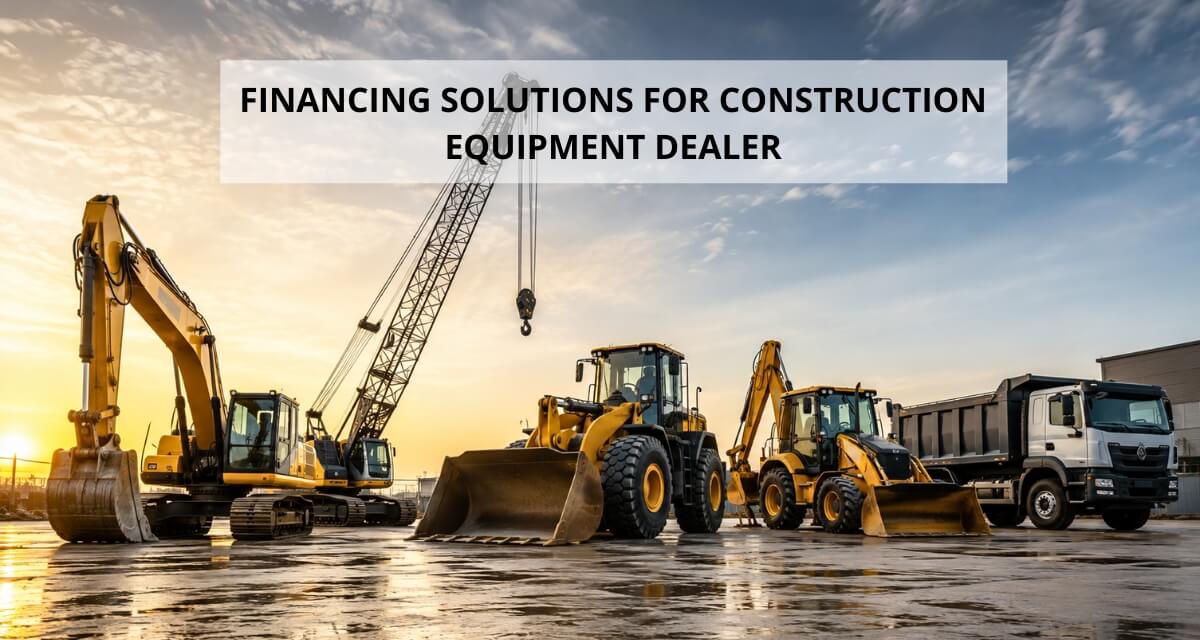
Construction Equipment Financing for Dealers | Dimension Funding

Construction Equipment Financing for Dealers

Construction Equipment Financing for Dealers | Dimension Funding

Construction equipment financing lets a dealer offer a monthly payment instead of a lump-sum price, which matters more in this category than most, given how much capital a contractor already has tied up across active jobs.

Dimension Funding has worked with construction equipment vendors and distributors for over 40 years, financing terms up to 84 months on heavy equipment, well beyond what most other equipment categories carry.

That longer-term window changes what a dealer can offer at the point of sale, which matters given how construction compares to other industries: per the Equipment Leasing & Finance Foundation’s Horizon Report, construction end-users were the most likely of any industry surveyed to use financing, at 85%, ahead of health care at 70% and professional services at 66%.

Who Carries the Paper Once a Deal Is Signed 

Dimension Funding underwrites, funds, and services the agreement directly with the buyer and pays the dealer in full once it’s signed. Regardless of term length, the dealer isn’t waiting on that schedule to get paid, and isn’t the one following up on a late payment down the line. 

A contractor who just won a bid often needs equipment moving within days. Quotes typically get processed within an hour or two, funding is usually available the same day once documentation clears, and electronic paperwork through DocuSign closes out the agreement without an in-person signing.

What Dimension Funding Finances for Construction Equipment Dealers

Dimension Funding finances the full range of construction equipment a dealer typically carries:

  • Excavators, including dragline excavators, from compact to full-size
  • Cranes, both new and used
  • Bulldozers, graders, and pavers
  • Dump trucks, pumper trucks, and backhoes
  • Trenchers, loaders, and compactors
  • Telehandlers and feller bunchers
  • Pile boring machines, pile driving machines, and wheel tractor scrapers

Full Deduction the Year the Equipment Goes to Work 

Per IRS Publication 946, businesses can deduct the full cost of qualifying equipment under Section 179 in the year it’s placed in service, rather than depreciating it over several years. For tax years beginning in 2026, the deduction limit is $2,560,000, with the phase-out threshold beginning at $4,090,000 in total qualifying purchases—both figures adjusted upward from 2025’s $2,500,000 and $4,000,000 levels. The deduction applies whether the machine is purchased outright or financed.

A contractor can take the full write-off the year the equipment goes into service while the actual payments stretch out over the term. The specifics for any one contractor’s tax situation should still come from their accountant, not the sales floor.

The Application-Only Ceiling Is Higher Than $250,000

Dimension Funding’s application-only program, which skips financial statements entirely, runs in tiers rather than a single cutoff: 

  • Up to $250,000 for equipment financing alone
  • Up to $500,000 when software or fleet technology is bundled into the purchase
  • Up to $750,000 in application-only financing overall, with financial statements required above that threshold

That $750,000 ceiling covers a meaningful share of mid-size fleet purchases without requiring a contractor to produce financials. It’s easy to mistake $250,000 for the hard limit.

For deals that exceed even that tier, Dimension Funding provides financing up to $10 million or more, with financial statements required to support the underwriting.

New vs. Used Equipment on the Dealer’s Lot

New and used equipment both qualify under the same financing structure. Mordor Intelligence notes that the used construction equipment market is estimated at $132.67 billion in 2026, growing to a projected $174.28 billion by 2031, making it a large enough secondary market that financing pre-owned machinery is routine underwriting.

Service records and a clean maintenance history carry more weight on used equipment. Attachments, delivery, setup, and third-party vendor costs can all go into the same agreement as the machine itself, and a buyer who already knows they’ll want an attachment added later is better off bundling it into the original deal than opening a separate financing conversation down the road.

How Equipment Age Affects Financing Eligibility

Dimension Funding’s age caps on used equipment commonly run 10 to 15 years by equipment type, though older assets can still qualify when they carry strong secondary market demand and documented maintenance histories. Construction machinery fits that second group more often than most equipment categories.

A well-maintained older excavator or crane usually qualifies the same as a newer one, based on service records and hours rather than the year on the title. 

Financing That Starts Before the First Invoice Clears

Dimension Funding’s construction equipment financing program includes a No Payments for 90 Days option on approved credit for new financing. A contractor can take delivery, put the machine to work on a job, and not owe a first payment until roughly the point a client invoice for that job would typically clear.

This is worth raising specifically with a buyer who’s financing equipment against a specific contract or bid, since it lines the payment schedule up with when the job starts generating revenue, rather than starting the clock the day the equipment ships.

What Dealers Get as a Vendor Partner

Vendor partners get a consistent point of contact for underwriting rather than routing each deal through a different desk. That matters more here than in higher-volume equipment categories: a multi-machine fleet order, or anything crossing the $750,000 application-only ceiling, benefits from one person already familiar with the account handling it start to finish rather than starting the conversation over each time.

Much of Dimension Funding’s sales team has been with the company for over 20 years, and the company carries an A+ rating from the Better Business Bureau. Dimension Funding has been financing construction equipment since 1978. Contact Dimension Funding to start onboarding as a vendor partner.

Frequently Asked Questions

If a buyer is trading in an older machine as part of the deal, how does that affect the financing?

A trade-in typically reduces the amount that needs to be financed, since its value gets applied against the purchase price before the agreement is structured. It’s worth confirming with the financing partner early in the process, since the trade-in usually needs to be appraised and settled before the new agreement is finalized, not worked out after the fact. A few things tend to affect how much the trade-in nets the buyer:

  • Documented service history on the trade-in machine
  • Hours or mileage relative to comparable used listings
  • Whether the trade-in is the same equipment category or something the dealer has to move separately

Can a manufacturer rebate or dealer incentive be used alongside financing, or does one cancel out the other?

The two aren’t mutually exclusive. A rebate or incentive generally reduces the purchase price up front, and the financed amount is based on whatever the price comes out to after that reduction. A dealer offering both should make sure the rebate gets applied before the financing paperwork is drawn up, so the buyer isn’t financing a higher amount than necessary. Some manufacturer incentive programs also have their own timing windows, so it’s worth checking whether the rebate needs to be locked in before the financing application goes through rather than after.

Does a dealer with multiple locations need a separate vendor agreement for each branch?

Not necessarily. A vendor partnership is typically set up at the company level rather than per location, so equipment moving through any of a dealer’s branches can usually be financed under the same arrangement. Worth confirming directly if a dealer operates under different business names or ownership structures at different locations, since that can change how the agreement is structured. 

Can equipment that’s been used as a rental or demo unit still qualify for financing when it’s later sold as used?

Yes, and it often has an easier time clearing underwriting than equipment coming from a private sale, since rental fleets tend to keep better records. A few things that typically strengthen an application on a former rental or demo unit:

  • Full service and maintenance logs from the rental fleet
  • Total hours of use, since rental equipment often runs harder than owner-operated machines
  • Confirmation of the original in-service date, since a demo unit’s age isn’t always obvious from a title alone

If a contractor is based in a different state than the dealer, does that complicate the financing?

Not typically. Financing is handled between the buyer and the finance company directly, so the buyer’s location doesn’t need to match the dealer’s. What matters more is where the equipment is being put to work and registered, which is worth confirming case by case for larger vehicles or machinery subject to state-specific registration rules. This comes up often with dealers who sell to contractors bidding on out-of-state infrastructure projects, where the equipment may end up registered somewhere other than the buyer’s home base entirely.

Is zero percent financing an option for construction equipment, or is that limited to software?

It’s not limited to software. Dimension Funding’s vendor financing program extends the same zero percent option to equipment vendors, typically structured per deal or per promotion rather than as a blanket policy, which lets a dealer apply it to specific machines or price points instead of every transaction that comes through. 

Does a newer construction business qualify, or does Dimension Funding require an established operating history? 

Two years in business is the general preference, but strong personal or business credit can substitute for a shorter track record. A newer contractor shouldn’t assume they’re automatically excluded from applying. 

Best Equipment Financing: Top Vendor Programs for Dealers

best equipment financing

Best Equipment Financing: Top Vendor Programs for Dealers

Best equipment financing, from a dealer’s perspective, is not the loan or lease itself. It is a vendor program that clears customers fast, covers everything tied to the sale, and pays the dealer in full without a collections cycle. 

Dimension Funding has run these programs for equipment and software sellers since 1978, and its equipment vendor program clears most applicants up to $250,000 without financial statements.

Above that threshold, expect a tax return or financial statement in the file, which is usually where turnaround stretches from hours to days. The program covers the equipment, delivery, installation, training, and outside vendor costs in one approval, structured as a loan or a lease. 

Dealers weighing vendor financing options are really comparing speed, paperwork, coverage, and sales support.

What the Best Vendor Financing Programs Have in Common

Dealers evaluating a finance partner tend to compare them the way they compare a distributor, on speed, coverage, and how much of the sales process the partner takes off their plate. A partner that asks for two years of financial statements on a routine transaction is not solving the dealer’s real problem: closing the sale before the buyer calls a competitor.

A vendor finance program is a partnership between a manufacturer, dealer, or distributor and a lender to offer financing at the point of sale. The vendor closes faster, and the lender gets a steady stream of originated business, according to equipment finance technology firm Uptiq. 

The most effective vendor programs usually have these five things in common:

  • Fast approvals, decisions in hours, not days, for standard deals
  • A clear “application-only” threshold so simple deals don’t get stuck in paperwork
  • Full-scope coverage that includes delivery, installation, and training costs
  • Flexible options that let you offer both loans and leases in one application
  • Ready-to-use marketing materials and calculators your sales team can use mid-conversation

Why Dealers Are Building Financing Into Every Quote

Forrester Research found that businesses offering point of sale financing saw a 32 percent increase in sales and a 75 percent increase in average order value, a pattern often cited for equipment sellers who put financing in front of the buyer at the moment of decision, according to Forbes. A buyer who has to leave the lot to sort out financing on their own does not always come back.

The finance industry’s own numbers back this up. Captive and vendor focused finance companies grew new business volume 5.9 percent in 2024, while bank lenders saw new business volume decline 1.3 percent, according to the Equipment Leasing and Finance Association’s 2025 Survey of Equipment Finance Activity. Independent finance companies grew 17.7 percent over the same period, faster than either banks or captives.

Application Only Approval Changes the Sales Conversation

Dimension Funding’s equipment vendor program clears qualified applicants up to $250,000 without financial statements, and software vendor programs extend that same threshold to $500,000. Most approvals come back within a few hours of a submitted quote, and electronic applications paired with DocuSign let a buyer sign from a phone before leaving the showroom or job site.

That speed changes what happens next. A buyer comparing two dealers will often pick the one who can answer “how do I pay for this” on the spot, not the one who says to call a bank and follow up next week.

What a Strong Vendor Program Covers Beyond the Equipment

Structuring the Deal as a Loan or a Lease

On paper, equipment financing sounds like it only covers the machine. In practice, a strong vendor program also picks up freight, rigging, on-site installation, operator training, and third-party integration work, all inside the same approval and the same monthly payment. A buyer paying installation out of pocket while financing only the invoice price is doing math on two separate bills instead of one.

Terms typically run 12 to 60 months, and the same application can be structured as a fixed-term loan or an equipment lease. A lease often suits a buyer who would rather expense the payment than carry the asset on the balance sheet; a loan puts both the asset and the obligation on the books from day one. That choice is often what separates a program a dealer’s team uses regularly from one that sits unused in a sales folder.

Marketing and Sales Support Behind the Financing

A financing partner that only processes paperwork leaves the sales team to explain and sell the financing itself, which rarely happens with any consistency. Dimension Funding’s vendor partner toolkit includes co-branded literature, a financing widget that adds a payment calculator and online credit application to the dealer’s own website, and material reps can hand a buyer mid conversation.

A rep who can pull up a payment estimate on a tablet mid-pitch is having a different conversation than one who promises someone will call back tomorrow.

Pairing Section 179 With Deferred Payment Offers

The 2025 IRS Section 179 deduction allows businesses to write off up to $2,500,000 in qualifying equipment and software purchases in the year they are placed in service, with a $4,000,000 spending cap before the deduction phases out, per Dimension Funding’s Section 179 breakdown. This is general information, not legal or tax advice, and buyers should confirm details with their own tax professional.

Pairing that deduction with a 90 day deferred payment structure, so the buyer installs and starts using the equipment before the first payment comes due, gives dealers a concrete reason to close before year end instead of waiting on next year’s budget.

Setting Up a Vendor Financing Program at Your Dealership

None of this works if the sales team does not use it, which is why Dimension Funding pairs its vendor programs with an account team that tends to stay in place. 

Much of its sales staff has been with the company 20 years or more, so the person handling your account this year is often the same one five years from now. Becoming a vendor partner does not require an existing relationship or a minimum transaction volume to start.

If your dealership is quoting equipment or software and losing deals to the “how do I pay for this” objection, applying to become a vendor partner is the direct next step. The team can also walk you through the payment calculator your sales staff would use with prospects, and you can reach Dimension Funding at 1.800.755.0585 or Sales@DimensionFunding.com.

Frequently Asked Questions

What is a vendor financing program for equipment dealers?

A vendor financing program is an arrangement between an equipment or software seller and a finance company that lets the seller offer financing directly at the point of sale. The finance partner handles underwriting and funding, so the dealer keeps control of the sales conversation instead of sending the buyer off to arrange financing on their own.

How fast can a customer get approved through a dealer’s financing program?

For deals under a program’s application-only threshold, approval can come back within a few hours of submitting a quote. Once a transaction requires financial statements, the review typically takes a few business days instead of a few hours.

Does the financing cover delivery and installation, or just the equipment cost?

Yes, a program built for the full transaction finances freight, installation, and training alongside the equipment itself. For software purchases, that same structure typically rolls implementation work and license fees into a single payment.

Can a dealer offer both leases and loans through the same program?

Most vendor programs let the buyer choose between a fixed-term loan or an equipment lease within the same application. A lease suits a buyer who wants the payment to run through the income statement, while a loan puts the asset and the debt directly on the books.

What is the difference between a captive finance company and a third party vendor financing partner?

A captive finance company is a lender wholly owned by the equipment manufacturer, built to finance only that manufacturer’s products. A third party partner works across multiple dealers and equipment categories, which often means more flexibility in how a program is structured and a faster path to onboarding for dealers outside a manufacturer’s in-house finance arm.

Does becoming a vendor partner cost the dealer anything to join?

Becoming a vendor partner does not carry an upfront cost for the dealer in a standard program. The finance partner earns through the transactions it originates, while the dealer gets faster closes and marketing support at no separate charge.

How does the Section 179 deduction fit into a vendor financing pitch?

The 2025 Section 179 deduction lets businesses write off up to $2,500,000 in qualifying equipment and software purchases in the year of purchase. Raising that figure alongside a financing quote gives a buyer a reason to close before their fiscal year ends rather than pushing the purchase into next year’s budget, though they should confirm specifics with a tax professional.

Finance Commercial Equipment: Smart Strategies for Growing Companies

finance commercial equipment (1)

Finance Commercial Equipment: Smart Strategies for Growing Companies

A company lands a contract that finally justifies the new equipment it has needed for a year, then finds out the bank loan process takes weeks and calls for years of financial statements it would rather not hand over. 

By the time approval comes through, the window to actually use that contract to grow may have narrowed. This is the exact moment more companies choose to finance commercial equipment instead of waiting on a traditional bank loan.

Why Growing Companies Finance Commercial Equipment Instead of Paying Cash

Paying cash for a forklift, a commercial oven, or a fleet of service vehicles feels simple, but it ties up money a growing company usually needs somewhere else, payroll, inventory, marketing, or the next opportunity that shows up before the current one is even finished paying for itself.

Financing spreads that cost into a single fixed monthly payment instead of one large outlay. That keeps cash available for the parts of the business that do not have a financing option, while the equipment itself starts generating revenue right away. For a company adding capacity to handle growth, that timing matters more than the interest rate.

The companies that get the most out of this approach tend to treat equipment financing as a standing part of how they grow, not a one-time fix for a single purchase. 

Every time capacity becomes the limiting factor, whether that is a second delivery vehicle, another piece of production equipment, or a system upgrade, the same question comes up: save up and buy it outright later, or put it to work now while the payment stays predictable and cash keeps moving.

Financing vs. Leasing: Which Fits Your Strategy

Both options get equipment onto your floor without draining your bank account, but they work differently depending on what the business needs most.

Equipment Financing (Loans)

With an equipment loan, the business owns the equipment from day one and builds equity in it as the loan gets paid down. Payments are fixed, terms commonly run up to 60 months, and once the loan is paid off, the equipment is fully owned with no further payments or lease-end decisions to make.

Equipment Leasing

A lease can be structured a couple of different ways, and the structure changes what it does for the business. A capital lease looks and functions much like a loan, letting the business claim depreciation and take advantage of the same tax treatment as ownership. 

An operating lease usually does not appear as debt on the balance sheet, which matters for a company watching its debt to credit ratio, though it also affects the tax benefits available.

Because the right structure depends on a company’s specific financials and goals, this is worth a conversation with an accountant or tax advisor before deciding, not just a rate comparison.

Why Application-Only Financing Speeds Everything Up

The biggest practical difference between a bank and an equipment finance company is usually the paperwork. Application-only financing up to $250,000 does not require financial statements, tax returns, or the kind of underwriting package a bank typically wants before approving a commercial loan.

That difference shows up in speed. Approvals often come back within 24 hours, and funding is commonly available within 48 hours of approval. For a company that needs equipment running before a busy season starts or a new contract kicks off, that turnaround can matter as much as the payment amount itself.

Using Section 179 to Lower the Real Cost

Financed equipment is not just easier to acquire, it can also reduce what a company owes in taxes for the year it goes into service. Under Section 179 of the IRS code, businesses can elect to deduct the full cost of qualifying equipment and off-the-shelf software in the year it is purchased, rather than depreciating it slowly over several years.

For 2025, the deduction limit sits at $2,500,000, with a $4,000,000 spending cap before the available deduction starts phasing out dollar for dollar. Bonus depreciation, generally applied once that spending cap is reached, is set at 100 percent for the year. 

Both new and used equipment can qualify, as long as it is used for business more than half the time and placed in service within the tax year. These figures are adjusted for inflation periodically, so it is worth confirming the current year’s numbers before assuming last year’s limits still apply.

Financing does not disqualify equipment from this treatment. In many cases a business can finance the purchase, keep its cash on hand, and still take the full deduction in the same year, which is part of why financing and Section 179 tend to get mentioned together. 

Because the details depend on a company’s specific tax situation, this is worth confirming with an accountant before filing, not assumed from a blog post. 

Dimension Funding keeps an updated breakdown of the current year’s Section 179 deduction limits for anyone comparing the numbers before a purchase.

What It Takes to Qualify

Growing companies often assume equipment financing requires the same credit profile as a bank loan, which is not usually the case. Approval is based more on the overall picture, time in business, revenue trends, and how the equipment itself supports the company’s plans, than on a single credit score cutoff.

Credit profiles ranging from strong to marginal are commonly considered rather than automatically declined, and a newer or less established company is not necessarily locked out the way it might be with a traditional bank. 

That does not mean every applicant is approved for every amount, but it does mean a less than perfect credit history is not automatically disqualifying the way it often is elsewhere.

Common Mistakes Growing Companies Make When Financing Equipment

A few patterns show up often enough to be worth flagging before signing anything.

Waiting until cash is already tight to start the financing conversation is one of the most common. Approval and funding take some amount of time even at their fastest, so starting the process before the equipment is needed, not after, avoids a scramble.

Matching the loan or lease term to how long the equipment will actually stay useful is another. A term that runs longer than the equipment’s useful life means paying for something the business has already replaced.

Overlooking soft costs is a third. Delivery, installation, and ongoing maintenance are often left out of a budget built around the sticker price of the equipment alone, when in most cases those costs can be rolled into the financing itself instead of paid separately out of pocket.

Financing Commercial Equipment with Dimension Funding

Dimension Funding has financed equipment for small and mid-sized businesses since 1978, working with almost any equipment vendor a company chooses rather than a fixed list of approved suppliers.

Approvals up to $250,000 are available without financial statements, and most decisions come back quickly, with funding often available within 48 hours of approval. Terms extend up to 60 months, and both loan and lease structures are available depending on which fits a company’s tax and balance sheet goals better. Financing over $250,000 requires financial statements but still moves through a streamlined process rather than a traditional bank underwriting timeline.

Delivery, installation, and maintenance costs can be rolled into the financed amount, and the application itself is a short electronic form rather than a stack of paperwork, with most agreements signed and finalized without a single trip to a bank branch.

Equipment vendors who want to offer financing directly to their own customers can also look into Dimension Funding’s vendor partner programs, which let a sales team answer the payment question on the spot instead of losing a deal to a slow financing decision.

Frequently Asked Questions About Financing Commercial Equipment

Is it better to finance or lease commercial equipment?

It depends on the goal. Financing builds equity toward ownership from day one, while a lease, depending on how it is structured, can either mirror ownership for tax purposes or keep the equipment off the balance sheet. An accountant can weigh in on which fits a specific company’s situation.

How much financing is available without financial statements?

Approvals up to $250,000 don’t require financial statements. Financing above that amount requires financials but still moves through a streamlined process rather than a traditional bank underwriting timeline.

How fast can commercial equipment financing get approved?

Approvals often come back within 24 hours, and funding is commonly available within 48 hours of approval, much faster than the multi-week process typical of a traditional bank loan.

Can financed equipment still qualify for the Section 179 tax deduction?

In many cases, yes. Financing a purchase does not disqualify it from Section 179 treatment, so a business can often keep its cash on hand and still take the deduction in the year the equipment is placed in service. The specifics depend on the company’s tax situation, so this is worth confirming with an accountant.

Does a company need strong credit to finance commercial equipment?

Not necessarily. Approval tends to weigh the overall picture, time in business, revenue trends, and how the equipment supports the company’s plans, rather than a single credit score cutoff, so credit profiles from strong to marginal are commonly considered.

What does Dimension Funding’s commercial equipment financing include?

Delivery, installation, and maintenance costs can be rolled into the financed amount, and equipment can come from almost any vendor a business chooses rather than a fixed list of approved suppliers.

If growth is being held back by equipment a company cannot justify paying cash for, use the payment calculator to see what a monthly payment could look like, or start a financing application to get a quote, usually within a few hours.

Equipment Financing Rates in 2026: What Interest Rate to Expect?

equipment financing rates

Equipment Financing Rates in 2026: What Interest Rate to Expect?

If you’ve been shopping for equipment financing, you’ve probably noticed that no two lenders quote the same number. 

One bank comes back at 7 percent, an online lender quotes 18 percent, and a leasing company skips the rate conversation entirely and just hands you a fixed monthly payment. That spread leaves a lot of business owners stuck on one question: what rate should you actually expect to pay in 2026?

There’s no single answer, and anyone who gives you a flat number without asking about your business first is skipping steps. Your rate depends on your credit profile, how long you’ve been operating, the type of equipment involved, and which kind of lender you approach. 

Once you know how those pieces fit together, you can sit down for a financing conversation and tell whether the offer in front of you is actually fair.

What Actually Determines Your Equipment Financing Rate

A lender isn’t guessing when it hands you a number. A handful of factors do most of the work.

Your credit history

Personal and business credit is usually the first thing an underwriter looks at. Strong credit doesn’t just improve your odds of approval, it unlocks the lower end of the rate range. Businesses with marginal or limited credit still get approved often, just at a higher rate that offsets the lender’s added risk.

Time in business and revenue

A company with several years of steady revenue reads as a safer bet than a brand new operation, and the rate reflects that. Newer businesses can still qualify, but should expect a few extra points added to the quote until they build a track record.

Equipment type and age

Financing for new equipment with strong resale value, like a delivery vehicle or a piece of medical equipment, tends to price better than financing for older or specialized equipment that would be hard to resell if a deal fell apart.

Loan term and amount

Shorter terms generally carry lower rates. Longer terms spread the payment out but can add cost over the life of the agreement. The financing amount plays a role too. Larger requests sometimes earn better pricing, though they may call for more documentation up front.

Down payment

Putting money down reduces the lender’s exposure and can shave points off your rate. Many equipment financing programs don’t require one at all, which is part of the appeal, but a modest down payment can still improve your terms if your budget allows for it.

Equipment Financing Rates in 2026: What the Ranges Look Like

Rates move with the broader economy, but the order between lender types tends to hold steady from year to year.

Banks and credit unions typically offer the most competitive pricing on commercial equipment financing, often between 6 and 12 percent for borrowers with strong credit and an established history. The tradeoff is a slower process, more paperwork, and stricter approval standards.

SBA backed programs can push rates even lower, sometimes into the 5 to 10 percent range, but they come with tighter credit requirements and a longer timeline that doesn’t always fit a business that needs equipment running this month.

Alternative and direct lenders move faster and work with a wider range of credit profiles. Rates through these channels commonly fall between 10 and 25 percent, depending on the strength of the borrower and the specifics of the deal.

Put together, a well qualified borrower using a bank, credit union, or SBA program can expect a rate around 6 to 14 percent. A business with a shorter operating history or less than ideal credit should expect a rate toward the higher end of the overall range, sometimes above 20 percent, particularly through faster alternative channels.

How the 2026 Rate Environment Factors In

The Federal Reserve has held its benchmark rate steady through the first half of 2026, and the prime rate lenders use as a starting point has followed along. That stability is good for planning. A quote you get this quarter probably won’t look dramatically different three months from now, so there’s less reason to rush a decision purely out of fear that rates will jump overnight.

That doesn’t mean every lender is standing still. Underwriting standards, seasonal promotions, and how badly a particular lender wants new business all move the number you get quoted, often more than the benchmark rate itself does. Comparing more than one offer still matters, even when the broader rate environment is calm.

Fixed Rate Versus a Rate Tied to the Market

Most equipment financing and leasing arrangements use a fixed rate for the full term, so your payment stays the same from the first month to the last. That’s different from a variable rate credit line, where payments move as the market shifts.

A fixed rate gives you a number you can actually plan around for budgeting and cash flow. That predictability is why it’s the standard structure for equipment financing, not a feature you have to ask for.

Loans vs Leases: Does the Rate Work the Same Way?

Equipment loans and equipment leases get compared using different math. A loan has a straightforward interest rate attached to it. 

A lease is often quoted as a payment factor or bundled into one monthly number that already reflects the cost of financing, so a lease payment and a loan rate aren’t always apples to apples on paper.

That doesn’t make one automatically cheaper than the other. A loan builds equity in the equipment from day one and tends to make sense if you plan to keep it long term. 

A lease can lower the monthly payment and may bundle in maintenance or upgrade options, which matters more for equipment that ages out fast, like certain IT hardware. The right structure depends on how long you plan to actually use the equipment, not just which number looks smaller.

How to Position Your Business for a Better Rate

Clean up your credit before you apply, if you have time. Even a modest score improvement can move you into a better pricing tier.

Have your basic financials organized, even for application only programs. A clear answer to a lender’s questions speeds up approval and supports a stronger offer.

Think about term length. A shorter term often earns a better rate, but the payment still needs to fit comfortably into your monthly cash flow.

Get more than one quote. Shopping for equipment financing typically doesn’t affect your credit the way shopping for many consumer loans does, and a second quote gives you real leverage in the conversation.

Why the Rate Isn’t the Only Number to Watch

The interest rate is only part of the cost picture. Through Dimension Funding, businesses can get application only financing up to 250,000 dollars for equipment and up to 500,000 dollars for software, meaning no financial statements are required to get an answer. 

Financing can cover 100 percent of the project, including delivery, installation, and maintenance, so those costs don’t come out of your pocket separately. Terms run from 12 to 60 months, giving you room to match the payment to how long the equipment will actually generate revenue for your business.

Most equipment purchases also qualify for a Section 179 write off, which can lower the after tax cost of financing below what the sticker rate suggests. Run the numbers with your accountant before you finalize a purchase, and use the payment calculator to see what a given rate actually means for your monthly payment.

A slightly higher rate paired with same day approval, a longer term, and maintenance built into the payment can cost less in practice than a lower rate that takes weeks to close and leaves you covering installation on your own.

Frequently Asked Questions

What is a good interest rate for equipment financing in 2026?

Anything in the 6 to 14 percent range is strong for a well qualified borrower going through a bank, credit union, or SBA program right now. Rates above 20 percent aren’t unusual for businesses with a shorter operating history or credit challenges, especially through faster alternative lenders.

Can you get equipment financing with bad credit?

Yes. Most equipment financing programs work with a wide range of credit profiles, including marginal or limited credit. The tradeoff is usually a higher rate rather than an outright decline, since the higher rate offsets the lender’s added risk.

Do you need a down payment for equipment financing?

Not always. Many programs are structured without a large down payment, which helps preserve working capital. Putting money down is optional in most cases, though it can improve your rate if your budget allows for it.

Is equipment financing tax deductible?

The equipment itself may qualify for a Section 179 write off, which can let you deduct a significant portion of the purchase in the year you buy it instead of depreciating it over time. Talk to your accountant about how this applies to your specific purchase and financing structure.

How fast can you get approved for equipment financing?

Approvals are often issued within a few hours for application only programs, with funding arriving the same day or within 48 hours. Larger financing amounts that require full financials take a bit longer, but still move faster than most traditional bank loans.

Does shopping for equipment financing hurt your credit?

Generally, no. Getting quotes from multiple equipment lenders typically doesn’t affect your credit the way shopping for personal loans or credit cards can, so comparing more than one offer before you commit is a reasonable thing to do.

Getting Your Actual Rate Quote

Every number in this article is a range. The only way to know what your business will actually pay is to apply and let a lender underwrite your specific credit, revenue, and equipment.

Dimension Funding has been financing equipment and software for small and medium sized businesses since 1978, working with almost all credit types across industries including construction, medical, restaurant, brewery, and IT technology equipment. Approvals are typically issued within a few hours, with funding often arriving the same day or within 48 hours.

If you want a clear answer on what rate and payment your business qualifies for, request a quick financing quote or call 1.800.755.0585 to talk through your options with a financing expert.

Tow Truck Financing: Fund Flatbeds, Wreckers & Recovery Vehicles

Tow Truck Financing: Fund Flatbeds, Wreckers & Recovery Vehicles

Tow Truck Financing: Fund Flatbeds, Wreckers & Recovery Vehicles

Tow trucks are among the most expensive commercial vehicles a small business can purchase — and one of the most reliably utilized. An estimated 55,000 vehicles are towed daily across the United States, according to lookupaplate.com’s towing industry data, supported by approximately 88 million roadside assistance calls annually. The U.S. automobile towing industry generated $11.3 billion in revenue in 2025, according to IBISWorld, across approximately 39,000 businesses — most of them small, independent operators.

Dimension Funding has provided commercial equipment financing for over 40 years, working with towing operators, recovery businesses, and transportation companies across the country. With same-day approvals, an A+ BBB rating, and application-only financing up to $250,000, Dimension Funding offers a direct path to the equipment your operation needs.

What Tow Trucks Cost in 2026

Tow truck pricing spans a wider range than almost any other commercial vehicle category — from entry-level used units to seven-figure heavy rotators.

New light-duty flatbeds (rollbacks) run $125,000 to $175,000; late-model used units fall between $35,000 and $120,000, per Heavy Equipment Appraisal’s 2026 pricing guide. Medium-duty wreckers run $190,000 to $275,000 new.

Heavy-duty and specialty equipment

Heavy-duty integrated wreckers start around $450,000 for a standard 50-ton unit, with specialized rotators reaching $750,000 to $1 million or more. These assets represent a significant capital commitment — and financing is almost universally how operators acquire them. The global towing equipment market was valued at $2.45 billion in 2022 and is projected to reach $3.72 billion by 2030, reflecting sustained demand for specialized recovery equipment.

Flatbed vs. Wrecker vs. Heavy-Duty: How Truck Type Affects Financing

The type of tow truck you’re financing affects loan amounts, terms, and lender appetite significantly.

Flatbeds are the most financeable entry point — lower cost, broad secondary market demand, and strong collateral value. They serve the widest range of towing jobs and appeal to operators building a first truck or expanding a light-duty fleet. Wreckers carry higher price tags and typically require more business history or stronger credit at comparable terms.

Heavy-duty and specialty equipment

Heavy-duty wreckers and rotators are a different underwriting environment entirely. Lenders financing $500,000+ equipment require stronger documentation — financial statements, revenue history, and evidence of contracts that justify the asset’s utilization. For most operators entering heavy-duty recovery, the financing conversation starts with establishing a track record on lighter equipment first.

Financing Options for Towing Operators

The right structure depends on your equipment type, credit profile, and whether you’re starting out or scaling an existing operation.

Equipment financing

Equipment financing is the most direct and commonly used path for tow truck acquisition. The truck itself serves as collateral, which improves approval accessibility compared to unsecured business lending — particularly relevant for operators with limited business history. Dimension Funding offers terms up to 60 months, 100% financing on qualifying transactions, and application-only decisions up to $250,000 with no financial statements required.

SBA loans

SBA loan programs — particularly the 7(a) — are an option for established towing businesses needing larger financing amounts or seeking longer repayment terms. SBA approval involves more documentation and a longer timeline than equipment-specific financing, but can support larger fleet buildouts or multi-truck acquisitions for qualifying operators.

Working capital loans

For operators bridging cash flow between tow jobs, insurance reimbursements, or impound billing cycles, a working capital loan provides short-term flexibility. Dimension Funding offers terms up to 24 months with daily, weekly, or monthly repayment options — particularly useful for managing gaps between service calls and insurance payments.

What Lenders Look at for Tow Truck Applications

Towing is a service-based business where revenue consistency matters as much as credit score.

Insurance and motor club contracts are among the strongest signals a tow truck application can carry. Documented AAA, Agero, or direct insurance dispatch agreements demonstrate predictable, recurring revenue that spot-call operations can’t match. Municipal or police impound contracts carry similar weight.

Time in business and credit profile

According to the Federal Reserve’s 2025 Small Business Credit Survey, businesses under two years old had a full-funding rate of 28% compared to 57% for businesses with ten or more years of history. The truck as collateral reduces this gap for equipment-secured loans. Operators with strong personal credit, a clear service area, and documented call volume or contract relationships are in the best startup position.

Down payments

Down payment expectations depend on credit profile, equipment type, and business history. Established operators with strong credit may qualify for low or no down payment on qualifying transactions. Newer operators should budget 10–20% down, and heavier specialty equipment — medium and heavy-duty wreckers — may require more given the larger loan amounts involved.

How Tow Truck Businesses Generate Revenue

Understanding the revenue model is essential before committing to a monthly loan payment — and lenders assess it too.

Per-tow fees vary by service type, distance, and local market. Roadside assistance calls (lockouts, battery jumps, tire changes) resolved without a tow are quicker volume but lower ticket. Accident recovery, motor club dispatches, and private property impounds generate higher per-job revenue and often involve insurance billing. Storage fees from impounded vehicles are a significant revenue stream for operators with yard capacity.

The towing segment accounts for 32.2% of the global roadside assistance market — the largest single service category — according to Grand View Research, which values the overall market at $26.58 billion in 2024 and projects it to reach $35.36 billion by 2030. Towing isn’t a peripheral service in roadside assistance — it’s the core revenue driver.

Revenue consistency by contract type

Spot-market towing is more volatile than contract-based work. Operators with motor club agreements, insurance company dispatch relationships, or municipal contracts have more predictable monthly income — and that predictability directly affects how lenders assess repayment capacity. Building contract revenue before financing additional equipment is a sound strategy for both business stability and financing terms.

Tax Benefits Worth Knowing Before You Sign

Financing a tow truck opens up meaningful first-year write-offs that can materially reduce the net cost of acquisition.

Section 179 allows businesses to deduct the full purchase price of qualifying equipment placed in service during the tax year — up to $2,560,000 for 2026 per IRS Publication 946. On a $150,000 flatbed financed over 60 months, a business in a 35% tax bracket could cut its first-year tax bill by $52,500 while spreading the actual cash outlay over time. Used equipment new to your business also qualifies under the One Big Beautiful Bill Act of 2025’s restored 100% bonus depreciation. Confirm eligibility with a tax advisor.

Scaling a Tow Truck Fleet

A single flatbed generates revenue per job but limits how many simultaneous calls you can handle. Adding a second truck expands coverage area, enables parallel dispatching, and opens access to motor club or insurance contracts that often require minimum fleet capacity. The most common mistake is adding a truck before the first is generating consistent net income.

Dimension Funding can finance single units or multiple trucks, depending on deal size. Fleet transactions above $250,000 will typically require financial statements. Establishing clean payment history on the first unit before expanding puts subsequent applications in a materially stronger position.

Financing Your Tow Truck with Dimension Funding

Dimension Funding finances light-duty flatbeds, medium-duty wreckers, heavy-duty recovery vehicles, and specialty equipment for towing operators across the country. Application-only financing is available up to $250,000 with no financial statements required, and most credit types are accepted — including first-time operators and applicants declined by traditional banks.

Contact Dimension Funding to discuss financing options based on your specific equipment, business profile, and timeline — same-day decisions are available on qualifying transactions.

Frequently Asked Questions

How much does it cost to finance a flatbed tow truck? 

New light-duty flatbeds typically run $125,000 to $175,000; late-model used units generally range from $35,000 to $120,000. The monthly payment depends on loan amount, term, and down payment. Dimension Funding offers terms up to 60 months with application-only financing up to $250,000 — no financial statements required for qualifying transactions.

Can I finance a tow truck as a startup with no business history? 

Yes. Equipment financing is generally more accessible for startups than unsecured lending because the truck reduces lender risk as collateral. Operators with strong personal credit and documented towing experience are in the best position. Having a motor club or insurance dispatch agreement — even a pending one — significantly strengthens a startup application.

What types of tow trucks does Dimension Funding finance? 

Dimension Funding finances light-duty flatbeds (rollbacks), medium-duty wreckers, wheel-lift units, heavy-duty recovery vehicles, and specialty towing equipment for operators across all business sizes and credit profiles.

Do motor club or insurance contracts help with financing approval? 

Yes, significantly. Documented dispatch contracts with motor clubs (AAA, Agero, etc.) or direct insurance company agreements demonstrate predictable, recurring revenue — which lenders view favorably when assessing repayment capacity. Operators with these contracts in place are in a materially stronger approval position than those relying entirely on spot-market calls.

Can I write off a financed tow truck on my taxes? 

Yes. Section 179 allows businesses to deduct the full purchase price of qualifying equipment placed in service during the tax year — up to $2,560,000 for 2026 per IRS Publication 946. The One Big Beautiful Bill Act of 2025 also restored 100% bonus depreciation for qualifying property placed in service after January 19, 2025, including used equipment new to your business. Consult a tax advisor to confirm eligibility for your specific situation.

How is tow truck financing different from financing other commercial trucks? 

Tow trucks are specialty vehicles with unique body configurations, hydraulic systems, and equipment specs — and lenders assess them as such. The underwriting emphasis is on the operator’s service area demand, contract relationships, and revenue model rather than freight lane history. Heavy-duty and specialty rotators involve larger loan amounts and typically require financial documentation regardless of the application-only threshold. Light-duty flatbeds generally finance more like standard commercial equipment.

What hidden costs should I budget for beyond the loan payment? 

Towing insurance is one of the largest fixed costs — and new authorities typically pay significantly more than established operators. Annual maintenance per truck can run $7,000 to $12,000 under normal use, with major repairs potentially exceeding that. Licensing, DOT registration, and compliance costs add further fixed expenses. Budgeting for these before committing to a loan payment is essential to confirm the operation is viable at your current or projected call volume.

Box Truck Financing: Delivery Vehicle Loans for Small Business Fleets

Box Truck Financing: Delivery Vehicle Loans for Small Business Fleets

Box Truck Financing: Delivery Vehicle Loans for Small Business Fleets

The last-mile delivery economy runs on box trucks — and for most operators, those trucks are financed. U.S. domestic parcel volume hit 23.9 billion packages in 2025, with independent carriers growing 13% year-over-year, the fastest of any segment, according to ShipMatrix’s 2025 U.S. Parcel Market Report. The global last-mile delivery market is projected to reach $277.76 billion by 2030, per The Business Research Company.

Dimension Funding has been a vendor partner to construction and cargo companies for decades, financing new and used box trucks for small and medium-sized businesses across the country. With same-day approvals and an A+ BBB rating, box truck financing through Dimension Funding includes no payments for 90 days on qualifying transactions, fixed rates for the life of the loan, and terms up to 60 months.

How Much Does a Box Truck Cost in 2026?

New medium-duty box trucks — Class 4 through Class 6 vehicles used for most delivery and moving operations — typically run $45,000 to $100,000 depending on body length, lift gate configuration, and manufacturer. Refrigerated or specialty units run higher.

Used box trucks in good working condition generally fall between $25,000 and $60,000, with late-model used units commanding more. Most businesses launching a delivery operation or adding a fleet unit budget $40,000 to $80,000 as a realistic all-in acquisition target.

New vs. used: what changes in financing

New box trucks qualify for the longest loan terms and carry manufacturer warranties that reduce maintenance risk during the financing period. Used trucks cost significantly less upfront — making them the entry point of choice for Amazon DSP contractors, local delivery startups, and operators expanding a fleet without tying up large amounts of capital.

Both new and used box trucks qualify for Section 179 and 100% bonus depreciation under current IRS rules, per IRS Publication 946, provided the asset is placed in service during the tax year.

Financing Options for Box Truck Operators

The right structure depends on whether you’re acquiring a single truck, building a fleet, or managing working capital alongside vehicle payments.

Equipment financing

Equipment financing is the most common and accessible path for box truck acquisition. The truck itself serves as collateral, improving approval odds compared to unsecured business lending — particularly for newer operations. Dimension Funding offers terms up to 60 months, 100% financing on qualifying transactions, and application-only decisions up to $250,000 with no financial statements required.

SBA loans

SBA loan programs — particularly the 7(a) — suit established operators who need larger financing amounts for multi-truck purchases or fleet buildouts. SBA loans involve more documentation and a longer approval timeline than equipment-specific financing but offer longer repayment terms for larger capital needs.

Working capital loans

For operators who already have trucks running but need funds to cover payroll, fuel, insurance, or a gap between delivery contracts, a working capital loan provides flexible short-term capital. Dimension Funding offers working capital loans with terms up to 24 months and daily, weekly, or monthly repayment options.

What Lenders Look at for Box Truck Applications

Delivery contracts and route stability are strong positive signals. A business with a documented Amazon DSP agreement, a FedEx contractor arrangement, or a consistent roster of commercial delivery clients demonstrates predictable revenue that lenders value when underwriting a payment-dependent asset. 

The average American household received 167 packages in 2024, according to Capital One Shopping’s parcel delivery research — and U.S. parcel revenue is projected to reach $286 billion by 2028, meaning the underlying demand that drives box truck utilization isn’t going anywhere.

Time in business and credit profile

Established operators with two or more years of history are in the strongest approval position. According to the Federal Reserve’s 2025 Small Business Credit Survey, businesses under two years had a full-funding rate of 28% compared to 57% for businesses with ten or more years of history. Equipment financing partially offsets this because the truck as collateral reduces lender exposure.

Down payments

Borrowers with strong credit may qualify for low or no down payment financing on qualifying transactions. Newer businesses or thinner credit profiles should budget 10–20% down. Higher down payments reduce monthly payment size and improve approval odds when business history is limited.

Scaling from One Truck to a Fleet

A single box truck can generate strong revenue on consistent routes, but the business model becomes more defensible with multiple units. Fleet operators spread fixed costs across more revenue-generating assets — improving margin per truck as the fleet grows.

The key constraint is usually cash flow. Adding a second or third truck before the first is generating consistent net income is a common way to overextend. Operators building toward a larger fleet benefit from establishing strong payment history on initial financing before scaling — consistent on-time payments improve the credit profile that underlies subsequent approvals.

Structuring multi-unit financing

Dimension Funding can finance multiple trucks under a single structure or as separate transactions depending on deal size and business profile. For fleets requiring more than $250,000 in total financing, financial statements will typically be required.

The Operating Economics of a Delivery Box Truck

A box truck running local or regional delivery routes generates revenue through per-stop delivery contracts, daily or weekly route rates, or hourly moving jobs. Operating costs include fuel, insurance, maintenance, driver wages where applicable, and dispatch fees.

The American Transportation Research Institute (ATRI) reports total operating costs for commercial trucks averaged $2.26 per mile in 2024. Box trucks operating shorter urban routes with more stops per mile tend to have different cost structures than long-haul equipment — but the principle holds: know your cost structure before committing to a monthly payment.

Break-even planning before you sign

The loan payment is fixed. Revenue isn’t. Before financing a box truck, map out how many delivery stops, moving jobs, or route miles are needed monthly to cover the payment plus fuel, insurance, and maintenance.

This gives you a realistic picture of whether the operation is viable at your current route volume — or what you’d need to build toward to make the numbers work.

Financing Your Box Truck Fleet with Dimension Funding

Dimension Funding finances new and used box trucks for operators across delivery, moving, distribution, and logistics industries. Application-only financing is available up to $250,000 with no financial statements required, and most credit types are accepted — including first-time operators and businesses declined by traditional banks.

Contact Dimension Funding to discuss financing options for your specific truck, fleet size, and business timeline — same-day decisions are available on qualifying transactions.

Frequently Asked Questions

How much do I need to put down on a box truck loan? 

Down payment requirements vary by credit profile and business history. Borrowers with strong credit may qualify for low or no down payment on qualifying transactions. Newer businesses or those with limited credit history typically need 10–20% down. The truck itself serves as collateral, which generally makes equipment financing more accessible than unsecured business loans at comparable down payment levels.

Can I finance a box truck as a startup or new business? 

Yes. Equipment financing is typically more accessible for startups than conventional business loans because the truck reduces lender risk as collateral. Having a delivery contract, a defined client base, or a documented route arrangement strengthens a startup application significantly. Dimension Funding accepts most credit types, including first-time operators.

What types of businesses does box truck financing cover? 

Box truck financing through Dimension Funding covers virtually any commercial delivery or transport application — local and regional delivery, last-mile logistics, Amazon DSP and similar contractor programs, moving and relocation services, medical supply distribution, food service distribution, and more.

Can I finance multiple box trucks at once? 

Yes. Dimension Funding can structure financing for single trucks or multiple units. Application-only financing is available up to $250,000; larger fleet transactions may require financial statements. Operators building a fleet often finance the first unit, establish payment history, then expand — a pattern that strengthens subsequent applications.

Can I write off a financed box truck on my taxes? 

Yes. Section 179 allows businesses to deduct the full purchase price of qualifying equipment placed in service during the tax year — up to $2,560,000 for 2026 per IRS Publication 946. The One Big Beautiful Bill Act of 2025 also restored 100% bonus depreciation for qualifying property placed in service after January 19, 2025, including used equipment new to your business. Consult a tax advisor to confirm eligibility.

What’s the difference between financing and leasing a box truck? 

Financing gives you ownership from day one — you build equity and own the truck at term end. Leasing finances the use of the truck rather than its full value, with lower monthly payments but no ownership at the end. For box trucks in ongoing operations, financing typically offers better long-term economics given the asset’s resale value. Leasing suits operators who prefer to cycle equipment or want lower fixed monthly costs.

How does box truck financing differ from semi truck financing? 

Box trucks are lower-cost assets than Class 8 semis, meaning smaller loan amounts, shorter terms, and less scrutiny around freight contracts or CDL history. Approval is generally more straightforward — lenders focus on delivery contract stability and business cash flow rather than specialized freight market knowledge.