

Working Capital for Manufacturers Buying Materials Before Payment Lands

manufacturing business loan

Working Capital for Manufacturers Buying Materials Before Payment Lands

A manufacturer can win a strong order and still feel it first as a cash drain. Steel, resin, components, and packaging must be ordered, paid for, and converted into finished goods long before the customer’s payment arrives. Dimension Funding has financed manufacturers and equipment buyers since 1978, and funding materials ahead of customer payment is one of the most common reasons production businesses look for working capital.

The gap is built into how orders move through a plant. Manufacturers who map when each dollar leaves and when payment returns can size their need precisely. A Dimension Funding working capital loan can then cover the stretch the order leaves exposed.
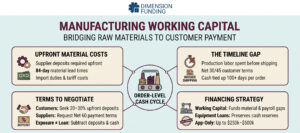
Working-Capital-for-Manufacturers-Buying-Materials-Before-Payment-Lands

Why Manufacturers Pay for Materials Long Before Customers Pay

Material costs arrive at the start of an order. Customer payment arrives at the end, after production, shipping, invoicing, and the customer’s payment terms, so the longer the chain, the more cash the manufacturer carries in the middle.

Current conditions are stretching that chain. The ISM Manufacturing PMI Report for August 2026 shows raw materials prices rising for the 23rd straight month and supplier deliveries slowing for the ninth month in a row. Purchasing executives reported an average lead time of 84 days for production materials.

The Order-Level Cash Exposure

Looking at one order at a time shows exactly where cash is tied up. The illustrative example below follows a $250,000 customer order with $112,500 in materials, a 30% supplier deposit, an 84-day material lead time, and customer terms of net 45.

Day

Event

Cash Out

Cumulative Cash Out

0

Purchase order placed, 30% supplier deposit

$33,750

$33,750

84

Materials arrive


$33,750

96

Estimated duties on imported components

$6,000

$39,750

84–130

Production labor and overhead

$50,000

$89,750

114

Supplier balance due, net 30 after delivery

$78,750

$168,500

130

Finished goods ship; invoice sent


$168,500

175

Customer pays on net 45 terms

+$250,000

Recovered

The manufacturer funds $168,500 before a single dollar comes back, and the supplier deposit is out for 175 days. A profitable order still requires months of carrying before it turns into cash.

The Materials Share Drives the Gap

Labor and overhead are spread across the production window, but material costs land in two large payments near the beginning. The higher the materials share and the larger the supplier deposit, the more of the order is funded up front.

Three Forces That Stretch the Timeline

Several conditions outside the plant can widen the gap between material payments and customer payment.

Longer Lead Times

When suppliers take longer to deliver, the deposit sits longer before materials arrive. The ISM report found that 46% of negative comments from purchasing executives mentioned increasing lead times.

Price Increases Between Quote and Purchase

A customer quote set in one month may be filled with materials bought at higher prices weeks later. ISM respondents cited steel and aluminum increases tied to Section 232 tariffs, along with petroleum-based cost increases linked to the Middle East conflict. Shorter quote validity periods and material price adjustment clauses reduce how much of that increase you absorb.

Duties on Imported Materials

According to U.S. Customs and Border Protection, an entry summary must be filed and estimated duties deposited within 10 working days after goods are entered. A CBP general notice explains that importers in the periodic monthly statement program can deposit estimated duties and fees by the 15th working day of the month after entry or release.

Terms You Can Negotiate on Both Ends

The exposure in the order table is not fixed. Adjusting terms with customers and suppliers can shrink it before any financing is needed.

With Customers

A customer deposit at order placement is the most direct offset. In the example, a 25% deposit of $62,500 at day 0 would cover the full supplier deposit and cut the peak exposure from $168,500 to $106,000. Milestone billing on long production runs can reduce it further.

With Suppliers

Smaller deposits, longer net terms after delivery, and blanket purchase orders with scheduled releases all push material cash out later. Moving the supplier balance from net 30 to net 60 in the example would push the largest payment past the ship date.

Order Cash Exposure Is Not the Same as the Financing Requirement

The total cash an order consumes before collection is not automatically the amount a manufacturer needs to borrow. In the example, $168,500 is the order’s peak cash exposure. The financing requirement may be lower if customer deposits, existing cash, supplier credit, or collections from other orders cover part of it.

The two figures measure different things. The FDIC and SBA’s Money Smart for Small Business curriculum describes working capital as the money available for day-to-day expenses and the cash conversion cycle as the days it takes to turn inventory and other investments into cash from sales. An order’s exposure shows how much cash that cycle absorbs, while the financing need is the portion no other source covers.

Separating the Two Calculations

Order cash exposure = total cash tied up before collection

Financing need = peak order-related cash deficit − available cash allocated to the order

A $62,500 customer deposit lowers this order’s peak deficit from $168,500 to $106,000. If the manufacturer also allocates $40,000 of available cash, the remaining funding requirement is about $66,000, assuming no other timing differences. The same order can create very different borrowing needs depending on how it is funded.

Mapping Cash by Date

Lenders structure this kind of financing around the same cycle. The OCC’s Comptroller’s Handbook on accounts receivable and inventory financing describes it as collateral-based commercial lending. Borrowers use receivables and inventory to secure financing, which is repaid as inventory converts to cash, either directly or through collection of receivables.

The practical approach is to map each order’s inflows and outflows by date and find the lowest projected cash position. Then compare that low point with the minimum reserve the business needs to keep operating. The result is a funding target based on when cash is needed, rather than on the order’s production cost.

Matching the Financing to the Need

A working capital loan fits the funding target that mapping produces. Short-term business loans can cover a narrower need, such as the supplier balance on one large purchase order.

Capital purchases are a separate decision, because paying cash for a new machine drains funds meant for materials. Equipment financing spreads machinery costs over fixed payments, and software financing does the same for ERP and production planning systems. Dimension Funding offers application-only financing up to $250,000 for equipment and $500,000 for software, with no financial statements required, and funding typically arrives the same day or the next business day through DocuSign.

Turning Orders Into Cash on Your Schedule

Material-heavy orders are good business, but they tie up cash before they pay off. Map exposure order by order, negotiate deposits and terms on both ends, and borrow only the portion your own cash and customer deposits do not cover.

Dimension Funding prefers businesses with two or more years in operation, though strong credit can substitute. To size financing around your production cycle, Contact Dimension Funding at 1-800-755-0585 or Sales@DimensionFunding.com.

Frequently Asked Questions

Should I buy materials in bulk to get a volume discount?

Compare the discount against how long the extra material will sit before it is used. A discount that ties up cash for six months may cost more in flexibility than it saves.

What happens if a customer cancels after I have bought materials?

Include cancellation charges in the customer contract that cover materials already ordered. Non-cancellable, non-returnable items need special attention, since suppliers will not take them back.

Do lenders count raw materials inventory as an asset?

Many lenders give some value to raw materials but discount them, and work-in-process is often valued lower still. Finished goods tied to a confirmed customer order are usually viewed more favorably.

What records help a lender understand an order-based need?

Customer purchase orders, supplier quotes and terms, a production schedule, and your receivables aging show how the order converts to cash.

Can I recover duties if I export the finished product?

CBP’s duty drawback program can refund most duties paid on imported materials that are later exported or used in exported goods. The documentation rules are detailed, so work with a licensed customs broker.

Should I accept a large customer’s early-payment program?

Early payment in exchange for a discount shortens the gap but reduces revenue. Compare the discount with the cost of carrying the order to its normal due date.

Is safety stock a working capital need?

Yes, but a permanent one. Safety stock stays on the shelf as long as the policy stands, so plan for it as an ongoing requirement rather than a one-time gap.

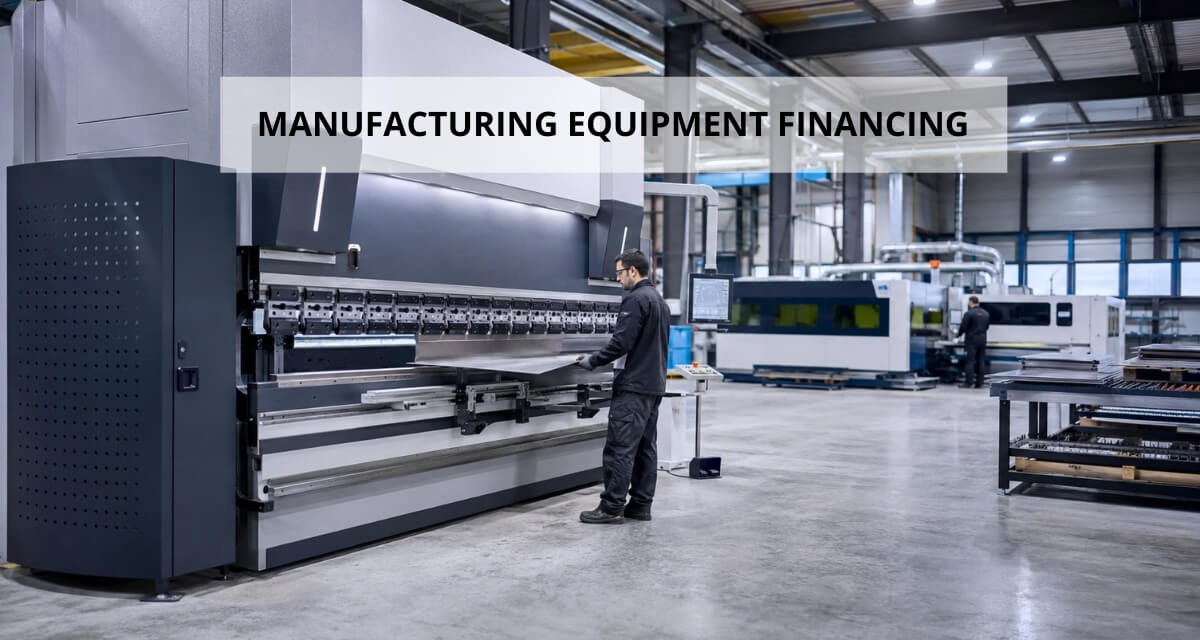
Manufacturing Equipment Financing for Dealers | Dimension Funding

Manufacturing Equipment Financing for Dealers

Manufacturing Equipment Financing for Dealers | Dimension Funding

Manufacturing equipment financing lets a dealer offer a monthly payment alongside the quote instead of leaving a buyer to arrange financing on their own after the sale stalls on price.

Dimension Funding works with dealers selling CNC machines, press brakes, injection molding equipment, robotic assembly cells, and material handling systems, financing terms up to 60 months on standard equipment and total capacity extending past $10 million for larger capital purchases.

That range matters more in manufacturing than in most equipment categories, since a single-machine purchase and a multi-machine production line order can sit at completely different scales. 

How Often Manufacturing Equipment Gets Financed 

The Equipment Leasing & Finance Foundation’s 2024 Horizon Report found that 82% of equipment end-users already use some form of financing to acquire equipment and software, and that of the $2.3 trillion in equipment and software investment tracked in 2023, roughly 58% was financed rather than paid in cash.

Industrial and manufacturing equipment specifically ranks among the top five most-financed asset categories tracked by the Equipment Leasing and Finance Association’s Survey of Equipment Finance Activity, alongside transportation, agriculture, and construction. 

How the Dealer Partnership Works Day to Day

The mechanics are designed to stay out of a dealer’s way rather than add a second job on top of selling machines. A dealer quotes the equipment, the buyer submits an application, and once approved, Dimension Funding pays the dealer the full purchase price directly.

That last detail is more important than it sounds. The dealer isn’t carrying the balance, chasing payments from the buyer over the life of the term, or exposed if the buyer’s business hits a rough stretch two or three years in. Dimension Funding’s equipment vendor financing program absorbs the credit decision and the collection risk. The dealer’s relationship with the buyer stays focused on the machine, the install, and the service relationship that follows.

Getting Paid Without the Paperwork Delay

Applications run electronically, and signatures happen through DocuSign, so a deal that’s otherwise ready to close doesn’t sit waiting on paperwork or a signature that has to travel between offices. 

What Qualifies for Financing

Production Machinery

The financeable list covers most of what a manufacturing equipment dealer sells: CNC machining centers, lathes, milling machines, press brakes, laser cutters, waterjet systems, injection molding equipment, stamping presses, welding and fabrication systems, robotic assembly cells, and conveyor or material-handling systems. Both new and used units qualify under the same program, with the same approval process either way.

Delivery, installation, commissioning, and multi-year maintenance contracts can all be consolidated into one monthly payment alongside the machine itself. 

The Software Layer

Machine sales increasingly arrive with a software component attached: control software on the machine itself, or an update to the buyer’s ERP or manufacturing execution system (MES) so it can communicate with the new equipment. Dealers selling that software alongside the hardware, or partnering with a software vendor on the deal, can fold both into one financed transaction rather than presenting them as separate purchases with separate decisions attached.

Software subscriptions are financeable on their own terms as well. Annual SaaS renewals and multi-year MES or ERP licensing agreements can be converted into fixed monthly payments through Dimension Funding’s ERP financing programs, which is increasingly relevant given how many equipment purchases now arrive bundled with a platform subscription rather than a one-time software license.

The US material handling leasing and financing market is projected to grow from $1.54 billion in 2025 to $3.63 billion by 2031, according to Mordor Intelligence, driven in part by automation adoption and the spread of equipment-as-a-service contracts that lower balance-sheet exposure for smaller manufacturers. 

Approval Thresholds and Timelines Dealers Should Know

  • Equipment only: application-only approval, no financial statements required, up to $250,000.
  • Equipment plus software: the application-only threshold rises to $500,000 for the combined transaction.
  • Larger transactions: a streamlined process remains available up to $750,000; above that, buyers provide basic financials, though the review still moves faster than a conventional bank underwriting cycle.
  • Terms: 12 to 60 months depending on deal size and structure, with total financing capacity extending well past $10 million for large capital equipment purchases.

Most approvals come back within hours, and funding typically follows within 48 hours, sometimes the same day. Dealers can run a prospective deal through Dimension Funding’s payment calculator before a sales call, so they walk in with a realistic monthly figure instead of a rough estimate that might not hold up once the buyer starts asking specifics.

Section 179 and Bonus Depreciation, Layered 

The One Big Beautiful Bill Act permanently restored 100% bonus depreciation for qualifying equipment placed in service after January 19, 2025, per IRS Publication 946. Unlike Section 179, bonus depreciation carries no dollar cap and no business-income limitation, which matters for a shop financing a large order in a lower-income year.


Section 179

Bonus depreciation

2026 limit

$2,560,000, phasing out above $4,090,000

No dollar cap

New or used equipment

Both qualify

Both qualify (must be first use by the buyer)

Income limitation

Limited to business taxable income

None

Typical use

Applied first, gives control over which assets get expensed

Covers remaining basis after Section 179, or anything above the 179 cap

The standard approach is to apply Section 179 first, since it lets a buyer choose which specific machines get expensed, then let bonus depreciation absorb whatever falls outside that cap. As always, the specifics belong with a buyer’s accountant, not the sales floor. 

Ready to Add Financing to the Sales Process

Becoming a vendor partner doesn’t require an in-house finance team or an existing lender relationship to bring to the table. The process starts with a vendor partner application, and Dimension Funding builds the program around how a specific dealer sells: typical transaction size, the credit profile of their buyers, and how fast deals generally need to move. Once that relationship is in place, dealers get marketing materials and sales-team support so financing becomes a standard part of every pitch.

A dealer selling mostly new machines, mostly used, or a mix of both doesn’t need a different program for each. The same application and approval process covers a single CNC mill or a phased production line with a software vendor attached. Contact Dimension Funding to see what that looks like for a specific product line.

Frequently Asked Questions

If a buyer defaults, does the machine come back to the dealer or stay with Dimension Funding? 

It stays with Dimension Funding. The financing agreement, not the original sale, governs what happens to the equipment, so a defaulted machine doesn’t become the dealer’s problem to repossess, resell, or otherwise handle. 

Does bonus depreciation apply the same way to leased equipment as it does to a finance agreement? 

Generally, no. Bonus depreciation applies to equipment the buyer owns, so a true lease, where the leasing company retains ownership, typically doesn’t pass the deduction to the buyer the way a finance agreement does. That’s a meaningful distinction to flag to a buyer weighing a large order against both deductions, since assuming a lease carries the same tax treatment as ownership can lead to a surprise at filing time. 

Can a full production line delivered and installed in phases be financed under one agreement, or only single-machine purchases?

Multi-stage projects qualify. Dimension Funding finances entire project costs, including design, implementation, consulting, staff training, and multi-year maintenance and support contracts, not just a single piece of equipment. For larger automation projects specifically, costs like multi-year support and maintenance can be structured as part of Dimension Funding’s early commencement funding program, so a dealer selling a phased line rollout can present the whole project as one financed transaction rather than a series of separate purchases billed as they occur. 

If the equipment and software come from two different vendors, does that change which application-only threshold applies? 

No. The combined transaction still qualifies under the $500,000 equipment-plus-software threshold regardless of how many vendors are involved, as long as it’s submitted as one deal. A dealer working with a separate software or automation vendor doesn’t need to worry about the vendor count itself changing the underwriting tier. 

What credit profiles can a dealer’s buyers have and still qualify?

Dimension Funding works with most credit profiles, from strong Tier A commercial credit down to marginal credit. A buyer with a thinner credit file isn’t automatically disqualified, which matters for dealers selling to newer shops or businesses in a growth phase. Newer businesses without an established credit history are typically asked to provide a business plan or revenue projections in place of extensive financials, and shops with two or more years of operating history and tax returns on file tend to move through approval faster.

Is zero percent financing available on equipment-only deals, or only when a software vendor is part of the transaction? 

It’s specific to the software layer. Zero percent programs on manufacturing deals are structured around a software or automation vendor covering the arrangement, so an equipment-only purchase with no software component wouldn’t carry the same offer. 

If a multi-year maintenance contract renews before the equipment’s financing term ends, does that need a separate financing agreement? 

Not necessarily. A renewal can typically be added into the existing agreement rather than opened as a new one, since it’s an extension of a cost already built into the original financed transaction rather than a separate purchase.