

A manufacturer can win a strong order and still feel it first as a cash drain. Steel, resin, components, and packaging must be ordered, paid for, and converted into finished goods long before the customer’s payment arrives. Dimension Funding has financed manufacturers and equipment buyers since 1978, and funding materials ahead of customer payment is one of the most common reasons production businesses look for working capital.
The gap is built into how orders move through a plant. Manufacturers who map when each dollar leaves and when payment returns can size their need precisely. A Dimension Funding working capital loan can then cover the stretch the order leaves exposed.
Why Manufacturers Pay for Materials Long Before Customers Pay
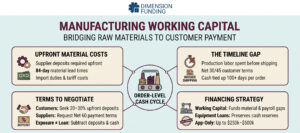
Material costs arrive at the start of an order. Customer payment arrives at the end, after production, shipping, invoicing, and the customer’s payment terms, so the longer the chain, the more cash the manufacturer carries in the middle.
Current conditions are stretching that chain. The ISM Manufacturing PMI Report for August 2026 shows raw materials prices rising for the 23rd straight month and supplier deliveries slowing for the ninth month in a row. Purchasing executives reported an average lead time of 84 days for production materials.
The Order-Level Cash Exposure
Looking at one order at a time shows exactly where cash is tied up. The illustrative example below follows a $250,000 customer order with $112,500 in materials, a 30% supplier deposit, an 84-day material lead time, and customer terms of net 45.
Day | Event | Cash Out | Cumulative Cash Out |
0 | Purchase order placed, 30% supplier deposit | $33,750 | $33,750 |
84 | Materials arrive | $33,750 | |
96 | Estimated duties on imported components | $6,000 | $39,750 |
84–130 | Production labor and overhead | $50,000 | $89,750 |
114 | Supplier balance due, net 30 after delivery | $78,750 | $168,500 |
130 | Finished goods ship; invoice sent | $168,500 | |
175 | Customer pays on net 45 terms | +$250,000 | Recovered |
The manufacturer funds $168,500 before a single dollar comes back, and the supplier deposit is out for 175 days. A profitable order still requires months of carrying before it turns into cash.
The Materials Share Drives the Gap
Labor and overhead are spread across the production window, but material costs land in two large payments near the beginning. The higher the materials share and the larger the supplier deposit, the more of the order is funded up front.
Three Forces That Stretch the Timeline
Several conditions outside the plant can widen the gap between material payments and customer payment.
Longer Lead Times
When suppliers take longer to deliver, the deposit sits longer before materials arrive. The ISM report found that 46% of negative comments from purchasing executives mentioned increasing lead times.
Price Increases Between Quote and Purchase
A customer quote set in one month may be filled with materials bought at higher prices weeks later. ISM respondents cited steel and aluminum increases tied to Section 232 tariffs, along with petroleum-based cost increases linked to the Middle East conflict. Shorter quote validity periods and material price adjustment clauses reduce how much of that increase you absorb.
Duties on Imported Materials
According to U.S. Customs and Border Protection, an entry summary must be filed and estimated duties deposited within 10 working days after goods are entered. A CBP general notice explains that importers in the periodic monthly statement program can deposit estimated duties and fees by the 15th working day of the month after entry or release.
Terms You Can Negotiate on Both Ends
The exposure in the order table is not fixed. Adjusting terms with customers and suppliers can shrink it before any financing is needed.
With Customers
A customer deposit at order placement is the most direct offset. In the example, a 25% deposit of $62,500 at day 0 would cover the full supplier deposit and cut the peak exposure from $168,500 to $106,000. Milestone billing on long production runs can reduce it further.
With Suppliers
Smaller deposits, longer net terms after delivery, and blanket purchase orders with scheduled releases all push material cash out later. Moving the supplier balance from net 30 to net 60 in the example would push the largest payment past the ship date.
Order Cash Exposure Is Not the Same as the Financing Requirement
The total cash an order consumes before collection is not automatically the amount a manufacturer needs to borrow. In the example, $168,500 is the order’s peak cash exposure. The financing requirement may be lower if customer deposits, existing cash, supplier credit, or collections from other orders cover part of it.
The two figures measure different things. The FDIC and SBA’s Money Smart for Small Business curriculum describes working capital as the money available for day-to-day expenses and the cash conversion cycle as the days it takes to turn inventory and other investments into cash from sales. An order’s exposure shows how much cash that cycle absorbs, while the financing need is the portion no other source covers.
Separating the Two Calculations
Order cash exposure = total cash tied up before collection
Financing need = peak order-related cash deficit − available cash allocated to the order
A $62,500 customer deposit lowers this order’s peak deficit from $168,500 to $106,000. If the manufacturer also allocates $40,000 of available cash, the remaining funding requirement is about $66,000, assuming no other timing differences. The same order can create very different borrowing needs depending on how it is funded.
Mapping Cash by Date
Lenders structure this kind of financing around the same cycle. The OCC’s Comptroller’s Handbook on accounts receivable and inventory financing describes it as collateral-based commercial lending. Borrowers use receivables and inventory to secure financing, which is repaid as inventory converts to cash, either directly or through collection of receivables.
The practical approach is to map each order’s inflows and outflows by date and find the lowest projected cash position. Then compare that low point with the minimum reserve the business needs to keep operating. The result is a funding target based on when cash is needed, rather than on the order’s production cost.
Matching the Financing to the Need
A working capital loan fits the funding target that mapping produces. Short-term business loans can cover a narrower need, such as the supplier balance on one large purchase order.
Capital purchases are a separate decision, because paying cash for a new machine drains funds meant for materials. Equipment financing spreads machinery costs over fixed payments, and software financing does the same for ERP and production planning systems. Dimension Funding offers application-only financing up to $250,000 for equipment and $500,000 for software, with no financial statements required, and funding typically arrives the same day or the next business day through DocuSign.
Turning Orders Into Cash on Your Schedule
Material-heavy orders are good business, but they tie up cash before they pay off. Map exposure order by order, negotiate deposits and terms on both ends, and borrow only the portion your own cash and customer deposits do not cover.
Dimension Funding prefers businesses with two or more years in operation, though strong credit can substitute. To size financing around your production cycle, Contact Dimension Funding at 1-800-755-0585 or Sales@DimensionFunding.com.
Frequently Asked Questions
Should I buy materials in bulk to get a volume discount?
Compare the discount against how long the extra material will sit before it is used. A discount that ties up cash for six months may cost more in flexibility than it saves.
What happens if a customer cancels after I have bought materials?
Include cancellation charges in the customer contract that cover materials already ordered. Non-cancellable, non-returnable items need special attention, since suppliers will not take them back.
Do lenders count raw materials inventory as an asset?
Many lenders give some value to raw materials but discount them, and work-in-process is often valued lower still. Finished goods tied to a confirmed customer order are usually viewed more favorably.
What records help a lender understand an order-based need?
Customer purchase orders, supplier quotes and terms, a production schedule, and your receivables aging show how the order converts to cash.
Can I recover duties if I export the finished product?
CBP’s duty drawback program can refund most duties paid on imported materials that are later exported or used in exported goods. The documentation rules are detailed, so work with a licensed customs broker.
Should I accept a large customer’s early-payment program?
Early payment in exchange for a discount shortens the gap but reduces revenue. Compare the discount with the cost of carrying the order to its normal due date.
Is safety stock a working capital need?
Yes, but a permanent one. Safety stock stays on the shelf as long as the policy stands, so plan for it as an ongoing requirement rather than a one-time gap.