

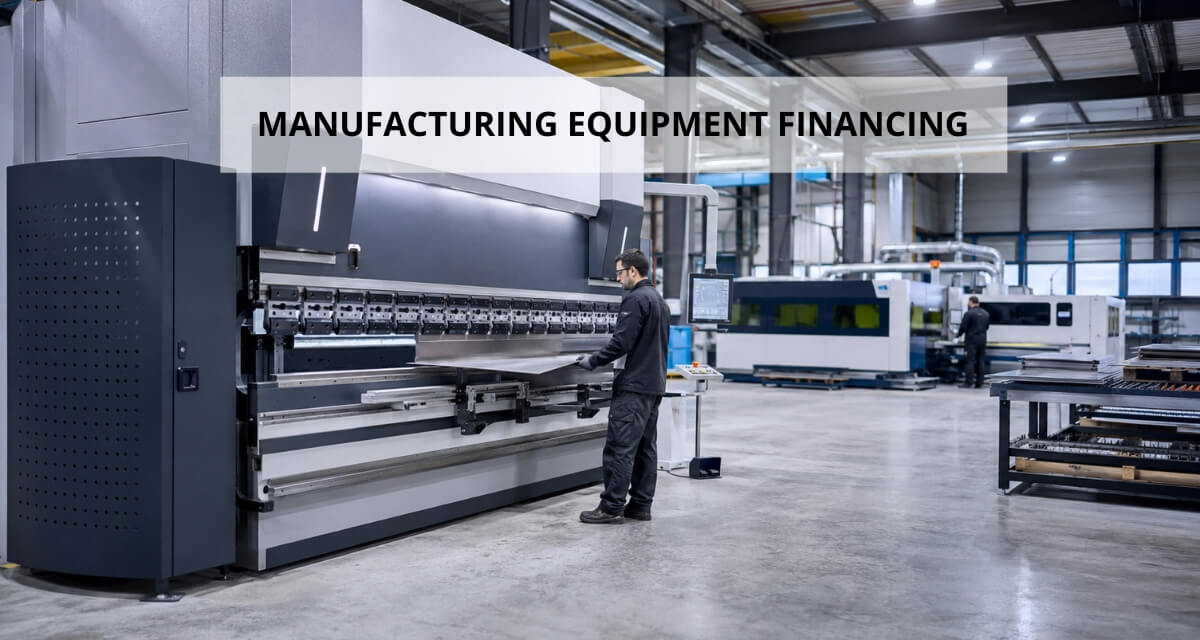
Manufacturing Equipment Financing for Dealers | Dimension Funding
Manufacturing equipment financing lets a dealer offer a monthly payment alongside the quote instead of leaving a buyer to arrange financing on their own after the sale stalls on price.
Dimension Funding works with dealers selling CNC machines, press brakes, injection molding equipment, robotic assembly cells, and material handling systems, financing terms up to 60 months on standard equipment and total capacity extending past $10 million for larger capital purchases.
That range matters more in manufacturing than in most equipment categories, since a single-machine purchase and a multi-machine production line order can sit at completely different scales.
How Often Manufacturing Equipment Gets Financed
The Equipment Leasing & Finance Foundation’s 2024 Horizon Report found that 82% of equipment end-users already use some form of financing to acquire equipment and software, and that of the $2.3 trillion in equipment and software investment tracked in 2023, roughly 58% was financed rather than paid in cash.
Industrial and manufacturing equipment specifically ranks among the top five most-financed asset categories tracked by the Equipment Leasing and Finance Association’s Survey of Equipment Finance Activity, alongside transportation, agriculture, and construction.
How the Dealer Partnership Works Day to Day
The mechanics are designed to stay out of a dealer’s way rather than add a second job on top of selling machines. A dealer quotes the equipment, the buyer submits an application, and once approved, Dimension Funding pays the dealer the full purchase price directly.
That last detail is more important than it sounds. The dealer isn’t carrying the balance, chasing payments from the buyer over the life of the term, or exposed if the buyer’s business hits a rough stretch two or three years in. Dimension Funding’s equipment vendor financing program absorbs the credit decision and the collection risk. The dealer’s relationship with the buyer stays focused on the machine, the install, and the service relationship that follows.
Getting Paid Without the Paperwork Delay
Applications run electronically, and signatures happen through DocuSign, so a deal that’s otherwise ready to close doesn’t sit waiting on paperwork or a signature that has to travel between offices.
What Qualifies for Financing
Production Machinery
The financeable list covers most of what a manufacturing equipment dealer sells: CNC machining centers, lathes, milling machines, press brakes, laser cutters, waterjet systems, injection molding equipment, stamping presses, welding and fabrication systems, robotic assembly cells, and conveyor or material-handling systems. Both new and used units qualify under the same program, with the same approval process either way.
Delivery, installation, commissioning, and multi-year maintenance contracts can all be consolidated into one monthly payment alongside the machine itself.
The Software Layer
Machine sales increasingly arrive with a software component attached: control software on the machine itself, or an update to the buyer’s ERP or manufacturing execution system (MES) so it can communicate with the new equipment. Dealers selling that software alongside the hardware, or partnering with a software vendor on the deal, can fold both into one financed transaction rather than presenting them as separate purchases with separate decisions attached.
Software subscriptions are financeable on their own terms as well. Annual SaaS renewals and multi-year MES or ERP licensing agreements can be converted into fixed monthly payments through Dimension Funding’s ERP financing programs, which is increasingly relevant given how many equipment purchases now arrive bundled with a platform subscription rather than a one-time software license.
The US material handling leasing and financing market is projected to grow from $1.54 billion in 2025 to $3.63 billion by 2031, according to Mordor Intelligence, driven in part by automation adoption and the spread of equipment-as-a-service contracts that lower balance-sheet exposure for smaller manufacturers.
Approval Thresholds and Timelines Dealers Should Know
- Equipment only: application-only approval, no financial statements required, up to $250,000.
- Equipment plus software: the application-only threshold rises to $500,000 for the combined transaction.
- Larger transactions: a streamlined process remains available up to $750,000; above that, buyers provide basic financials, though the review still moves faster than a conventional bank underwriting cycle.
- Terms: 12 to 60 months depending on deal size and structure, with total financing capacity extending well past $10 million for large capital equipment purchases.
Most approvals come back within hours, and funding typically follows within 48 hours, sometimes the same day. Dealers can run a prospective deal through Dimension Funding’s payment calculator before a sales call, so they walk in with a realistic monthly figure instead of a rough estimate that might not hold up once the buyer starts asking specifics.
Section 179 and Bonus Depreciation, Layered
The One Big Beautiful Bill Act permanently restored 100% bonus depreciation for qualifying equipment placed in service after January 19, 2025, per IRS Publication 946. Unlike Section 179, bonus depreciation carries no dollar cap and no business-income limitation, which matters for a shop financing a large order in a lower-income year.
Section 179 | Bonus depreciation | |
2026 limit | $2,560,000, phasing out above $4,090,000 | No dollar cap |
New or used equipment | Both qualify | Both qualify (must be first use by the buyer) |
Income limitation | Limited to business taxable income | None |
Typical use | Applied first, gives control over which assets get expensed | Covers remaining basis after Section 179, or anything above the 179 cap |
The standard approach is to apply Section 179 first, since it lets a buyer choose which specific machines get expensed, then let bonus depreciation absorb whatever falls outside that cap. As always, the specifics belong with a buyer’s accountant, not the sales floor.
Ready to Add Financing to the Sales Process
Becoming a vendor partner doesn’t require an in-house finance team or an existing lender relationship to bring to the table. The process starts with a vendor partner application, and Dimension Funding builds the program around how a specific dealer sells: typical transaction size, the credit profile of their buyers, and how fast deals generally need to move. Once that relationship is in place, dealers get marketing materials and sales-team support so financing becomes a standard part of every pitch.
A dealer selling mostly new machines, mostly used, or a mix of both doesn’t need a different program for each. The same application and approval process covers a single CNC mill or a phased production line with a software vendor attached. Contact Dimension Funding to see what that looks like for a specific product line.
Frequently Asked Questions
If a buyer defaults, does the machine come back to the dealer or stay with Dimension Funding?
It stays with Dimension Funding. The financing agreement, not the original sale, governs what happens to the equipment, so a defaulted machine doesn’t become the dealer’s problem to repossess, resell, or otherwise handle.
Does bonus depreciation apply the same way to leased equipment as it does to a finance agreement?
Generally, no. Bonus depreciation applies to equipment the buyer owns, so a true lease, where the leasing company retains ownership, typically doesn’t pass the deduction to the buyer the way a finance agreement does. That’s a meaningful distinction to flag to a buyer weighing a large order against both deductions, since assuming a lease carries the same tax treatment as ownership can lead to a surprise at filing time.
Can a full production line delivered and installed in phases be financed under one agreement, or only single-machine purchases?
Multi-stage projects qualify. Dimension Funding finances entire project costs, including design, implementation, consulting, staff training, and multi-year maintenance and support contracts, not just a single piece of equipment. For larger automation projects specifically, costs like multi-year support and maintenance can be structured as part of Dimension Funding’s early commencement funding program, so a dealer selling a phased line rollout can present the whole project as one financed transaction rather than a series of separate purchases billed as they occur.
If the equipment and software come from two different vendors, does that change which application-only threshold applies?
No. The combined transaction still qualifies under the $500,000 equipment-plus-software threshold regardless of how many vendors are involved, as long as it’s submitted as one deal. A dealer working with a separate software or automation vendor doesn’t need to worry about the vendor count itself changing the underwriting tier.
What credit profiles can a dealer’s buyers have and still qualify?
Dimension Funding works with most credit profiles, from strong Tier A commercial credit down to marginal credit. A buyer with a thinner credit file isn’t automatically disqualified, which matters for dealers selling to newer shops or businesses in a growth phase. Newer businesses without an established credit history are typically asked to provide a business plan or revenue projections in place of extensive financials, and shops with two or more years of operating history and tax returns on file tend to move through approval faster.
Is zero percent financing available on equipment-only deals, or only when a software vendor is part of the transaction?
It’s specific to the software layer. Zero percent programs on manufacturing deals are structured around a software or automation vendor covering the arrangement, so an equipment-only purchase with no software component wouldn’t carry the same offer.
If a multi-year maintenance contract renews before the equipment’s financing term ends, does that need a separate financing agreement?
Not necessarily. A renewal can typically be added into the existing agreement rather than opened as a new one, since it’s an extension of a cost already built into the original financed transaction rather than a separate purchase.