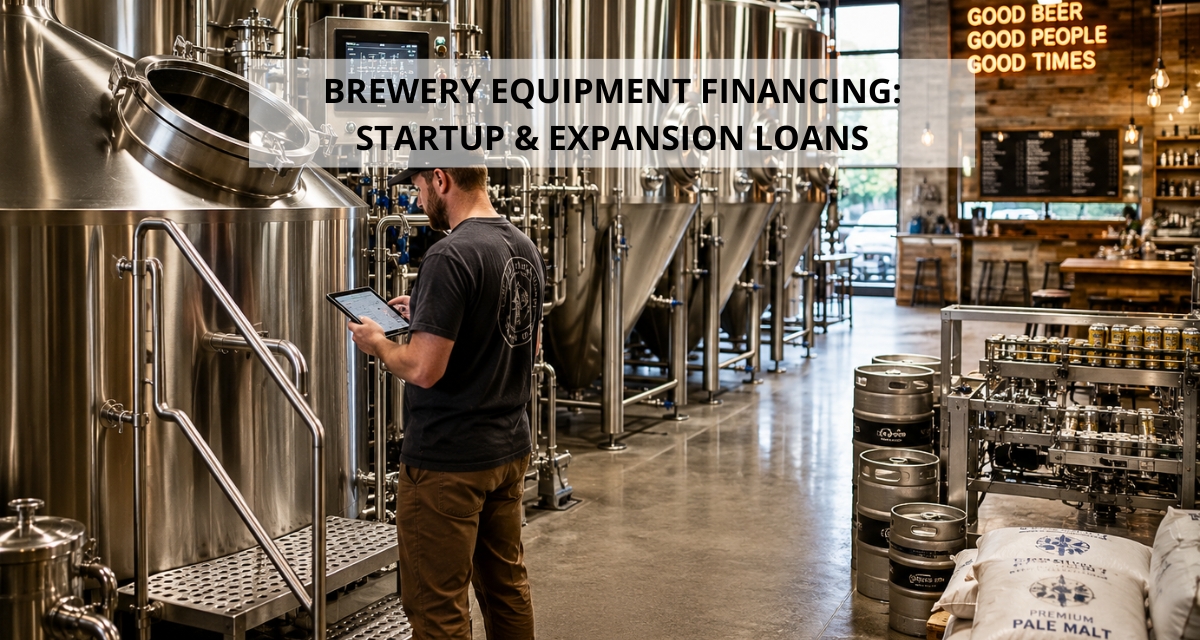
Brewery Equipment Financing: Startup & Expansion Loans

Brewery Equipment Financing

Brewery Equipment Financing: Startup & Expansion Loans

Brewery equipment financing covers the purchase or lease of the physical assets needed to brew, package, and serve beer commercially, including brewing systems, fermentation tanks, kegging and canning lines, refrigeration, and taproom buildout equipment. Lenders evaluate time in business, credit profile, and revenue when structuring a financing arrangement. 

For craft breweries looking to open or expand without tying up working capital, Dimension Funding has been financing commercial equipment since 1978, with application-only approvals available up to $250,000 and same-day funding in most cases.

Dimension Funding finances new and used brewery equipment under commercial equipment financing terms that bundle delivery, installation, and related costs into a single fixed monthly payment, with terms extending up to 60 months.

What Brewery Equipment Financing Covers

The financeable list covers the full production chain. Dimension Funding finances brewing kettles, mash tuns, fermentation tanks, brite beer tanks, keg washers, bottling and canning lines, grain handlers, pumps, filters, labeling machines, refrigeration and cooler systems, and taproom furniture and fixtures.

Delivery, setup, and maintenance costs can be included in a single package, helping prevent post-purchase invoices from eroding cash reserves after the deal closes. Brewery management software can also be included, and financing that incorporates software raises the application-only threshold to $500,000.

The Capital Reality of Opening and Growing a Brewery

The U.S. craft brewing industry counted 9,612 active breweries at the end of 2024, according to the Brewers Association, with taproom and brewpub models now representing 73% of all craft businesses. That shift toward hospitality-focused operations means more brewers are equipping not just a production floor but a full customer-facing space at the same time.

The capital requirement reflects that. Brewing systems, fermentation vessels, and a functional taproom represent a significant upfront commitment before a single pint is poured. Financing converts that into a fixed monthly payment, preserving cash for payroll, ingredients, licensing fees, and the working capital buffer every new brewery needs during its first operating year. 

The Brewers Association notes that the average craft brewery takes two to three years to reach profitability. Keeping cash on hand through that runway matters more than owning equipment outright from day one.

How Lenders Evaluate a Brewery Application

Credit score, time in business, and annual revenue are the primary factors. Established breweries with two or more years of operating history move through faster and typically access a wider range of terms. Startups carry greater underwriting risk, and most lenders require a business plan, revenue projections, and proof that the required licenses are in place in lieu of operating history.

Dimension Funding accepts most credit profiles, from Tier A down to marginal credit. Applications under $250,000 require no financial statements. Transactions above $250,000 involve a review of basic financials, though the process moves faster than a conventional bank underwriting cycle.

One practical detail: lenders familiar with the brewery space pay attention to the distribution model. A taproom-only brewery carries different revenue predictability than one with established wholesale accounts, and that distinction can affect how an application gets structured.

New Equipment, Used Equipment, Same Program

Dimension Funding finances both new and used brewery equipment under the same terms. For smaller operations and startups, used fermentation vessels and brewing systems are a common path to getting production-ready without the full outlay of new equipment.

Used equipment qualifies for the same fixed monthly payment structure as new. Delivery, installation, and setup costs can be bundled in either case, so there are no separate vendor invoices to manage after the deal closes.

Financing vs. Paying Cash

A brewery that pays cash for its brewing system removes that capital from circulation on day one. The same purchase, financed over 48 months, preserves cash to cover costs that hit immediately after opening: ingredients, staffing, taproom supplies, licensing renewals, and the slower revenue ramp most first-year operations face.

The equipment produces revenue regardless of how it was paid for. The difference lies in how much cash remains available to run the business while revenue builds.

IRS Section 179 adds a practical dimension here. Under 2025 rules, qualifying brewery equipment placed in service before December 31 can be deducted up to $2,500,000 in the year of purchase, per the IRS via Section179.org. Both new and used equipment qualifies. That means a brewery can take the full tax deduction in year one, while the actual cash payments are spread over the financing term. The IRS Section 179 deduction page on Dimension Funding’s site explains how this applies to financed purchases. Talk to a CPA before acting on it.

Applying for Brewery Equipment Financing

Dimension Funding works directly with breweries to finance equipment from their chosen vendor. The application is electronic, execution runs through DocuSign, and funding typically lands within 24 hours of approval. Applications under $250,000 require no financial statements. Transactions above $250,000 require recent tax returns and basic financials.

Use Dimension Funding’s payment calculator to model monthly payment ranges before applying. When ready, the financing application handles requests from first-time startups through established operations expanding capacity or replacing aging equipment. The team is also reachable at 1.800.755.0585.

Frequently Asked Questions

What types of brewery equipment can I finance through Dimension Funding?

Dimension Funding finances virtually any brewery equipment, including brewing kettles, fermentation tanks, brite beer tanks, canning and bottling lines, keg washers, refrigeration systems, grain handlers, and taproom furniture. Delivery, installation, and brewery management software can be included in the same financing package.

How much can a brewery finance without providing financial statements?

Equipment financing up to $250,000 requires no financial statements. If brewery management software is included, the application-only threshold rises to $500,000. Transactions above those amounts require basic financials but still process faster than a traditional bank loan.

What credit score do I need to qualify for brewery equipment financing?

Dimension Funding works with most credit profiles, from strong commercial credit down to marginal ratings. Time in business, revenue, and the overall financial picture are weighed alongside credit score. A lower score does not automatically disqualify an application.

Can a brewery startup qualify for equipment financing?

New breweries can apply. Startups are typically asked for a business plan, revenue projections, and proof that required federal and state licenses are in place in lieu of operating history. Established breweries with two or more years of tax returns on file move through the process faster.

Does brewery equipment financing qualify for an IRS Section 179 deduction?

Financed brewery equipment placed in service during the tax year generally qualifies for Section 179, which allows deductions up to $2,500,000 for 2025 per Section179.org. Both new and used equipment qualify. A brewery can take the full deduction in year one, while cash payments are spread over the financing term. Confirm eligibility with a CPA before filing.

Can I finance used brewery equipment?

Yes. Dimension Funding finances both new and used brewery equipment under the same program terms. Used fermentation vessels, brewing systems, and packaging equipment qualify for the same fixed monthly payment structure as new purchases, with delivery and installation costs included.

How long does it take to get approved and funded?

Most approvals come back the same day. Funding typically follows within 24 hours. The entire process is handled electronically via DocuSign, with no physical paperwork required.

Veterinary Equipment Financing: Diagnostic Tools and Practice Loans

veterinary equipment financing

Veterinary Equipment Financing: Diagnostic Tools and Practice Loans

Veterinary equipment financing covers the purchase or lease of clinical tools, diagnostic systems, and facility assets used in a veterinary practice, with a lender advancing 100% of the cost in exchange for fixed monthly payments over a set term. 

Dimension Funding has been financing medical and veterinary equipment since 1978, carrying an A+ rating from the Better Business Bureau. Lenders evaluate time in business, practice revenue, the type of equipment being financed, and the applicant’s credit profile. For practices that qualify under application-only thresholds, approvals can move in hours without financial statements.

Applications up to $250,000 require no financial statements, and financing covers not just the equipment itself but delivery, installation, and associated maintenance costs, all rolled into a single fixed monthly payment. Apply for a no-obligation veterinary equipment financing quote through Dimension Funding.

What Veterinary Equipment Financing Covers

Veterinary equipment financing applies to nearly any tangible asset a practice needs to operate and grow. That includes diagnostic imaging systems, surgical equipment, anesthesia machines, dental units, laboratory analyzers, and patient monitoring technology.

It also extends to practice infrastructure: exam tables, sterilization equipment, hospital furniture, and IT hardware used for electronic health records. When multiple vendors are involved, a lender can often bundle the costs from equipment suppliers, third-party installers, and training providers into one financing agreement, keeping a single monthly payment rather than managing several.

Both new and used equipment qualify. A practice buying a refurbished digital radiography unit carries the same financing eligibility as one purchasing a brand-new ultrasound system.

The Equipment Costs Shaping Every Buying Decision

According to the American Veterinary Medical Association (AVMA), there were 34,296 veterinary practices in the United States as of 2023, with approximately 362 new practices added each year since 2010. 

The majority are small to mid-sized companion animal clinics where equipment budgets compete directly with staffing, rent, and working capital reserves.

Small-animal veterinary clinics typically allocate between $65,000 and $130,000 for major medical and diagnostic equipment in their first year of operation. That range moves fast once a practice adds imaging.

Diagnostic Imaging

Digital radiography and ultrasound represent the largest single equipment investment most general practices make. Radiography systems led the veterinary diagnostic imaging market with a 35.64% share in 2024, confirming their role as the foundational modality across companion animal practices. Ultrasound units, CT scanners, and digital dental radiography add further capital requirements on top of that.

The global veterinary diagnostic imaging market was valued at $1.27 billion in 2023 and is projected to reach $2.39 billion by 2033, growing at a compound annual rate of 6.7%. For individual practices, that growth translates into consistent pressure to keep diagnostic capabilities current as client expectations and clinical standards advance.

Surgery and Anesthesia

Surgical suites require anesthesia machines, patient monitoring systems, electrosurgical units, and recovery area equipment. Each piece carries its own replacement and maintenance schedule. Annual maintenance and servicing for veterinary equipment typically runs 5 to 8% of the equipment’s purchase value, which means a $100,000 equipment inventory will cost $5,000 to $8,000 per year to maintain.

That recurring cost is a factor financing helps manage. By preserving working capital through fixed monthly payments, a practice keeps its maintenance and replacement budget intact rather than drawing it down to fund an acquisition.

Dental and Laboratory

The American Veterinary Dental Society (AVDS) reports that over 80% of dogs and 70% of cats exhibit signs of dental disease by age three. Dental units, scalers, polishers, and dental radiography systems have become standard in companion animal clinics rather than specialty-only tools. In-house laboratory analyzers, including hematology and chemistry panels, add further capital requirements while reducing diagnostic turnaround time. 

How Lenders Evaluate a Veterinary Practice

Lenders assess veterinary financing applications on several factors. Time in business matters: established practices with documented revenue history qualify more easily than startups. Practice revenue, the stability of that revenue relative to local market conditions, and existing debt obligations all feed into the approval calculation.

The equipment itself plays a role. Diagnostic imaging systems, surgical equipment, and laboratory analyzers are tangible assets with clear resale markets, which supports stronger financing outcomes compared to purely consumable expenditures.

Credit profile is reviewed but is not a hard barrier. Dimension Funding accepts most credit ratings, from Tier A borrowers down to marginal credit. For applications under $250,000, no financial statements are required. Applications above that threshold require some financials but move through a structured process rather than an open-ended underwriting review.

Most approvals are issued the same day the application is submitted, with funding often occurring within a few hours or by the next business day.

Financing New vs. Used Veterinary Equipment

Both new and used veterinary equipment qualify for financing through Dimension Funding. Used equipment financing is particularly relevant in veterinary medicine, where a well-maintained digital radiography unit or ultrasound system holds diagnostic value well past its initial purchase date.

The practical consideration with used equipment is condition documentation. Lenders will typically want to confirm the asset is functional, and practices benefit from securing service records before applying. A refurbished system with documented calibration history presents a cleaner financing case than one purchased at auction with no maintenance record.

Financing used equipment also allows a practice to access technology it might not reach at new prices. A smaller single-doctor clinic can access the same diagnostic capability through a quality used unit, financed over a term that aligns with monthly cash flow, without waiting until working capital accumulates to cover a full purchase.

The IRS Section 179 Angle

Veterinary practices that finance equipment during the tax year may be able to deduct the full purchase price in the same year rather than depreciating it gradually. For 2025, the IRS Section 179 deduction limit has been raised to $2,500,000, with a spending cap of $4,000,000 before the deduction begins to phase out on a dollar-for-dollar basis.

Financing through a commercial lender qualifies for Section 179 treatment. A practice that finances a diagnostic imaging system, dental unit, and surgical monitoring equipment in the same calendar year can potentially deduct the entire financed amount in year one, subject to taxable income and business-use requirements. The equipment must be placed in service by December 31 of the applicable tax year.

Dimension Funding maintains a dedicated IRS Section 179 resource page with current year limits and qualifying guidelines. Consult a qualified tax advisor to confirm the deduction applicable to your specific situation.

Ready to Move on Your Next Equipment Purchase

Dimension Funding has provided commercial equipment financing to small and medium-sized businesses across the United States since 1978. For veterinary practices, the program covers 100% of a purchase: equipment, shipping, installation, and maintenance costs can all be bundled into a single financing agreement.

The application is electronic, with DocuSign handling document execution. Approvals typically arrive the same business day. Terms extend up to 60 months, giving each practice control over payment size relative to its cash flow. A practice that is expanding its diagnostic capabilities does not have to choose between equipment access and working capital preservation.

If you are evaluating a diagnostic imaging system, surgical suite upgrade, dental unit, or laboratory analyzer, Dimension Funding’s medical equipment financing program is structured for exactly that acquisition. Submit an application or use the payment calculator to estimate monthly payments before committing to a vendor quote.

Frequently Asked Questions 

What types of veterinary equipment can be financed?

Financing covers a wide range of clinical and practice assets, including digital radiography systems, ultrasound machines, CT scanners, anesthesia equipment, surgical monitors, dental units, laboratory analyzers, exam tables, sterilization equipment, and IT hardware for electronic health records. Delivery, installation, and maintenance costs associated with the equipment can typically be bundled into the same financing agreement.

What credit score do I need to qualify for veterinary equipment financing?

Dimension Funding does not publish a minimum credit score requirement. Most credit profiles are accepted, from Tier A borrowers to applicants with marginal credit histories. Applications under $250,000 require no financial statements; above that threshold, some financials are requested as part of a standard review.

How long does the approval process take?

Most applications receive a same-day decision. Funding typically follows within a few hours of approval or by the next business day, depending on documentation requirements.

Can I finance used veterinary equipment?

Yes. Both new and used equipment qualify for financing through Dimension Funding. For used equipment, having service records and calibration documentation in order before submitting an application generally supports a cleaner approval process.

What are typical financing terms for a veterinary practice?

Dimension Funding offers terms up to 60 months. The actual term and monthly payment depend on the financed amount, the applicant’s credit profile, and the equipment type. Practices can estimate monthly payments using the payment calculator on Dimension Funding’s website before applying.

Does financing veterinary equipment qualify for the IRS Section 179 deduction?

Equipment financed through a commercial lender generally qualifies for IRS Section 179 treatment, allowing the full purchase price to be deducted in the year the equipment is placed in service rather than depreciated over several years. For 2025, the deduction cap is $2,500,000. A qualified tax professional can confirm eligibility and calculate the deduction applicable to your practice.

Is there a minimum amount required to apply for veterinary equipment financing?

Dimension Funding does not publish a hard minimum financing amount for veterinary equipment. The $250,000 application-only threshold is the point at which no financial statements are required; applications of any size within that range can be submitted through the standard electronic process without additional documentation.

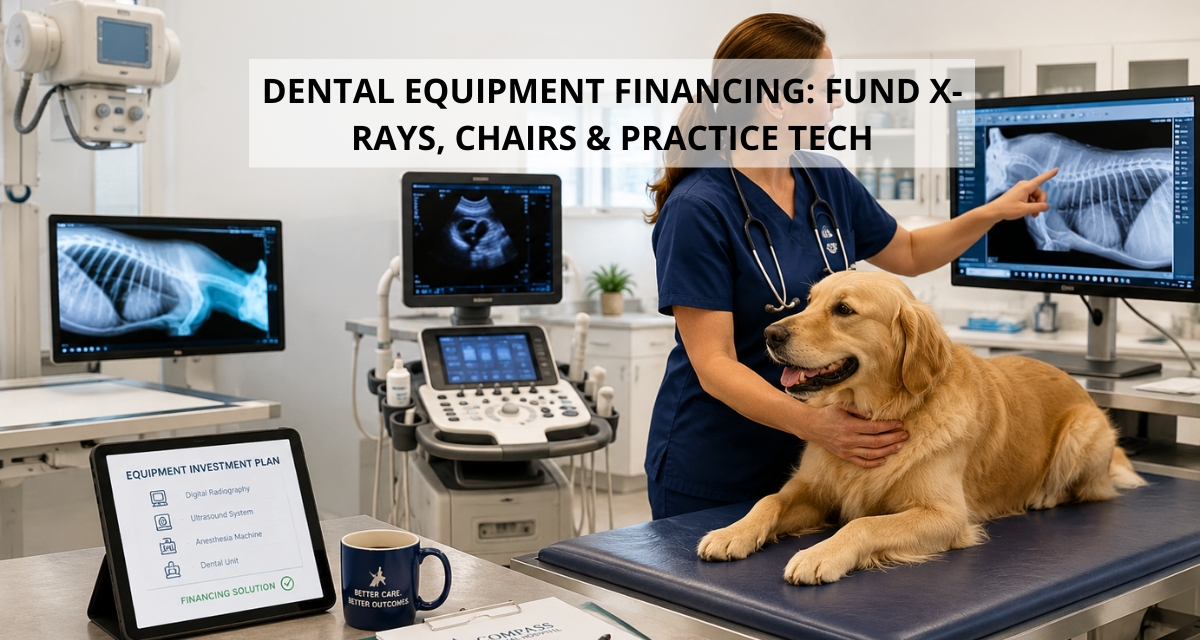
Dental Equipment Financing: Fund X-Rays, Chairs & Practice Tech

Dental Equipment Financing

Dental Equipment Financing: Fund X-Rays, Chairs & Practice Tech

Dental equipment financing covers the purchase or lease of clinical and diagnostic equipment used in a dental practice, including operatory chairs, digital X-ray systems, CBCT scanners, intraoral cameras, sterilization units, and practice management technology.

Lenders evaluate the practice’s credit profile, time in business, and revenue when structuring a financing arrangement. For practices looking to grow without depleting working capital, Dimension Funding has been structuring equipment financing programs for healthcare businesses since 1978, with approvals available up to $500,000 on an application-only basis.

Dimension Funding finances new and used dental equipment under commercial equipment financing terms that include delivery, installation, and associated costs in a single fixed monthly payment. Terms extend up to 60 months, and most approvals come back the same day with funding following within 48 hours.

What Dental Equipment Financing Actually Covers

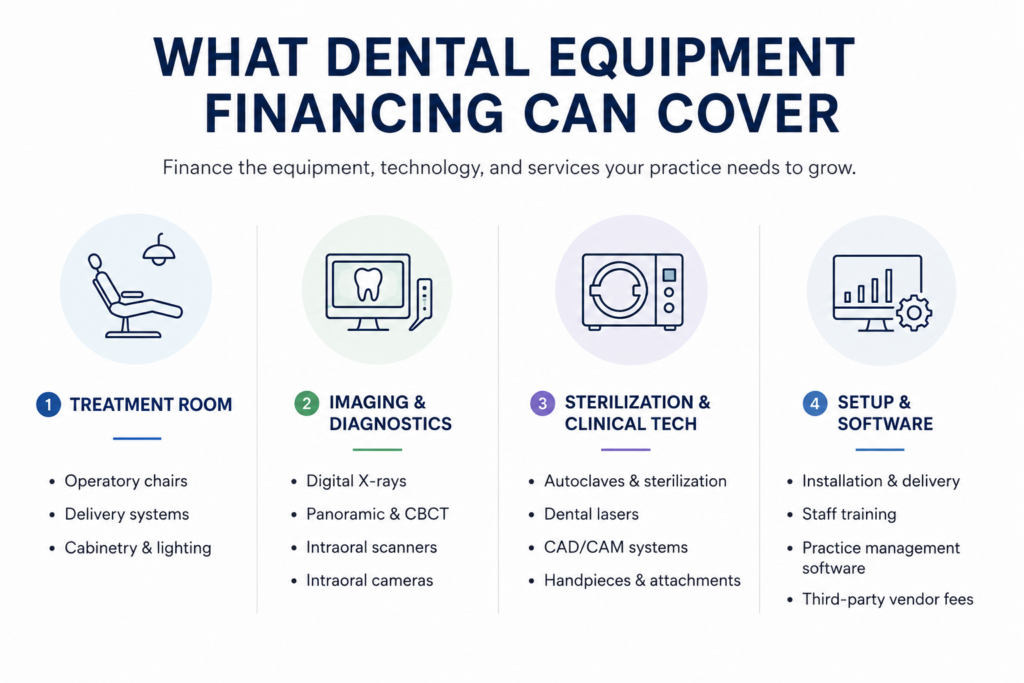
Most practitioners underestimate how broad the financeable list is. Operatory chairs and delivery systems, digital intraoral X-ray sensors, panoramic imaging units, CBCT scanners, CAD/CAM milling machines, intraoral scanners, sterilization and autoclave equipment, dental lasers, practice management software, and patient furniture all qualify.

Installation costs, staff training, and third-party vendor fees can be bundled into the same package. That matters because the hidden costs of getting equipment operational often rival the purchase price itself, and bundling them into a single fixed payment prevents post-purchase invoices from quietly draining cash reserves.

What Dental Equipment Financing Can Cover

Why Dental Practices Finance Equipment

Outfitting a modern dental practice means committing capital on multiple fronts before the doors open. A single operatory requires a chair and delivery system, imaging capability, sterilization equipment, and cabinetry before the first patient walks in. Multi-operatory buildouts multiply that across every treatment room, and imaging upgrades such as CBCT scanners or CAD/CAM systems represent significant standalone commitments on their own.

About 54% of dental equipment acquisitions were financed in 2024, according to Clarify Capital. The logic is straightforward: financing turns a large upfront purchase into a fixed monthly payment, leaving working capital intact for payroll, supplies, and patient acquisition.

Dental practices also have among the lowest default rates in commercial lending. Clarify Capital puts the loan default rate for dental professionals at under 1%, reflecting stable practice income and the fact that people continue to need dental care regardless of economic conditions. Lenders know this, which is part of why dental financing approvals tend to move faster and reach further down the credit spectrum than many other industries.

How Lenders Evaluate a Dental Practice

Time in business, credit score, and monthly revenue are the primary factors. Dimension Funding works with most credit profiles, from Tier A down to marginal credit, which is relevant for newer practices or anyone who hit financial turbulence during startup.

Applications under $250,000 require no financial statements. Larger transactions go through an expedited review rather than a full bank underwriting cycle. Startups should be prepared to provide a business plan or revenue projections. Practices with two or more years of tax returns on file move through faster.

The Case for Financing Over Cash

Paying cash for equipment removes that capital from circulation the moment the invoice clears. The same purchase financed over 48 months preserves the cash position to cover an unexpected repair, bring on a new associate, or run a patient acquisition push during a growth period. The equipment produces revenue either way.

IRS Section 179 adds another dimension. Under 2025 rules, qualifying dental equipment can be fully deducted up to $2,500,000 in the year of purchase, per the IRS via Section179.org. Both new and pre-owned equipment placed in service before December 31 qualifies. 

A practice can take the full tax deduction in year one, while the actual cash outflow is spread over the financing term. The IRS Section 179 page on Dimension Funding’s site explains how the deduction applies to financed purchases.

Talk to a CPA before acting on Section 179. The timing of deductions and the resulting tax liability in subsequent years requires planning specific to each practice.

New Equipment, Used Equipment, Same Terms

Dimension Funding finances both new and used dental equipment under the same program. For imaging in particular, certified pre-owned CBCT systems and panoramic units are common acquisitions. 

According to Renew Digital, certified pre-owned CBCT machines typically sell at 30% to 50% below new list prices, and financing either option produces the same predictable monthly payment structure. 

The financing package can include the equipment purchase, delivery, installation, extended warranties, and software licensing in a single agreement, so there are no separate vendor invoices to manage after the deal closes.

Applying for Dental Equipment Financing

For transactions under $250,000, Dimension Funding requires no financial statements. The application is electronic, execution runs through DocuSign, and funding typically lands the same day or the next business day after approval.

Transactions above $250,000 require recent tax returns and basic financials, though the timeline is still faster than that of a conventional bank. Practices at every stage qualify, from single-location startups adding foundational equipment to established groups upgrading imaging across multiple sites.

Use Dimension Funding’s payment calculator to model monthly payment ranges before submitting. When ready, the financing application is the starting point. The team is also reachable directly at 1.800.755.0585.

Frequently Asked Questions

What types of dental equipment can I finance through Dimension Funding?

Dimension Funding finances virtually any dental equipment, including operatory chairs, digital X-ray sensors, panoramic units, CBCT scanners, intraoral scanners, sterilization equipment, CAD/CAM systems, and practice management software. Delivery, installation, training, and third-party vendor costs can be bundled into the same financing package.

How much can a dental practice finance without providing financial statements?

Dimension Funding approves equipment financing up to $250,000 with no financial statements required. Software financing on an application-only basis is available up to $500,000. Transactions above those thresholds undergo an expedited review that still moves faster than a conventional bank’s underwriting process.

What credit score do I need to qualify for dental equipment financing?

Dimension Funding works with most credit profiles, from strong commercial credit down to marginal ratings. A lower score does not automatically disqualify a practice. Time in business, monthly revenue, and the overall financial picture are weighed alongside credit score during the review.

Can I finance used or refurbished dental equipment?

Yes. Both new and certified pre-owned dental equipment qualify for financing under the same terms. Used imaging equipment often carries purchase prices well below new list prices, and financing either option produces the same fixed monthly payment structure.

Does financing dental equipment affect my ability to take an IRS Section 179 deduction?

Financed dental equipment placed in service during the tax year generally qualifies for Section 179, which allows a deduction of up to $2,500,000 for 2025. A practice can take the full deduction in year one, while cash payments are spread over the financing term. Confirm eligibility and timing with a CPA before filing.

How long does it take to get approved and funded?

Most Dimension Funding approvals come back the same day. Funding typically follows within 24 to 48 hours. The entire process is handled electronically via DocuSign, with no physical paperwork.

Can a dental startup qualify for equipment financing?

New practices can apply, though approval terms may differ from those available to established practices. Startups are typically asked for a business plan or revenue projections in place of tax returns. Practices with two or more years of operating history move through the process faster and tend to access a wider range of program options.

Backhoe Financing: Loans for Backhoe Loaders & Excavator Combos

Backhoe Financing

Backhoe Financing: Loans for Backhoe Loaders & Excavator Combos

Backhoe financing puts a loader and an excavator, built into a single machine, on your job site for a fixed monthly payment instead of one painful check. The backhoe loader earns its keep precisely because it does two jobs, but that dual capability still carries a serious purchase price, and the contractors who lean on backhoes hardest, utility crews, septic installers, rural builders, municipal subcontractors, rarely have that kind of cash sitting idle between jobs.

Dimension Funding has financed equipment for small and medium-sized businesses since 1978, and backhoes sit inside the same construction program that covers its dozer, excavator, and dump truck lending. 

The company funds new and used backhoe loaders with a fixed rate for the entire term, monthly payments up to 60 months, and a one-page application for amounts up to $250,000. If you already know which machine you want, you can start a financing application and hear back the same day. If you are still deciding between a backhoe and a pair of compact machines, that decision is worth settling before any paperwork starts.

One Machine or Two: The Question Behind Every Backhoe Purchase

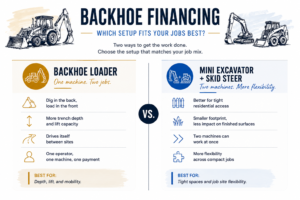
Most backhoe buyers today are really choosing between two configurations. The first is the classic backhoe loader, digging in the back and loading in the front. The second is a mini excavator paired with a skid steer, which splits the same work across two smaller machines. The compact pair has taken real ground on tight residential sites, where narrow gates and finished lawns punish a full-size backhoe.

The backhoe wins where depth, lift, and distance matter. Aaron Robinson, a product consultant for site development at John Deere, told Heavy Equipment Guide that sewer work usually requires a backhoe because of its lift and trench-depth requirements, while mini excavators dominate residential utility and fiber-optic trenching. A backhoe also drives itself between sites on public roads, which means no trailer, no second truck, and no second operator just to move iron.

The financing math follows the same fork. A backhoe is one contract and one payment covering both functions. The compact route means two machines, and if that is where your job mix points, Dimension Funding finances mini excavators under the same program terms. Either way, the structure of the deal should follow the work, not the other way around.

backhoe financing - which setup fits your jobs best

What Backhoe Financing Covers

The financing extends beyond the machine itself. Under its construction equipment financing program, Dimension Funding can finance 100 percent of the project, including delivery and maintenance costs that buyers often omit from the budget. Getting a backhoe from the seller’s yard to your first job is not free, and folding that cost into the contract means you pay almost nothing upfront.

New and used backhoes both qualify, and the used market is where the term length does its real work. A well-maintained backhoe has a long working life, and Dimension Funding structures the term around that life, up to 60 months, so the payments end while the machine is still producing. For a used unit, that alignment matters more than any single rate point, because nobody wants to keep paying for iron that has already left the fleet.

What It Takes to Qualify

Dimension Funding keeps the requirements short and publishes them plainly. Here is what the company looks for on a backhoe deal:

  1. At least two years in business. This is the firm requirement. Startups under two years old do not qualify for the backhoe program.
  2. A completed application. Approvals up to $250,000 run on a one-page application with no financial statements. Deals above $250,000 require financials.
  3. Credit somewhere on the spectrum. Programs are set up for everything from A+ credit to marginal credit, so a past rough patch does not automatically end the conversation.

From there, the paperwork is electronic end-to-end. Applications and contracts go through DocuSign, approvals usually come back the same day, and funds typically arrive within two to three business days. Filling out the financing application before you settle on a specific machine is a legitimate move. It costs nothing, carries no obligation, and tells you your real budget before you start negotiating with a seller.

How the Numbers Work: Terms, Payments, and Taxes

Three program features shape your monthly payment.

Term length. Financing runs up to 60 months. A longer term lowers the monthly payment, while a shorter term reduces total interest paid. A backhoe that anchors your daily work can justify an aggressive payoff. One that fills gaps between rentals may fit better on the full 60 months.

Fixed rate. The rate is locked at signing and holds for the entire term, so the payment you budget in year one is the payment you make in year five.

Deferred first payment. Qualifying borrowers can take no payments for the first 90 days, with restrictions. That window lets the backhoe start billing hours before the first payment comes due, which helps when the machine is tied to a contract that has not yet started paying.

The payment calculator on Dimension Funding’s site shows how a given purchase price spreads across different terms, and checking it before you talk to a seller beats checking it after.

There is a tax dimension as well. The Section 179 deduction allows businesses to deduct qualifying equipment in the year it goes into service rather than depreciating it over time, and IRS rules extend this to financed purchases. 

A backhoe financed in the fall and put on a job before year-end may be deductible that same tax year, even though most of the payments have not been made. Your accountant should confirm eligibility, which turns on business income and the total equipment you place in service, before the deduction goes into your budget.

Buying a Used Backhoe? Check These Before You Sign

A financing approval does not include an inspection of the machine for you. Before signing on a used backhoe, verify these items yourself or pay a heavy equipment mechanic to do it:

  • Swing tower and kingpin play, since slop in the swing pivot is one of the most expensive repairs a backhoe can need and easy to feel during a test dig.
  • Loader arm pins and bushings, which take a beating on machines that spent their life loading trucks.
  • Hydraulic cylinders and hoses for leaks, scoring, or drift when the boom holds a load.
  • Hour meter readings against maintenance records, because hours tell you more than the model year does.
  • Tires, since backhoes travel on pavement between sites and road miles wear rubber faster than dirt does.
  • A clean title and a lien search on the serial number.

A careful inspection protects the financing decision as much as the purchase decision. Sixty months is a long time to make payments on a machine with a worn-out swing frame.

Getting a Backhoe Financed with Dimension Funding

Dimension Funding has been underwriting equipment purchases since 1978 and holds an A+ rating from the Better Business Bureau. For a backhoe deal, that history translates into a short application, an answer the same day in most cases, and money moving within two to three business days, all of it handled electronically.

When the right machine shows up, apply for financing online or call 800.755.0585 and walk through the deal with a person rather than a portal. A buyer whose financing is already moving negotiates from a stronger position than one still waiting on a bank.

Frequently Asked Questions

How long can I finance a backhoe?

Backhoe financing through Dimension Funding is available for up to 60 months, and the rate stays fixed from the first payment to the last. Terms are matched to the machine’s remaining working life, which keeps used backhoes fully eligible.

What credit score do I need to finance a backhoe?

There is no published minimum credit score for the program. Dimension Funding structures financing across the full range from A+ down to marginal credit, with two years in business as the one firm requirement. Where you fall on that range tends to shape your rate rather than your approval.

How fast can I get approved for a backhoe loan?

Approvals typically come back the same day you apply. Funding follows within two to three business days, and deals up to $250,000 skip financial statements entirely in favor of a one-page application.

Is it better to finance or lease a backhoe?

Dimension Funding offers both equipment financing agreements and equipment lease agreements, and the right structure depends on how long you plan to keep the machine. Financing suits contractors who want to own the backhoe outright at the end of the term, while equipment leasing suits operations that prefer to upgrade machines on a set cycle.

Does the financing cover delivery and other project costs?

Yes, Dimension Funding’s program can finance 100 percent of the project, which bundles delivery, maintenance, and similar costs into a single contract with the backhoe itself. Nothing about getting the machine to your site needs to be recorded in your account as a separate expense.

Bulldozer Financing: New & Used Dozer Loans for Earthmoving Projects

Bulldozer Financing

Bulldozer Financing: New & Used Dozer Loans for Earthmoving Projects

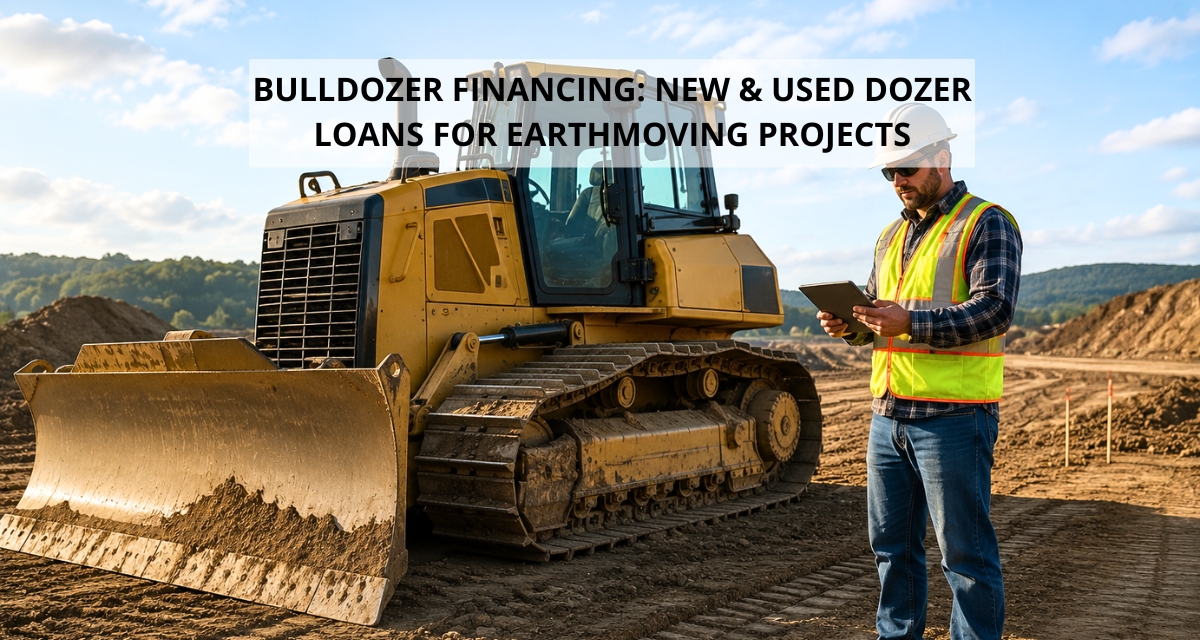
Bulldozer financing turns one of the largest equipment purchases in construction into a fixed monthly payment instead of a six-figure withdrawal from your operating account. A new crawler dozer from a major manufacturer can cost as much as a house. 

Even a clean used machine is rarely cheap once you factor in freight, attachments, and reconditioning. Few earthmoving contractors keep that kind of cash idle, and the ones who do usually need it for payroll, fuel, and the next bid.

Dimension Funding has financed equipment for small and medium-sized businesses since 1978, including the machines that move dirt for a living. The company funds new and used bulldozer purchases with fixed rates for the entire term, monthly payments stretched up to 60 months, and a one-page application for amounts up to $250,000. 

If you already have a machine picked out, you can start a financing application and get an answer the same day. If you are still weighing options, the rest of this article covers how dozer financing works, what it takes to qualify, and how to structure the deal around your cash flow.

Why Contractors Finance Dozers Instead of Paying Cash

A bulldozer earns money by the hour, not by sitting on your balance sheet. Financing matches the cost of the machine to the revenue it produces. You make a payment each month, and the dozer generates billable work. Paying cash inverts that logic: you absorb the full cost on day one and spend years recovering it.

There is also the question of what that cash could do instead. A grading contractor who drains reserves to buy a dozer outright has nothing left for a blown final drive, a slow winter, or a bonding requirement on a larger job. 

Keeping cash in the business protects your ability to operate. If a rough season does hit, working capital loans exist for that scenario, but it is better to never need one because you never emptied the account.

What Bulldozer Financing Covers

Dozer financing is not limited to the machine itself. Under its construction equipment financing program, Dimension Funding can finance 100 percent of the project, including costs buyers often forget to budget for, such as delivery and maintenance. Hauling a 20-ton machine across two states is not cheap, and rolling that cost into the financing means you pay almost nothing upfront. 

The program covers both new and used bulldozers, and used machines are where the terms genuinely matter. The price gap between a three-year-old dozer and a new one can fund a second piece of equipment, which is exactly why so many contractors shop the secondary market in the first place. 

Dimension Funding structures the term around the working life of the bulldozer, up to 60 months, so you are not making payments on a machine that has aged out of your fleet. If the dozer is part of a larger fleet purchase, the same process applies to companion machines such as mini excavators and dump trucks, so a contractor outfitting a new crew can run everything through one lender instead of three.

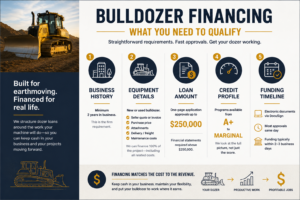
What It Takes to Qualify

Dimension Funding keeps the requirements short and publishes them plainly. Here is what the company looks for on a dozer deal:

  1. At least two years in business. This is the firm requirement. Startups under two years old do not qualify for the bulldozer program.
  2. A completed application. Approvals up to $250,000 run on a one-page application with no financial statements. Deals above $250,000 require financials.
  3. Credit somewhere on the spectrum. Programs are set up for everything from A+ credit to marginal credit, so a past rough patch does not automatically end the conversation.

The process itself runs on electronic documents signed through DocuSign, so there is nothing to print, scan, or mail. Most applicants hear back the same day, and funding typically completes within two to three business days. 

If you want to know where you stand before committing to a machine, the financing application takes only a few minutes and carries no obligation, making it a reasonable first step even while you are still comparing dozers.

Bulldozer financing - what you need to qualify

How the Numbers Work: Terms, Payments, and Taxes

Three program features shape your monthly payment:

Term length. Financing runs up to 60 months. A longer term lowers the monthly payment; a shorter term reduces total interest paid. A machine working full time on contracted jobs can justify a shorter, more aggressive payoff. A dozer that supplements rentals during peak season may fit better on the full 60 months.

Fixed rate. The rate is locked at signing and holds for the entire term. The number you budget in year one is the same number you pay in year five.

Deferred first payment. Qualifying borrowers can take no payments for the first 90 days, with restrictions. That window lets the dozer start generating revenue before the first payment comes due, a meaningful cushion when the machine is tied to a new contract that has not started paying yet.

Run your target purchase price through the payment calculator before you apply. Five minutes there tells you whether the dozer you are looking at fits your budget at 48 months or needs the full 60.

Financed equipment can also qualify for the Section 179 deduction, which under IRS rules lets businesses deduct qualifying equipment purchases in the year the equipment is placed in service rather than depreciating the cost over several years. 

Buying Used? A Short Checklist Before You Finance

A financing approval does not inspect the machine for you. Before signing on a used dozer, verify these items yourself or pay a heavy equipment mechanic to do it:

  • Undercarriage condition. Caterpillar’s maintenance guidance puts undercarriage parts and service at an average of 50 percent of a dozer’s lifetime maintenance cost, which makes it the single most expensive item to misjudge.
  • Hour meter reading against maintenance records, since hours matter more than age.
  • Final drives, hydraulics, and blade cylinders for leaks or play.
  • A clean title and a lien search on the serial number.

A thorough inspection protects the financing decision as much as the purchase decision. Sixty months is a long time to make payments on a machine with a cracked frame.

Getting a Dozer Financed with Dimension Funding

Dimension Funding has financed equipment for over 40 years, holds an A+ rating from the Better Business Bureau, and works with contractors across the U.S. The process is built for speed: a one page application for deals up to $250,000, same day approvals, electronic signing through DocuSign, and funding within two to three business days.

If you have a bulldozer purchase in front of you, new or used, apply for financing online or call 800.755.0585 to talk through the deal with someone who has structured hundreds like it. You can have an answer before the dealer closes for the day.

Frequently Asked Questions

How long can I finance a bulldozer?

Dimension Funding offers bulldozer financing terms up to 60 months with a fixed rate for the entire term. The term is structured around the machine’s working life, so used dozers qualify for monthly payment plans just as new ones do.

What credit score do I need to finance a bulldozer?

Dimension Funding does not gate approvals behind a single minimum score. Programs are set up for credit profiles ranging from A+ to marginal, and the firm must be at least 2 years old. Credit history typically affects the rate you are offered more than the approval itself.

How fast can I get approved for a dozer loan?

Most applicants receive same-day approval, and funding is typically completed within two to three business days. Deals up to $250,000 require only a one-page application with no financial statements.

What should I have ready when I apply?

For deals up to $250,000, you only need the information requested on the one-page application; financial statements come into play above that amount. Having the seller’s quote or invoice for the bulldozer on hand speeds up the paperwork, since the financed amount and equipment details come straight from it.

Does the financing cover delivery and other project costs?

Dimension Funding can finance 100 percent of the project, including delivery and maintenance costs, not just the bulldozer’s purchase price. Rolling these costs into the contract keeps your upfront cash outlay near zero.

Dump Truck Financing: Heavy-Duty Vehicle Loans for Hauling Businesses

Dump Truck Financing

Dump Truck Financing: Heavy-Duty Vehicle Loans for Hauling Businesses

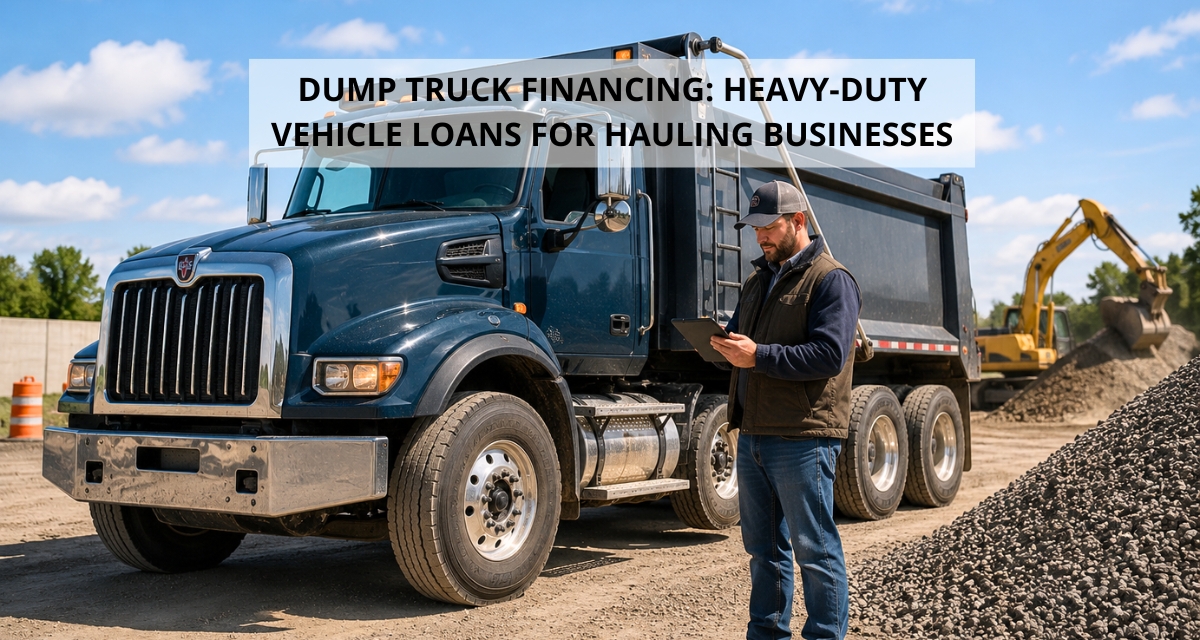
Dump truck financing covers new and used trucks alike, from single-axle units to tri-axle and super-dump configurations, with the truck itself securing the loan and payments fixed for the full term.

Lenders look at two things: the truck and the business behind it. The truck’s age and mileage determine the term, and time in business determines approval. Dimension Funding requires at least two years in business for dump truck financing, a threshold common across equipment lenders.

Dimension Funding finances new and used dump trucks with a one-page application, same-day approval decisions, and funding within two to three business days.

What Is Dump Truck Financing?

Dump truck financing is a commercial vehicle loan or lease used to purchase a dump truck, with the truck serving as collateral and the balance repaid in fixed monthly installments over terms up to 60 months. Because the truck secures the transaction, approval is faster and more flexible than unsecured business borrowing of the same size.

The sequence is short. You pick the truck, the lender pays the dealer or seller, and the truck starts hauling while you repay out of the loads it moves. For businesses running mixed fleets, the same lender relationship typically extends to commercial trucks and other vehicles, which keeps approvals and paperwork in one place as the operation grows.

What It Takes to Qualify

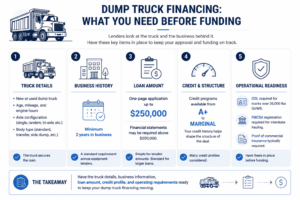
Dimension Funding’s dump truck program has three working parts. Purchases up to $250,000 are approved on a one-page application; above that amount, financial statements are required, a standard step across the industry for larger transactions.

The business must have operated for at least two years. Credit programs run from A+ tier down to marginal credit, so an imperfect history changes the structure of the deal rather than ending it.

Plan for the operational requirements in parallel. A truck with a gross vehicle weight rating above 26,000 pounds requires a commercial driver’s license to operate, and interstate hauling brings FMCSA registration into the picture. Lenders also typically expect proof of commercial insurance before funding. None of this is paperwork you want to start the week the truck arrives.

Dump Truck Financing - What you need before funding

Loan or Lease for a Dump Truck

Most dump truck buyers choose a loan, and the asset explains why. A well-maintained dump truck remains productive long after the 60-month term ends and retains resale value, so the equity built through a loan is worth having.

A lease earns consideration in two situations. Fleets that refresh trucks on a fixed cycle, often to stay ahead of emissions standards and maintenance costs, use equipment leasing to keep monthly costs lower and replacement predictable. And businesses testing a new service line sometimes lease first rather than commit to ownership before the work proves out.

Choosing the Truck: Configuration, New or Used

The truck you choose sets the loan amount, and dump trucks vary in price more than most buyers expect.

What Drives the Price

Axle count is the biggest variable after size. Tri-axle and quad-axle configurations exist largely because the federal bridge formula ties legal payload to axle spacing, so more axles mean more payload per trip in most states.

Body material matters too: aluminum beds cost more up front than steel beds but reduce tare weight, which adds payload capacity over the life of the truck. Specialty configurations such as transfer dumps and side dumps carry their own premiums.

Buying Used

Used dump trucks are readily financed and, for many operators, the sensible entry point. Mileage and engine hours together tell the condition story, since a truck can idle and work a PTO for hours without adding miles.

Documented maintenance records move underwriting along. Dealer purchases with inspection reports are the smoothest path, and private-party sales can be financed upon verification of condition and clear title.

The Section 179 Deduction on a Financed Dump Truck

A financed dump truck can qualify for the Section 179 deduction in the year it goes to work. Under IRS Section 179, a qualifying business can deduct the full purchase price of equipment placed in service during the tax year, even when the purchase is financed, subject to annual limits.

The operative phrase is placed in service. A truck ordered in December but delivered in February belongs to the next tax year, so build delivery lead times into any year-end purchase. Dimension Funding maintains a current summary of limits on its Section 179 page, and your tax professional can confirm how the rules apply to your business.

Why Hauling Businesses Choose Dimension Funding

Dimension Funding has provided equipment financing to small and medium-sized businesses since 1978 and has worked as a vendor partner to construction companies for decades. The process runs on electronic documents, approvals often come back the same day, and funding typically arrives within two to three business days.

The structure is direct: a one-page application for approvals up to $250,000, fixed monthly payments on terms up to 60 months matched to the working life of the truck, credit programs from A+ to marginal, and new and used trucks both eligible.

To put numbers on a specific truck, start a financing application or call 800.755.0585, or test payment scenarios first with the payment calculator. A quick, no-obligation quote will show what the truck costs per month before you commit to anything.

Frequently Asked Questions

How hard is it to get dump truck financing?

Dump truck financing is accessible for most established businesses because the truck itself secures the loan. Dimension Funding approves purchases up to $250,000 with a one-page application and offers credit programs ranging from A+ tier to marginal credit, with a minimum of 2 years in business.

Can I finance a used dump truck?

Yes, used dump trucks qualify for financing from dealers and, in many cases, private sellers. Lenders weigh mileage, engine hours, and maintenance history when setting terms, so documented service records strengthen an application and help underwriting move faster.

How long can you finance a dump truck?

Dimension Funding offers dump truck financing terms up to 60 months with fixed monthly payments. The term should fit the truck’s remaining working life, which is why age and mileage factor into the structure on used units.

Does dump truck financing cover delivery and other project costs?

Yes, Dimension Funding can finance 100% of the project, including delivery and maintenance costs, as well as the truck itself. Folding those costs into the financing keeps the purchase under a single approval and a single monthly payment, rather than splitting it between cash and credit.

Can I finance a trailer along with the dump truck?

Yes, Dimension Funding also finances commercial trailers, including transfer and dump trailers that pair with a truck purchase. Combining the truck and trailer under one lender keeps the paperwork consolidated and puts the full rig on a single payment schedule.

Forklift Financing: Material Handling Equipment Loans & Lease Options

Forklift Financing

Forklift Financing: Material Handling Equipment Loans & Lease Options

Forklift financing takes one of two forms: a loan, in which the business owns the truck at the end of the term, or a lease, in which the truck is returned or replaced on a set schedule. Both apply to new and used equipment, electric or internal combustion.

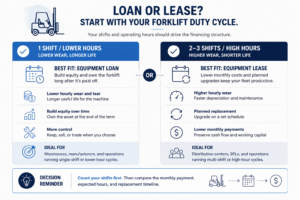
Which form fits depends mostly on duty cycle. Forklift wear tracks operating hours rather than age, so a truck running multiple shifts reaches the end of its economic life years sooner than the same model on a single shift. A loan makes sense for a truck that will stay in service long after it is paid off, while a lease fits operations that replace equipment on a shorter cycle.

Dimension Funding finances new and used forklifts and other material handling equipment with application-only approval up to $250,000, meaning no financial statements are required at that level.

What Is Forklift Financing?

Forklift financing is a commercial equipment loan or lease used to acquire a forklift, with the lift truck itself serving as collateral. Because the equipment secures the transaction, approval moves faster, and a wider range of credit profiles qualify than would for an unsecured loan of the same size.

The mechanics are simple. You choose the unit, the lender pays the dealer or seller, and you repay in fixed monthly installments over terms of up to 60 months. The forklift starts moving pallets immediately while your cash stays where it belongs, in inventory, payroll, and the orders that keep the building busy. 

When the pressure is on day-to-day cash flow rather than equipment, a separate working capital loan covers that gap without touching the equipment side at all. 

Loan or Lease: The Forklift Question

A lift running three shifts in a busy distribution center accumulates the wear in eighteen months; a single shift operation takes five years to produce.

That difference should drive the structure. High-hour, multi-shift operations often prefer an equipment lease, which keeps monthly costs lower and builds fleet replacement into the calendar before maintenance costs climb. Single shift operations that intend to run a truck for a decade or more are usually better served by a loan, since the equity they build outlasts the payments by years.

A useful shorthand: count your shifts. One shift, lean toward owning. Two or three, run the lease numbers before you commit to a purchase.

Loan or lease - start with your forklift duty cycle

Financing by Forklift Class

OSHA groups powered industrial trucks into seven classes, and the class you are buying shapes both the price and the financing conversation.

Electric Forklifts (Classes I Through III)

Electric rider trucks, narrow aisle reach trucks, and electric pallet jacks dominate indoor warehouse work. They tend to cost more up front than comparable internal combustion units, and the purchase often includes batteries and charging equipment alongside the truck itself.

A good lender treats that as one transaction. Ask whether supporting equipment can ride on the same approval, because financing the truck and buying the charger out of pocket splits a single business decision into two.

Internal Combustion Forklifts (Classes IV and V)

Cushion-tire and pneumatic-tire IC trucks handle lumber yards, ports, and outdoor storage, where capacity and runtime matter more than emissions. These units span a wide capacity range, and the larger models can carry price tags well beyond what most owners expect from a forklift.

The financing process does not change with size. Larger transactions simply move past the application-only threshold, at which point financial statements enter the picture, a standard step across the industry for bigger deals.

Rough Terrain Forklifts and Telehandlers (Class VII)

Class VII machines operate on job sites rather than on warehouse floors, which puts them in the same financing family as construction equipment. Contractors often bundle a telehandler purchase with other site machinery under one lender relationship, which keeps approvals and paperwork consolidated.

New vs. Used Forklifts

Both finance readily, and used forklifts deserve more respect than they sometimes get. A well-maintained lift truck is a durable asset, which is precisely why lenders accept one as collateral.

The hour meter is the used forklift’s odometer. A unit with documented maintenance and moderate hours moves through underwriting quickly, while a high-hour truck with no service history invites harder questions about condition and remaining life. 

Dealer sales with inspection records are the smoothest path; private-party purchases can still be financed, but expect verification of condition and clear title. One discipline worth keeping: match the term to the hours left in the machine, not the hours behind it. A loan should never outlast the asset’s earning years.

Payments, Terms, and the Section 179 Deduction

Three inputs shape the monthly number. The financed amount sets the baseline, and strong applicants may qualify to finance the full purchase. Term length ranges from 60 months with fixed payments, where a longer term lowers the monthly cost and a shorter one pays off the balance sooner.

Credit history is the third input. It influences how the deal is structured, though Dimension Funding works with most types of borrower credit, so a rough stretch shapes the terms rather than ending the conversation.

Then there is the tax side, which surprises first-time equipment buyers every year. Under IRS Section 179, a qualifying business can deduct the full purchase price of equipment placed in service during the tax year, even when the purchase is financed. 

A forklift financed in October and running by December can potentially generate a full purchase price deduction for that year, subject to annual limits. Dimension Funding keeps a current summary of those limits on its Section 179 deduction page, and your tax professional can confirm how the rules apply to your business.

The phrase that matters is placed in service. Ordered is not enough. Build delivery lead times into any year-end purchase decision.

Why Warehouses Choose Dimension Funding for Forklift Financing

Dimension Funding has provided equipment financing to small and medium-sized businesses across the U.S. since 1978. The program is built for speed: an electronic application signed through DocuSign, approvals that often come back the same day, and funding that typically lands within hours or by the next business day.

The structure is just as direct. Application-only equipment financing up to $250,000 with no financial statements. Capacity above $10 million for larger purchases. Fixed monthly payments on terms up to 60 months. Most credit types considered, new and used equipment both eligible, all backed by an A+ rating from the Better Business Bureau.

If a rental invoice started this whole line of thinking, finish it with real numbers. Start a financing application or call 800.755.0585, or test scenarios first with the payment calculator. A quick, no-obligation quote will show you exactly what the forklift costs per month before you commit to anything.

Frequently Asked Questions

Is it hard to get forklift financing?

Forklift financing is among the more accessible forms of business credit because the lift truck itself secures the loan. Dimension Funding approves equipment purchases up to $250,000 based solely on an application, with no financial statements required, and considers most types of borrower credit.

Can I finance a used forklift?

Yes, used forklifts qualify for financing from both dealers and, in many cases, private sellers. Lenders weigh hours, condition, and maintenance history when setting terms, so documented service records strengthen an application and help underwriting move faster.

How long can I finance a forklift?

Dimension Funding offers forklift financing terms up to 60 months with fixed monthly payments. The right term depends on the truck’s hours and duty cycle, since the loan should be paid off while the machine is still earning.

Can I finance more than one forklift at a time?

Yes, fleet purchases can be financed under a single relationship, and Dimension Funding provides business financing up to $10 million for larger acquisitions. Consolidating multiple units with one lender keeps the paperwork, payments, and future add-ons in one place.

Can forklift dealers offer their customers financing through Dimension Funding?

Yes, Dimension Funding runs a vendor financing program that allows forklift and material-handling dealers to offer financing directly to their buyers. Quoting a monthly payment next to the sticker price helps dealers overcome payment objections, shorten the sales cycle, and close larger transactions.

Excavator Financing: Mini, Compact & Full-Size Loans

excavator financing

Excavator Financing: Mini, Compact & Full-Size Loans

Excavator financing usually enters the picture at a very specific moment: the operator is hired, the work is lined up, and the only thing between you and the contract is a machine you cannot yet pay cash for.

Most contractors know the workarounds by heart. Rent and watch the margin shrink. Sub out the dirt work and watch the schedule slip. Pass on the job entirely and let a competitor have it. Financing is the fourth option, the one where the machine shows up this week and pays its own way out of the work it does.

This guide explains how excavator loans work across all three size classes, what affects your payment, how new and used machines are financed differently, and where the tax code works in your favor.

If you already have a machine in mind, Dimension Funding finances new and used excavators with application-only approval up to $250,000, so no financial statements are required at that level. You can have an answer before the dealer changes the price.

What Is Excavator Financing?

Excavator financing is a commercial equipment loan or lease used to purchase an excavator, with the machine itself serving as collateral. Because the equipment secures the loan, lenders can approve faster and accept a wider range of credit profiles than they would for an unsecured loan of the same size. 

Financing is also the norm rather than the exception. Surveys from the Equipment Leasing and Finance Association consistently find that most U.S. businesses acquire equipment through financing rather than paying cash.

The structure is straightforward. You select the machine, the lender pays the dealer or private seller, and you repay the balance in fixed monthly installments, typically over terms up to 60 months. The excavator goes to work immediately. Your cash stays in the business, covering payroll, fuel, and materials while the machine generates the revenue that covers its own payment.

That last point is the entire logic of equipment financing. An excavator sitting on a job site, billing hourly, is an income-producing asset. Paying for it out of future income it produces is usually smarter than draining the reserves you need to win and run the jobs in the first place. If cash flow is the tighter constraint, a separate working capital loan can cover operating gaps without touching the equipment loan at all.

Mini, Compact, or Full Size: Matching the Loan to the Machine

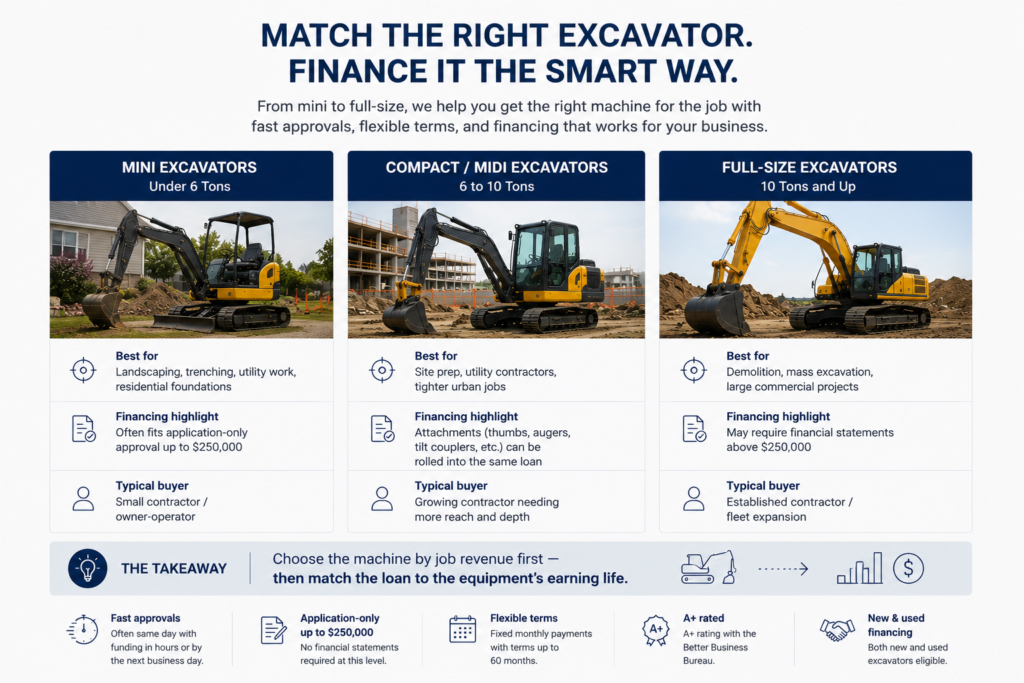
The size class you buy changes the loan amount, but the financing process is nearly identical across all three. What differs is how much of the purchase falls under application-only approval thresholds.

Mini Excavators (Under 6 Tons)

Mini excavators handle trenching, landscaping, utility work, and residential foundations, and most models fall well within application-only territory. For machines in this range, Dimension Funding can approve mini excavator financing without financial statements, often the same day, with funding in hours or by the next business day once documents are signed electronically.

For a small contractor or an owner-operator adding a first machine, this matters. The approval process is a brief electronic application, not a loan committee review. Qualified borrowers may also defer payments for 90 days, with some restrictions, which gives a new machine a full quarter to start earning before the first payment comes due.

Compact and Midi Excavators (6 to 10 Tons)

Midi machines bridge the gap between backyard access and real digging depth. They are popular with site prep crews and utility contractors who need more reach than a mini provides but still work in tight urban lots.

Pricing for these machines varies widely depending on attachments. A hydraulic thumb, an auger drive, or a tilt coupler can add meaningful cost, and a good equipment lender will roll attachments into the same loan rather than forcing a second transaction. Ask before you sign, because financing the bucket separately from the machine is a paperwork problem you do not need.

Full Size Excavators (10 Tons and Up)

Full-size excavators are the heavy hitters of construction equipment financing, and their price tags often exceed application-only limits. Above $250,000, expect to provide financial statements, which is standard across the industry for transactions of that size.

The good news is that larger deals get more structural flexibility. Dimension Funding provides business financing of up to $10 million, so a fleet purchase or a full-size machine with a long-reach boom and multiple attachments can be financed at a single facility. Contractors expanding into demolition or mass excavation frequently pair an excavator loan with dump truck financing to build out the full production loop at once.

match the right excavator

New vs. Used Excavator Loans

Lenders finance both, but the math differs in ways worth understanding before you shop.

New machines carry full warranties and the latest emissions and telematics packages, and they typically qualify for the longest terms because their useful life extends furthest beyond the loan term. Used machines cost less up front, and a well-maintained excavator with documented hours holds value remarkably well, which is exactly why lenders are comfortable taking one as collateral.

The variable to watch on used equipment is the seller. Dealer sales with inspection records move through underwriting quickly. Private party sales can still be financed, but expect the lender to verify the machine’s condition and clear title. Dimension Funding finances both new and used excavators, so the decision can rest on jobsite economics rather than on what a lender will allow.

One practical rule: match the loan term to the machine’s remaining working life. Financing a 9,000-hour excavator over 60 months invites a situation where you are making payments on a machine that has stopped earning. A shorter term costs more per month and saves you from that trap.

What Shapes Your Monthly Payment

Four inputs determine what you will pay each month.

Loan amount and down payment. The financed balance drives everything. Some programs require a down payment, while strong applicants may qualify for full financing of the purchase price.

Term length. Terms up to 60 months are available. Longer terms lower the monthly payment, while shorter terms pay the machine off sooner and free up borrowing capacity for your next purchase.

Credit profile. Lenders weigh credit history when structuring a deal. Dimension Funding works with most types of borrower credit, so a past rough patch shapes the structure rather than automatically triggering a decline.

Structure: loan vs. lease. A loan builds equity toward ownership. An equipment lease can lower monthly costs and simplify upgrades when technology or emissions standards change. The right answer depends on how long you plan to run the machine.

Before talking to any lender, decide what monthly payment your job calendar can support, and test how the term length and loan amount affect that number. Walking into a financing conversation with a target payment in mind puts you in control of the negotiation.

Section 179 and the Tax Side of an Excavator Purchase

A financed excavator can generate a tax deduction far larger than the payments you make in year one. Under IRS Section 179, qualifying businesses can deduct the full purchase price of equipment placed in service during the tax year, even when the purchase is financed.

Read that again, because it surprises many first-time buyers. You can finance the machine, make a handful of monthly payments before December 31, and still deduct the entire purchase price for that tax year, subject to annual IRS limits. Dimension Funding maintains a current breakdown of limits and qualifying rules on its Section 179 deduction page.

Timing matters here. The machine must be placed in service, not merely ordered, before year-end. Contractors planning a Q4 purchase should factor in delivery lead times when making the decision and confirm specifics with their tax professional, since eligibility depends on your business’s income and total equipment spend.

Why Contractors Finance Excavators Through Dimension Funding

Dimension Funding has provided equipment financing to small and medium-sized businesses across the U.S. since 1978. That tenure shows up in the details that matter on a deal: an electronic application signed through DocuSign, approvals that often come back the same day, and funding that typically lands within hours or by the next business day.

The numbers that define the program are simple. Application-only equipment financing up to $250,000 with no financial statements. Total financing capacity above $10 million for larger purchases. Fixed monthly payments with terms up to 60 months. Most credit types considered. New and used machines both eligible. An A+ rating from the Better Business Bureau backs all of it.

If you are pricing a mini excavator for utility work or a 30-ton machine for mass excavation, start a financing application or call 800.755.0585. You can also run the numbers yourself first with the payment calculator. Either way, a quick, no-obligation quote will tell you exactly what the machine costs per month before you commit to anything.

Frequently Asked Questions

How hard is it to get financing for an excavator?

Excavator financing is among the more accessible forms of business credit because the machine itself secures the loan. Lenders like Dimension Funding consider most types of borrower credit, and equipment purchases up to $250,000 can be approved on an application alone, without financial statements.

Can I finance a used excavator?

Yes, used excavators qualify for financing, including machines purchased from dealers and, in many cases, private sellers. Lenders will weigh the machine’s age, hours, and condition when setting terms, so documented maintenance records strengthen your application and help underwriting move faster.

How long can I finance an excavator for?

Dimension Funding offers excavator financing terms up to 60 months with fixed monthly payments. The right term depends on the machine’s age and remaining working life, since the loan should not outlast the equipment’s earning years.

Can I deduct a financed excavator on my taxes?

Yes, financed equipment can qualify for the Section 179 deduction in the year it is placed in service, even though you have not paid for it in full. That means a machine financed in November can potentially generate a full purchase price deduction for that tax year. Confirm eligibility and current limits with your tax advisor.

Do excavator attachments count toward the loan?

Attachments such as buckets, thumbs, augers, and couplers can typically be rolled into the same financing as the machine. Bundling them keeps you on one payment and one approval rather than splitting the purchase across multiple transactions.

Can equipment dealers offer their customers financing through Dimension Funding?

Yes, Dimension Funding runs a vendor financing program that lets excavator dealers and equipment sellers offer financing directly to their buyers. Presenting a monthly payment next to the sticker price helps dealers overcome payment objections, shorten the sales cycle, and close larger transactions.