


A working capital loan offer can look great on the surface: a fast approval, a friendly sales call, a number that solves your immediate cash flow problem. But the details that actually matter are often buried in the fine print, and the only way to surface them is to ask directly before you sign anything.
Dimension Funding has spent over 40 years financing small and mid-sized businesses across the U.S., and giving straight answers to these exact questions is part of how the company built its working capital program. Contact Dimension Funding to get clear answers before you sign anything, or keep reading for the seven questions worth asking any lender first.
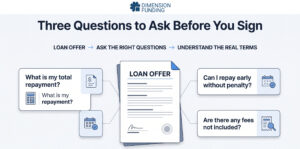
Three Questions Lenders Hope You Don’t Ask
A lot of borrowers compare loans by looking only at the advertised cost or the periodic payment. Those numbers matter, but they rarely tell the whole story.
Ask This | Why It Matters |
What is my total repayment? | Reveals the actual amount you’ll repay over the life of the loan, including all required charges |
Can I repay early without penalty? | Determines whether paying off the loan ahead of schedule will actually save money or trigger extra fees |
Are there any fees not included in the quoted terms? | Helps you spot origination fees, admin charges, late-payment fees, or other costs that push up the loan’s overall price |
Why These Three Matter More Than the Headline Number
These questions push the conversation past marketing lines like “affordable financing” or “fast approval.” A trustworthy lender should be able to give you clear, written answers with actual dollar amounts, not vague promises or sales talk. Prepayment deserves special attention, because not every loan lets you pay off debt early without a downside. CFPB’s general explanation of how prepayment penalties work notes that a prepayment penalty is a fee some lenders charge for paying off a loan early, and recommends understanding exactly when and how much a penalty would apply before signing. That guidance is written for mortgages specifically, but the same idea carries over to business financing: ask before you sign, not after you’re already trying to pay a loan off.
What Is the Total Cost of This Loan, Not Just the Quoted Terms?
A quoted headline number rarely tells the whole story. Origination fees, closing costs, and other charges can meaningfully add to what you actually repay, even when the advertised terms look good on paper.
Ask for the total dollar amount you’ll repay over the life of the loan, not just the periodic payment or the quoted terms. A lender who can answer this clearly and immediately is generally one who prices transparently instead of burying costs in the fine print.
Is the Payment Fixed, or Can It Change During the Term?
Some working capital financing carries a fixed payment that never moves once the loan is signed, while other products — especially those tied to daily sales, like a merchant cash advance — carry costs that shift depending on how the business performs.
Dimension Funding’s working capital loans use fixed payments that don’t change over the life of the loan, giving borrowers certainty from the first payment to the last. Confirming whether your payment is truly fixed protects you from surprises if revenue swings during repayment.
What Repayment Schedules Are Available, and Can I Choose?
Repayment frequency — weekly, daily, or monthly — affects how a loan actually fits into your cash flow, not just how the payment looks on paper. A schedule that doesn’t match your revenue pattern can create unnecessary strain even on an otherwise reasonable loan.
Ask whether the lender offers multiple repayment options and whether you get any say in choosing the one that fits your business. A lender willing to build repayment around your revenue pattern, instead of forcing one rigid schedule, is usually easier to work with over the life of the loan.
Is There a Personal Guarantee or Collateral Requirement?
Many working capital loans are unsecured, meaning no specific business asset is pledged as collateral. But unsecured doesn’t mean risk-free. Many still require a personal guarantee, which makes the business owner personally responsible if the business can’t repay.
Ask directly whether a personal guarantee is required, and if so, whether it’s limited or unlimited in scope.
This kind of requirement isn’t unique to alternative lenders, either — the SBA’s own Unconditional Guarantee form confirms that anyone owning 20% or more of a business applying for an SBA-backed loan must sign an unlimited personal guarantee, which shows just how standard this kind of requirement is across small business lending generally, not something specific to any one lender. Understanding exactly what you’re personally on the hook for is one of the most important things to clarify before signing anything.
What Happens If I Need to Repay Early?
Some loans charge a prepayment penalty, while others let you pay off early at no extra cost, and the difference matters if your cash flow improves faster than expected. A shorter effective term generally lowers the total cost of the loan, so being able to prepay without a penalty can meaningfully change what a loan ends up costing you.
Ask specifically how early repayment is treated before you sign, not after you’re already trying to pay the loan off. A lender who doesn’t penalize early payoff is generally giving you more room to manage your total cost over time.
How Fast Can I Actually Expect Funding After Approval?
Approval and funding aren’t always on the same timeline, and the gap between the two can matter a lot if you’re dealing with an urgent cash flow need. A lender might approve quickly but take much longer to actually send the money.
Many lenders, including Dimension Funding, can offer same-day or next-business-day funding once a completed application and bank statements are submitted. Getting a specific, realistic funding timeline upfront, instead of a vague estimate, helps you plan around when the money will actually show up.
What Documentation Will I Need to Provide?
Documentation requirements vary a lot between lenders, and knowing what to expect upfront saves time and avoids delays partway through. Some lenders want extensive financial statements; others rely mostly on bank statements and a simple application.
Ask specifically how many months of bank statements are required, whether tax returns are needed, and at what loan amount those requirements change. A lender who can answer this precisely, rather than vaguely, is one with a clear and consistent underwriting process.
The Best Loan Is the One You Understand Completely
A working capital loan is a commitment, and the time to understand every detail of that commitment is before you sign, not after. Asking these questions, and expecting clear, specific answers to each one, puts you in a much stronger position to choose the right lender for your business. Dimension Funding offers working capital loans between $25,000 and $250,000, with terms up to 24 months and repayment plans that flex around your business model. Contact Dimension Funding for straightforward answers to all seven questions before you sign anything.
FAQs
Is it reasonable to ask these seven questions over the phone, or should I get answers in writing?
Both have a place. A phone conversation is a good first filter for how transparent a lender seems, but getting the specific numbers and terms in writing before signing protects you if there’s ever a discrepancy between what was said and what the contract actually states.
Do these questions apply the same way to a line of credit as they do to a term loan?
Mostly, yes, though a couple need slight adjustment. For a line of credit, “total cost” depends on how much you actually draw and for how long, so it’s worth asking how cost is calculated on the drawn portion specifically rather than assuming it works the same as a lump-sum loan.
Should I ask these questions again if I renew or refinance an existing loan?
Yes. Terms can change between an original loan and a renewal or refinance, even with the same lender, so it’s worth confirming total cost, repayment structure, and any personal guarantee terms again rather than assuming they carry over automatically.
What’s a reasonable amount of time to expect a lender to answer all seven questions?
A lender with a clear, consistent underwriting process should be able to answer most of these on an initial call, with written confirmation of specific numbers following shortly after. A lender who needs several days just to answer basic structural questions may not have a very transparent process.
Are there questions beyond these seven that are worth asking for a larger loan request?
For larger requests, it’s often worth also asking about any financial covenants or reporting requirements that come with the loan, since bigger loans sometimes carry ongoing obligations beyond just the repayment schedule itself.
If a lender’s answers to these questions differ from what a broker told me, which should I trust?
The lender’s own written terms take precedence, since a broker is generally relaying information rather than setting the actual terms of the loan. Any discrepancy is worth clarifying directly with the lender before signing.
Does asking these questions upfront ever slow down the approval process?
Generally not in a meaningful way. A lender with a transparent, well-organized process can usually answer these questions without adding real delay, and doing so before signing is far faster than trying to untangle a misunderstanding after funding.