

Working Capital Loan Requirements: Two Years, $200K, No Stacking

working capital loan requirements

Working Capital Loan Requirements: Two Years, $200K, No Stacking

Working capital loan qualification often gets reduced to a single number, your credit score, when the reality is far more specific. Time in business, revenue thresholds, and existing debt obligations all play a role, and understanding exactly what a lender is checking for makes the difference between a smooth approval and a frustrating rejection.

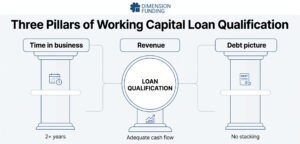
Dimension Funding has spent over 40 years financing small and mid-sized businesses across the U.S., with working capital requirements built around three consistent pillars: sufficient operating history, adequate revenue, and a clean debt picture free of existing stacked loans. Contact Dimension Funding to see where your business stands, or keep reading to break down each requirement in detail.
 

Working-Capital-Loan-Requirements-Two-Years,-$200K,-No-Stacking

Two Years: Why Operating History Matters

Time in business is one of the clearest signals a lender uses to gauge risk. A business that’s weathered two years of slow months, seasonal swings, and unexpected expenses has demonstrated a kind of resilience that a brand-new company simply hasn’t had the chance to prove yet.

That doesn’t mean newer businesses are automatically disqualified everywhere, but a shorter operating history typically means less favorable terms or a smaller approved amount until more history builds up. 

This pattern shows up in national data too — the Federal Reserve Bank of Chicago’s analysis of the 2024 Small Business Credit Survey found that approval rates overall remained lower in 2024 than they were in 2019, and that many applicants who didn’t receive their full request cited not meeting a lender’s credit qualifications as the reason. Businesses approaching or just past the two-year mark are often in the strongest position to qualify for the most favorable terms, since they’ve cleared the threshold most lenders consider a meaningful track record.

$200K: What Revenue Threshold Actually Signals

A revenue requirement exists for a simple reason: a lender needs evidence that a business generates enough income to support a new fixed payment on top of everything else it already covers. Requiring a minimum annual revenue level, rather than just checking a credit score, ties approval directly to the business’s actual ability to repay.

Dimension Funding’s working capital requirements generally call for annual revenue above $150,000, with larger loan requests over $100,000 requiring corporate tax returns in addition to bank statements. Revenue thresholds like these scale with loan size for a reason: a $200,000 loan request needs a stronger revenue picture behind it than a $25,000 request, since the lender’s exposure is proportionally larger.

Why Bank Statements Matter More Than Your Profit & Loss Statement

Many business owners assume a strong profit and loss statement is the main factor lenders consider when reviewing a working capital loan application. While a P&L provides important information about profitability, lenders often look deeper into actual cash movement to determine whether a business can support a new repayment obligation.

Document

What It Shows

Why Lenders Care

Bank statements

Actual cash deposits and withdrawals

Verifies real cash flow, payment patterns, and existing obligations

Profit & Loss statement

Accounting income and expenses

Shows profitability but may include non-cash items or timing differences

Tax return

Annual reported business performance

Confirms reported revenue and overall financial history

Why Lenders Cross-Check These Documents Together

Lenders typically review these documents together rather than relying on a single source. The SBA’s 7(a) Loan Application Checklist illustrates how lenders commonly evaluate financial statements, tax returns, and cash flow projections together rather than in isolation when reviewing a loan application. 

A company may show strong revenue on a tax return and positive income on a P&L, but recent bank statements could reveal declining deposits, frequent overdrafts, or multiple existing loan withdrawals, details that may require additional explanation before approval. For working capital borrowers, the lesson is simple: profitability tells lenders how a business performed, but bank statements show how the business is operating today, and that distinction can make a major difference during underwriting.

No Stacking: Why Lenders Check for Existing Debt

Loan stacking, taking on multiple loans simultaneously and often from different lenders, is one of the clearest red flags in underwriting. A business carrying several overlapping repayment obligations has less available cash flow to absorb a new loan payment, regardless of how strong its revenue looks on paper.

Lenders check for this through bank statement review, credit inquiries, and UCC filings that reveal existing secured financing. If a business shows signs of recent stacking, a lender may reduce the approved amount, request additional documentation, or decline the application outright, since the added debt materially changes the risk of the new loan being repaid on schedule.

Ownership Documentation: The Requirement Often Overlooked

Beyond time in business, revenue, and existing debt, lenders also need to confirm who actually controls the business applying for the loan. Most working capital lenders require documentation showing at least 51% ownership, ensuring that whoever signs the application and any accompanying personal guarantee has real authority over the business.

This requirement matters because a personal guarantee is only meaningful if it’s tied to someone with genuine decision-making power in the company. Gathering ownership documentation ahead of time, rather than scrambling for it mid-application, is one of the simplest ways to avoid unnecessary delays in underwriting.

What Happens If You Don’t Meet One of the Three

Falling short on one requirement doesn’t automatically mean disqualification, but it does typically shift the terms of what’s offered. A business just under two years old with very strong recent revenue may still qualify, often with a smaller approved amount or a shorter term until more history builds.

Similarly, a business with revenue just below a lender’s threshold might still qualify for a reduced loan amount that matches actual repayment capacity. The clearest disqualifier tends to be undisclosed stacking, since it directly undermines a lender’s ability to trust the rest of the application, which is why transparency about existing debt matters more than almost any other factor.

How to Position Your Business Before Applying

If your business is approaching the two-year mark, it’s often worth waiting until you cross that threshold before applying, since the difference in terms can be meaningful. If revenue is close to a lender’s minimum, a few months of documented growth can materially improve your position.

And if you have any existing financing, the smartest move is disclosing it upfront rather than letting a lender discover it during underwriting. A business that’s transparent about its current obligations, and requests an amount realistically sized around them, tends to move through approval far more smoothly than one hoping a gap goes unnoticed.

Three Pillars, One Clear Picture

Two years in business, an adequate revenue threshold, and a clean debt picture free of stacking aren’t arbitrary hurdles. Together, they give a lender a genuine picture of whether a business can responsibly take on a new loan. Dimension Funding offers working capital loans between $25,000 and $250,000, with terms up to 24 months and same-day or next-business-day funding. Contact Dimension Funding to find out where your business stands against these requirements.

FAQs

How many months of bank statements do I need to provide?

Requirements typically range from three months for smaller loan requests to six months for larger ones, since bank statements are central to verifying revenue and debt history.

If my business is an LLC with multiple owners, does each owner need to meet the two-year requirement individually?

Generally, the operating history requirement applies to the business entity itself rather than to each individual owner. What matters more for each owner above the ownership threshold is providing accurate personal and ownership documentation, not an individual track record.

Does a seasonal business get evaluated differently for the revenue threshold?

Lenders typically look at annual revenue as a whole rather than penalizing a business for uneven monthly totals, but strong documentation of the seasonal pattern helps a lender understand why certain months look lighter than others.

Can a business with two different revenue streams combine them to meet the threshold?

Usually, yes, as long as both revenue streams flow through the same business bank accounts and are reflected consistently across bank statements and tax returns. Inconsistent or unclear commingling of separate revenue sources can complicate underwriting rather than help it.

Does a recent large one-time expense count against a business during underwriting?

Not typically on its own, but it’s worth having a clear explanation ready. Lenders reviewing bank statements may flag a large, unusual withdrawal and ask for context to confirm it wasn’t a sign of financial strain rather than a planned, one-time cost.

If a business has fully paid off a previous stacked loan, does that history still count against a new application?

A fully repaid loan generally counts in a business’s favor rather than against it, since it demonstrates the debt was managed and closed out responsibly. What matters most to a new lender is the business’s current, active debt picture rather than resolved obligations from the past.

Is there a way to get a preliminary sense of qualification before submitting a full application?

Many lenders, including Dimension Funding, can give an early read on likely qualification based on a general overview of revenue, time in business, and existing debt before a business submits full documentation, which can save time if the fit isn’t there yet.


Working Capital Loan Requirements: Two Years, $200K, No Stacking

working capital loan requirements

Working Capital Loan Requirements: Two Years, $200K, No Stacking

Working capital loan qualification often gets reduced to a single number, your credit score, when the reality is far more specific. Time in business, revenue thresholds, and existing debt obligations all play a role, and understanding exactly what a lender is checking for makes the difference between a smooth approval and a frustrating rejection.

Dimension Funding has spent over 40 years financing small and mid-sized businesses across the U.S., with working capital requirements built around three consistent pillars: sufficient operating history, adequate revenue, and a clean debt picture free of existing stacked loans. Contact Dimension Funding to see where your business stands, or keep reading to break down each requirement in detail.


Working-Capital-Loan-Requirements-Two-Years,-$200K,-No-Stacking

Two Years: Why Operating History Matters

Time in business is one of the clearest signals a lender uses to gauge risk. A business that’s weathered two years of slow months, seasonal swings, and unexpected expenses has demonstrated a kind of resilience that a brand-new company simply hasn’t had the chance to prove yet.

That doesn’t mean newer businesses are automatically disqualified everywhere, but a shorter operating history typically means less favorable terms or a smaller approved amount until more history builds up. 

This pattern shows up in national data too — the Federal Reserve Bank of Chicago’s analysis of the 2024 Small Business Credit Survey found that approval rates overall remained lower in 2024 than they were in 2019, and that many applicants who didn’t receive their full request cited not meeting a lender’s credit qualifications as the reason. Businesses approaching or just past the two-year mark are often in the strongest position to qualify for the most favorable terms, since they’ve cleared the threshold most lenders consider a meaningful track record.

$200K: What Revenue Threshold Actually Signals

A revenue requirement exists for a simple reason: a lender needs evidence that a business generates enough income to support a new fixed payment on top of everything else it already covers. Requiring a minimum annual revenue level, rather than just checking a credit score, ties approval directly to the business’s actual ability to repay.

Dimension Funding’s working capital requirements generally call for annual revenue above $150,000, with larger loan requests over $100,000 requiring corporate tax returns in addition to bank statements. Revenue thresholds like these scale with loan size for a reason: a $200,000 loan request needs a stronger revenue picture behind it than a $25,000 request, since the lender’s exposure is proportionally larger.

Why Bank Statements Matter More Than Your Profit & Loss Statement

Many business owners assume a strong profit and loss statement is the main factor lenders consider when reviewing a working capital loan application. While a P&L provides important information about profitability, lenders often look deeper into actual cash movement to determine whether a business can support a new repayment obligation.

Document

What It Shows

Why Lenders Care

Bank statements

Actual cash deposits and withdrawals

Verifies real cash flow, payment patterns, and existing obligations

Profit & Loss statement

Accounting income and expenses

Shows profitability but may include non-cash items or timing differences

Tax return

Annual reported business performance

Confirms reported revenue and overall financial history

Why Lenders Cross-Check These Documents Together

Lenders typically review these documents together rather than relying on a single source. The SBA’s 7(a) Loan Application Checklist illustrates how lenders commonly evaluate financial statements, tax returns, and cash flow projections together rather than in isolation when reviewing a loan application. 

A company may show strong revenue on a tax return and positive income on a P&L, but recent bank statements could reveal declining deposits, frequent overdrafts, or multiple existing loan withdrawals, details that may require additional explanation before approval. For working capital borrowers, the lesson is simple: profitability tells lenders how a business performed, but bank statements show how the business is operating today, and that distinction can make a major difference during underwriting.

No Stacking: Why Lenders Check for Existing Debt

Loan stacking, taking on multiple loans simultaneously and often from different lenders, is one of the clearest red flags in underwriting. A business carrying several overlapping repayment obligations has less available cash flow to absorb a new loan payment, regardless of how strong its revenue looks on paper.

Lenders check for this through bank statement review, credit inquiries, and UCC filings that reveal existing secured financing. If a business shows signs of recent stacking, a lender may reduce the approved amount, request additional documentation, or decline the application outright, since the added debt materially changes the risk of the new loan being repaid on schedule.

Ownership Documentation: The Requirement Often Overlooked

Beyond time in business, revenue, and existing debt, lenders also need to confirm who actually controls the business applying for the loan. Most working capital lenders require documentation showing at least 51% ownership, ensuring that whoever signs the application and any accompanying personal guarantee has real authority over the business.

This requirement matters because a personal guarantee is only meaningful if it’s tied to someone with genuine decision-making power in the company. Gathering ownership documentation ahead of time, rather than scrambling for it mid-application, is one of the simplest ways to avoid unnecessary delays in underwriting.

What Happens If You Don’t Meet One of the Three

Falling short on one requirement doesn’t automatically mean disqualification, but it does typically shift the terms of what’s offered. A business just under two years old with very strong recent revenue may still qualify, often with a smaller approved amount or a shorter term until more history builds.

Similarly, a business with revenue just below a lender’s threshold might still qualify for a reduced loan amount that matches actual repayment capacity. The clearest disqualifier tends to be undisclosed stacking, since it directly undermines a lender’s ability to trust the rest of the application, which is why transparency about existing debt matters more than almost any other factor.

How to Position Your Business Before Applying

If your business is approaching the two-year mark, it’s often worth waiting until you cross that threshold before applying, since the difference in terms can be meaningful. If revenue is close to a lender’s minimum, a few months of documented growth can materially improve your position.

And if you have any existing financing, the smartest move is disclosing it upfront rather than letting a lender discover it during underwriting. A business that’s transparent about its current obligations, and requests an amount realistically sized around them, tends to move through approval far more smoothly than one hoping a gap goes unnoticed.

Three Pillars, One Clear Picture

Two years in business, an adequate revenue threshold, and a clean debt picture free of stacking aren’t arbitrary hurdles. Together, they give a lender a genuine picture of whether a business can responsibly take on a new loan. Dimension Funding offers working capital loans between $25,000 and $250,000, with terms up to 24 months and same-day or next-business-day funding. Contact Dimension Funding to find out where your business stands against these requirements.

FAQs

How many months of bank statements do I need to provide?

Requirements typically range from three months for smaller loan requests to six months for larger ones, since bank statements are central to verifying revenue and debt history.

If my business is an LLC with multiple owners, does each owner need to meet the two-year requirement individually?

Generally, the operating history requirement applies to the business entity itself rather than to each individual owner. What matters more for each owner above the ownership threshold is providing accurate personal and ownership documentation, not an individual track record.

Does a seasonal business get evaluated differently for the revenue threshold?

Lenders typically look at annual revenue as a whole rather than penalizing a business for uneven monthly totals, but strong documentation of the seasonal pattern helps a lender understand why certain months look lighter than others.

Can a business with two different revenue streams combine them to meet the threshold?

Usually, yes, as long as both revenue streams flow through the same business bank accounts and are reflected consistently across bank statements and tax returns. Inconsistent or unclear commingling of separate revenue sources can complicate underwriting rather than help it.

Does a recent large one-time expense count against a business during underwriting?

Not typically on its own, but it’s worth having a clear explanation ready. Lenders reviewing bank statements may flag a large, unusual withdrawal and ask for context to confirm it wasn’t a sign of financial strain rather than a planned, one-time cost.

If a business has fully paid off a previous stacked loan, does that history still count against a new application?

A fully repaid loan generally counts in a business’s favor rather than against it, since it demonstrates the debt was managed and closed out responsibly. What matters most to a new lender is the business’s current, active debt picture rather than resolved obligations from the past.

Is there a way to get a preliminary sense of qualification before submitting a full application?

Many lenders, including Dimension Funding, can give an early read on likely qualification based on a general overview of revenue, time in business, and existing debt before a business submits full documentation, which can save time if the fit isn’t there yet.
Seven Questions to Ask a Working Capital Lender Before You Sign

working capital lenders

Seven Questions to Ask a Working Capital Lender Before You Sign

A working capital loan offer can look great on the surface: a fast approval, a friendly sales call, a number that solves your immediate cash flow problem. But the details that actually matter are often buried in the fine print, and the only way to surface them is to ask directly before you sign anything.

Dimension Funding has spent over 40 years financing small and mid-sized businesses across the U.S., and giving straight answers to these exact questions is part of how the company built its working capital program. Contact Dimension Funding to get clear answers before you sign anything, or keep reading for the seven questions worth asking any lender first.

Seven-Questions-to-Ask-a-Working-Capital-Lender-Before-You-Sign

Three Questions Lenders Hope You Don’t Ask

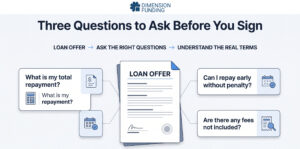
A lot of borrowers compare loans by looking only at the advertised cost or the periodic payment. Those numbers matter, but they rarely tell the whole story.

Ask This

Why It Matters

What is my total repayment?

Reveals the actual amount you’ll repay over the life of the loan, including all required charges

Can I repay early without penalty?

Determines whether paying off the loan ahead of schedule will actually save money or trigger extra fees

Are there any fees not included in the quoted terms?

Helps you spot origination fees, admin charges, late-payment fees, or other costs that push up the loan’s overall price

Why These Three Matter More Than the Headline Number

These questions push the conversation past marketing lines like “affordable financing” or “fast approval.” A trustworthy lender should be able to give you clear, written answers with actual dollar amounts, not vague promises or sales talk. Prepayment deserves special attention, because not every loan lets you pay off debt early without a downside. CFPB’s general explanation of how prepayment penalties work notes that a prepayment penalty is a fee some lenders charge for paying off a loan early, and recommends understanding exactly when and how much a penalty would apply before signing. That guidance is written for mortgages specifically, but the same idea carries over to business financing: ask before you sign, not after you’re already trying to pay a loan off.

What Is the Total Cost of This Loan, Not Just the Quoted Terms?

A quoted headline number rarely tells the whole story. Origination fees, closing costs, and other charges can meaningfully add to what you actually repay, even when the advertised terms look good on paper.

Ask for the total dollar amount you’ll repay over the life of the loan, not just the periodic payment or the quoted terms. A lender who can answer this clearly and immediately is generally one who prices transparently instead of burying costs in the fine print.

Is the Payment Fixed, or Can It Change During the Term?

Some working capital financing carries a fixed payment that never moves once the loan is signed, while other products — especially those tied to daily sales, like a merchant cash advance — carry costs that shift depending on how the business performs.

Dimension Funding’s working capital loans use fixed payments that don’t change over the life of the loan, giving borrowers certainty from the first payment to the last. Confirming whether your payment is truly fixed protects you from surprises if revenue swings during repayment.

What Repayment Schedules Are Available, and Can I Choose?

Repayment frequency — weekly, daily, or monthly — affects how a loan actually fits into your cash flow, not just how the payment looks on paper. A schedule that doesn’t match your revenue pattern can create unnecessary strain even on an otherwise reasonable loan.

Ask whether the lender offers multiple repayment options and whether you get any say in choosing the one that fits your business. A lender willing to build repayment around your revenue pattern, instead of forcing one rigid schedule, is usually easier to work with over the life of the loan.

Is There a Personal Guarantee or Collateral Requirement?

Many working capital loans are unsecured, meaning no specific business asset is pledged as collateral. But unsecured doesn’t mean risk-free. Many still require a personal guarantee, which makes the business owner personally responsible if the business can’t repay.

Ask directly whether a personal guarantee is required, and if so, whether it’s limited or unlimited in scope. 

This kind of requirement isn’t unique to alternative lenders, either — the SBA’s own Unconditional Guarantee form confirms that anyone owning 20% or more of a business applying for an SBA-backed loan must sign an unlimited personal guarantee, which shows just how standard this kind of requirement is across small business lending generally, not something specific to any one lender. Understanding exactly what you’re personally on the hook for is one of the most important things to clarify before signing anything.

What Happens If I Need to Repay Early?

Some loans charge a prepayment penalty, while others let you pay off early at no extra cost, and the difference matters if your cash flow improves faster than expected. A shorter effective term generally lowers the total cost of the loan, so being able to prepay without a penalty can meaningfully change what a loan ends up costing you.

Ask specifically how early repayment is treated before you sign, not after you’re already trying to pay the loan off. A lender who doesn’t penalize early payoff is generally giving you more room to manage your total cost over time.

How Fast Can I Actually Expect Funding After Approval?

Approval and funding aren’t always on the same timeline, and the gap between the two can matter a lot if you’re dealing with an urgent cash flow need. A lender might approve quickly but take much longer to actually send the money.

Many lenders, including Dimension Funding, can offer same-day or next-business-day funding once a completed application and bank statements are submitted. Getting a specific, realistic funding timeline upfront, instead of a vague estimate, helps you plan around when the money will actually show up.

What Documentation Will I Need to Provide?

Documentation requirements vary a lot between lenders, and knowing what to expect upfront saves time and avoids delays partway through. Some lenders want extensive financial statements; others rely mostly on bank statements and a simple application.

Ask specifically how many months of bank statements are required, whether tax returns are needed, and at what loan amount those requirements change. A lender who can answer this precisely, rather than vaguely, is one with a clear and consistent underwriting process.

The Best Loan Is the One You Understand Completely

A working capital loan is a commitment, and the time to understand every detail of that commitment is before you sign, not after. Asking these questions, and expecting clear, specific answers to each one, puts you in a much stronger position to choose the right lender for your business. Dimension Funding offers working capital loans between $25,000 and $250,000, with terms up to 24 months and repayment plans that flex around your business model. Contact Dimension Funding for straightforward answers to all seven questions before you sign anything.

FAQs

Is it reasonable to ask these seven questions over the phone, or should I get answers in writing?

Both have a place. A phone conversation is a good first filter for how transparent a lender seems, but getting the specific numbers and terms in writing before signing protects you if there’s ever a discrepancy between what was said and what the contract actually states.

Do these questions apply the same way to a line of credit as they do to a term loan?

Mostly, yes, though a couple need slight adjustment. For a line of credit, “total cost” depends on how much you actually draw and for how long, so it’s worth asking how cost is calculated on the drawn portion specifically rather than assuming it works the same as a lump-sum loan.

Should I ask these questions again if I renew or refinance an existing loan?

Yes. Terms can change between an original loan and a renewal or refinance, even with the same lender, so it’s worth confirming total cost, repayment structure, and any personal guarantee terms again rather than assuming they carry over automatically.

What’s a reasonable amount of time to expect a lender to answer all seven questions?

A lender with a clear, consistent underwriting process should be able to answer most of these on an initial call, with written confirmation of specific numbers following shortly after. A lender who needs several days just to answer basic structural questions may not have a very transparent process.

Are there questions beyond these seven that are worth asking for a larger loan request?

For larger requests, it’s often worth also asking about any financial covenants or reporting requirements that come with the loan, since bigger loans sometimes carry ongoing obligations beyond just the repayment schedule itself.

If a lender’s answers to these questions differ from what a broker told me, which should I trust?

The lender’s own written terms take precedence, since a broker is generally relaying information rather than setting the actual terms of the loan. Any discrepancy is worth clarifying directly with the lender before signing.

Does asking these questions upfront ever slow down the approval process?

Generally not in a meaningful way. A lender with a transparent, well-organized process can usually answer these questions without adding real delay, and doing so before signing is far faster than trying to untangle a misunderstanding after funding.