
Remanufactured Equipment Vendor Programs | Dimension Funding
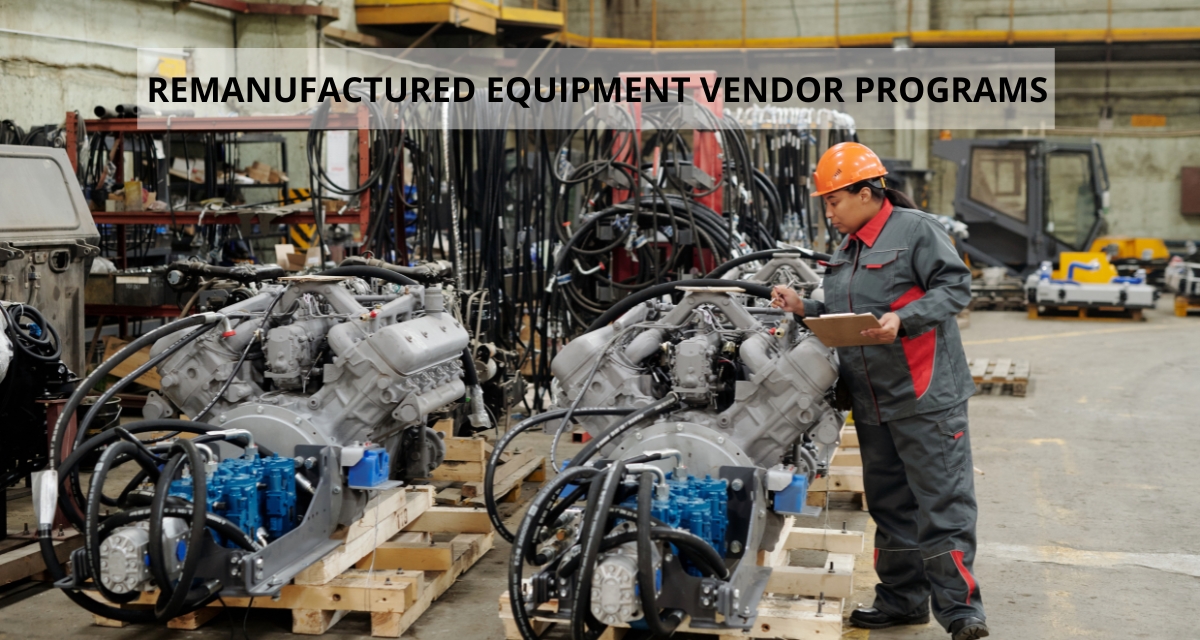
Remanufactured equipment is rebuilt to original manufacturer specifications, not simply repaired or resold, and that distinction changes how a lender looks at the collateral compared to ordinary used equipment.
Dimension Funding finances new and used equipment on the same application-only basis, up to $250,000 for equipment alone and $500,000 when software is part of the deal, and that structure extends to remanufactured units without a separate approval track. Most remanufacturers already know financing exists. What they need to know is whether a rebuilt unit gets treated the same way a new one does.
The backdrop is a large and steady replacement cycle. The global off-highway vehicle engine market, covering construction, agricultural, and mining equipment, stood at $47.94 billion and is projected to reach $66.21 billion by 2031, according to Mordor Intelligence, driven by replacement cycles and emission-compliance retrofits that keep older machines in service longer.
Alongside that sits a related but distinct market: machinery maintenance and heavy equipment repair services in the US reached $59.9 billion in 2025, per IBISWorld. Keeping aging equipment running, whether through repair or a full rebuild, is a large and active part of the economy, not a niche behind new-equipment sales.
The Programs Available to Remanufacturers
Remanufacturers draw on the same core set of programs as any other equipment vendor, applied to a category of collateral that behaves differently on paper. Standard equipment financing covers the rebuilt unit itself, zero percent financing is available as a vendor-sponsored option, and working capital loans run separately, funding the vendor’s own operation rather than a specific sale.
Dimension Funding generally prefers at least two years in business from the applicant, whether that’s a remanufacturer financing its own shop equipment or a buyer financing a purchase from one, though strong credit can substitute for a shorter history. Credit requirements themselves are flexible too, covering most types from strong commercial credit down to marginal, which matters for a newer rebuild shop or a buyer whose credit took a hit during a slow stretch.
Why Remanufactured Equipment Isn’t Financed Like Ordinary Used Equipment
A machine that’s simply used has depreciated in an uneven, hard-to-predict way, which is part of why lenders often ask for more documentation on it. A remanufactured unit has gone through a controlled teardown-and-rebuild process to original specification and typically carries a warranty comparable to a new unit’s, which gives the collateral a more predictable value profile than a random used machine of the same age.
That’s why remanufactured equipment can usually support the same term lengths available on new equipment, up to 60 months, rather than the shortened terms a lender might apply to equipment nearing the end of its useful life.
Financing a Component vs. a Whole Unit
A significant share of remanufacturing happens below the level of a complete machine: engines, transmissions, and hydraulic pumps rebuilt and installed into equipment the buyer already owns, rather than sold as a standalone unit. That changes what gets financed. The component going into the machine, plus the labor to remove the old one and install the rebuild, is the asset, not the host machine itself.
That distinction carries into the tax treatment too. A rebuilt component installed into equipment the buyer already owns is itself the qualifying property for Section 179 purposes, not the host machine, so the deduction is based on what the component and its installation cost, not the original price of the machine it’s going into.
Section 179 and Bonus Depreciation on Remanufactured Equipment
Per IRS Publication 946, the 2026 Section 179 limit is $2,560,000, phased down once qualifying purchases exceed $4,090,000, and it applies to remanufactured equipment the same as new. Dimension Funding covers the current-year figures under Section 179 and how the deduction applies to financed equipment.
Bonus depreciation carries a separate wrinkle worth knowing before a buyer assumes both deductions work identically. Since the 2017 Tax Cuts and Jobs Act, bonus depreciation applies to used property only if it wasn’t used by the taxpayer or a predecessor at any time before the acquisition. A buyer who sends in their own worn unit as the core and receives back the remanufactured version is arguably reacquiring equipment they already had a depreciable interest in, which can put that specific transaction’s bonus depreciation eligibility in question even though Section 179 wouldn’t carry the same restriction. That’s a detail worth flagging to a buyer’s accountant before the deduction gets assumed rather than confirmed.
Stacking the 90-Day Deferral With the Tax Deduction
A remanufactured unit purchased and financed through Dimension Funding can also use the No Payments for 90 Days promotion, which lets a buyer take delivery, put the rebuilt unit to work, and wait 90 days before the first payment is due.
That timing lines up with the tax question above. A buyer can place a qualifying rebuilt unit in service, start claiming Section 179 or bonus depreciation for the year, and do both before making a single payment on it. For a buyer weighing a rebuilt unit against a full-price new one, that combination often closes the gap in ways a straight price comparison doesn’t capture.
Zero Percent Financing for Remanufactured Equipment Vendors
Remanufactured equipment already competes on price against two different sellers at once: new-equipment dealers arguing full capability justifies full price, and other remanufacturers rebuilding the same models. A zero percent offer lets a vendor hold the line on the sale price instead of discounting the unit itself to win a price-sensitive buyer.
Setting one up runs through Dimension Funding’s vendor partner application, the same starting point for any vendor financing arrangement, and from there the promotion can be scoped to specific product lines rather than applied across the board.
Bringing a Remanufacturing Program Online
None of this asks a remanufacturer to restructure how a rebuild gets quoted or sold. It asks for a financing partner that treats a remanufactured unit’s collateral value the way the rebuild process earns it, rather than defaulting to the documentation and term-length assumptions built for ordinary used equipment.
A vendor can run a sample deal through Dimension Funding’s payment calculator or start an application directly. Contact Dimension Funding to talk through what a vendor program would look like for a specific remanufactured product line.
Frequently Asked Questions
Does equipment need to come from an OEM-certified remanufacturing program to qualify, or does independently remanufactured equipment qualify too?
Dimension Funding’s equipment financing applies broadly to new and used equipment without requiring a specific certifying body, so independently remanufactured equipment qualifies on the same basis as an OEM-authorized rebuild, provided documentation on the rebuild itself is available with the application.
Is the 90-day payment deferral available on any remanufactured unit, or does it depend on the product line?
It’s generally available across financed equipment and software, though exceptions apply, so it’s worth confirming eligibility for a specific remanufactured product line before assuming it’s included in a given deal.
Can financing on a remanufactured unit include the remanufacturer’s own warranty or an extended service plan, not just the equipment itself?
Yes. Associated costs including installation, labor, and maintenance can be bundled into the same fixed payment as the equipment, and a remanufacturer’s own warranty or service plan can be included the same way rather than billed as a separate line item.
Can a remanufacturer use working capital financing for its own operation, such as sourcing cores or building inventory, separate from financing a specific buyer’s purchase?
Yes. Working capital loans, available from $25,000 to $250,000 for businesses with annual revenue above $150,000, are structured around the business itself rather than a specific transaction, which makes them usable for a remanufacturer’s own operating needs rather than only for financing a buyer’s equipment purchase.
Do the same application-only thresholds, $250,000 for equipment and $500,000 with software included, apply to remanufactured equipment as they do to new equipment?
Yes. The application-only thresholds apply based on transaction size and structure, not on whether the equipment is new, used, or remanufactured, so a remanufactured unit financed on its own or bundled with software qualifies under the same limits.
Is a remanufactured unit financed only as a purchase, or can it be structured as a lease the same way new equipment can?
Both structures are available. Dimension Funding offers equipment leasing alongside standard finance agreements, and a remanufactured unit can go through either one the same way a new unit would, depending on whether the buyer wants ownership at the end of the term or lower payments with the option to upgrade.
Can a remanufacturer finance the equipment used to run its own rebuild operation, such as test benches or diagnostic tooling, separately from financing a buyer’s purchase?
Yes. That equipment is financed the same way any other commercial equipment purchase would be, with the remanufacturer as the applicant rather than the buyer. It’s a separate transaction from financing offered to a customer purchasing a rebuilt unit, though both can run through Dimension Funding.