

Growth costs money before it makes money. A new location, a larger contract, or a second shift brings expenses on day one, while the revenue builds over months. Dimension Funding, a business lender founded in 1978 with an A+ BBB rating, finances small and midsize companies through that gap so expansion plans do not stall for lack of cash.
Dimension Funding offers financing up to $10M+, uses fully electronic DocuSign documents, and often funds approved requests the same day or the next business day. Once you have estimated what your expansion will tie up in operating balances, reviewing working capital loan options alongside the equipment and software programs below is a sensible next step.
Expansion Is a Common Reason to Borrow
Growth is one of the main reasons small firms seek outside money. In the Federal Reserve’s 2026 Report on Employer Firms, pursuing an expansion or new opportunity was cited by 46% of financing applicants, second only to meeting operating expenses at 56%. At the same time, the survey’s revenue expectations index fell from 39 to 33 and its employment expectations index fell from 26 to 23, the lowest readings since the 2020 survey.
That caution creates room for well-funded firms to gain ground, but it also argues for conservative planning. The stakes are broad, since the SBA Office of Advocacy counts 36.2 million small businesses employing 45.9% of private-sector workers.
Calculate Working Capital Using Actual Operating Costs
A cash conversion cycle estimate can forecast how much cash an expansion will absorb, but applying daily sales to every component distorts the result. Inventory is recorded at cost, and supplier credit depends on purchasing activity rather than revenue. The CFA Institute’s explainer on the cash conversion cycle notes that receivable days are measured against revenue per day, while inventory days are measured against cost of goods sold per day.
Three measures make up the cycle. Days sales outstanding (DSO) tracks how long customers take to pay invoices. Days inventory outstanding (DIO) tracks how long inventory stays on hand before it sells. Days payable outstanding (DPO) tracks how long the business takes to pay suppliers. The cycle equals DSO plus DIO minus DPO.
Size the Operating Balances Directly
For a practical expansion estimate, project the balances themselves from the new operation’s expected activity:
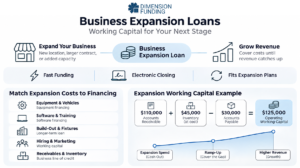
Required operating working capital ≈ accounts receivable + inventory at cost − accounts payable
Operating Balance (New Market) | Projected Amount |
Unpaid customer invoices | $110,000 |
Inventory at cost | $45,000 |
Supplier payables | −$30,000 |
Estimated operating working capital | $125,000 |
This figure is the net cash tied up in operating balances, not the full loan amount. Receivables make up nearly 90% of the requirement here, which is common for businesses selling on terms. Deduct existing working capital that can support the expansion, and count launch costs, operating losses, and your minimum cash reserve separately. Because these balances rise and fall with volume, a business line of credit often fits this portion of the plan.
Match Each Expansion Cost to the Right Financing
Expansion budgets mix costs with very different lifespans. Paying for long-lived assets out of short-term working capital compresses repayment into months for something that earns revenue for years. Matching each cost to its own structure keeps payments in line with the benefit.
Expansion Cost | Useful Life | Typical Financing Fit |
Production equipment, vehicles, machinery | 5+ years | |
Business software, implementation, and training | Multi-year | |
Build-out, fixtures, and furniture | Several years | Longer-term small business loans |
Hiring, training, and launch marketing | Months | Working capital loan |
Receivables and inventory | Ongoing, grows with sales | Business line of credit |
Separating the categories keeps the working capital request smaller and easier to evaluate. Dimension Funding requires no financial statements for software financing up to $500,000 or equipment loans up to $250,000, so the capital assets in an expansion can often move forward on a simpler track.
Budget the Ramp-Up Before New Revenue Covers Costs
A new location or service line usually loses money for several months before reaching break-even. Projecting monthly results, including launch costs such as hiring and marketing, shows how much cash the ramp-up consumes at its lowest point.
Month | Monthly Net Result | Cumulative Total |
1 | −$28,000 | −$28,000 |
2 | −$22,000 | −$50,000 |
3 | −$15,000 | −$65,000 |
4 | −$8,000 | −$73,000 |
5 | −$2,000 | −$75,000 |
6 | +$4,000 | −$71,000 |
The cumulative low of $75,000 arrives in month five, and a 20% contingency brings the ramp budget to $90,000. Suppose $15,000 of existing working capital can support the new market. The $125,000 operating requirement then nets to $110,000, for roughly $200,000 in total operating funding, with the current reserve untouched and equipment financed separately. Treat these as planning estimates, and map supplier payments, payroll, and collections by month to see when the peak shortfall actually lands.
Set Go/No-Go Checkpoints
Tie the plan to milestones, such as reaching 60% of projected month-three revenue before signing a second lease or hiring a second crew. Checkpoints let you slow an underperforming phase before the full budget is committed, and they show a lender how you will manage risk.
What Dimension Funding Reviews in an Expansion Request
Lenders evaluating growth want to see both the plan and the track record behind it. Prepare recent bank statements, projected receivables, inventory, and payables for the new operation, the ramp-up table, equipment or build-out quotes, and any signed contracts, letters of intent, or leases. Together they show what the money will do and when it comes back.
Dimension Funding generally prefers two or more years in business, though strong credit can offset a shorter history. Its long-tenured team, described on the About Us page, works across equipment, software, and working capital needs. Requests can begin through the online financing application.
Funding the Next Stage Without Stalling the Current One
Expansion succeeds when the existing business keeps running smoothly while the new piece ramps up. Sizing operating balances from actual costs, budgeting the ramp-up honestly, and financing each cost on a term that matches its life keeps both halves of the company funded.
If your next stage is taking shape, Contact Dimension Funding to map each part of the plan to the right structure. You can also call 1-800-755-0585 or email Sales@DimensionFunding.com.
Frequently Asked Questions
Should I fund an expansion with cash on hand or with financing?
Many owners use a mix. Spending all available cash on growth leaves no cushion if the ramp-up runs long or a large customer pays late. Financing part of the expansion preserves a reserve for the existing business while new revenue builds.
Can I apply before signing a lease or purchase agreement?
Yes. Lenders can often review a request based on a letter of intent, draft lease, or vendor quote. Final funding may depend on signed documents, so applying early lets approval and negotiations move in parallel.
Does my existing financing limit how much I can add?
It can. Some loan agreements restrict additional borrowing or require notice before taking on new debt. Review your current agreements before applying so the expansion financing does not conflict with an existing lender.
Can working capital support a business acquisition?
Acquisitions are usually financed through dedicated structures such as seller financing or longer-term loans. Working capital can still help after closing, covering integration costs, overlapping payroll, and the receivables the acquired company brings with it.
What extra costs come with expanding into another state?
A business entering a new state typically needs to register as a foreign entity, open state payroll tax accounts, and review sales tax obligations. Budget for these fees and any professional help before the launch date.
Will an expansion loan affect my ability to borrow later?
Timely payments build a stronger borrowing record, which can help future requests. Lenders also weigh total debt against cash flow, so an oversized loan today can limit flexibility later. Sizing each piece carefully protects future options.
How long should repayment run on an expansion loan?
Repayment should roughly match how long the financed item produces value. Ramp-up working capital fits a shorter term, while equipment and build-out fit longer ones. Mismatched terms are a common reason growing companies feel squeezed even as sales rise.