


A carrier pays for diesel at the pump, pays its drivers every week, and makes truck payments every month. The broker who tendered the load pays on its own schedule, often 30 days or more after the paperwork arrives. Dimension Funding has financed commercial trucks and trailers since 1978, and the gap between hauling a load and getting paid for it is one of the most common reasons carriers look for working capital.
That gap is built into how brokered freight works. Carriers who understand where payment delays start can plan for them, and a Dimension Funding working capital loan can cover what the payment terms leave exposed.
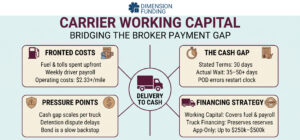
Why Carriers Fund the Load Before They Get Paid
Every brokered load is a short-term loan from the carrier to the broker. Fuel, tolls, driver wages, and maintenance are spent before or during the trip. Payment arrives only after delivery, invoicing, and the broker’s own payment cycle.
Rising costs make that loan more expensive to carry. The American Transportation Research Institute’s 2026 Analysis of the Operational Costs of Trucking found that the industry-average cost to operate a truck reached $2.336 per mile in 2025, the highest in the report’s history. Operating margins in the truckload and refrigerated sectors stayed below 1%, and flatbed carriers averaged an operating loss of 0.5%.
Invoice Terms Are Not the Same as Days-to-Cash
A broker’s payment terms tell a carrier when payment is supposed to be made. They do not necessarily tell you how long the money will take to reach your account. For cash flow planning, the more useful metric is delivery-to-cash: the number of days between proof of delivery (POD) and actual payment.
FMCSA’s broker transparency rulemaking shows why payment dates matter. In its 2024 proposed rule, the agency proposed requiring broker records to include the date of payment to the carrier. It said that information would give carriers visibility into their payment structure and help them establish a timeline when chargebacks or payment disputes arise. FreightWaves reported that a supplemental proposal went to the White House for review on August 27, 2026.
Comparing Brokers by Actual Payment History
Actual payment history is more useful than advertised terms. Two brokers can both offer 30-day terms while producing very different cash cycles.
Broker | Terms | Average POD-to-Cash | Late-Payment Rate |
Broker A | 30 days | 34 days | 5% |
Broker B | 30 days | 47 days | 22% |
Broker C | 15 days | 18 days | 3% |
These figures are illustrative, and the late-payment rate is the share of loads paid after the contractual due date. Carriers can calculate their own numbers by recording five dates for each load: POD, invoice submission, invoice acceptance, contractual due date, and actual payment. Over time, that history shows whether a broker consistently pays within its stated terms or routinely takes longer.
Payment terms tell you when a broker says it will pay. Days-to-cash tells you when you actually get paid.
What the Difference Costs a Small Fleet
Longer actual payment cycles tie up more operating cash, even when the contract terms look identical. Using ATRI’s per-mile average and an illustrative 10,000 miles per truck per month, a five-truck fleet spends about $116,800 a month to operate.
At Broker A’s 34-day pace, about $132,000 of those costs would be waiting on payment at any time. At Broker B’s 47-day pace, the figure rises to about $183,000. That is roughly $51,000 more cash tied up under the same 30-day terms, before counting the days the truck spent on the road.
What Delays Broker Payment After Delivery
Stated terms describe the best case. Several common problems push payment later, and most of them start with paperwork.
Paperwork That Stops the Clock
Brokers typically start their payment cycle only after they receive a complete invoice package. A missing signature on the bill of lading, an unreadable scan, or a rate confirmation that does not match the invoice can send the package back. The payment clock then restarts from the corrected submission.
Submitting documents the same day as delivery, through the broker’s preferred portal or email address, removes days from every load. Carriers running more than a few trucks often assign one person to check each packet before it goes out.
Accessorial Disputes
Detention, lumper fees, and layover charges are frequent sources of delay. If the broker questions an accessorial charge, some brokers hold the entire invoice rather than paying the undisputed line haul. Getting written approval for accessorials at the time they occur, and attaching receipts and timestamps, keeps the core payment moving.
What the Broker Bond Does and Does Not Cover
Every property broker must maintain $75,000 in financial security, either a surety bond or a trust fund. The Federal Register notice extending the compliance date confirms that FMCSA must suspend a broker’s operating authority when its available financial security falls below $75,000. That rule took full effect on January 16, 2026.
The bond is a backstop, not a cash plan. That $75,000 is shared by every claimant against a failed broker. The FMCSA’s rule FAQ also explains that the 60-day claim period begins only after FMCSA posts a cancellation notice in its register, so a carrier owed money by an insolvent broker may wait months and still recover only part of the balance.
Financing Built Around Freight Cash Flow
A working capital loan fits the recurring gap between fuel and payroll and the first broker payments. It is especially useful when a carrier adds trucks, opens a new lane, or signs with a broker whose actual days-to-cash runs long. Short-term business loans can bridge a specific delay, such as a large disputed invoice that is being worked out.
Equipment is a separate decision, because paying cash for a tractor drains the reserves that carry fuel between settlements. Commercial truck financing and commercial trailer financing spread those costs over fixed payments. Dimension Funding offers application-only equipment financing up to $250,000 with no financial statements required, and funding typically arrives the same day or the next business day through DocuSign.
Keeping Trucks Moving Between Settlements
Broker payment timing is predictable once you measure it. Track delivery-to-cash for each broker, clean up paperwork at the source, and keep equipment purchases on their own financing so working capital can carry operating costs.
Dimension Funding prefers businesses with two or more years in operation, though strong credit can substitute. To plan financing around your actual payment cycle, Contact Dimension Funding at 1-800-755-0585 or Sales@DimensionFunding.com.
Frequently Asked Questions
Is quick pay a better option than financing the gap?
Quick pay shortens the wait, but the broker usually keeps a percentage of each invoice as a fee. Over a year, that fee comes straight out of revenue. Compare the annual total against the cost of carrying the gap with fixed financing.
What happens to broker payments if I factor my invoices?
Factoring usually requires a notice of assignment telling brokers to pay the factoring company instead of you. Ending the arrangement typically requires a release letter from the factor before brokers can pay you directly again.
Can I file a bond claim if a broker is slow but still in business?
Claims can be filed with the broker’s surety or trust provider, but a bond claim is a dispute process, not a payment method. Document the load, the invoice date, and your collection attempts before filing.
Are fuel advances a good way to cover the gap?
Some brokers offer fuel advances against a load, often for a fee, and deduct the advance from the final payment. Advances help on a single trip but do not solve a gap that repeats on every load.
Which seasonal costs should carriers plan for?
The federal heavy vehicle use tax on Form 2290 is generally due by August 31 for trucks in service in July. IFTA fuel tax returns are due quarterly. Both create cash needs regardless of when brokers pay.
Can a carrier with new authority qualify for financing?
Newer carriers often face more limited options. Dimension Funding prefers two or more years in business, but strong credit can substitute. A clear record of broker payments helps any application.
How can I vet a new broker before the first load?
Before you have your own payment history with a broker, commercial credit services publish broker credit and days-to-pay reports. Verifying active authority and bond status with FMCSA adds another layer of protection.