


A salon’s appointment book can thin out in January while payroll day arrives right on schedule. Stylists still need to be paid, the front desk still needs to be staffed, and December’s payroll taxes come due just as revenue drops. Dimension Funding has financed service businesses since 1978, and covering payroll through a slow quarter is one of the most common reasons salon owners look for working capital.
A slow quarter is manageable when the owner knows which costs will fall, which will not, and when each one is due. With that map in hand, a Dimension Funding working capital loan can keep paychecks on time without forcing cuts to the team that brings clients back.
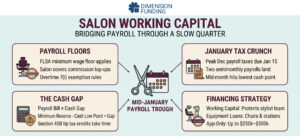
Why Salon Payroll Doesn’t Shrink With the Appointment Book
Payroll is usually a salon’s largest expense, and how it behaves depends on how stylists are paid. Commission pay falls when service revenue falls, but not all the way. Hourly staff, minimum wage rules, and payroll taxes keep a floor under the total.
The workforce itself is split. According to the Bureau of Labor Statistics, hairdressers, hairstylists, and cosmetologists held about 575,200 jobs in 2024. Of those, 46% worked for personal care services businesses and 48% were self-employed, and some leased booth space from a salon owner.
How Your Pay Model Changes the Exposure
Pay Model | What Flexes in a Slow Quarter | What Stays Fixed | Slow-Quarter Exposure |
Commission employees | Commission payouts | Minimum wage floor, payroll taxes, hourly support staff | Moderate |
Hourly plus commission | Commission portion | Base hourly wages, payroll taxes | High |
Booth rental | Nothing for the salon; renters absorb the dip | Rent income and salon overhead | Low for payroll, but renters may fall behind |
Many salons run a hybrid, with some stylists on commission and others renting chairs. The mix determines how much of the slow quarter lands on your payroll and how much lands on your stylists.
The Minimum Wage Floor Under Commission Pay
Commission pay does not remove the minimum wage requirement. Under the Fair Labor Standards Act, commissioned employees generally must still earn at least the minimum wage for every hour worked in each workweek. When commissions fall short, the salon covers the difference, and many states set minimums well above the federal $7.25.
Overtime rules add a second test. The Department of Labor’s Fact Sheet #20 explains that the Section 7(i) overtime exemption for commissioned employees of retail and service establishments has three requirements. The employee must work for a qualifying establishment, earn a regular rate of pay above one and one-half times the minimum wage in overtime weeks, and receive more than half of their earnings from commissions over a representative period of one month to one year.
Where Slow Months Create Top-Ups
Established stylists with full books usually clear the floor even in a slow month. The risk sits with newer stylists who are still building a client base.
Consider a newer stylist who works 173 hours in a month in a state with a $15 minimum wage. The floor for that month is about $2,595. If January commissions come to $1,800, the salon owes roughly $795 in additional wages. If a slow week with overtime pushes that stylist’s regular rate below one and one-half times the minimum, the 7(i) exemption does not apply for that week and overtime pay is due.
The January Payroll Calendar
According to the IRS guidance on employment tax deposits, an employer that reported $50,000 or less in taxes during its lookback period is a monthly schedule depositor. Monthly depositors generally must deposit taxes on wages paid during a month by the 15th of the following month.
For a salon, that means taxes on December’s busy-season wages come due in mid-January, the slowest point of the year. The illustrative calendar below assumes semimonthly payroll, a monthly deposit schedule, and a team of commissioned stylists plus front-desk staff.
Date | Outflow | Amount |
January 1 | Rent | $8,000 |
January 2 | Payroll for late December | $24,000 |
January 10 | Product restocking | $4,000 |
January 15 | Federal tax deposit for wages paid in December | $9,300 |
January 15 | Payroll for early January | $17,000 |
January 31 | Payroll for late January | $16,500 |
Total January outflows | $78,800 |
Tips and Credits Add Their Own Timing
Card tips are often paid to stylists through payroll, and the salon owes the employer share of Social Security and Medicare taxes on reported tips. An IRS internal guidance update confirms that, starting in 2025, the One Big Beautiful Bill Act extended the Section 45B credit for employer FICA taxes paid on certain tips to the beauty industry.
The credit is claimed on Form 8846 with the annual return, so it reduces income tax later. It does not add cash during the slow quarter itself.
The Payroll Bill Is Not the Same as the Payroll Cash Gap
A salon can have a large payroll bill without needing to borrow that amount. Payroll expense measures what the business owes employees, while the cash gap measures how much additional cash it needs to keep those payments and other obligations covered. SBA training on cash flow management explains why profitable businesses can still run into cash shortages and how to prepare for slow periods.
In the January example, outflows of $78,800 against collections of $62,000 leave a monthly shortfall of $16,800. That is not automatically the financing requirement. A salon entering January with $25,000 in available cash may cover the shortfall on its own, while one starting with $5,000 and a $10,000 operating reserve needs more.
Tracking When Money Moves
The forecast should follow the dates when cash actually moves: payroll, federal tax deposits, rent, supplier payments, debt payments, and expected appointment collections. Deposit dates follow the employer’s deposit schedule and the wages paid in each period, as the same IRS guidance explains. The checkpoints below assume the salon starts January with $25,000 and collects $62,000 evenly across the month.
Checkpoint | Cumulative Collections | Cumulative Outflows | Cash Balance |
January 1, opening balance | $25,000 | ||
January 15, after payroll and tax deposit | $31,000 | $62,300 | −$6,300 |
January 31, after final payroll | $62,000 | $78,800 | $8,200 |
Payroll cash gap = minimum required cash balance − lowest projected cash balance. With a $10,000 reserve, the gap is 10,000minus(-6,300), or $16,300. The low point arrives on January 15, when two payrolls and the December deposit have cleared but only half the month’s collections are in, so a month-end view would show $8,200 and miss the dip entirely. A salon starting with $5,000 would face a $36,300 gap, so size working capital around this lowest point rather than the payroll bill or the monthly shortfall.
Financing a Slow Quarter Without Cutting Your Team
In a salon, clients often follow their stylist. Losing a strong stylist during a slow quarter can mean losing that stylist’s book when business returns. A working capital loan fits a defined payroll gap such as the mid-January trough above, and short-term business loans can cover a narrower need, such as the December tax deposit.
Equipment is a separate decision. Replacing styling chairs, dryers, or pedicure stations with cash drains the reserve meant for payroll. Equipment financing spreads those costs over fixed payments, and Dimension Funding offers application-only equipment financing up to $250,000 with no financial statements required. Funding typically arrives the same day or the next business day through DocuSign.
Keeping Chairs Filled and Paychecks on Time
A slow quarter tests timing more than profitability. Know your pay model’s exposure, check commissioned stylists against the minimum wage floor, and forecast cash by payroll date so you can see the true low point.
Dimension Funding prefers businesses with two or more years in operation, though strong credit can substitute. To size financing around your salon’s actual payroll cash gap, Contact Dimension Funding at 1-800-755-0585 or Sales@DimensionFunding.com.
Frequently Asked Questions
Can I pay stylists a draw against commission during slow months?
Many salons use draws, which are advances against future commissions. Recovering an unearned draw later cannot push a stylist’s pay for any workweek below the minimum wage, so review your draw policy with an employment attorney.
Should I convert commissioned stylists to booth renters to cut payroll?
Worker classification depends on how much control the salon has over the work, not on the label. If the salon sets schedules, prices, and methods, the stylist may still be an employee, and misclassification can create back wages and tax liability.
How do rebooking habits affect the slow quarter?
Booking each client’s next appointment at checkout during the holidays fills January and February before they start. A higher rebooking rate going into the slow season shrinks the payroll gap directly.
When do card tips have to be paid to stylists?
Many salons pay card tips through the next regular payroll. Some states set rules for timing and for deducting card processing fees from tips, so confirm your state’s requirements.
What documents will a lender want from a salon?
Expect recent business bank statements, quarterly payroll tax returns, and a year of revenue history that shows the seasonal pattern. Booking data for future appointments can also help explain the slow quarter.
Does retail product inventory help or hurt in a slow quarter?
Retail sales can add revenue when services slow, but a large product order ties up cash before it sells. Smaller, more frequent orders keep inventory from competing with payroll.
Is it better to reduce hours than to let staff go?
Trimming open days or front-desk hours usually preserves more value than losing a stylist with an established book. Share the plan with your team early so stylists can keep clients booked.