


A contractor can finish a month of work, bill every dollar of it, and still wait weeks to see most of the money. Then part of that money stays locked up until the job closes out. Dimension Funding has financed contractors since 1978, and retainage combined with slow progress draws is one of the most common reasons profitable construction firms run short of cash.
The pressure is structural, not a sign of a weak business. Contractors who understand how retainage and draw timing work can plan for the gap. A Dimension Funding working capital loan can then cover what the payment schedule leaves exposed.
How Retainage and Draw Schedules Hold Back Earned Cash
Retainage is a portion of each progress payment that the owner or general contractor withholds until the project, or a defined part of it, is complete. It protects the paying party against unfinished or defective work. For the contractor, it means earned revenue sits on someone else’s balance sheet for the life of the job.
Progress draws add a second delay. Every billed dollar moves through review and payment before it reaches the bank, and retainage still holds back a slice of each payment after that.
Federal and State Retainage Rules Differ
Federal rules limit retainage. FAR 32.103 allows retainage when a contractor has not made satisfactory progress. It caps the amount at 10% of the approved estimate, allows adjustments as the contract nears completion, and requires retained amounts to be paid promptly once all requirements are met.
States set their own limits for public work. According to a California Senate floor analysis, California’s Public Contract Code caps retention on public projects at 5%. The analysis also notes that the cap does not stop a public entity from withholding funds for other reasons, including 150% of the value of disputed work.
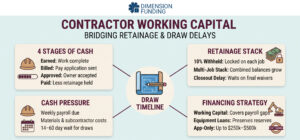
Earned, Billed, Approved, and Paid Are Four Different Stages
For a contractor, completing work does not make the cash available. Revenue passes through four stages between the field and the bank account, and each stage can create a different working capital need. Under FAR 52.232-5, federal progress payments are based on approved estimates of work that meets the contract’s quality standards, and each request must itemize the amounts requested.
Federal prompt-payment rules show the last distinction. Under FAR 52.232-27, a progress payment is due 14 days after the billing office receives a proper payment request. Retained amounts follow their own clock: payment is due as the contract specifies or, if the contract is silent, 30 days after the contracting officer approves the release.
Tracking Each Stage Separately
Stage | What It Means | What Moves It Forward |
Earned | Work is in place but not yet billed | The next pay application cutoff |
Billed | Pay application submitted | Review by the owner, architect, lender, or contracting officer |
Approved | Amount accepted for payment | The payer’s payment cycle |
Paid | Cash received, less retainage | Retainage waits for release approval |
A contractor can have revenue sitting at every stage at once, and each stage behaves like a different kind of receivable. The planning question is not how much work is complete. It is how much has moved far enough through billing and approval to become cash, and when the rest will arrive.
A profitable contractor can still run short when payroll, materials, and subcontractor costs come due before completed work clears these stages. Tracking each stage separately makes the size and timing of the working capital gap much easier to forecast.
Pay Applications That Get Sent Back
An incomplete or unsupported request stalls between billed and approved. On federal jobs, a billing office that finds a request improper must return it within 7 days with the reasons. The corrected request then starts a new clock. A frequently missing item is the certification that prior subcontractor and supplier payments were made.
On private work, submitting a clean schedule of values, backup documentation, and matching lien waivers on the first attempt keeps the draw moving.
Payment Chains Down the Tiers
Subcontractors usually wait for the general contractor to be paid first. On federal projects, FAR 52.232-27 requires prime contractors to include a clause obligating them to pay subcontractors within 7 days of receiving payment for their work. Private contracts vary, and pay-when-paid terms can extend a subcontractor’s wait well beyond the owner’s payment date.
Why Retainage Stacks Across Projects
Retainage on a single job is manageable. The problem appears when several jobs overlap, because retainage on each job is released only at completion. With new jobs starting as old ones finish, the combined balance never resets to zero.
Project | Contract Value | Percent Complete | Retainage Rate | Retainage Held |
Job A, commercial fit-out | $800,000 | 90% | 10% | $72,000 |
Job B, municipal site work | $500,000 | 50% | 5% | $12,500 |
Job C, warehouse addition | $1,200,000 | 30% | 10% | $36,000 |
Job D, finished, awaiting closeout | $300,000 | 100% | 10% | $30,000 |
Total | $150,500 |
In this illustrative example, the contractor has $150,500 of earned revenue it cannot spend, even though that money was already paid out in payroll, materials, and equipment. As the business wins larger jobs, the stack grows with it.
Closeout Is Its Own Delay
Job D shows why finished work still ties up cash. Final retainage typically waits on punch-list completion, final inspections, lien waivers, warranties, and closeout documents. Assigning one person to own closeout paperwork on every job is often the fastest way to release retained cash.
The Draw Timeline in Practice
A single billing cycle shows how much cash a contractor carries before the first dollar arrives. The example below assumes a monthly pay application, 10% retainage, and weekly payroll.
Timing | Event | Cash Position |
Days 1–30 | Four weekly payrolls of $40,000 each | $160,000 paid out |
Days 1–30 | Materials and rentals | $90,000 paid out |
Day 30 | Pay application submitted for $300,000 | $250,000 funded by the contractor |
Day 44 to 60 | Draw paid, less 10% retainage | $270,000 received |
Closeout | Retainage released | $30,000 received |
The contractor funds $250,000 for 44 to 60 days, depending on whether the job follows the federal 14-day rule or a private payment schedule. Meanwhile, the next month’s payroll has already started before the first draw clears.
Financing Built Around Contract Cash Flow
A working capital loan fits the costs of mobilization and the gap between payroll and the first draw on a new contract. Short-term business loans can bridge a retainage release that is delayed by closeout. Both provide a set amount on a fixed schedule tied to a known need.
Equipment is a separate decision, because paying cash for a loader or truck drains the reserves that carry payroll between draws. Construction equipment financing and dump truck financing spread those costs over fixed payments. Dimension Funding offers application-only equipment financing up to $250,000 with no financial statements required, and funding typically arrives the same day or the next business day through DocuSign.
Getting Paid for Work Already in the Ground
Retainage and slow draws are predictable features of construction contracts. Track revenue by stage, watch your retainage stack across every job, and keep equipment purchases on their own financing so working capital can carry payroll and materials between draws.
Dimension Funding prefers businesses with two or more years in operation, though strong credit can substitute. To plan financing around your draw schedule, Contact Dimension Funding at 1-800-755-0585 or Sales@DimensionFunding.com.
Frequently Asked Questions
Can retainage terms be negotiated before signing?
Often, yes. Contractors can ask for reduced retainage after a completion milestone or for release of their scope once it is finished. Early trades such as site work benefit most, since their work may finish months before the project closes.
Is retainage taxable before I receive it?
It depends on your accounting method. Under the percentage-of-completion method, income generally follows work performed, which can include retained amounts. The IRS small business taxpayer regulations exempt qualifying contractors below the gross receipts threshold from that method, so confirm your treatment with a CPA.
Do lenders count retainage receivable as an asset?
Many lenders discount or exclude retainage when evaluating receivables, because payment depends on completing the project. Expect current billings and retainage held to be reviewed separately.
How do lien waivers affect draw timing?
Owners and lenders commonly require waivers from the contractor and lower tiers before releasing funds. Conditional waivers that match the pay application amount avoid a common reason draws are held.
Why do change orders strain cash flow?
Work performed before a change order is approved usually cannot be billed. Pricing and approving change orders quickly keeps that work from staying in the earned stage for several cycles.
Does working capital financing affect bonding capacity?
Sureties review working capital and debt on your financial statements when setting bonding limits. Discuss any new financing with your surety agent so it supports the jobs you plan to bid.
When should a contractor arrange financing for a new job?
Ideally at the bid or award stage, once the schedule of values and payment terms are known. Arranging funding before mobilization avoids scrambling after the first payroll is due.