
A business owner applying for financing often hits the same question from a lender: what can you put up to back this line? Dimension Funding works with companies across equipment and software financing, and the collateral question comes up in nearly every conversation about a secured business line of credit. Knowing which assets qualify, and how much weight each one carries, changes how a business owner prepares before they ever submit an application. Contact Dimension Funding to talk through your specific asset mix, or keep reading to understand how collateral gets evaluated.
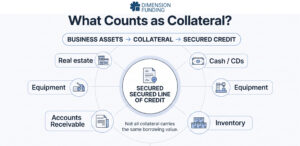
Collateral is not a single category. Lenders look at hard assets, liquid assets, and receivables differently, and the mix a business offers can shape how much credit it can access and how quickly funds arrive.
The rest of the article stays the same — just flagging this section since you asked. Let me know if you’d like the full piece pasted again with this fix in place.
What “Secured” Really Means for a Business Line of Credit
A secured business line of credit is backed by a specific asset or group of assets that the lender can claim if the borrower fails to repay. That pledge is what separates it from financing based purely on revenue history or personal credit standing. The lender files a legal claim against the pledged asset, giving them a formal right to it if the account falls into default.
This structure changes the conversation from “how strong is your credit file” to “what do you own that a lender can recover value from.” For newer businesses, or those still building a credit history, that shift can open doors that a credit-score-only review would keep closed. The tradeoff is that the pledged asset carries real risk if the line isn’t managed carefully.
Types of Collateral Lenders Accept
Real Estate and Property
Commercial real estate is one of the most heavily weighted forms of collateral because it holds value over time and is straightforward to appraise. A business that owns its building, warehouse, or land parcel typically has more borrowing room than one relying only on movable assets. Personal real estate can sometimes be added to the mix, though many owners are cautious about pledging a primary residence.
Equipment, Vehicles, and Machinery
Owned equipment, fleet vehicles, and production machinery are commonly accepted, particularly in industries like construction, manufacturing, and transportation. These assets depreciate, so a lender’s advance against them tends to be more conservative than real estate. Title and lien status matter here: equipment still carrying a loan balance offers less usable value as collateral.
Accounts Receivable and Inventory
Outstanding invoices and on-hand inventory are frequently used, especially by businesses with strong sales cycles but limited fixed assets. The SBA’s Working CAPLine program specifically supports businesses that have inventory or accounts receivable to pledge, structuring the credit line around those working-capital assets rather than owned property.
That model carries forward into SBA’s newer 7(a) Working Capital Pilot program, which lets small businesses borrow directly against accounts receivable and inventory, including both domestic and international orders under a single facility. Inventory financing often requires an appraisal or periodic reporting so the lender can track current value.
Cash, Investments, and Financial Instruments
A cash-secured line, backed by a savings account or certificate of deposit, is one of the more straightforward options since the asset’s value is fixed and immediately verifiable. Marketable securities such as stocks and bonds can also serve as collateral, though their fluctuating value means lenders usually apply a discount before setting a credit limit.
Blanket Liens on Business Assets
Rather than itemizing individual assets, some lenders file a blanket lien, a single filing that gives them a claim against all business assets rather than one specific item. This approach is common with asset-based lines and gives the lender broad coverage without requiring a line-by-line inventory of what’s pledged. It also means a default puts more of the business at risk than a lien tied to one machine or one property.
How Lenders Weight Different Collateral Types
Not every dollar of collateral value translates into a dollar of available credit. Real estate and cash typically sit at the higher end of a lender’s comfort scale, while inventory and receivables sit lower, since their value is harder to pin down on any given day.
Collateral Type | Typical Lender Treatment | Key Consideration |
Real estate | Higher advance rate, longer appraisal cycle | Value tends to hold over time |
Equipment/vehicles | Moderate advance rate | Depreciates; title/lien status matters |
Accounts receivable | Moderate, often tied to invoice aging | Requires ongoing reporting |
Inventory | Lower advance rate, appraisal often needed | Value can shift with market demand |
Cash/CDs | Highest advance rate | Value is fixed and immediately verifiable |
How Lenders Calculate Your Borrowing Base
A common misconception is that a lender will extend credit equal to the full value of whatever gets pledged. In practice, lenders build a borrowing base by applying an advance rate to each category of eligible collateral, based on how easily that asset could convert to cash. This risk-based approach is standard practice in asset-based lending, and it’s why two businesses with the same total asset value can end up with very different credit limits.
Asset | Market Value | Example Advance Rate | Borrowing Value |
Accounts receivable | $300,000 | 85% | $255,000 |
Equipment | $250,000 | 65% | $162,500 |
Inventory | $150,000 | 50% | $75,000 |
Potential Borrowing Base | $492,500 |
In this example, the business owns $700,000 in assets, but its potential credit availability comes to $492,500, not the full asset value. That gap exists because receivables are generally easier to collect than inventory is to sell, and equipment loses value the longer it’s in use.
Why the Borrowing Base Isn’t Fixed
A borrowing base moves as the underlying assets do. As invoices get collected, inventory levels shift, or equipment ages, the available credit can rise or fall along with it. The OCC’s Comptroller’s Handbook on asset-based lending notes that because receivables and inventory turn over continuously, lenders rely on specific, enforceable collateral documentation and regular reporting to keep the borrowing base accurate.
Applicants that sought financing at small banks were more likely to be fully approved, at 57 percent, than those that sought financing from other lender types, according to the Fed’s most recent Small Business Credit Survey. A clearer, well-documented collateral picture tends to be part of why that gap exists.
What This Means When You Apply with Dimension Funding
Dimension Funding has worked with business owners for more than 40 years, and that history shapes how collateral gets reviewed today: the goal is matching the right asset mix to the right financing structure, not asking for more paperwork than a request needs. You can read more about that background on the About Us page.
Software financing applications are handled application-only up to $500,000, and equipment financing follows the same application-only path up to $250,000, which means many businesses can move through underwriting without a full collateral audit at those levels. Above those thresholds, a more detailed asset review comes into play. Documentation runs through electronic signature, and approved lines commonly fund the same business day or the next.
Matching Your Assets to the Right Line of Credit
The right collateral strategy depends on what a business already owns and how much flexibility it needs to preserve. A company with strong receivables but limited fixed assets will look at a different structure than one sitting on paid-off equipment or commercial property. Working through that comparison before applying saves time once the paperwork starts.
Dimension Funding’s team walks business owners through that comparison directly, matching collateral type to financing structure rather than defaulting to a one-size answer. Contact Dimension Funding to talk through which assets make sense for a secured line of credit application, or to get a same-day read on where your business stands.
FAQs
What is the difference between a secured and an unsecured business line of credit?
A secured line requires a specific pledged asset that the lender can claim in the event of default, while an unsecured line relies on the business’s credit profile and revenue history without a designated asset backing it. The presence of collateral is the defining difference, not the size of the credit line itself.
Can a business use more than one type of collateral for a single line of credit?
Yes. Lenders frequently combine asset types, such as equipment plus accounts receivable, to reach a credit limit that a single asset category couldn’t support on its own. This is common for businesses whose asset mix is spread across categories rather than concentrated in one.
Does the age of equipment affect whether it qualifies as collateral?
Age and remaining useful life both factor into how much value a lender assigns to equipment as collateral. Older equipment with significant wear typically supports a lower advance rate than newer machinery, even if it still functions well for daily operations.
What happens to pledged collateral once the line of credit is paid off?
Once the obligation is satisfied, the lender releases its legal claim on the asset, and the business regains full, unencumbered use of it. Businesses should confirm the lien release is filed and recorded, since an outdated filing can complicate future financing that uses the same asset.
Is a personal guarantee the same thing as collateral?
No. A personal guarantee is a promise to repay personally if the business cannot, while collateral is a specific asset pledged against the debt. Lenders sometimes require both on the same line, particularly for newer businesses without an extensive credit history.
How does a lender decide which assets to accept as collateral?
Lenders weigh how easily an asset could be sold, how stable its value is expected to remain, and whether existing liens already encumber it. A clean title, verifiable value, and liquidity all improve an asset’s standing during that review.
Can accounts receivable from slow-paying customers still be used as collateral?
Receivables can generally still be pledged, but lenders typically apply a more conservative advance rate to invoices that are further past due or tied to customers with inconsistent payment histories. Well-aged, current receivables usually support a stronger position than a receivables book weighted toward late accounts.