

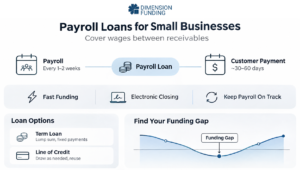
Your crew gets paid every other Friday, but your largest customer pays in 45 days. The gap between those two calendars decides whether payday feels routine or frightening. Dimension Funding is a business lender operating since 1978 with an A+ BBB rating. It works with owners who are profitable on paper but short on cash the week wages come due.
A payroll loan closes that timing gap. It works best when it is sized to the lowest point in a dated cash forecast rather than to a rough guess. Dimension Funding uses fully electronic DocuSign documents, so funding often arrives the same day or the next business day. If a slow-paying invoice is already pressing on your next payroll, reviewing your working capital loan options is a sensible first step.
Why Payroll and Receivables Fall Out of Sync
Wages run on a schedule that owners only partly control. The U.S. Department of Labor’s state payday requirements table shows that states set minimum pay frequencies, and some require payment at regular intervals of no more than 16 days. Customers face no comparable rule, so invoices on net-30 or net-60 terms routinely outlast two or three pay cycles.
Federal data shows how common the squeeze is. In the Federal Reserve’s 2026 Report on Employer Firms, 54% of small employer firms named paying operating expenses as a financial challenge and 50% cited uneven cash flow. The survey counts payroll as an operating expense and receivables collection as part of uneven cash flow. Meeting operating expenses was also the most common reason firms sought financing, cited by 56% of applicants.
How a Payroll Loan Works
A payroll loan is not a separate legal product. It is working capital financing used to cover wages, employer payroll taxes, and benefit contributions while the business waits on money it has already earned. The shape of your cash forecast, meaning one deep dip or a repeating monthly one, points to the right structure.
Term Working Capital Loan
A working capital business loan delivers a lump sum repaid in fixed installments. It suits a forecast with a single low point, such as staffing up for a large contract whose first invoice will not clear for 60 days.
Business Line of Credit
A business line of credit lets you draw only what a given payroll requires and repay as customer payments arrive. It fits a forecast that dips below zero every month, because the same approved limit can be reused cycle after cycle.
Build a Payroll-by-Payroll Cash-Gap Calculator
The amount you need to borrow depends on when cash leaves your account and when customer payments actually clear. Counting how many payrolls fall within a 60-day window is not enough. A rolling cash-flow forecast identifies your lowest projected balance so you borrow only what is necessary. The U.S. Small Business Administration’s guidance on managing your finances is a practical starting point for tracking business finances and planning upcoming obligations.
Map Every Cash Movement by Date
Start with your available cash above your minimum operating reserve. Then enter every scheduled payroll, employer payroll-tax deposit, benefit contribution, core operating expense, and expected customer receipt by date. The simplified example below follows a contractor with $90,000 available.
Date | Cash Movement | Running Balance |
October 30 | Opening available cash | $90,000 |
November 6 | Payroll: −$52,000 | $38,000 |
November 9 | Payroll taxes: −$8,000 | $30,000 |
November 13 | Core operating expenses: −$12,000 | $18,000 |
November 20 | Payroll: −$52,000 | −$34,000 |
November 25 | Customer payment: +$100,000 | $66,000 |
The projected balance falls to −$34,000. That makes $34,000 the minimum funding gap in this example, before financing costs or a safety cushion. A simple payroll count would have suggested borrowing far more. SCORE notes that business owners can use a cash flow projection to anticipate working capital needs and plan for upcoming expenses, and its 12-month cash flow statement template can serve as the base for your own forecast.
Stress-Test a Late Customer Payment
Before applying, repeat the calculation with customer receipts delayed by 15 days. In the example above, moving the November 25 payment to December 10 pushes it past a December 4 payroll. The low point then deepens from −34,000toatleast-86,000, before the tax deposit tied to that payroll is even counted.
If a delay scenario creates a much larger deficit, consider a larger available credit limit or a different repayment structure. Update the forecast as invoices clear and actual expenses change. The goal is to cover the lowest projected balance without borrowing more than necessary.
Comparing the Ways Businesses Cover a Payroll Gap
Option | Speed | Main Risk | Best Fit |
Working capital term loan | Same day to a few days with electronic documents | Fixed payments begin before every receivable clears | A single, well-defined low point |
Business line of credit | Fast once the limit is approved | Requires discipline to repay draws | A forecast that dips every month |
Owner personal funds | Immediate | Personal savings exposed, no repayment plan | Very small, short gaps |
Delaying payday | None | State wage law penalties and staff turnover | Not advisable |
Holding back withheld payroll taxes | Immediate | Personal IRS liability | Not advisable |
Payroll gaps are often smaller than owners fear once they are measured by date. The Federal Reserve survey found that 37% of financing applicants sought less than $50,000. A modest request built from a dated forecast is common, and it is often enough to bridge one or two slow invoices.
The Payroll Shortcut That Creates Personal Liability
The November 9 tax deposit in the forecast above is the line owners are most tempted to skip. The Internal Revenue Service classifies withheld income tax and the employee share of FICA as trust fund taxes, because the employer holds that money in trust until it makes the federal deposit.
The Trust Fund Recovery Penalty equals the full unpaid trust fund balance, and the IRS treats paying other creditors instead of employment taxes as a sign of willfulness. Responsible persons can include corporate officers, partners, sole proprietors, or employees with authority over business funds. Keeping tax deposits in the forecast and financing them with wages keeps that exposure off the owner personally.
What Dimension Funding Looks For
Dimension Funding offers financing up to $10M+ and generally prefers businesses with two or more years of operating history, though strong credit can offset a shorter track record. Most of its staff have been with the company for 10 years or more, so borrowers tend to work with people who understand seasonal and contract-driven revenue. More on that history is on the About Us page.
For a payroll-related request, bring your dated cash forecast, including the delayed-payment scenario. Add recent bank statements, an accounts receivable aging report, and your latest payroll register. Together these show the lender exactly when cash leaves and returns. Applications can start through the online financing application, with documents signed electronically.
Keeping Paydays Fixed While Customers Pay on Their Own Schedule
Employees should not absorb the timing of your customers’ accounts payable departments. A payroll loan sized to the lowest point in your forecast lets you meet every payday, make every tax deposit on time, and keep collections on your own terms.
If your forecast dips below zero before a major invoice clears, Contact Dimension Funding to talk through the right structure. You can also call 1-800-755-0585 or email Sales@DimensionFunding.com.
Frequently Asked Questions
Can a payroll loan cover 1099 contractors as well as W-2 employees?
Yes. Working capital proceeds can pay contractor invoices just as they cover employee wages. This matters for many firms, since 46% of small employer firms use contract workers. Enter contractor payments in your forecast on the dates they are due so the request reflects your full labor bill.
How is a payroll loan different from invoice factoring?
Factoring sells your unpaid invoices to a third party at a discount, and the factor may contact your customers to collect. A payroll loan leaves invoices, collections, and customer relationships with you. You repay the lender on a set schedule regardless of which customer pays first.
Will employees know the business used financing to make payroll?
No. Loan proceeds land in your operating account, and payroll runs through your usual provider or bank. Nothing on pay stubs or direct deposit records changes. The financing is a business-level transaction between you and the lender.
Does using a payroll service or PEO change the timing?
It can. Many payroll providers debit the employer’s account one or more business days before payday to process direct deposits. Date payroll entries in your forecast on the debit date rather than the payday, especially around holidays when processing windows shorten.
Can a business with less than two years of history qualify?
Possibly. Dimension Funding prefers two or more years in business, but strong owner credit can substitute. Newer firms help their case with signed contracts or purchase orders that show revenue already committed and the dates customers are expected to pay.
What happens if the customer I was waiting on never pays?
Repayment is not tied to any single invoice, so the obligation remains. To limit that risk, run credit checks on large new customers and request deposits or progress billing on long projects. Avoid sizing a loan around one account that makes up most of your receivables.
Is a payroll loan appropriate if sales are falling?
A payroll loan solves timing problems, not revenue problems. If your forecast never returns to a positive balance after receivables clear, borrowing only delays a harder decision. In that case, review staffing levels and costs first, then consider financing for any remaining short-term gap.