

When cash flow gets tight, it’s tempting to apply for financing wherever it’s offered — a second loan here, a merchant cash advance there, until you’re juggling multiple payments just to stay afloat. This pattern, known as loan stacking, can turn a manageable cash flow gap into a much bigger problem. The better approach is securing the right amount of working capital once, sized correctly for your business.
That’s the philosophy behind how Dimension Funding structures its working capital loans. With over 40 years of financing small and mid-sized businesses across the U.S., the company focuses on right-sizing a single loan to a business’s actual cash flow rather than encouraging repeat borrowing. Understanding why stacking happens, and how lenders spot it, puts you in a much stronger financial position. Contact Dimension Funding if you’re weighing whether your current financing is sized correctly.
What Loan Stacking Actually Is
Loan stacking refers to taking out two or more loans simultaneously, often from different lenders, in an attempt to access more capital than any single loan would provide. It became especially common after the 2008 financial crisis, when traditional banks tightened lending standards and small businesses turned to multiple loans as a workaround to secure working capital.
The appeal is obvious on the surface: more capital, faster. But many lenders don’t allow stacking because they don’t want to compete with other lenders over collateral if a borrower can’t repay, and the practice can quietly compound into far more debt than a business can service.
Why Regulators Are Paying Closer Attention
Stacking risk has grown alongside the products most often stacked. A Congressional Research Service report on small business lending notes that merchant cash advance originations more than doubled between 2014 and 2019, even though they represented less than 1% of the small business financing market as recently as 2017. That rapid growth is part of why regulators have started treating these products more like traditional credit.
The Consumer Financial Protection Bureau has clarified that merchant cash advances count as covered business credit under its small business lending rule, alongside loans and lines of credit, even though MCA providers have historically argued their products are structured as a sale of receivables rather than a loan. That distinction matters for a business considering multiple financing sources, since a merchant cash advance sitting alongside a term loan or line of credit is still additional debt from an underwriting standpoint, regardless of how it’s structured on paper.
How Lenders Detect Loan Stacking
Loan stacking isn’t always disclosed by borrowers, so lenders rely on several underwriting tools to determine whether a business has recently taken on additional financing. The goal isn’t simply to identify existing debt, it’s to assess whether the business has sufficient cash flow to support another repayment obligation. During underwriting, lenders commonly review credit reports, bank statements, and public financing records to build a complete picture of an applicant’s current financial commitments. The Federal Trade Commission’s work on small business credit reporting notes that commercial credit reports can include payment history and other information lenders use to evaluate business creditworthiness.
Underwriting Signal | Why It Raises Concern |
Recent credit inquiries | May indicate multiple financing applications within a short period |
New UCC filings | Suggest recently originated secured financing that may already encumber business assets |
Multiple daily ACH withdrawals | Can indicate overlapping loan or merchant cash advance repayments |
Sudden increase in debt obligations | Reduces available cash flow for servicing new debt |
Bank statement inconsistencies | May reveal undisclosed financing or unusual borrowing activity requiring clarification |
The Role of UCC Filings
One of the most valuable underwriting resources is the Uniform Commercial Code filing system. When a lender files a UCC-1 financing statement, it publicly records its security interest in a borrower’s business assets, allowing other lenders to identify existing secured obligations before extending additional credit. The Uniform Law Commission’s UCC Article 9 resources provide background on this filing framework, and the full statutory text is available through Cornell Law School’s UCC Article 9 reference. If lenders discover multiple undisclosed obligations, they may request additional documentation, reduce the approved loan amount, or decline the application altogether.
Why Stacking Creates More Problems Than It Solves
Stacking loans multiplies your fixed obligations without multiplying your revenue. Each additional loan adds its own payment schedule and its own risk of default, and because the payments often overlap, a single slow month can trigger missed payments across multiple lenders at once, not just one.
There’s also a compounding cost problem. Short-term loans and cash advances taken on top of existing debt tend to carry higher costs precisely because the borrower already looks overleveraged to a new lender. What starts as a bridge to cover one gap can quickly become a cycle of borrowing simply to make payments on previous borrowing.
Why Businesses End Up Stacking in the First Place
Stacking rarely starts as a plan, it starts as a reaction. A business borrows an amount that turns out to be too small for the actual need, and rather than going back to the same lender, it seeks a second loan elsewhere to cover the shortfall. Undersized initial financing is one of the most common root causes.
Slow approval timelines are another driver. If a business needs cash quickly and a first application is still pending, it may apply elsewhere out of urgency, ending up with two loans instead of one appropriately sized loan. Getting the amount and the speed right the first time removes much of the pressure that leads to stacking in the first place.
How Right-Sizing a Working Capital Loan Prevents Stacking
The most effective way to avoid stacking is securing a loan sized to your actual cash flow need from the start. That means being realistic about the amount requested, rather than under-borrowing to keep payments low and then needing a second loan to make up the difference. Dimension Funding’s working capital loans range from $25,000 to $250,000, giving businesses room to request an amount that actually covers the gap rather than a fraction of it.
Speed matters just as much as size. Because Dimension Funding uses a single-page application supported by bank statements, approved businesses can often access same-day or next-business-day funding, fast enough that businesses aren’t tempted to apply elsewhere while waiting. Getting the right amount, quickly, through one lender is the most direct way to avoid the stacking spiral altogether.
Repayment Structure as a Stacking Deterrent
Part of what pushes businesses toward stacking is a repayment structure that doesn’t fit their cash flow, leaving them short on funds mid-cycle and searching for a second source. Choosing a repayment plan that actually matches revenue timing, whether weekly, daily, or monthly, reduces the odds of running short before the loan is repaid.
Dimension Funding structures repayment around the business rather than a rigid schedule, offering weekly, monthly, or daily plans depending on what fits the borrower’s revenue pattern. A seasonal business on a repayment plan that eases during slow periods is far less likely to need supplemental financing than one locked into a payment schedule that doesn’t reflect its cash flow.
What to Do Instead of Stacking
If your current working capital loan isn’t covering what you need, the better move is usually going back to your existing lender rather than adding a new one. Many lenders, including Dimension Funding, can evaluate whether a business qualifies for additional working capital or a restructured amount based on updated revenue and bank statement history, rather than layering on a separate, competing loan.
It’s also worth stepping back and confirming the loan type actually fits the need. A working capital loan is built for daily expenses, inventory, and operating gaps, while a distinct cash flow event, like a large receivable on a 60- to 120-day cycle, may be better matched to short-term bridge financing instead of a second working capital loan taken on top of the first.
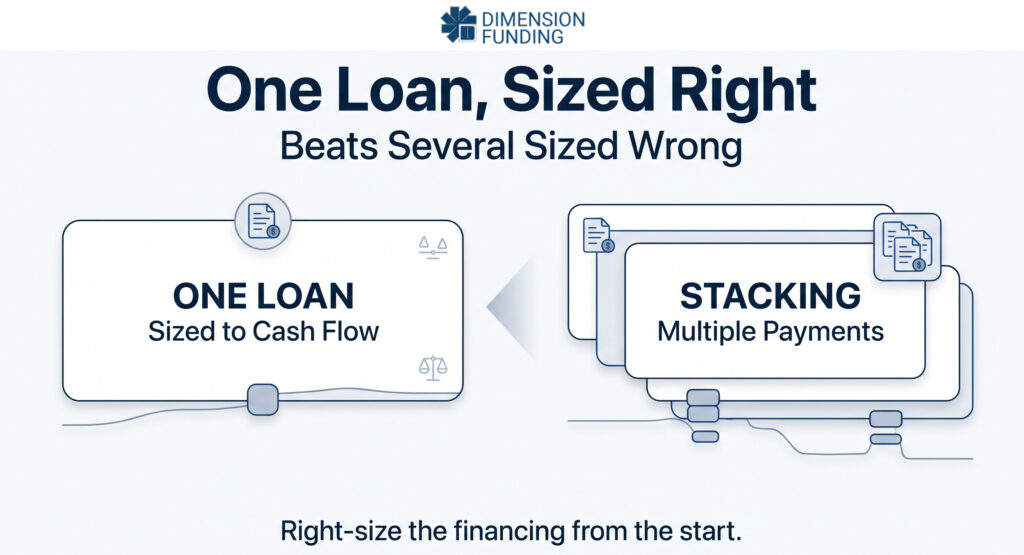
One Loan, Sized Right, Beats Several Sized Wrong
Stacking loans feels like a solution in the moment, but it almost always creates more financial pressure than it relieves. The better path is securing a single working capital loan sized correctly to your actual cash flow need, with a repayment structure that matches how your business earns revenue. Dimension Funding offers working capital loans between $25,000 and $250,000, with terms up to 24 months, same-day or next-business-day funding, and a single-page, bank-statement-based application. Contact Dimension Funding to find out what your business qualifies for.
Is loan stacking always intentional, or can it happen by accident?
It’s often unintentional. A business owner may apply to a second lender simply because a first application is taking too long, not realizing that holding two open approvals at once can look like stacking to an underwriter reviewing recent credit activity.
Does loan stacking show up on a personal credit report, or only a business one?
It primarily shows up on business credit reports and through UCC filings, though many small business loans also involve a personal guarantee, which means related credit inquiries can appear on the owner’s personal report as well.
If I’ve stacked loans in the past, does that hurt future applications permanently?
Not permanently. Lenders are generally more focused on your current debt load and cash flow than on past financing decisions, so demonstrating consistent repayment and a cleaner financial picture going forward can offset a stacking history over time.
Can consolidating multiple stacked loans into one new loan make sense?
It can, if the consolidated payment is genuinely lower or more manageable than the combined payments it replaces. It’s worth running the numbers carefully, since consolidating doesn’t always reduce total cost, even when it simplifies the number of payments.
How does a lender distinguish stacking from a business simply having multiple, unrelated types of financing?
Lenders generally look at timing and purpose. A business with an existing equipment loan and a newly opened working capital line for an unrelated need looks different than two working capital loans opened weeks apart to cover the same cash flow gap.
Does the size of a business affect how closely lenders watch for stacking?
Smaller businesses with thinner cash flow margins tend to get closer scrutiny, since a stacked repayment load has a proportionally bigger impact on a business with less revenue cushion to absorb it.
What’s the first step if I suspect I’m already overextended across multiple loans?
Start by listing every current obligation and its payment schedule against your actual monthly cash flow, rather than assuming it will work itself out. That full picture is also what a lender will want to see if you’re exploring a restructured or consolidated loan.