
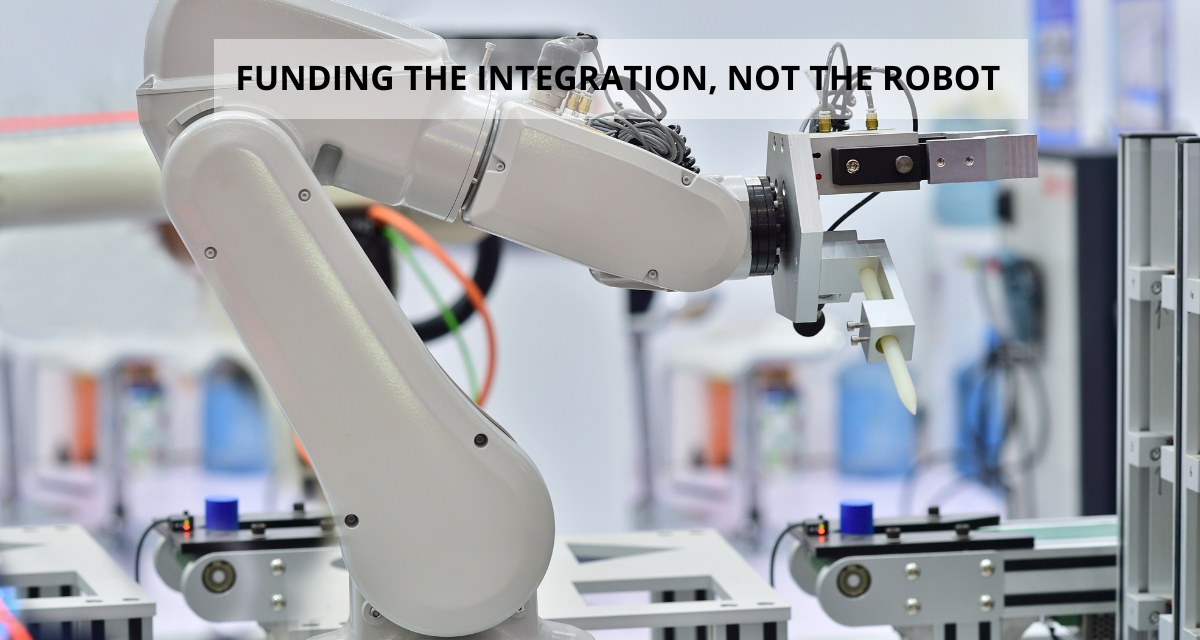
Financing the Integration, Not the Robot: Where Automation Project Cost Sits
The robot on the automation quote is rarely the number that breaks the deal. Dimension Funding finances entire automation projects, not just the hardware line item, because the programming, controls, safety systems, and commissioning work wrapped around a robot typically costs as much as the robot itself, sometimes even more.
Grand View Research valued the global industrial robotics market, the robots themselves, at $33.9 billion in 2024. The same research firm separately values the global robotics system integration market—the design, programming, controls, and commissioning work required to put those robots to work—at $74.56 billion for the same year. More than double the hardware figure. For a vendor selling automation, financing that only covers the robot is financing less than a third of what the customer is buying.
Why the Integration Bill Outgrows the Hardware Bill
The integration work behind a cell rarely comes from just one vendor. A robot manufacturer, a systems integrator handling controls and commissioning, and a separate safety equipment supplier might each invoice the same project independently, which is usually the point where a customer ends up financing the robot alone and paying everything else in cash. Dimension Funding underwrites the combined project as a single transaction regardless of how many vendors are billing it, provided the full scope is submitted together rather than piecemeal as each invoice comes in.
Mordor Intelligence puts the global industrial automation services market, including the design, integration, commissioning, and support work layered around automation hardware, at $187.49 billion in 2026, projecting growth to $339.18 billion by 2031 at a 12.58% compound annual rate. That growth outpaces hardware spending because a manufacturer is paying for a working cell, and getting a cell to run is mostly integration work rather than the robot itself.
What a Single Financed Application Covers
Dimension Funding structures an automation project through an industrial automation financing program as one transaction rather than a hardware purchase with separate integration invoices trailing behind it. That includes:
- Design and engineering for the cell layout, including simulation and virtual commissioning before anything ships
- Controls integration, covering PLC and HMI programming, vision system calibration, and safety system installation
- Physical commissioning, including installation, alignment, and the on-site labor to bring the cell to a running state
- Staff training, so the customer’s own operators and maintenance staff can run and service the cell without depending on the integrator indefinitely
- Multi-year maintenance and support contracts, paid at the time of purchase rather than billed annually as separate service invoices
Application-only approval covers combined equipment-and-software automation projects up to $500,000. Larger integration projects, including multi-cell production lines, remain eligible for a streamlined review process rather than a full bank-style underwriting cycle.
Why the Integration Number Keeps Climbing
Part of the gap between the hardware bill and the integration bill comes down to who’s available to do the work. The Bureau of Labor Statistics projects industrial machinery mechanics will add more new jobs than any other manufacturing occupation between 2024 and 2034, with 41,200 positions driven specifically by the continued adoption of automated machinery that needs skilled people to keep it running. Demand for that labor is growing faster than the hardware itself.
For a vendor quoting a project today, that shows up as commissioning timelines running longer than a customer expects, and integrators pricing labor-heavy phases higher than they would have a few years ago. Financing the full labor-heavy scope alongside the hardware matters more in that environment, not less, since the portion of a project’s cost that’s hardest to compress is exactly the portion most likely to keep growing.
The 90-Day Deferral and Section 179 Together
A qualifying automation purchase can be delivered, installed, and put into production for 90 days before the first payment comes due. That runway matters specifically for automation projects, where commissioning and ramp-up can take weeks before a cell is running at full output, and a customer making payments on equipment that isn’t yet producing revenue is a harder sale than one who isn’t.
Pairing that deferral with Section 179 strengthens the pitch further. Qualifying automation equipment and software placed in service during the tax year can be deducted under the 2026 Section 179 limit of $2,560,000, phasing out above $4,090,000, and under the bonus depreciation provisions restored by the One Big Beautiful Bill Act, per IRS Publication 946, equipment placed in service after January 19, 2025 can qualify for 100% bonus depreciation on any amount above the Section 179 cap. A customer can take the deduction in the same year the cell goes live, while the actual cash payments haven’t started yet.
Zero Percent Financing for Automation Vendors and Integrators
Automation sales often stall on the same objection regardless of how well-engineered the cell is: the customer likes the solution but isn’t sure the payback justifies committing capital this year. A zero percent program, offered directly through Dimension Funding’s vendor partner application, gives a vendor a way to answer that objection without cutting the project price itself.
It tends to do the most work when tied to a specific technology a vendor is trying to get a customer to adopt for the first time, a newer cobot line, a vision-guided system, or any category the customer hasn’t bought before and is naturally more cautious about committing capital to. Once a customer has deployed and validated one cell, the incentive matters less on the next purchase than the track record from the first one does.
What Showing a Monthly Number Changes at the Customer’s End
A proposal that shows a monthly figure next to the project scope can change who at the customer’s organization has to approve it. A capital request large enough to trigger a full committee review sometimes clears faster once it’s presented as a fixed monthly payment rather than a lump sum, since it can move through the budget the way an operating expense does instead of a capital appropriation. Getting that monthly number into the proposal from the first conversation, rather than introducing it after the customer has already seen the total price, is what keeps that path open.
A vendor can run the full project cost, hardware, integration, and multi-year support together through Dimension Funding’s payment calculator before the proposal goes out, and bring the customer an exact monthly number. A vendor connecting an automation cell to a customer’s existing ERP or MES environment can also fold that integration cost into the same request, since ERP financing covers the same categories of implementation and configuration work as the automation project itself.
Quoting the Whole Project Instead of Just the Hardware
An automation quote that only prices the robot understates what the customer is buying, and a financing structure that only covers the robot understates what Dimension Funding can do for that deal. Structuring the full project, hardware, integration, controls, training, and support, as one financed transaction gives a vendor a stronger proposal and a customer a payment that matches what they’re receiving.
Contact Dimension Funding to structure financing around a specific automation project, or to set up a standing vendor partnership ahead of the next quote.
Frequently Asked Questions
Does the $500,000 application-only threshold apply to the integration cost alone, or to the combined project total?
It applies to the combined total, not any single line item. Application-only approval covers projects up to $500,000, and in many cases that threshold extends to $750,000 before financial statements are required, so a project spanning several vendor invoices doesn’t necessarily need full underwriting just because the sum crosses the standard ceiling.
Does financing a multi-vendor project require separate approval from each company involved?
No. The financing is tied to the customer submitting the request, not to any of the vendors billing the project, so the robot manufacturer, the integrator, and any other suppliers involved don’t need their own credit approval or separate sign-off for the application to move forward.
If a customer already owns the robot and only needs the integration work financed, does that qualify?
Yes. Integration, controls work, and commissioning can be financed on their own when the robot itself was already purchased separately, structured around the integration invoice rather than requiring the hardware to be part of the same request.
Does financing the support contract separately from the original project cost anything, compared to bundling it upfront?
Bundling a multi-year support contract into the original financed transaction avoids a separate underwriting event later, since it’s evaluated as part of the same combined project rather than its own line item. Financing it separately after the fact would require a new application tied to that specific service invoice.
Can a vendor offer zero percent financing on the integration portion only, while the customer pays cash for the robot itself?
Yes. A zero percent program can be scoped to specific cost categories within a project, including the integration and controls work alone, without extending the same terms to the hardware portion.
Does a used or refurbished robot change how the surrounding integration work is financed?
No. Integration, controls, and commissioning costs are financed the same way regardless of whether the robot itself is new or used, since the underwriting is based on the full project rather than the age of the hardware component.
What happens if the actual integration costs run higher than the original quote once the project is underway?
Material cost increases discovered mid-project typically require a supplemental request rather than being absorbed into the original agreement, so vendors quoting complex integrations are better served getting a firm number from the integrator before the initial application is submitted.