


A burst pipe, a failed compressor, or a customer bankruptcy can turn a healthy month into a crisis overnight. The costs arrive immediately, while insurance checks, disaster aid, and recovered revenue take weeks. Dimension Funding, a business lender founded in 1978 with an A+ BBB rating, provides financing that keeps owners operating while slower sources of money catch up.
Dimension Funding uses fully electronic DocuSign documents and often funds approved requests the same day or the next business day. Once you have calculated what the disruption will cost, reviewing working capital loan options built for short-term operating needs is a sensible next step.
What Counts as a Business Emergency
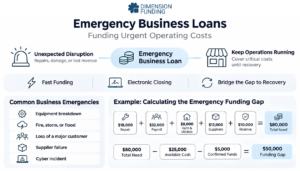
An emergency is any event that creates unplanned costs or stops revenue faster than normal cash flow can absorb. Each type has a different cost profile, which shapes how much you need and how quickly.
Emergency | First Costs | How Fast Cash Is Needed |
Equipment breakdown | Repair or replacement, rush freight, overtime | Days |
Fire, storm, or flood | Cleanup, temporary space, unreimbursed repairs | Hours to days |
Loss of a major customer | Payroll and overhead sized for vanished revenue | Weeks |
Supplier failure | Higher-cost alternate sourcing, expedited shipping | Days to weeks |
Cyber incident | Systems restoration, outside technical help, delayed billing | Days |
Physical events usually need the fastest money but often have insurance behind them eventually. Revenue shocks rarely come with reimbursement, so that financing must be repaid entirely from future operations.
Emergency Versus Ongoing Shortfall
Before borrowing, confirm that the problem has a clear end point. An emergency is a one-time event with a recovery date, such as a repair that will be finished or a replacement customer already in negotiation. If the same shortfall would return next month even without the triggering event, the business faces a structural cash problem, and emergency financing would only postpone a harder decision about costs or pricing.
The First 72 Hours: Which Bills to Protect First
Emergencies force choices about who gets paid first. Ranking obligations before cash runs short keeps the business compliant, insured, and able to restart.
Priority | Obligation | Why It Ranks Here |
1 | Employee wages and withheld payroll taxes | Legal obligations; unpaid withholding can create personal liability |
2 | Insurance premiums | A lapse leaves the business exposed to the next loss |
3 | Suppliers needed to restart | Revenue cannot resume without them |
4 | Secured loans and equipment payments | Protects the assets that generate revenue |
5 | Rent and utilities | Often negotiable short term if contacted early |
6 | Unsecured and discretionary bills | Most flexible; call before the due date |
Tiers one through four are the core operating costs to fund during a disruption. Call creditors in tiers five and six before payments are missed, since early contact leaves more room for a short delay.
Calculate the Emergency Funding Gap Before You Borrow
An emergency loan should cover the cash needed to keep operating until revenue recovers. The immediate repair bill is only part of it. Start with this formula:
Emergency funding gap = urgent repair and recovery costs + core operating costs during disruption + minimum cash reserve − available cash − confirmed funds arriving in time
Component | Amount |
Compressor repair and expedited delivery | $18,000 |
Payroll during a three-week interruption | $32,000 |
Rent and utilities | $8,000 |
Core supplier payments | $12,000 |
Minimum cash reserve | $10,000 |
Total cash requirement | $80,000 |
Less available cash | −$25,000 |
Less confirmed customer payments arriving before bills are due | −$5,000 |
Emergency funding gap | $50,000 |
In this example, the repair accounts for only 36% of the cash the business needs to get through the disruption. Map these items on a weekly cash-flow forecast to see when the shortfall peaks and whether funds are needed at once or in stages.
Stress-Test the Recovery Timeline
Repairs and recoveries rarely finish on the first estimate. In the example, payroll, rent, utilities, and supplier payments total $52,000 over three weeks, or about $17,300 per week of disruption. If parts arrive late and the interruption stretches to five weeks, the gap grows from $50,000 to roughly $84,700. Run the formula at your expected timeline and at a delayed one, then decide how much of the difference to borrow upfront versus keep available as unused credit.
Why Insurance and Disaster Aid Leave a Timing Gap
Owners often assume insurance or government aid will cover an emergency immediately. Both help, but neither pays on day one, and contractors expect payment when work begins.
Insurance Waiting Periods
Business income coverage rarely starts at the moment of loss. The International Risk Management Institute explains that business interruption policies often use a waiting period deductible, so the insurer is not responsible for losses during a set period, such as 72 hours, right after the damage. Do not subtract an expected settlement in the funding-gap formula just because a claim is filed. Until the amount and timing are certain, treat it as a future source of repayment, not cash available today.
SBA Disaster Loans
The U.S. Small Business Administration’s disaster assistance program separates two needs. SBA disaster loans cover uninsured losses from a disaster, while Economic Injury Disaster Loans help eligible small businesses that have trouble meeting operating expenses because of it. According to Benefits.gov, a business must be located in a declared disaster area or a contiguous jurisdiction, and the $2 million cap covers physical and economic injury loans combined. Equipment failures and customer losses fall outside the program entirely.
Emergency Equipment Replacement
When a core machine fails beyond repair, the true cost is the revenue lost each day it sits idle. Consider a production line generating $6,000 in gross profit per business day. Waiting three weeks to save cash for a $140,000 replacement forfeits about $90,000 in gross profit, more than half the machine’s price.
Finance a full replacement separately and leave it out of the funding-gap formula, which should hold only short-term recovery costs. Dimension Funding offers equipment financing, and equipment loans up to $250,000 require no financial statements, a simpler path that suits urgent purchases. Spreading a long-lived machine over a multi-year term also keeps monthly payments from crowding out the payroll and supplier costs the recovery still requires.
Preparing Before the Next Emergency
The best time to arrange emergency credit is before the emergency. The Federal Reserve’s 2026 Report on Employer Firms found that 34% of firms faced a financing shortfall after applying and another 15% needed funds but did not apply. Run the funding-gap formula for a plausible three-week disruption, then arrange a business line of credit sized to that figure.
Keep an emergency document kit ready. It should hold three months of bank statements, your latest tax return, insurance declarations pages, and an equipment list. Dimension Funding generally prefers two or more years in business, though strong credit can offset a shorter history. Its team is described on the About Us page, and requests can begin through the online financing application.
Match Repayment to the Recovery
Choose a repayment structure that fits where the money to repay it will come from. If an insurance settlement is likely, a shorter term with the option to pay early lets you clear the balance when the check arrives. If repayment depends on revenue returning to normal, a longer term with fixed monthly payments keeps the obligation manageable during the months when sales are still rebuilding.
Keeping the Doors Open While Recovery Catches Up
Most emergencies are survivable when cash keeps flowing through the first few weeks. Protecting the right obligations, borrowing against a realistic recovery timeline, and replacing failed equipment quickly limits the damage to a temporary setback.
If an urgent cost is threatening operations, Contact Dimension Funding to discuss the fastest appropriate structure. You can also call 1-800-755-0585 or email Sales@DimensionFunding.com.
Frequently Asked Questions
What slows down an emergency funding approval?
The most common delays are missing bank statements, an unclear use of funds, and existing liens on the assets involved. Sending complete documents with the first request and describing the emergency plainly usually shortens the review. A short written summary of what happened and when operations will resume also helps.
Should I use a business credit card instead?
A card can cover small, immediate purchases while a larger request is reviewed. Limits are often too low for major repairs or payroll, however, and revolving balances can linger long after the emergency ends. Moving large costs onto a structured loan keeps repayment defined.
What records should I keep during the recovery?
Keep every receipt, invoice, and payroll record tied to the disruption. Policies with extra expense coverage may reimburse some emergency costs, and clean records also support any later lender or SBA review. Photos of damage and dated repair estimates are worth saving as well.
Does business interruption insurance cover a cyberattack?
Often not. Standard coverage typically requires direct physical damage, which a cyber incident may not involve. Cyber policies are sold separately, so review your coverage with your agent before an incident occurs rather than after.
What should I do if a major customer files for bankruptcy?
File a proof of claim in the case, but plan as if that money will not return soon. Adjust staffing and purchasing to remaining revenue, and finance only the transition period while you replace the lost business with new accounts.
Will an emergency loan hurt my credit?
An application may trigger a credit inquiry, and on-time payments build a positive record. Avoid applying to many lenders at once in a panic, since multiple inquiries and stacked loans with overlapping payments make recovery harder to manage.
Can a temporarily closed business apply?
Possibly. Lenders will want to know the cause, the expected reopening date, and how revenue will resume. Repair estimates, insurance documentation, and signed customer commitments help show the closure is temporary rather than permanent.