


A veterinary practice can run double-booked through spring parasite season, then face a week in January when exam rooms sit empty half the day. The staff, the lease, and the equipment payments stay the same either way. Dimension Funding has financed equipment and service businesses since 1978, and uneven caseloads are one of the most common reasons practice owners look for working capital.
Caseload swings are not random. Owners who know how many cases a day cover their fixed costs, and how long a slow stretch can last, can size a Dimension Funding working capital loan around the real risk instead of guessing.
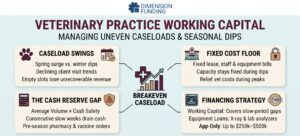
Why Veterinary Revenue Moves More Than Veterinary Costs
Caseloads rise and fall for predictable reasons. Spring and summer bring parasite prevention, vaccines, and outdoor injuries, while holiday weeks bring cancellations and toxin emergencies. Surgery and dental days depend on how many estimates clients accept.
Visit trends add pressure. According to the American Veterinary Medical Association, practices saw revenue rise about 2.5% in 2025 while visits fell roughly 3%, continuing a four-year trend. More clients are also declining recommended care, with diagnostics the service most often refused.
Fixed Capacity Sets the Cost Floor
A practice builds its costs around capacity, not each day’s appointments. The AVMA’s 2025 Report on the Economic State of the Veterinary Profession found that practices used an average of at least 81.7% of their total square footage in 2024, and notes that unused space carries costs the practice cannot recover.
Doctors and technicians are scheduled days or weeks ahead. When the caseload dips, those costs remain, and each empty appointment slot is revenue that cannot be recovered later.
Finding Your Breakeven Caseload
The most useful number for a practice with uneven volume is its breakeven caseload: the number of cases per day that covers the day’s fixed costs.
Breakeven cases per day = daily fixed costs ÷ (average revenue per case − variable cost per case)
Consider an illustrative practice with $6,000 in daily fixed costs for base payroll, rent, equipment payments, and software. Its average revenue per case is $260, and variable costs per case (drugs, supplies, outside lab fees, and card processing) average $85. Each case contributes $175 toward fixed costs, so the practice needs about 35 cases a day to break even.
Why Averages Hide the Risk
The table below shows eight illustrative weeks for the same practice, open six days a week.
Week | Average Cases per Day | Weekly Result |
1 | 42 | +$8,100 |
2 | 38 | +$3,900 |
3 | 33 | −$1,350 |
4 | 31 | −$3,450 |
5 | 36 | +$1,800 |
6 | 44 | +$10,200 |
7 (holiday week) | 29 | −$5,550 |
8 | 40 | +$6,000 |
The eight-week average is about 36.6 cases a day, above breakeven, and the period finishes $19,650 ahead. But three weeks lose money, and weeks 3 and 4 together lose $4,800 back to back.
Breakeven Caseload Is Not the Same as the Cash Reserve Requirement
A practice can operate above breakeven over an entire month and still face a cash shortage if visits fall below that threshold for several consecutive weeks. Breakeven caseload is an operating threshold, while the cash reserve requirement is a time-based liquidity threshold. Keeping them separate shows how much cash a slow period can actually consume.
Both depend on consistent books. The AAHA’s guide to practice financial metrics recommends tracking operating profit margin alongside revenue growth, transactions, expenses as a share of revenue, and accounts receivable aging, rather than relying on one measure. The VMG/AAHA Chart of Accounts, endorsed by the AVMA and the Veterinary Hospital Managers Association, is the standard structure for classifying revenue, expense, and balance sheet accounts in small-animal practice.
Estimating the Slow-Period Cash Need
Slow-period cash need = (daily fixed cash costs − average daily contribution margin) × slow-period days
If the practice above falls to 20 cases a day, those cases generate $3,500 in daily contribution margin against $6,000 in fixed costs, a $2,500 daily shortfall. Over 15 operating days, about two and a half weeks at six days a week, the practice needs roughly $37,500 in operating cash. That is before irregular expenses such as inventory purchases, taxes, equipment repairs, or other scheduled payments.
Slow-Period Length | At 28 Cases per Day | At 20 Cases per Day |
6 operating days | $6,600 | $15,000 |
12 operating days | $13,200 | $30,000 |
15 operating days | $16,500 | $37,500 |
18 operating days | $19,800 | $45,000 |
Depth and duration both matter. A mild dip that lasts three weeks can consume more cash than a sharp dip that lasts one. Planning is therefore a two-part exercise: calculate the caseload that covers operations, then calculate the cash needed to get through the expected length of the slow period.
Where Uneven Caseloads Strain Cash
Several expenses tend to land when volume is changing, making the swings sharper than the breakeven math alone suggests.
Pharmacy and Vaccine Inventory
Practices often stock up on parasite preventives and vaccines before spring demand arrives. That cash leaves weeks before busy-season revenue does, and seasonal buying programs can make the order larger than one month requires.
Relief Coverage
Relief veterinarians keep appointments from being turned away when a doctor is out, but short-notice coverage usually costs more per day than a staff doctor. Those costs often arrive during the practice’s strongest weeks.
Declined Care and In-House Payment Plans
When clients decline diagnostics, a full schedule produces less revenue per case. In-house payment plans keep care moving but stretch collections over weeks or months, adding a receivables gap to a business that normally collects at checkout.
Financing Built Around Caseload Swings
Reducing the swing comes first, then financing covers what remains.
Smooth the Caseload First
Automated reminders for vaccines and preventive care pull visits into slower weeks. Scheduling elective dental and surgical procedures in predictably quiet months, such as during February’s National Pet Dental Health Month promotions, fills gaps with higher-value cases.
Matching Financing to the Slow Period
A working capital loan fits the slow-period cash need your own history points to, plus pre-season inventory. Short-term business loans can cover a narrower need, such as a large preventive order. Paying cash for digital radiography, ultrasound, or a lab analyzer drains the slow-week reserve, so equipment financing and software financing can spread those costs over fixed payments.
Dimension Funding offers application-only financing up to $250,000 for equipment and $500,000 for software, with no financial statements required. Funding typically arrives the same day or the next business day through DocuSign.
Planning Around the Weeks That Don’t Average Out
Uneven caseloads are a normal part of veterinary medicine, but they are measurable. Know your breakeven caseload, estimate how much cash your longest likely slow period will consume, and keep equipment purchases on their own financing.
Dimension Funding prefers businesses with two or more years in operation, though strong credit can substitute. To size financing around your practice’s caseload pattern, Contact Dimension Funding at 1-800-755-0585 or Sales@DimensionFunding.com.
Frequently Asked Questions
Do wellness plans help cash flow?
Monthly plan fees add predictable revenue, but the practice owes the included services. Track how often members use their benefits so plan revenue matches the care it funds.
Should I collect deposits for surgeries and dental procedures?
Deposits on estimated procedures reduce collection risk and last-minute cancellations. Many practices collect a portion at booking and the balance at discharge.
How does pet insurance affect practice cash flow?
Most U.S. pet insurance policies reimburse the owner after the visit, so the practice usually collects at checkout. Some insurers offer direct payment to the practice, which adds a short receivables wait.
Does controlled substance inventory affect working capital?
Controlled substances carry recordkeeping and storage requirements, and they are usually a small but steady part of inventory. Ordering to actual usage keeps cash off the shelf.
What records help a lender understand an uneven caseload?
Twelve to 24 months of daily caseload and revenue reports from your practice management system, along with bank statements, show the pattern clearly.
Should I extend hours to fill slow periods?
Extended hours can add cases, but they also add staffing costs. Test the change against your breakeven caseload first.
How can I tell if a slow stretch is seasonal or a trend?
Compare the same weeks across two or three years. A repeating dip is seasonal, while a steady decline in new clients or visits per client points to a longer-term issue.