


January fills a gym’s front desk with new sign-ups, enrollment fees, and paid-in-full memberships. By July, many of those members have frozen or canceled, while rent, payroll, and equipment payments stay the same. Dimension Funding has financed service businesses since 1978, and the stretch between the January rush and the summer drop is one of the most common reasons gym owners look for working capital.
The pattern repeats every year, so it can be planned for. Owners who understand which January cash is recurring and which is not can arrange a Dimension Funding working capital loan before collected dues fall below fixed costs, not after.
The Two Seasons That Shape Gym Cash
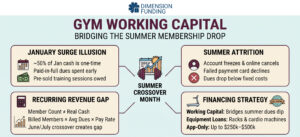
Most gyms run on two cycles. The first is the January surge, when new-year resolutions drive a wave of joins. The second is the gradual attrition that follows through spring and into summer, when new joins slow and existing members travel, freeze their accounts, or cancel.
Demand for fitness is strong overall. The Health & Fitness Association’s 2026 consumer report found that a record 81 million Americans held a fitness facility membership in 2025, or 26.1% of the population ages six and older. The association’s traffic tracker has also reported record July visitation at high-volume, low-price and mid-priced gyms, so for many clubs the summer drop shows up in joins and cancellations more than in foot traffic.
Why January Cash Can Mislead
A strong January bank balance often includes money that will not repeat and money that has already been promised back to members as future service. Separating the two is the first step in planning for summer.
Paid-in-Full Memberships Are Spent Before They’re Earned
A member who prepays for a year hands over twelve months of dues at once. The gym receives the cash in January but owes access through December. If that cash covers January expenses, nothing replaces it in July, even though the member is still using the facility.
Prepaid personal training works the same way. A client who buys twenty sessions in January may use many of them in spring and summer, and trainers are often paid when sessions are delivered.
Where January Collections Come From
The example below shows illustrative January collections for a gym with 1,200 existing members and 250 new joins.
Source | January Amount | Repeats in July? |
Monthly dues from existing members, at the advertised $45 | $54,000 | Yes, minus attrition |
Enrollment fees from 250 new joins at $49 | $12,250 | No |
Paid-in-full annual memberships, 60 at $450 | $27,000 | No, but service is owed all year |
Prepaid personal training packages | $15,000 | No, but sessions are owed |
Total | $108,250 |
Only about half of January’s total comes from recurring dues. The other $54,250 is either one-time revenue or prepaid service that the gym will spend months delivering.
Where the Summer Drop Hits the Billing Run
Summer attrition reaches the gym through the monthly billing run. Two forces drive it, and one of them is getting easier for members to use.
Cancellations and Freezes
Cancellation rules are changing in some states. According to Cooley’s summary of California’s amended Automatic Renewal Law, businesses must offer cancellation through the same medium the consumer used to enroll, or one the consumer typically uses. A business that lets consumers sign up online must also let them cancel online.
When canceling takes a few clicks, attrition responds faster to summer schedules. Freeze options can hold on to members who would otherwise cancel, but a frozen account usually bills a small fee or nothing at all.
Failed Payments
Some attrition is involuntary. Expired or replaced cards and declines on low-balance accounts cause monthly drafts to fail. Retrying failed payments on a set schedule and using card-updater services from your payment processor can recover part of those dues before members lapse.
Membership Count Does Not Equal Recurring Monthly Revenue
A gym’s active member count is only the starting point for forecasting recurring revenue. Multiplying members by the advertised monthly fee assumes every member pays the same amount, remains billable, and completes each payment. In practice, cancellations, freezes, discounted memberships, failed payments, and different pricing tiers can make collected dues materially different from the headline count.
Industry benchmarks measure these separately. The HFA’s 2025 Fitness Industry Benchmarking Report tracks monthly accounts added and dropped, net growth, retention, and revenue per member as distinct metrics. It reported a median member retention rate of 66.4% and net membership growth of 5.5% for 2024, meaning roughly one in three members left over the year even as totals grew. Retention should be measured, not assumed.
From Member Count to Collected Dues
Ending members = beginning members + new joins − cancellations − permanent lapses
Collected recurring revenue = billed members × average dues × collection rate
Billed members are ending members minus frozen or otherwise nonbilling accounts. For example, 1,200 members at an advertised $45 suggests $54,000 in billings. If promotional pricing brings the average realized dues to $42 and 97% of drafts succeed, actual recurring collections come to about $48,888, more than $5,000 below the simple member-count calculation.
Finding the Crossover Month
The most useful date in a gym’s cash plan is the crossover month: the first month when collected recurring dues fall below fixed operating costs. The model below applies the $42 average dues and 97% collection rate, or about $40.74 collected per billed member, against $52,000 in monthly fixed costs. Freeze fees are left out for simplicity.
Month | Ending Members | Frozen | Billed Members | Collected Dues | Difference vs. Fixed Costs |
January | 1,450 | 0 | 1,450 | $59,073 | +$7,073 |
March | 1,390 | 10 | 1,380 | $56,221 | +$4,221 |
May | 1,330 | 20 | 1,310 | $53,369 | +$1,369 |
June | 1,290 | 50 | 1,240 | $50,518 | −$1,482 |
July | 1,250 | 70 | 1,180 | $48,073 | −$3,927 |
August | 1,220 | 60 | 1,160 | $47,258 | −$4,742 |
In this illustrative model, the crossover arrives in June. A simple count of 1,290 members at $45 would show June at $58,050, comfortably above fixed costs, and hide the shortfall entirely. The real summer gap is larger still, because trainer pay for sessions sold in January keeps coming due. Build your forecast from your own monthly history of joins, cancellations, freezes, average dues, and successful collections.
Financing Timed to the Membership Cycle
A working capital loan fits the period between the crossover month and the fall rebound. Arranged in spring, while January’s joins still show in your billing reports, it provides a set amount on a fixed schedule. Short-term business loans can cover a narrower need, such as trainer payroll for prepaid sessions delivered over the summer.
Equipment is a separate decision. Replacing treadmills, racks, or free-weight areas with cash drains the reserve meant for the summer gap. Equipment financing spreads those costs over fixed payments, and Dimension Funding offers application-only equipment financing up to $250,000 with no financial statements required. Funding typically arrives the same day or the next business day through DocuSign.
Planning Past the Resolution Rush
January’s cash surge is real, but much of it is either one-time or already owed back as service. Separate recurring dues from prepaid collections, forecast collected dues rather than member counts, and find the month when those dues cross below fixed costs.
Dimension Funding prefers businesses with two or more years in operation, though strong credit can substitute. To plan financing around your gym’s membership cycle, Contact Dimension Funding at 1-800-755-0585 or Sales@DimensionFunding.com.
Frequently Asked Questions
Should I push paid-in-full memberships in January?
They bring in cash and often improve retention, but they also create a year of owed service. Some owners set aside a monthly share of paid-in-full revenue so the cash lasts as long as the obligation.
Can I raise dues in the middle of the year?
Many agreements allow it, but notice rules may apply. Kilpatrick Townsend’s review of California’s amendments notes that a fee change now requires clear notice at least 7 and no more than 30 days before it takes effect.
How should freeze policies be structured?
Common approaches include a small monthly freeze fee, a maximum freeze length, and an automatic return to full billing. Clear limits keep freezes from becoming long stretches of nonpaying accounts.
Are enrollment fees and prepaid dues taxable when received?
It depends on your accounting method and how the payments are structured. Some businesses can defer part of certain advance payments, so review the treatment with your CPA.
Do summer promotions help close the gap?
Discounted summer joins add members, but many cancel by fall. Track promotional cohorts separately so they do not hide weakness in your core membership.
What will a lender want to see from a gym?
Expect 12 months of bank statements and billing reports showing billed members, freezes, and failed payments by month. Two years of history with the same seasonal pattern shows the dip is predictable.
What happens to prepaid training if a trainer leaves?
The gym still owes the sessions. Reassign clients promptly so prepaid packages are delivered and do not turn into refund requests.