

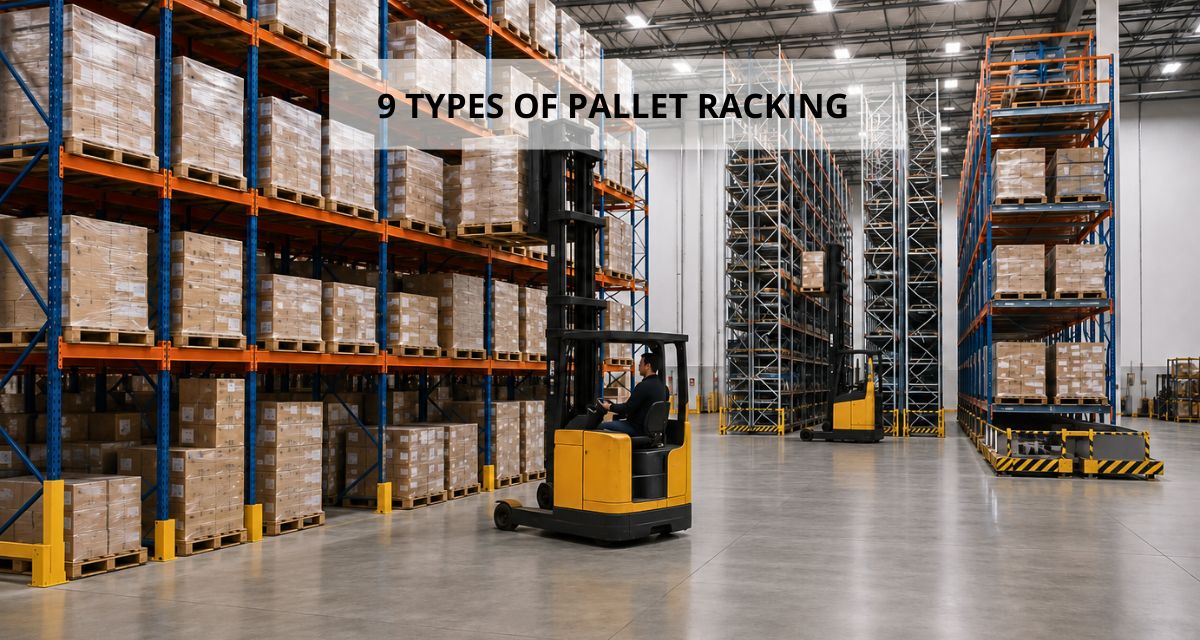
Pallet Racking Systems: 9 Types Compared + Installation & Financing
A warehouse manager signs off on a new racking layout, waits weeks for it to arrive and get installed, and only then realizes the forklifts on the floor cannot reach the second row. That single mismatch between rack type and equipment can turn a storage upgrade into a redo, with the whole project sitting idle while someone figures out what went wrong. Picking the right pallet racking system before anything gets ordered is the difference between the two.
What Is Pallet Racking?
Pallet racking is a structural storage system built from vertical frames and horizontal beams that holds palletized inventory above the floor, usually several levels high. Instead of stacking pallets directly on top of each other, racking lets a forklift place and retrieve pallets at defined levels.
That protects the product underneath, puts vertical space to use that would otherwise sit empty, and keeps inventory organized enough to actually find when someone needs it.
Not every rack type solves the same problem. Some prioritize getting to every pallet whenever you need it. Others sacrifice that access in exchange for packing far more product into the same floor space.
9 Types of Pallet Racking Systems Compared
1. Selective Racking
The standard rack type in most warehouses. Every pallet sits directly accessible from the aisle, works with any standard forklift, and supports any inventory rotation method. It uses floor space less efficiently than denser systems, but the tradeoff is that any pallet can be pulled at any time without moving another pallet first.
2. Double-Deep Racking
Pallets store two positions deep instead of one, so more inventory fits in the same footprint. The catch is that a standard forklift cannot reach the back pallet. Double-deep requires a truck with telescoping or reach forks built for the second row.
3. Drive-In Racking
Forklifts drive directly into the rack structure itself to load and unload pallets, with only one aisle serving as both entry and exit. This packs pallets tightly but locks the system into last-in, first-out rotation, since the first pallet loaded ends up buried behind everything that came after it.
4. Drive-Through Racking
Structurally similar to drive-in, but open on both ends so a forklift can enter from one side and exit the other. That opens up first-in, first-out rotation, useful for perishable goods or anything with a shelf life.
5. Push-Back Racking
Pallets sit on wheeled carts on a slightly sloped rail system. A forklift pushes each new pallet back, and gravity feeds the next pallet forward when one is removed. Push-back typically stores pallets two to six deep per lane and still allows access from a single aisle.
6. Pallet Flow Racking
Also called gravity flow, this system uses angled roller tracks so pallets loaded at the high end roll down to the pick end under their own weight. Loading and picking happen from opposite ends of the same lane, so it supports true first-in, first-out rotation at high density.
7. Cantilever Racking
Built with arms extending from a single vertical column instead of enclosed bays, cantilever racking is designed for long or awkward loads that do not sit well on a standard pallet, things like lumber, pipe, or metal bar stock.
8. Very Narrow Aisle (VNA) Racking
Standard selective racking built for aisles far tighter than a conventional forklift can turn in, paired with specialized VNA trucks that move on guide rails or wire guidance. The narrower aisles reclaim floor space that would otherwise sit empty for truck turning radius.
9. Mobile Racking
Rack rows sit on motorized carriages that roll along floor-mounted rails, closing the aisle between rows until someone needs access. Only one aisle needs to be open at any given time, so a warehouse can fit meaningfully more racking into the same building footprint.
How to Choose the Right System
The decision usually comes down to a handful of practical questions rather than a single best answer.
What forklifts are already on the floor, and can they reach a double-deep or VNA layout without buying new trucks? Does inventory need strict first-in, first-out rotation, which rules out drive-in racking, or is last-in, first-out acceptable for the product being stored? How much of the building’s footprint needs to go toward storage versus staging, receiving, and aisle space for daily operations?
Ceiling height and building growth plans matter too. A warehouse expecting to add SKUs or scale volume in the next few years benefits from a system that is not maxed out on day one. Getting this wrong is expensive to fix later, since it usually means tearing out and replacing a system rather than adjusting it.
Common Mistakes When Planning a Racking Layout
A few mistakes show up often enough to be predictable, and most of them are avoidable with a bit of planning before steel gets ordered.
Ordering racking before confirming which forklifts will actually service it is the most common one, and it is the exact scenario from the opening of this piece. A double-deep or VNA layout does nothing for a warehouse if the trucks already on the floor cannot reach it.
Sizing a layout for today’s inventory instead of where the business expects to be in two or three years is another. Racking is expensive to tear out and replace, so building in some headroom upfront is usually cheaper than a second project down the line.
Skipping engineered drawings and proper anchoring to save time or money is the costliest mistake by far. It turns a budget decision into a safety problem. A system that is not engineered and anchored to code can fail under load, and the cost of a collapse is far higher than whatever the engineering step would have added to the price.
Pallet Racking Installation Requirements
Racking is a structural system, not furniture, and it is regulated as one. The Rack Manufacturers Institute’s ANSI MH16.1 standard governs how racking is designed, loaded, and anchored, and most reputable installers work directly against it.
Every loaded rack column needs to be anchored to the floor, not just the columns along the aisle. The floor itself needs to be engineered to handle the point loads a fully loaded rack system puts on a relatively small footprint, something most warehouse floors were never built to handle on their own. In earthquake-prone regions, seismic requirements add additional bracing and anchoring specifications on top of the base standard.
Load capacity signage, regular inspections, and a plan for repairing damaged frames (a forklift strike bends steel more often than most warehouses expect) are part of keeping a system compliant long after installation day. Skipping any of this is how a storage upgrade turns into a safety liability instead of a productivity win.
What Does Pallet Racking Cost?
Cost depends on the type of system, the height and depth of the layout, and how much engineering and installation labor the project needs. Selective racking is the least expensive option per pallet position, while systems like mobile racking or VNA cost considerably more upfront, since they require specialized equipment and more precise installation, in exchange for the extra density or space savings they deliver.
Installation, permitting, floor engineering, and any building modifications needed to support the system are usually a significant part of the total project cost, not an afterthought tacked onto the price of the steel itself.
Financing Your Pallet Racking Project with Dimension Funding
Dimension Funding has provided material handling equipment financing for over 40 years, and that coverage extends to warehouse storage racks and shelving directly, not just the forklifts and equipment that move pallets in and out of them.
Rather than paying for a racking project in cash, financing spreads the full cost, including racking, installation, and any related equipment, into one fixed monthly payment.
Approvals up to $250,000 are available without financial statements, and larger projects go through a streamlined process rather than a traditional loan application. Terms extend up to 60 months, with no penalty for paying off the balance early.
Delivery, installation, and maintenance costs can be included in the financed amount rather than paid upfront out of pocket. That matters, since a meaningful share of a racking project’s total cost sits outside the steel itself.
Businesses financing a racking project may also be able to write off a significant portion of the cost under IRS Section 179 in the same tax year the system is installed, which can meaningfully offset the investment.
Frequently Asked Questions About Pallet Racking
What is the most common type of pallet racking?
Selective racking. It gives direct access to every pallet from the aisle, works with any standard forklift, and fits almost any inventory rotation method, which is why most warehouses start there before considering a denser system.
What is the difference between drive-in and drive-through racking?
Drive-in has one aisle that serves as both entry and exit, so it only supports last-in, first-out rotation. Drive-through is open on both ends, which allows first-in, first-out rotation instead.
How much does pallet racking cost to install?
It depends on the system type and the amount of engineering, permitting, and labor the layout needs. Selective racking is the least expensive per pallet position, while denser systems like mobile racking or VNA cost more upfront because of the specialized equipment and more precise installation involved.
Does pallet racking need to be anchored to the floor?
Yes. Every loaded column needs to be anchored, and the floor itself needs to be engineered to handle the point loads a fully loaded system creates. The Rack Manufacturers Institute’s ANSI MH16.1 standard governs how this is done, and seismic zones require additional bracing on top of that.
Can pallet racking be financed?
Yes. Dimension Funding finances warehouse storage racks and shelving directly, along with installation and related equipment, as one fixed monthly payment instead of a large upfront cost.
How long does approval take?
Approvals up to $250,000 don’t require financial statements, and most decisions come back within a few hours. Larger projects involve more documentation but are still handled by the same team from quote to funding.
If a storage upgrade is on the table, use the payment calculator to see what a monthly payment could look like, or start a financing application to get a quote, usually within a few hours.