
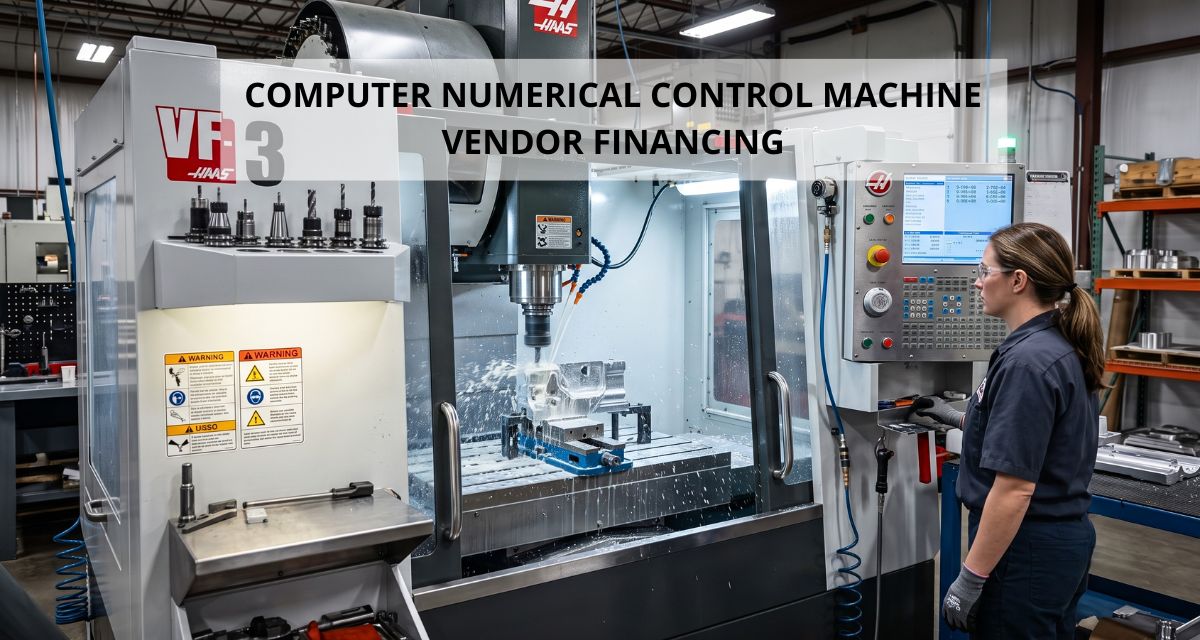
CNC Machine Vendor Financing: Fund Mills, Lathes & Automation

equipment financing for startups

CNC Machine Vendor Financing: Fund Mills, Lathes & Automation

CNC machine financing lets a machine shop or manufacturer spread the cost of a mill, lathe, or machining center over its working life instead of paying the full price at delivery. 

Dimension Funding finances CNC machines and the automation built around them on an application only basis up to $250,000, with a higher threshold available once automation or software becomes part of the purchase.

Most of that financing runs through the machine builder selling the equipment rather than a separate bank, which matters more on a machine tool purchase than it does on a lot of equipment, since a mill or lathe is rarely bought without also pricing tooling, installation, and whatever automation goes around it.

What CNC Machine Financing Covers

CNC machine financing typically means a mill, lathe, or machining center, but the practical scope runs wider on most shop floors. Automatic tool changers, bar feeders, robotic loaders, CAM software, and the installation and rigging needed to get a machine running are commonly financed alongside the machine itself rather than paid for separately.

Treating the purchase as one project instead of several separate costs is often the difference between a shop financing the automation it needs now and one bolting on a robot arm eighteen months later once cash flow allows it.

That shift toward automation shows up in the order data too. New orders of metalworking machinery rose nearly 29 percent over the first four months of 2026 versus the same period a year earlier, according to the U.S. Manufacturing Technology Orders report from AMT, The Association For Manufacturing Technology. A meaningful share of that growth came from added automation on increasingly sophisticated machines, not machine prices alone.

How Vendor Financing Works When You Buy Through the Machine Builder

A vendor finance program is an arrangement where the company selling the equipment already has a finance partner in place, so the buyer applies at the point of sale instead of shopping for a lender separately, according to equipment finance technology firm Uptiq

Dimension Funding runs this structure directly with CNC machine builders, including a financing program built specifically around Tork CNC’s client base.

That distinction matters on a machine tool purchase specifically. A shop pricing a new mill is usually working from one vendor quote that already includes tooling and installation, and vendor financing underwrites against that same number instead of treating the machine, the tooling, and the setup as three separate credit decisions.

Vendor programs like this run through the captive and independent side of the finance industry, not through a traditional bank. 

Banks originate 55 percent of new equipment finance business by volume, captive finance companies tied to manufacturers account for 32.2 percent, and independent finance companies the remaining 12.9 percent, according to the Equipment Leasing and Finance Association’s industry overview.

What the Application Only Threshold Means for a Machine Shop

Dimension Funding’s application only threshold covers CNC machines up to $250,000 without financial statements, evaluating credit profiles from strong commercial credit down to marginal credit rather than screening on a single score. When automation or software is bundled with the machine, a robotic loading system or a CAM package, that same application only threshold extends to $500,000.

A shop buying a mill on its own and a shop buying the same mill with a robotic loader attached are working against two different thresholds for the same paperwork requirement, so pricing the automation into the same quote can change which threshold applies.

Why the Financed Equipment Is the Only Collateral

Conventional bank financing for machine tools often comes with a blanket lien across a shop’s other assets, not just the machine being purchased. 

Dimension Funding’s manufacturing equipment financing uses only the financed equipment as collateral, which keeps a mill or lathe purchase separate from whatever real estate debt, inventory financing, or other credit lines the shop already carries.

For a shop financing a second or third machine while other equipment loans are still active, that separation is often the detail that carries the most weight, since it determines what happens to the rest of the shop’s assets if a single purchase runs into trouble.

New and Used CNC Machines Under the Same Program

Dimension Funding finances new and used CNC machines under the same terms, including certified pre-owned mills and lathes that are common in job shop replacement cycles. A well maintained used machining center can deliver the same output as a new one at a lower acquisition cost, and it qualifies for the identical fixed monthly payment structure.

Delivery, rigging, and installation are financed the same way regardless of whether the machine is new or used, which keeps the comparison straightforward when a shop is weighing a new mill against a lower cost used one from the same vendor.

Where Section 179 Fits for a Machine Shop

The 2025 Section 179 deduction lets a business write off up to $2,500,000 in qualifying equipment and software purchases in the year the equipment is placed in service, with a $4,000,000 spending cap before the deduction phases out. 

Both new and used CNC machines qualify, and the deduction applies whether the purchase is structured as a loan or an eligible lease.

For a shop closing a machine purchase before year end, that deduction is often what makes financing a new mill make more sense than waiting on next year’s budget, since the write off applies in the year the machine goes into service rather than the year it is fully paid off.

Getting Started

Dimension Funding has financed commercial and industrial equipment, CNC machines included, since 1978. The most useful first step is getting a firm quote from the machine builder or dealer, since that number, tooling and automation included, is what the vendor financing application gets built around.

From there, Dimension Funding’s financing application takes about six minutes, or you can run a payment estimate first with the payment calculator or call 1.800.755.0585 to talk through financing for a specific mill, lathe, or automation package.

Frequently Asked Questions

What can I include in CNC machine financing besides the machine itself?

Tooling packages, workholding and fixtures, extended warranties, and multi-year service contracts can typically be financed in the same application rather than paid for out of pocket. The full project, not just the base machine price, is usually what gets financed.

Does the $500,000 application only threshold apply per machine or per project?

It applies to the total project, not a single line item, so a mill priced at $300,000 with a $150,000 robotic loading system bundled in falls under the $500,000 threshold as one combined application. Splitting the purchase into separate applications does not reduce the total financing needed, it just adds paperwork.

Can I still finance a new CNC machine if another lender already has a blanket lien on my business?

Often, yes, since Dimension Funding’s financing attaches only to the equipment being purchased rather than requiring a lien across all business assets. An existing blanket lien with another lender does not automatically block a new equipment purchase, though the specifics depend on that lien’s own terms.

Does a used CNC machine need to meet specific requirements to qualify for financing?

Age and documented maintenance history can factor into the review, though there is no fixed cutoff that automatically disqualifies an older machine. A used machine coming from an established dealer with service records typically moves through underwriting more smoothly than one with no documented history.

How long does approval and funding take for a CNC machine purchase?

Most approvals come back the same day the application is submitted, and funding typically follows within 24 hours after that. The entire process runs through DocuSign, so a shop financing a mill or lathe is not waiting on paperwork to move a project forward.

If I order a CNC machine this year but it is not installed until next year, does it still qualify for this year’s Section 179 deduction?

No. The deduction applies in the year the machine is placed in service, not the year it is ordered or invoiced. A machine ordered in December but not running until January falls into the following tax year’s deduction instead of the current one.

Can I finance more than one CNC machine in the same application?

Yes. A shop replacing several machines at once or adding a second cell can finance the group under one application rather than filing separate requests for each machine. Combined purchases above the application only threshold move into the same basic financial review as any larger single transaction.

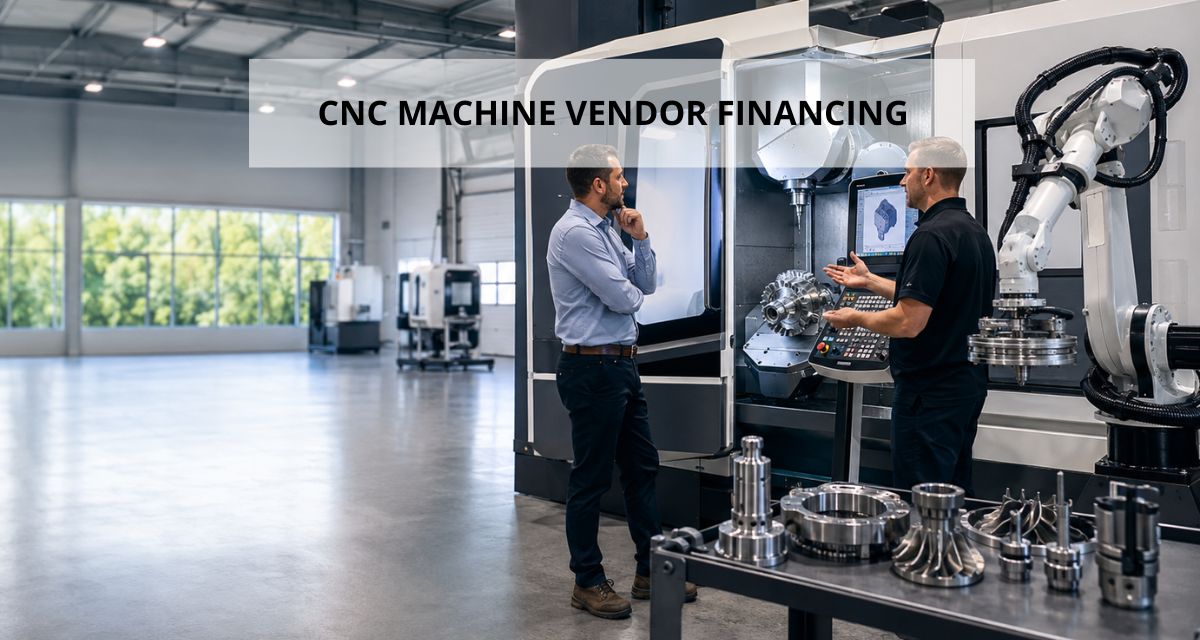
CNC Machine Vendor Financing: Loans for Mills, Lathes & Automation

cnc machine financing

CNC Machine Vendor Financing: Loans for Mills, Lathes & Automation

A shop owner walks your showroom floor, likes the five axis mill, likes the quote, and then goes quiet the moment the total comes up. 

That pause is the moment a lot of machine tool sales are won or lost. The equipment is right, the price is fair, and the deal still stalls because the buyer has no easy way to pay for it without tying up capital they need for payroll, materials, and the next job.

CNC machine vendor financing exists to remove that pause. Instead of sending a customer off to shop banks on their own, a mill or lathe dealer can offer financing at the point of sale, get paid in full once the machine ships, and let the customer pay it off in one predictable monthly payment.

Why CNC Machine Buyers Hesitate at the Quote

Machine tools are not a small purchase. A CNC machining center commonly runs anywhere from $50,000 to $500,000 depending on size and configuration, vertical machining centers often land between $75,000 and $300,000, and CNC lathes and turning centers typically fall somewhere between $50,000 and $300,000. Add tooling, controls, installation, and rigging, and the real number a buyer has to plan for climbs well past the machine’s base price.

That kind of ticket size is exactly why cash flow becomes the deciding factor. A shop can want the machine and still walk away if paying cash means draining the working capital it needs to keep running jobs. Financing turns that same purchase into a monthly payment that fits inside the shop’s existing budget instead of disrupting it.

What Offering Financing Does for a Machine Tool Dealer

Financing is not just a convenience for the buyer, it changes the outcome of the sale. Forrester Research found that vendors offering point of sale financing increased their sales by an average of 32 percent, and machine tool dealers see the same dynamic play out on the shop floor. 

A customer who was ready to walk because of the price tag often stays in the conversation once financing is on the table.

Offering financing also changes how a dealer gets paid. Instead of waiting on a buyer to arrange their own loan, a dealer working with a financing partner gets paid in full once the transaction closes, while the customer makes payments to the finance company over time. That removes the collection risk from the dealer entirely and speeds up how quickly a closed deal turns into cash in the business.

Loan or Lease: How CNC Financing Gets Structured

Buyers generally have two paths once they decide to finance the purchase.

A loan puts ownership of the machine on the buyer’s books from day one. It suits a shop that plans to run the equipment for its full working life, often seven to ten years for a well maintained CNC machine, and that wants the depreciation benefit that comes with owning the asset outright.

A lease usually carries a lower monthly payment and gives the shop more flexibility. At the end of the term, the buyer can purchase the machine, return it, or move up to newer equipment, which appeals to shops that expect their production needs or technology requirements to change before the machine wears out.

Terms for CNC and industrial equipment financing commonly run from 24 to 72 months, with 60 months being a common standard for new machines. The right structure depends on how long the buyer expects to keep the equipment and how they want the asset to show up on their books.

Financing Automation Cells Alongside the Machine

A CNC purchase increasingly comes with more than the machine itself. Robotic loading and unloading, vision systems, conveyors, and the software that ties a cell together all add cost on top of the mill or lathe, and a shop automating a process for the first time often needs design, programming, and training just to get the cell running.

Financing that only covers the machine leaves all of that as a separate expense the buyer has to find cash for elsewhere. 

A program built for industrial automation can instead roll the robotics, integration, programming, and multiple years of support and maintenance into the same agreement as the machine, so the shop ends up paying for one working cell instead of a stack of separately invoiced pieces.

What Buyers Should Have Ready

Preparation affects both approval speed and the terms a buyer gets offered. A down payment somewhere in the 10 to 20 percent range is common across CNC financing generally, and a credit score in the mid 600s or better tends to open up the most competitive terms available.

Speed depends on preparation too. A shop that comes in with a firm equipment quote, the intended use for the machine, and financial statements ready if the amount requires them typically sees a decision within a day or two. Incomplete applications, or ones missing a firm quote from the dealer, take longer regardless of how strong the buyer’s credit is.

Choosing the Right Financing Partner

Not every financing program is built for equipment at this price point and complexity.

Confirm whether the program can finance the whole project, not just the machine itself. Tooling, controls, software, rigging, and installation all cost money, and a financing partner that only covers the base machine leaves the buyer paying for the rest out of pocket. 

Ask how quickly the program pays the dealer, since getting paid at time of shipment rather than waiting on installation or customer approval changes how the deal affects cash flow. And check whether approval requires full financial statements at every dollar amount, since a program that can approve without them up to a meaningful threshold moves faster for both the dealer and the buyer.

How Dimension Funding Structures CNC and Industrial Automation Financing

Dimension Funding finances industrial automation and equipment including CNC mills, lathes, and automated production equipment, with approvals available from $25,000 up to $25,000,000 and up to $500,000 in financing without requiring financial statements. The financing can cover the entire project, equipment, software, and implementation, rather than just the machine on its own.

Dealers who become a vendor partner get paid through 100 percent prefunding before install, so cash comes in before the machine is even installed. Rates are fixed for the entire finance term, there are no prepayment penalties for the customer, and credit turnaround is typically measured in hours rather than days. Buyers can also structure the purchase as an equipment lease instead of a loan, with terms from 12 to 60 months depending on what fits their operation.

Some dealers choose to offer 0 percent financing to their customers, building the cost into pricing so interest rate shopping never becomes part of the sales conversation. Most CNC and automation equipment purchases also qualify for a Section 179 write off, which is worth mentioning to buyers since it can meaningfully lower what the machine costs in its first year.

Buying the Machine Directly

If you’re a shop owner or manufacturer financing a CNC purchase directly rather than through your dealer’s program, the same options apply. You can apply directly for financing on new or used equipment, use a payment calculator to see what a given amount looks like as a monthly payment, and structure the deal as a loan or a lease depending on how long you plan to run the machine.

Frequently Asked Questions

Does CNC machine financing cover tooling and installation, or just the machine?

A well structured program covers the whole project rather than the base machine alone. That can include tooling, controls, rigging, installation, and even robotics or automation tied to the same purchase, all rolled into one agreement instead of separate invoices.

Should a shop finance a CNC machine with a loan or a lease?

It depends on how long the shop plans to keep the machine. A loan builds ownership from day one and suits equipment that will run for its full working life, often seven to ten years. A lease usually carries a lower monthly payment and gives the shop the option to upgrade, return, or buy the machine once the term ends.

How fast do dealers get paid when they offer financing to customers?

Through a vendor financing program, a dealer typically gets paid in full once the transaction closes, sometimes through 100 percent prefunding before the machine is even installed, rather than waiting on the buyer to arrange financing or make payments over time.

Can a machine tool dealer offer 0 percent financing to customers?

Yes. Some dealers build the cost of financing into their pricing so they can offer 0 percent to the buyer. It takes the interest rate out of the sales conversation entirely and keeps the focus on the equipment itself.

What credit score or down payment does a buyer need for CNC financing?

There’s no single number that applies everywhere, but a down payment in the 10 to 20 percent range is common, and a credit score in the mid 600s or better tends to unlock the most competitive terms. Coming to the table with a firm equipment quote also speeds up approval regardless of credit profile.

Can automation and robotic cells be financed along with the CNC machine?

Yes. Robotics, vision systems, conveyors, and the programming or training needed to get a cell running can typically be financed alongside the machine itself, rather than treated as a separate cash expense.

Become a Vendor Partner

Losing a sale because a buyer couldn’t figure out financing on their own is avoidable. Dimension Funding has been financing equipment and software for vendors and their customers since 1978, with a team where much of the sales staff has been in place for over twenty years.

If you sell CNC mills, lathes, or automation equipment and want to offer your customers financing that closes deals instead of stalling them, become a vendor partner or call 1.800.755.0585 to talk it through with a financing expert.