

The busiest months of a seasonal business are paid for in the quietest ones. Crews get hired, equipment gets serviced, and supplies get stocked weeks before the first customer pays. Dimension Funding, a business lender founded in 1978 with an A+ BBB rating, finances seasonal operators so they can open each season fully prepared instead of scaling back to match a thin off-season bank balance.
Dimension Funding offers financing up to $10M+, uses fully electronic DocuSign documents, and often funds approved requests the same day or the next business day. Once you have calculated your pre-season funding gap, reviewing working capital loan options is a sensible next step.
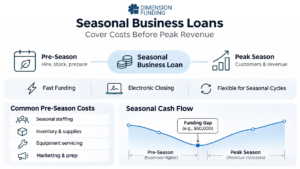
Why Seasonal Businesses Spend Before They Earn
Seasonal revenue rises and falls on a predictable cycle, but expenses do not follow the same curve. Labor shows the swing clearly. Bureau of Labor Statistics data published on FRED shows that leisure and hospitality employment, not seasonally adjusted, stood at about 16.92 million in October 2025 and about 16.25 million in January 2026.
That is a drop of roughly 663,000 jobs in three months. Those positions must be refilled and retrained before the next peak, and the wages, training, and onboarding costs land before peak revenue arrives.
A Pre-Season Spending Calendar by Industry
Every seasonal industry has a window when spending peaks and revenue has not yet started. Your window sets the dates for your cash forecast, and financing should be in place four to eight weeks before the first large expense.
Industry | Peak Revenue Months | Pre-Season Spend Window | Typical Pre-Season Costs |
Landscaping and lawn care | April to October | February to March | Crew hiring, equipment servicing, fuel, materials |
Snow removal | December to March | September to November | Plow blades, salt stockpiles, truck preparation |
Golf courses (northern climates) | April to October | February to March | Mower servicing, turf treatments, seasonal staff |
Summer tourism and lodging | June to August | March to May | Staffing, renovations, marketing |
Timing varies by region and weather, so build your own calendar from two or three years of bank statements. The month when outflows first exceed inflows marks the start of your pre-season window.
How to Calculate Your Seasonal Business Loan Amount
The right loan amount depends on when expenses come due and when customer payments arrive. The total cost of preparing for peak season is only part of it. Start with a simple formula:
Funding gap = pre-season and in-season cash costs + minimum cash reserve − available cash − confirmed incoming funds
Run the Formula First
Consider a landscaping company that expects $120,000 in pre-season and early-season costs and wants to preserve a $25,000 cash reserve. It has $70,000 available and expects $15,000 in customer deposits before its bills come due. Its initial funding gap is $120,000 + $25,000 − $70,000 − $15,000 = $60,000.
Map the Gap Week by Week
That figure is a starting point. A dated forecast shows whether the business needs the full amount at once or only during specific weeks. The U.S. Small Business Administration’s financial management guidance is a useful reference for managing business finances and keeping the reliable records a forecast depends on.
Timing | Cash Movement | Projected Balance | Shortfall Below $25,000 Reserve |
Start of March | Available cash | $70,000 | None |
March, week 1 | Servicing and supplies −30,000;deposits+15,000 | $55,000 | None |
March, week 2 | Materials and payroll −$40,000 | $15,000 | $10,000 |
End of March | Remaining startup and operating costs −$50,000 | −$35,000 | $60,000 |
April | Customer collections begin | Recovering | Shrinking |
The deepest shortfall arrives at the end of March, just before seasonal revenue starts. The company needs only $10,000 in week two and the full $60,000 by month-end. Map supplier deadlines, payroll dates, collection dates, and existing loan payments the same way, then compare the lowest projected balance with your reserve.
How SBA Seasonal Lines Compare With Private Working Capital
The U.S. Small Business Administration runs a dedicated program for this need. Its CAPLines program addresses short-term and cyclical working capital, and the Seasonal CAPLine finances seasonal increases in receivables and inventory, plus related labor costs in some cases. Within the 7(a) program, revolving lines are allowed only under SBA Express, Export Express, or CAPLines.
Feature | SBA Seasonal CAPLine | Private Working Capital |
Eligible uses | Seasonal receivables, inventory, and sometimes labor | Broad operating use, including repairs and marketing |
History required | A demonstrated seasonal pattern | Dimension Funding prefers 2+ years; strong credit can substitute |
Process | SBA program rules applied through a participating lender | Direct lender with electronic documents |
Speed | Varies by lender and SBA processing | Often same or next business day after approval |
A staged gap like the one in the landscaping example suits a revolving structure. A business line of credit lets the company draw $10,000 in week two and the balance at month-end, rather than borrowing the full amount on March 1.
Splitting Equipment Costs From Pre-Season Operating Costs
Pre-season budgets often mix two kinds of spending. Servicing, fuel, chemicals, and seasonal wages are used up within one season and belong in the funding-gap formula. Mowers, plow trucks, and service vans earn revenue for years, so financing them with short-term working capital squeezes repayment into a few months.
Keep equipment purchases out of the formula and finance them separately. Dimension Funding offers equipment financing, and equipment loans up to $250,000 require no financial statements. Course operators can use golf course mower financing for turf equipment and keep working capital open for staffing.
Planning for a Short or Late Season
Weather rarely delivers a full season on schedule. Before choosing a loan amount, rerun your weekly forecast with a late opening and delayed customer payments. If the landscaping company’s opening slips three weeks and $20,000 of April payroll falls due before collections begin, its peak gap grows from $60,000 to $80,000.
Size repayment so it can come from roughly 90% of a normal season’s revenue. Target payoff for mid-season, then build an off-season reserve. A business with $22,000 in monthly fixed costs and a four-month off-season needs about $88,000 set aside before revenue slows.
What Dimension Funding Needs From Seasonal Applicants
Seasonal requests are judged on the full annual cycle. Bring at least two years of business bank statements so the lender can see the pattern repeat. Add your funding-gap calculation, the weekly forecast with its late-opening scenario, and any signed contracts or customer deposits for the coming season.
Dimension Funding generally prefers two or more years in business, which suits operators who can show multiple completed cycles. Strong credit can offset a shorter history. Its team is described on the About Us page, and requests can start through the online financing application.
Opening Every Season Ready for Full Demand
Seasonal businesses that start their peak understaffed or underequipped rarely recover the lost revenue. Financing sized to the lowest point in your weekly forecast and repaid from a conservative estimate of peak revenue lets you open fully prepared and still keep a reserve.
If your next pre-season window is approaching, Contact Dimension Funding to match the financing structure to your calendar. You can also call 1-800-755-0585 or email Sales@DimensionFunding.com.
Frequently Asked Questions
Is the off-season a good time to apply?
Often, yes. Applying after a strong peak means your recent statements show the full revenue surge, giving the lender a complete picture. Approval in the off-season also leaves time to place pre-season orders without waiting on a decision.
Do I need to show a profit every month?
No. Lenders reviewing seasonal businesses expect slow or negative months. What matters is that the pattern repeats from year to year and that peak revenue covers the full cycle’s expenses.
Can a business with two seasons use one line of credit?
Yes. Operators with two peaks, such as landscaping in summer and snow removal in winter, can draw before each season and repay after each peak. Showing both cycles helps the lender size the limit to the larger gap.
Should refundable customer deposits count as confirmed incoming funds?
Count them cautiously. Refundable deposits may have to be returned if the season opens late or a job is canceled. Many owners include only non-refundable deposits in the formula and treat refundable ones as a cushion.
What if I cannot repay before the off-season starts?
Contact the lender before a payment is missed, since more options exist when problems surface early. Avoid taking a second short-term loan to cover the first, because stacked payments make the next off-season harder.
Should I rent or finance equipment I use only a few months a year?
It depends on use. Renting can make sense for equipment needed only a few weeks. Ownership often wins when the equipment works most of the season or when rentals are hard to secure during the peak.
Can a first-year seasonal business qualify?
It is harder without a completed cycle, since lenders cannot yet see the pattern. Dimension Funding prefers two or more years in business, but strong owner credit can substitute. Signed contracts, pre-bookings, and a detailed seasonal budget help offset the missing history.